 Elephants,
why are they so big?
Elephants,
why are they so big?Chickens, why are they so small? (repeat)
Think, do you know why? Do you know why?
Can you tell me?
| Home - Story Index 0 1 2 3 4 5 6 7 8 9 10 11 12 13 14 15 16 16½ 17 18 19 20 21 22 23 24 25 26 27 28 29- Extra Photos |
4/11/2002 - Our Work
Hello Everyone!
It occurs to us that most of our updates have been about places where we’ve traveled in Thailand on our days off. Many of you may be wondering, do we actually work? Or are we on a 27-month vacation in the tropics paid for by the US government? The answer is yes, we do actually have a job here, and cliché as it is to repeat the Peace Corps’ motto, it is the toughest job we’ve ever loved. So, we thought we’d share a bit with you.
First off, our main goal is to help primary school English teachers develop better lessons – right now pretty much all subjects in Thai schools are taught by having the class recite facts in unison. This is not necessarily a good way to teach any subject, let alone something as dynamic as language. So, several days a week we are at different schools, teaching lessons, co-teaching lessons with a Thai teacher, or observing lessons. In addition, Lisa runs a weekly workshop for teachers to plan lessons and exchange ideas with each other.
A cultural note about these workshops: often the primary motivation for teachers to attend is that they want to get a certificate, as promotions here seem to be handed out based on the number of certificates in your portfolio. This can cause confusion, as there are some teachers who really do want to learn about new ways to teach English, and some teachers who simply want a certificate. Lisa has set a modest standard of 80% attendance in order to get a certificate, and that has had interesting repercussions. Just last week she had 10 people in class, but 11 names were on the roster as present.
Once or twice a month we are asked to help with teacher trainings and English camps for students. English camps are the “in” thing here. They are usually 2-4 day camps (with anywhere from 20 to 200 kids) where very little learning actually takes place, but that’s OK because the stated point of the camps is to let the students have fun with English. This often results in lots of goofy games and English songs that Lisa and Denny have never heard before and that rarely have any sort of thematic connection to the lesson being taught. Lisa’s favorite song, in its entirety, is printed below:
Elephants,
why are they so big?
Chickens, why are they so small? (repeat)
Think, do you know why? Do you know why?
Can you tell me?
Part of what is so endearing about this song for us is that the Thai children cannot pronounce the short “i” sound, and end up saying chicken: CHEEK–en. The Thai’s love it because it’s a translation of a Thai song, although quite frankly we like the Thai version better because they end the song with a line that translates as, “Thinking gives me a headache.”
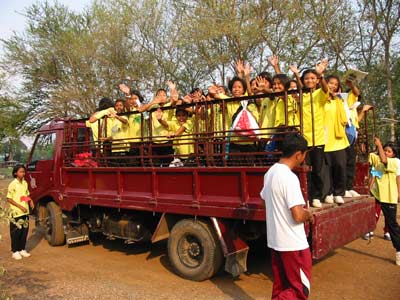
Here are students in a bus headed back from an English camp. “What? That’s not a bus, it’s a cattle truck,” we hear you say. That’s what we said too. But this was how they got to make the 20-mile trip back to Sangkha (the camp was held at a retreat center near the provincial capital). Incidentally, this truck is not radically different than the “buses” that students travel in to and from school every day. The school districts do not provide transportation for the students, so most students go to school by “songthaew.” Songthaews are small Japanese pickups with benches placed along each side of truck bed (the literal translation of songthaew is “two rows”), with an open air canopy over them. This doesn’t sound too bad, until you realize that students not only sit on the benches, they sit in the middle of the truck bed, they stand on the tailgate, they sit on the roof, and occasionally dangle from the sides of the truck and out the back. Each truck is generally loaded down with so many students that when it leaves town the front wheels are nearly off the ground and the rear wheels are nearly touching the wheel wells.
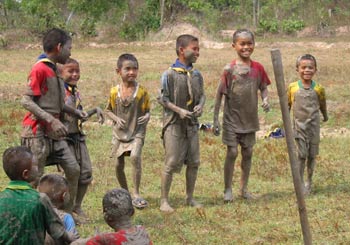 |
While the biggest part of the curriculum that we are involved in is English, the primary education curriculum encompasses a number of subjects, including math, Thai, science, social studies and citizenship, art, counseling, music, Thai dance, Buddhism (non-Buddhists can opt out of the ceremonies, but they still have to take the class), and scouting. The last month of the school year sees a lot of scouting activities, including these boys who just completed a military style “crawl under the barbed wire through the mud” exercise. |
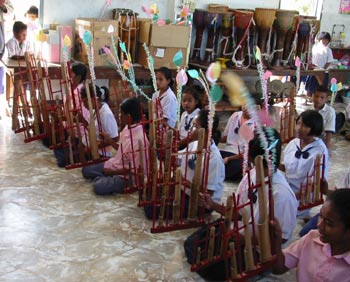 Our
secondary goals here (helping the English teachers is our primary goal) are
to foster community involvement in schools, integrate the teaching of health
and environmental issues, and to help develop curriculum that incorporates local
wisdom – customs, handicraft skills, etc. One of Lisa’s schools
has an excellent music/art teacher, and this photo shows an “angaloon”
choir. The angaloons are made out of bamboo tubes that, when rattled back and
forth against their frame, produce a note (well, three notes, but they seem
to be in octaves) on the musical scale. This is essentially the Thai version
of a handbell choir. And while Lisa cannot take credit for this particular program,
it does give you an idea of what we hope to do in other schools.
Our
secondary goals here (helping the English teachers is our primary goal) are
to foster community involvement in schools, integrate the teaching of health
and environmental issues, and to help develop curriculum that incorporates local
wisdom – customs, handicraft skills, etc. One of Lisa’s schools
has an excellent music/art teacher, and this photo shows an “angaloon”
choir. The angaloons are made out of bamboo tubes that, when rattled back and
forth against their frame, produce a note (well, three notes, but they seem
to be in octaves) on the musical scale. This is essentially the Thai version
of a handbell choir. And while Lisa cannot take credit for this particular program,
it does give you an idea of what we hope to do in other schools.
Lisa is also in the process of helping one of her schools develop a “Self-Access Learning Center” where students can practice English at their own pace (i.e. they can check out a book, read it on their own, and then answer questions about it). For those of you who are teachers or parents, if you have any ideas or projects the children could do independently, she’d love to hear them. (If you have any beginner’s level children’s books that you no longer use and wish to donate, she’d love those too, but remember to ship them surface mail. It will take roughly three months, but it’ll be a lot cheaper than airmail.)
Denny has been struggling with actively teaching and helping teachers – camps and trainings are OK, but routine teaching with unmotivated uncreative teachers is tough. So lately Denny has been focusing more on simply getting to know the students. He is helping several students apply for scholarships for high school, (although tuition is “free,” students must buy books, uniforms, supplies, and pay for transportation as well as a per semester lab fee). Denny is also helping a nurse, who goes to our church, to translate a proposal for a community development project to help at-risk youth.
In our spare time we climb mountains, build irrigation canals, develop vaccines including a promising one for HIV/AIDS, work on our cure for cancer, and clear mine fields in nearby Laos and Cambodia, and on the weekends we are designing a manned mission to Mars. Actually, our next-door neighbor for the first six months here was a man from Louisiana named George, who incidentally DOES clear land mines in Laos and Cambodia for a living, but that’s a whole story unto itself.
We hope things are going well for you this spring. Enjoy the changes in seasons – they are one of the things we miss most. The only changes we get here are from hot to hotter, and to hotter and wetter. Right now our season is hotter and starting to get wetter.
Denny & Lisa