3/7/2001 - In Training
For those that are craving our updates
– we apologize that this is late. We have been busy. Since our last update
we each taught a lesson together with a Thai teacher, played UNO with the neighborhood
kids, visited “model” schools to see good things that are happening
in Thai education, played UNO, attended 2 weddings, played UNO, learned the
location of our jobsite for the next two years, and played some UNO (did we
mention that we’ve played UNO?).
Our only teaching adventure (here at our
training site) since our last update was a lesson that we co-taught with the
Thai teacher for our class. Denny was planning to continue his geography theme,
but when he asked his teacher what she would like for her class, she said that
she would like them to learn spoken English interaction. She chose the topic
of buying various items in the market. She started by introducing the items
that we would “purchase” in class, and then Denny taught the interaction
(using Thai currency, and having the kids make change to incorporate some math
into the lesson). Denny then showed American bills ($1, $5, $10, $20) to demonstrate
what other money looks like, and the Thai teacher had the inspiration to talk
about exchange rates (40 Baht/$). Then to reinforce the lesson and further practice
the math, she had Denny offer to purchase items from the students with American
money, and have the students give change in Thai money. It was a really fun
session, not only for the kids, but Denny enjoyed working with a teacher where
creative ideas could be exchanged in the middle of a lesson!
Lisa’s co-teaching experience was
different, but still very positive. Since the 4th and 5th grade classes are
combined (the 5th grade teacher left to become a principal and was never replaced)
Lisa co-taught with the 4th/5th grade Thai teacher as well as the PC volunteer
assigned to the 4th grade class. The Thai teacher wanted her students to be
able to practice conversational English, so 3 stations were set up for the kids
to rotate through. They practiced “Where are you from? (Country, province,
and “amphur”/city), “Where are you going?” and “What
food/animal/fill in the blank do you like?” The interesting thing Lisa
learned is that many Thai teachers who teach English cannot hold a conversation
in English (this made planning the lesson difficult…) but can flawlessly
teach the lessons and vocab words taught in their English textbook.
It sounds like we will not be teaching
anymore until we get to our site because we will be focusing now on teacher
training and how to get teachers to use a more student-centered approach (most
teachers in Thailand still just stand at the chalkboard all day and have the
children recite in unison).
Our visit to “model” schools
took us in different directions across Thailand. Denny went to Nakon Pratom,
the place where Lisa had spent the day and seen the tall Chedi. Lisa went to
Nakon Sawan. We were both housed in hotels with hot and cold running water,
western flush toilets, Air Conditioning, and maid service that actually changed
the bed and provided fresh towels every night (these are items worth noting
because it is the first time we have been in a place with these items since
we arrived in Thailand). Both schools we visited were very large: Lisa’s
had 2000+ students, Denny’s had 1000+, compared with the school in our
village that has less than 100 students. The model schools suffered from large
class sizes (often in excess of 40 students per class), but had many resources
and teachers that made them “models” to learn from and emulate.
Denny’s school focused on integrating art into most aspects of the curriculum,
and they incorporated a broad range of disciplines ordinarily considered extra-curricular
into their curriculum (swimming, 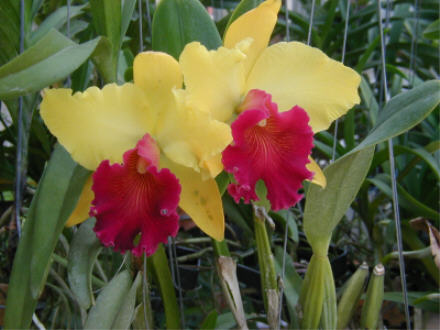 computers,
music, cooking, gardening, water purification). They also had a water purification
plant that was run by the school so that all of the tap water at the school
was drinkable (very uncommon in Thailand). The water from the sinks at the school
drained into a pond that was used as a reservoir to provide water for all of
the plants at the school. While this school visit was officially a time to “observe”,
Denny ended up teaching bits of English to 4 classes on 5 separate occasions
when he was asked.
computers,
music, cooking, gardening, water purification). They also had a water purification
plant that was run by the school so that all of the tap water at the school
was drinkable (very uncommon in Thailand). The water from the sinks at the school
drained into a pond that was used as a reservoir to provide water for all of
the plants at the school. While this school visit was officially a time to “observe”,
Denny ended up teaching bits of English to 4 classes on 5 separate occasions
when he was asked.
Lisa’s school had a major agriculture/gardening
program (including this orchid). The students were responsible for raising a
pesticide free vegetable garden to use in the school’s lunches. The teacher
integrated English, art, and math into the program, and the kids have started
a nursery of decorative plants that they sell to parents and members of the
community. After the school day was over, one of the teachers took Lisa and
another couple of PC volunteers on a “field trip.” They went to
a temple north of the school that had monkeys everywhere (about 500 of them),
and then to a cave to watch the bats fly out at sunset – similar to Carlsbad
Caverns in the winter.
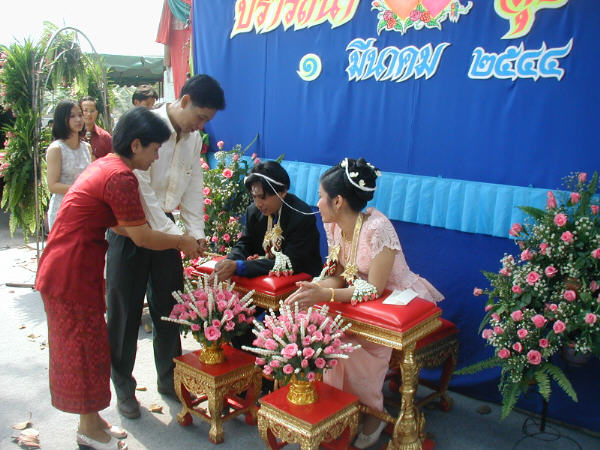
On our first day back from the model school
visit we were invited to attend the wedding of the younger sister of the 6th
grade teacher at our village school (the one Denny has worked with). It sounds
like the wedding had been going on for several hours before we arrived at 9:00
AM, and that it continued well into the night (though we left around noon).
When we arrived we became part of a procession of people carrying various foods
on elaborate platters, and at the front of the line were people carrying young
banana trees and young sugar canes. The food items were for the party, and the
plants were for the new couple to plant in their yard so that they would have
some good luck (and food). The ceremony started inside the house (with most
people outside at tables eating and enjoying the party) with the groom giving
the bride several pieces of jewelry - mostly necklaces and bracelets (Lisa wonders
now how Denny got away with only giving her a ring). Then the bride and groom
put a large amount of money in a platter, which was subsequently blessed by
various family members and several others in the room with kind words and a
sprinkling of dried flowers. The money and dried flowers were given to the mother
of the bride. The money was from the groom to the bride’s parents to prove
that he is wealthy enough to take care of their daughter. This was followed
by a nearly endless procession of people giving money to the bride and groom
(most of whom received a gift in return). The indoor events lasted for nearly
2 hours, and the entire event was narrated over loud speakers so that everyone
(except the foreigners who didn’t speak the language) could follow along
with what was happening. Later the bride and groom moved outside and were again
offered kind blessings as people poured water from a small ladle onto their
hands. The above picture is Denny’s teacher blessing the bride and groom.
During the entirety of the ceremony there was a crowd gathered outside under
a tent essentially participating in a large banquet. This last weekend we attended
the wedding of the brother of Jerapon (a kid in our last update), but we were
not brought inside – we were simply part of the banquet crowd.
Speaking of the kids in the last update
– they continue to come almost every night. Our UNO cards are wearing
out. When the crowd was small and not too rowdy a couple of days ago, Denny
brought out a real deck of cards and started teaching hearts. This will probably
work with small docile crowds of sharp kids, otherwise we’ll stick with
UNO and soccer. We are beginning to speak enough Thai to have interesting interactions
with these kids (and with our host family). We have learned their favorite sports
(for the girls, badminton and volleyball; for the boys, soccer and DaGra –
a local cross between hackeysack and volleyball), their favorite subjects in
school, how many people are in their immediate family, how many people live
in their household, and all of their nicknames. Nicknames here are different
than in the states. They are generally one syllable, they are usually unrelated
to the person’s real name, but they are almost always related to some
characteristic of the person. For example, Jerapon’s nickname is Goong,
which means shrimp (the animal). Wepapon’s nickname is Da, which means
eyes.
As for our site for the next two years
– we will be in the province of Surin, in the Amphur (district) of Sang
Kha. If you look in the Southern portion of Northeastern Thailand, near the
border with Cambodia, you will find our site. We don’t yet know our mailing
address there, or much more about the site. However, our regional school office
from which we will work has more than 60 elementary schools, and nearly 900
teachers (our primary purpose, beyond cultural exchange, is to teach teachers
about student centered teaching methods). Numerically, we have a very large
area compared with our fellow volunteers, and that’s why they are sending
two of us! We’re excited!
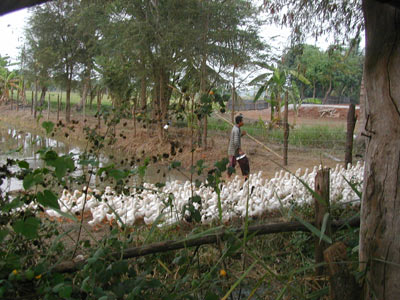 As
for this last photo - the duck herd has been using the rice field behind our
house as a grazing grounds in-between the harvest (about a month ago) and the
replanting (this week). The ducks waddling by every night (these are domestic
ducks that do not fly in migratory patterns, and may not fly at all) are humorous
to watch, and Lisa has decided that if the teaching job in Thailand falls through
she wants to herd ducks for the next two years. Denny will watch.
As
for this last photo - the duck herd has been using the rice field behind our
house as a grazing grounds in-between the harvest (about a month ago) and the
replanting (this week). The ducks waddling by every night (these are domestic
ducks that do not fly in migratory patterns, and may not fly at all) are humorous
to watch, and Lisa has decided that if the teaching job in Thailand falls through
she wants to herd ducks for the next two years. Denny will watch.
For those that want to know what’s
next on our agenda, we are going to go visit Kanchanaburi (the place with the
“Bridge over the River Kwai”) on our own this weekend. Next week
we are heading to visit a current volunteer in the far eastern part of Thailand,
and then we come back to visit our future work site in Surin. Our next update
will be in a couple of weeks due to logistics of internet access while traveling.
Denny & Lisa
P.S. we’ve been healthy since our last update. Hurray!