 out,
some were bombed out, some had bullet holes but were still in good condition
otherwise, and some had missing planks. However, not counting the bumps and
jostles, the trip was long but safe.
out,
some were bombed out, some had bullet holes but were still in good condition
otherwise, and some had missing planks. However, not counting the bumps and
jostles, the trip was long but safe. | Home - Story Index 0 1 2 3 4 5 6 7 8 9 10 11 12 13 14 15 16 16½ 17 18 19 20 21 22 23 24 25 26 27 28 29- Extra Photos |
9/17/2002 - Angkor Wat, Cambodia
Hi Everybody!
As some of you know, we just got back from 5 days in Cambodia. We went to the town of Siem Reap (pronounced "See-um Ree-up" which literally means "Siam [Thailand] defeated") to see Angkor Wat. Actually there are dozens of ancient ruins throughout the whole area, including a 10 square kilometer city complex known as Angkor Thom (pronounced "Toom"). Angkor Wat is simply the name of the most famous temple. Most of the temples were built between 800 - 1200 years ago, during the height of the Khmer empire, known as the Angkor period (hence the name Angkor Wat; "Wat" means temple.)
Our adventure began upon departure
from Bangkok on a van at 7:00 am. We reached the Cambodian border about 4 hours
later (260 km, so about 65kph. Not too bad considering that we had to dodge
Bangkok traffic on the way out of town), and we waited and waited and waited.
First we waited on the Thai side of the border for our visas to get processed.
Then we waited on the Cambodian side of the border for all of the people in
our group to cross the border (it turned out we were waiting for someone who
left in a group ahead of us). Then we waited at our tour company's office on
the other side of the border in Cambodia for their minibus to arrive. While
waiting for the bus, some tourists were starting to get impatient and when a
couple of pickups showed up, the tour company said, "Oh, you can hop in
the back of these trucks and get to Siem Reap in 3 hours, but the bus will take
5 hours, and we don't know when the bus will arrive." (Siem Reap is 140
km from the border). Three hours in the back of a pickup on a dirt road didn't
sound like a whole lot of fun, so we waited for the minibus. Good choice for
3 reasons:
1.) The minibus showed up 5 minutes after the pickups left.
2.) It took both the minibus and the pickup equal amounts of time to reach Siem
Reap - approximately 8 hours (not three!) For those of you doing the math, that
works out to 17.5kph or 10.5mph.
3.) It rained that afternoon. Hard. The people riding in the back of the pickup
were given a tarp and were told to hold it over their heads.
As evidenced by our snail's pace,
the road to Siem Reap was in terrible condition. For those of you from Fairbanks,
imagine the road from Murphy Dome out to the Minto Flats - only wider, flatter,
and less well maintained. To make it worse, it was full of 18 wheelers (here
they are 10 wheelers, but they were all hauling 2 trailers, so the 18 wheeler
moniker still fits) hauling goods from Thailand to Cambodia because that road
is the only road from Thailand to Phnom Phen. In reality, there were so many
potholes that it was more hole than road. Except that the potholes weren't really
the size of a pot, they were the size of a Cadillac. So instead of calling them
potholes, they should be called "anti-tank holes." And, speaking of
Cambodia's recently ended civil war, some of the bridges were washed out,
some were bombed out, some had bullet holes but were still in good condition
otherwise, and some had missing planks. However, not counting the bumps and
jostles, the trip was long but safe.
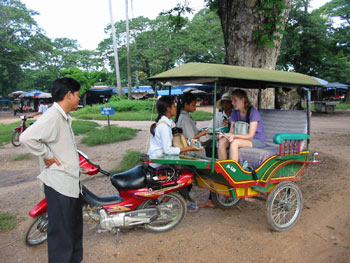
Once in Siem Reap (around 10pm), we wasted no time getting a guest house and falling immediately asleep. The next morning we switched guesthouses to one more conveniently located, hired a tuk-tuk driver for the day (the tuk-tuks in Cambodia were literally a motorcycle pulling a little cart for two, cute huh?) and we set off to explore the ruins (and the local crafts, as evidenced by this photo).
Through most of the reign of the
Khmer empire, the Khmer people were Hindu, with a few other local beliefs thrown
in for good measure. These included the belief that only gods were allowed to
live in stone buildings. All the buildings that remain today are temples, since
the royal palaces and houses of the time period were wood and decayed long ago.
Near the end of the Khmer empire's dominance, there was a gradual shift to Buddhism,
and in fact, in one of the temples, you can see where the rulers tried to have
a large Buddha image carved into the existing Hindu temple. 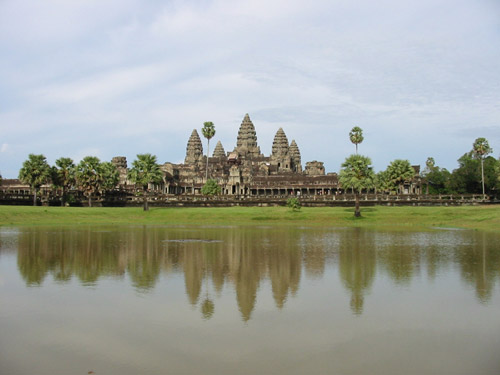 Invasions
from the Burmese about 800 years ago forced the Khmer empire to relocate its
capital to Phnom Phen and to abandon it's temples in Siem Reap. The jungle quickly
closed in, and in the 1800s, European explorers rediscovered the ruins, and
set to work excavating them. Interestingly enough, today, most of the money
for restoration comes from Japanese grants.
Invasions
from the Burmese about 800 years ago forced the Khmer empire to relocate its
capital to Phnom Phen and to abandon it's temples in Siem Reap. The jungle quickly
closed in, and in the 1800s, European explorers rediscovered the ruins, and
set to work excavating them. Interestingly enough, today, most of the money
for restoration comes from Japanese grants.
We visited Angkor Wat, pictured
here, both in the afternoon on our first day and at sunrise our second day (yes,
Denny & Lisa the night owls actually got up before 5 AM just to play tourist).
Lisa was impressed with its size as well as the intricate stonework inside.
Denny thought it made a nice picture at a distance, but wasn't really all that
impressed. Denny thought there were other temples which had much more elaborate
carvings that were more interesting, and that the temples not yet reclaimed
from the jungle were much more picturesque. Above all, Denny felt overrun with
people throughout this trip, and that feeling was most acute at Angkor Wat -
the place that EVERY tourist here goes to visit.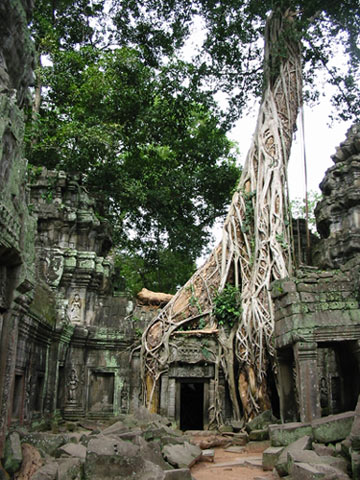
Speaking of temples not yet reclaimed from the jungle, here is perhaps the most famous one - Ta Phrom. Walking through this area feels like being in an Indiana Jones movie (in fact, we read in one of our guide books that one of the overgrown temples here was used in Tomb Raider, but we cannot find that quote at the moment).
Lisa: Very quiet, almost eerie.
Or perhaps I just liked it because it was shady and cool. :)
Denny: There is something especially wonderful about being simultaneously amazed
by the human feat of construction and nature's slow wrath of destruction. Entropy
at work.
The doorway in this photo is a rather famous photo stop. In the Lonely Planet Guide to Southeast Asia, there is a photo of this doorway with an old man sitting in front of the door. Near the end of our trip, as we were waiting with zillions of other tourists for sunset colors to show up on Angkor Wat itself, we encountered fellow travelers who said they ran into the same man from the Lonely Planet photo and took his picture again in front of the door. Apparently that's his doorway.
We spent about one and a half
days touring the temples in the immediate vicinity of Angkor Wat, and then we
headed down to Tonle Sap Lake, which is in the heart of Cambodia. We found another
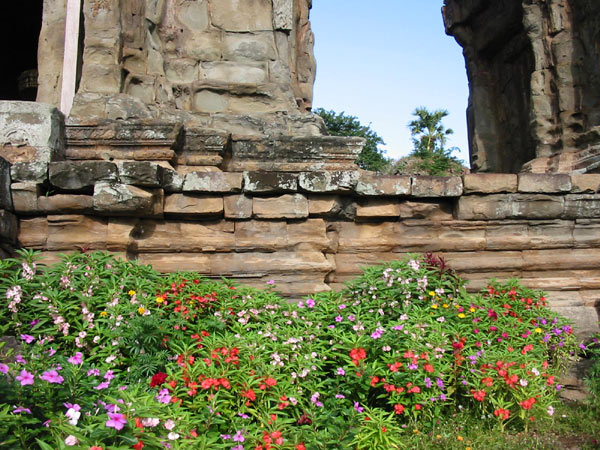
ancient temple on a hill overlooking the lake where the monks had planted flowers
everywhere. For our third day, we decided to explored some of the more remote
temples and ruins. We went to a place called Kbal Spien where the Khmers carved
figures into the rock creekbed to bless the water flowing into their city. The
work was quite impressive, and the hike to get there was reminiscent of hiking
in South-central Alaska (only lots hotter and with more people). Unfortunately
our digital photos didn't turn out too well there.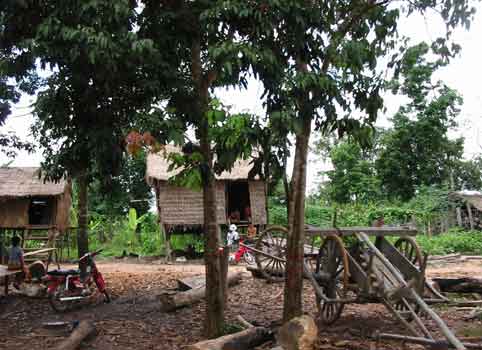
On both the trip to the lake, and to Kbal Spien we passed through many rural communities. It was interesting to compare and contrast these communities with their neighbors in Thailand. First, as seen here, people actually live in grass huts. Grass huts in Thailand are now mostly found as the temporary shelter in the middle of the rice field, or they are the quaint decor of outdoor restaurants. Villagers in Thailand are poor, but their tin roofs and recycled wood walls are substantially more sturdy that what we saw in Cambodia. Second, even the poor families in Thailand can afford a family motorcycle, but Cambodia, (like India), was teeming with bicycles. Third, also seen here, ox carts are still in common use in Cambodia. These too have become quaint decorations in Thailand, oxen and water buffalo have been replaced by small two-wheeled tractors for plowing and hauling grain. On the road from the border to Siem Reap we noticed another difference - rice fields in Thailand are surrounded by (and sometimes filled with) trees which offer shade and break up the view. There were several places along the road in Cambodia where the rice fields stretched to the horizon without a tree in sight. The irony of this is that many rice paddies in Thailand must be harvested by hand because, with the number of trees, a combine is not able to maneuver the tight spaces. In Cambodia, where fields are perfect for mechanical harvesting, the Cambodians cannot afford the machine. Another quick note about Cambodia - they drive on the right side of the road as we do in America, but the relative poverty of the place, and it's proximity to relatively prosperous Thailand (which drives on the left side of the road) results in nearly half of the cars on the road in Cambodia being set up to drive on the left. Guess you just have to know your car very well.
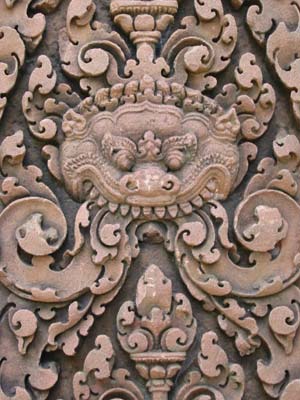 After
traveling through rural communities for several hours to go see the carvings
in the river, we stopped at the last temple of our trip - Banteay Srey. While
substantially older and smaller than Angkor Wat and other temples, it is made
from a red sandstone (instead of the gray rock of the other temples) and its
carvings are much more elaborate and remain almost entirely intact. Denny's
trigger finger on his camera went a little wild here.
After
traveling through rural communities for several hours to go see the carvings
in the river, we stopped at the last temple of our trip - Banteay Srey. While
substantially older and smaller than Angkor Wat and other temples, it is made
from a red sandstone (instead of the gray rock of the other temples) and its
carvings are much more elaborate and remain almost entirely intact. Denny's
trigger finger on his camera went a little wild here.
Our return trip to Thailand, aside from departing late, was long but uneventful. We arranged to ride a van back to the border with a tour company, but declined to spend extra money to have them take us all the way to Bangkok, as we figured (correctly), that we could beat their price and reduce our travel time using public transport once we hit Thailand.
Overall, Siem Reap was a bit more expensive than we were used to (hey, $3 for a plate of fried rice may not sound all that expensive to those of you in the States, but that's six times more expensive than it should be here), but we tried to keep things in perspective. Cambodia only pulled itself out of civil war five years ago (just as the Southeast Asian market crashed), its government is dubious (there are still Cambodian political refugees in Thailand under the auspices of the UN) and Cambodia is forced to import nearly everything. As with most countries that only recently got out from under the thumb of European colonization, Cambodia is struggling to establish a good government. So, Siem Reap is one of the few good things going for the economy right now. Business is booming, actually. Almost everything we saw in the town of Siem Reap was brand new (within the last 5 years), and we lost count of how many new hotels and guest houses are under construction. With the number of people crawling around there now, it is likely to become unbearably overrun with tourists in the near future.
One of the humorous bits about traveling in this part of the world, though, is discovering those cultural differences, especially when it comes to the English language. We offer for you the following quips from our trip:
We are now thankfully back in Thailand, and our next international adventure is likely to be Australia in December with Denny's parents. We'll keep you posted.
Denny & Lisa