3/27/2001 - Visiting our Future Worksite
Welcome to the continuing saga of Denny
& Lisa’s life as Peace Corps Trainees. As promised in the last update,
we have visited Kanchanaburi, we visited a current Peace Corps volunteer in
the Province of Ubon Ratchathani, and we visited our site in Surin (Amphur Sang
Kha). Unfortunately there is relatively little UNO playing to report this time
(we weren’t at our host family’s home more than 4 days in the last
2 weeks).
Before we get too far into this update,
it seems appropriate to tell you a little about Thailand’s internal geo/political
organization. Within Thailand there are 76 jangwats, which roughly translates
as “province” (the largest of which is smaller than New Jersey).
Each of the jangwats has a capitol city that bears the same name as the province
itself. Within the jangwats there are amphurs (covering areas and populations
slightly smaller than counties in the U.S.). As with the jangwat, the name for
the amphur applies to both the whole area and to the urban center. There are
two smaller divisions that go all the way down to the neighborhood. SOOOO, when
we talk about visiting Kanchanaburi, we visited the capitol of the province.
When we talk about visiting in the Province of Ubon, we visited in an amphur
outside the capitol, and our site is the capitol city in the amphur of Sang
Kha within the Province of Surin. We expect you to commit all of this to memory!
Ha!
Moving on to our trip to Kanchanaburi,
it was awesome! It was the first time since arriving in Thailand that Denny
perceived beauty in the landscape. It was the first time we’d seen landscape
that was NOT farmland to every horizon. It was the first time we took one of
our days off (we only have 10 scheduled in the 12 weeks of training) and, with
3 other trainees, went somewhere for fun. Kanchanaburi is famous for “The
Bridge over the river Kwai” (pronounced Kwaa as in quack) which is a book,
a movie, and a train bridge. We've heard that the book and movie are a little
different from the history, so here is a quick rundown on why this spot matters.
During WWII, Japan was seeking to make a land connection between the gulf of
Thailand and the Burmese battlefields to reduce shipping time South of Singapore.
They chose to build a railroad using prisoners of war as the labor force. The
conditions were terrible, and thousands of men died, thus earning the railway
the moniker “death railway”. Near the end of the war the Allies
bombed the bridges of this railroad that spanned the river Kwai to cripple Japan’s
transportation plans. There were two bridges at the time, but only one was repaired/rebuilt
and it is still in use today. 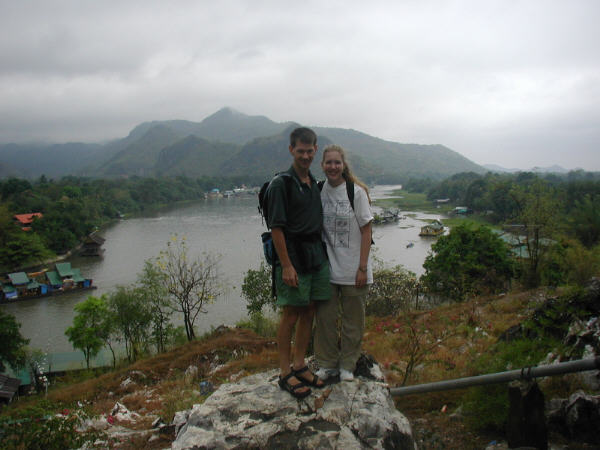 Sooooo.
. . we first visited the JEATH Museum (Japan, England, America/Australia, Thailand,
Holland) which is a collection of photographs and articles about the living
and working conditions of the labor force who built the Death Railway. It was
simple but profound, and is nowhere near the bridge, but it is next to the river.
So we hired a longboat driver (a longboat is a long riverboat whose hull, lengthwise,
looks like an italics w and whose engine is generally an automobile engine balanced
on a swivel with a 10+’ long drive shaft and a propeller at the end) for
550 Baht/$13 to take us sight seeing for the day. We went to a cemetery, a Wat
and cave (where the picture was taken – note the hills and trees on the
horizon, unlike other places we had seen in Thailand to date), and to the famous
bridge. When we walked across the bridge a group of tourists from southern Thailand
raved about how beautiful Lisa was and asked to take their picture with her
– Denny couldn’t agree more with their assessment, but couldn’t
help laughing about their need to take a group picture. Lisa’s not going
to want to go back home where her pale white skin is no longer perceived as
beautiful (“eeew – look how pale you are” . . . “nice
Alaskan tan”. . .)
Sooooo.
. . we first visited the JEATH Museum (Japan, England, America/Australia, Thailand,
Holland) which is a collection of photographs and articles about the living
and working conditions of the labor force who built the Death Railway. It was
simple but profound, and is nowhere near the bridge, but it is next to the river.
So we hired a longboat driver (a longboat is a long riverboat whose hull, lengthwise,
looks like an italics w and whose engine is generally an automobile engine balanced
on a swivel with a 10+’ long drive shaft and a propeller at the end) for
550 Baht/$13 to take us sight seeing for the day. We went to a cemetery, a Wat
and cave (where the picture was taken – note the hills and trees on the
horizon, unlike other places we had seen in Thailand to date), and to the famous
bridge. When we walked across the bridge a group of tourists from southern Thailand
raved about how beautiful Lisa was and asked to take their picture with her
– Denny couldn’t agree more with their assessment, but couldn’t
help laughing about their need to take a group picture. Lisa’s not going
to want to go back home where her pale white skin is no longer perceived as
beautiful (“eeew – look how pale you are” . . . “nice
Alaskan tan”. . .)
Our next adventure was heading off to Ubon
Ratchathani via Bangkok. We took a van to Bangkok in the morning and managed
to find the Peace Corps office, where we spent the afternoon and most of the
evening becoming familiar with what was available in the office. We then took
an overnight train to Ubon – an interesting experience. Having never been
on a sleeper train before we had no idea what to expect, but it wasn’t
too bad. There were singlewide bunks, upper and lower, on each side with a rather
narrow aisle down the middle. The beds were more comfy than our ones with our
host family, but the frequent stops and jostling of the train were not quite
like lullabies to sooth us to sleep. From Ubon to Lori’s site(the PC volunteer
we were visiting) was a small hassle, but once we arrived our pace slowed down.
She made improvised pizza for us (on bread, with hot dogs for meat, and only
a stove to cook on) and shared the affection of her cats with us. Lori was an
inspiration in that she showed us that, while we are learning Thai, and we have
not yet mastered it, a volunteer can be successful here in Thailand knowing
less Thai than we do! She and her co-workers not only showed us her office and
a couple of schools, but also showed us a village that makes tremendous handicrafts.
The shop in the village is rated to have the 3rd best silk fabric in Thailand
(Thai silk is pretty awesome to begin with, but this stuff was impressive)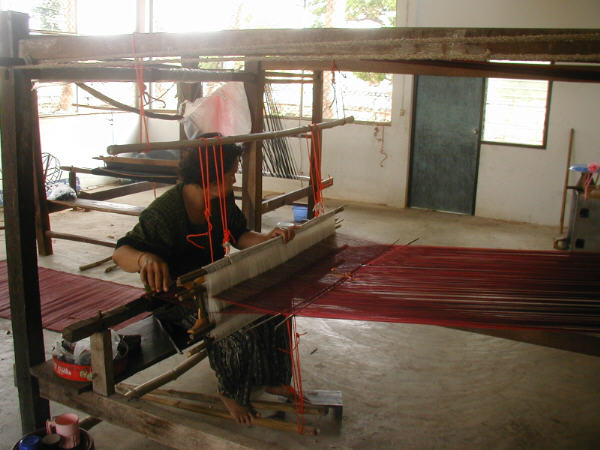 – we resisted the urge to buy too much, and instead took this picture
of one of the women in action at the loom. They evidently make material 20 meters
at a time, so the string from this loom stretched out of the frame of the picture
to the right, over the top of the loom to the left, across the room, and was
wound into a ball on the far wall. They were deft at making subtle shifts in
the twisting of the thread to create a beautiful pattern – it was all
pretty incredible. The next day we traveled to the capitol of Ubon and met with
2 other current volunteers and the trainees that were visiting them. We stayed
in a hotel that would make all but the nicest of hotels in America look shabby
for about 800 Baht/$20 for the night, and explored the town. It was a very nice,
brief change of pace from our training.
– we resisted the urge to buy too much, and instead took this picture
of one of the women in action at the loom. They evidently make material 20 meters
at a time, so the string from this loom stretched out of the frame of the picture
to the right, over the top of the loom to the left, across the room, and was
wound into a ball on the far wall. They were deft at making subtle shifts in
the twisting of the thread to create a beautiful pattern – it was all
pretty incredible. The next day we traveled to the capitol of Ubon and met with
2 other current volunteers and the trainees that were visiting them. We stayed
in a hotel that would make all but the nicest of hotels in America look shabby
for about 800 Baht/$20 for the night, and explored the town. It was a very nice,
brief change of pace from our training.
We traveled from Ubon to Sang Kha by bus.
We were traveling with a fellow trainee who still had several hours of bus riding
after she left our site, and who had not made good contact with her office due
to language difficulties. When we got off the bus, we were greeted by a woman
and two men who smiled and called us by name in English and gave us flower leis
– all of this while our friend was watching from the bus. We felt both
good and bad. As it turns out, the woman is our co-worker from the regional
school office and the men were English teachers. They all speak English well
enough that if we suddenly stopped learning Thai we would survive for the next
two years without trouble. We had heard stories of other volunteers visiting
and staying with their co-worker or another Thai person who lives in nearby
– we were housed with a Scottish man and his household. It was fun and
we learned a lot, but we had been hoping to connect more with the Thai people
in our area, and staying with a foreigner didn’t help (though for a week
we ate virtually no Thai food). As it turns out there are quite a few foreigners
living in Sang Kha already (enough that you see one almost every day in market,
but not enough to see more that that). In our brief visit we set up a bank account,
found a house to rent (we’ll send a picture later when we are sure we
got it – Thai’s function on verbal agreement and do not sign leases),
visited several schools and got a general sense for the layout of the community.
The two biggest differences between Sang Kha and our training site are that
there are no canals in Sang Kha so rice farming is once rather than 3 times
a year, and there is more than one language spoken by the people in the area.
Specifically, while most everyone speaks Thai on some level, there are some
who speak Lao, some who speak Khmer (the dominant language group in Cambodia),
and some who speak Suwai (another ethnic group in northeastern Thailand). We
will be able to function most places with our Thai, but we will probably pick
up a few phrases in other languages for talking in the markets.
We only have about 3 ½ weeks of
training left, so we’ll likely be very busy. If anyone has any specific
requests for pictures or information, or if anyone would like the hi-rez copies
of our pictures, please let us know.
Denny & Lisa