Introduction
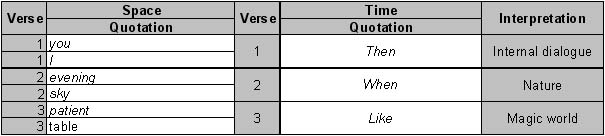
'Let us go then, you and I,
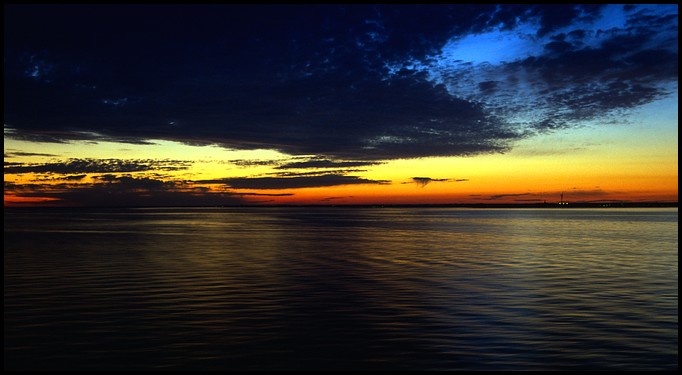
When the evening is spread out against the sky
Like a patient etherised upon a table;'
-T. S. Eliot (Ferguson et ales. 2005, p. 1340)
What is the setting of these lines? Where are �you and I� so that they can see the evening spreading like a patient? Finding the settings to which a poem refers requires an analytical approach to it, a recursive division of the piece of work into smaller parts in order to see its deep structure and �discover� its �secrets�. Although, having a mental picture of those settings requires a synthetic point of view that puts all the pieces together again leaving your mark on it so that, in the end, your transformed �I� can look at a transformed poem with new eyes.
�The people which ceases to care for its literary inheritance becomes barbaric; the people which ceases to produce literature ceases to move in thought and sensibility.�
-T. S. Eliot (1964, p. 15)
The double approach to literature that Eliot is describing in this quotation has very much to do with being analytic and synthetic at the same time, with being both an observer and an observed object (Childs, accessed Nov. 2007). This is the reason why I am focusing this essay on the settings that turn up in Eliot�s poem which, as we will see, are only two: The one described in the first stanza lingering until change in the last one.
Defining a Setting
We are used to think about settings from a pictorical point of view; that is, in a two-dimensional way defined by two axes. One of these axes refers to Opacity-Transparency and gives us the sense of width, perspective, and distance whereas the other is related to Light-Darkness, what gives us the sense of colours, shapes, and volume. These two dimensions define a plane that I would like to call Space.
Following this �Space-approach� to settings, we could think that, if we read The Love Song trying to make a list of the different places mentioned in the poem, we would obtain a list of settings:
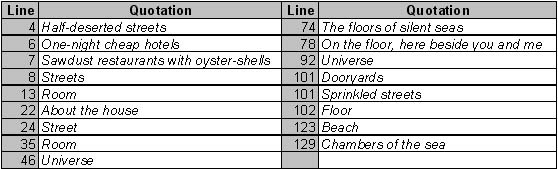
Table 1
Table 1 gives us an idea of the settings to which the poem refers, but it is not a list of them; there are spaces not mentioned here that appear in the poem, and repeated spaces that could be condensed in an only one. Let us face our first problem of not having all the spaces listed.
Spaces: Mentioned and described
There is a need to make a distinction among the explicit spaces mentioned in the poem and some impressionist details on other spaces, that require some kind of interpretation. For this reason, we will make a distinction between Mentioned and Described spaces, relating them in case of finding any kind of relationship among them:
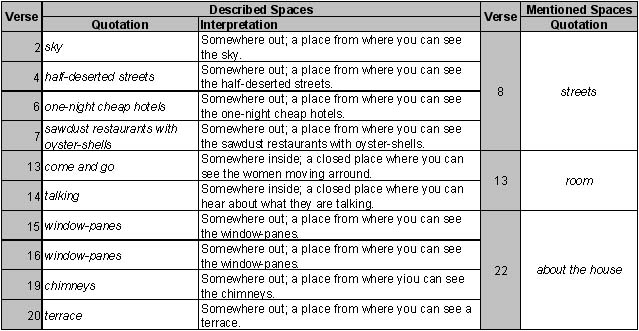
Table 2
As we see in Table 2, there are parts of the poem that seem to display a very clear relationship between its described and its mentioned spaces. What is more, the open spaces (�streets� and �about the house�) are described using characteristic entities that define them, while the closed space (�room�) is referred using verbs. This means that we can say that �chimneys� and �terrace� are characteristic of a house�s facade, but we cannot say -in the same sense- that �women� and �Michelangelo� are characteristic of a room. Nevertheless, �come and go� refer to a limited space, and �talking� is an event which is very likely to happen in a room, especially if it is in the evening and there is a feline yellow fog �rubbing its back upon the window panes�.
Table 2 still displays a very general approach to the study of settings in The Love Song, so let us have a look at what happens when we analyse it more in depth not forgetting about what Marjorie Perloff wrote once:
�We are so used to the famous metaphysical conceit in which the evening sky is seen as an etherized patient, that we tend to forget how strange these lines actually are. For to take an abstraction like �the evening� and have it �spread out against the sky� gives the surreal sense that time can actually occupy space � a proto-Einstenian notion � and also a notion that becomes a central motif in this poem in which time has such powerful agency'
-Perloff (2002, p. 22)
Time is the clue. Time is the one that will give movement and rhythm to the poem. The Love Song of J. Alfred Prufrock has no sense without a temporal dimension, so we need to re-define what we understand by setting.
Re-defining a Setting
We said in a previous point that we are used to think about settings in a two-dimensional way. This re-defining the concept of setting will lead us to think about it in a 3D way defined by three axes and an intersection point:
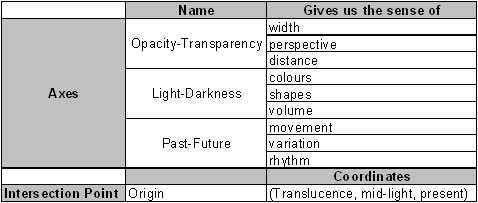
Table 3
These three axes and their common point define three planes that I would like to call Change. The fact of including movement in the setting�s definition gives us a dynamic concept of a basic space structure. See what happens in geometry when we add time -as a fourth dimension- to a cube:
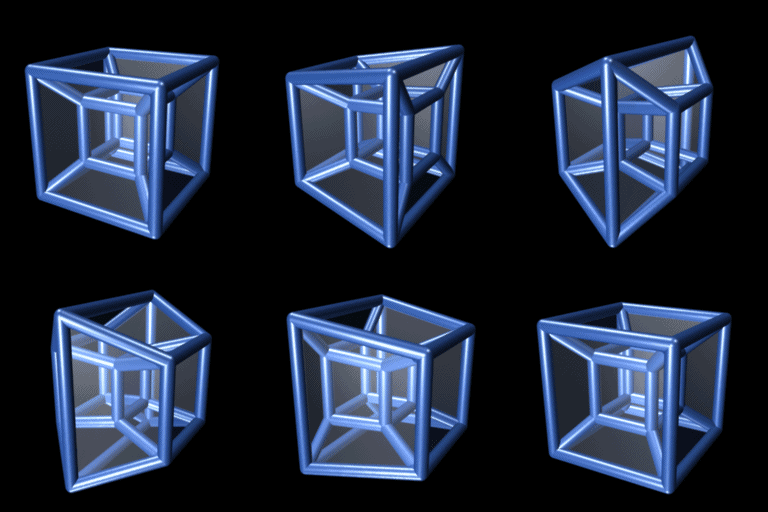
Image 1
As we see, adding time to any definition implies change, but we are unable to analyse change the same way that I am unable to insert an animated image in a printed document. We need to make some screenshots of change to determine its different positions/variations. Only after this analytic approach, we are able to put these screenshots in movement again knowing that change�s fluency depends on the number of screenshots we have made (i.e. like in a movie, the more screenshots you take from a scene, the more fluent the movement in the scene seems to be).
Juan Malpartida wrote in his Rostros del tiempo what could be translated as:
�When we talk about time, we are talking about what we are. This is because, if in a very synthetic way we can say what we are, it is precisely that, time that knows itself to be time, measure: what has a beginning and an end, and, at the same time, devises excess.'
-Malpartida (2000)
One of the beautiful things of language is that, as in us, time already exists in it; it is made for lasting in time and cannot be detached from it. This statement implies a definition of rhythm as a proof of the fact that time and space are combined, in language, in a way that they cannot survive separately. Following this same line of argument, settings are each of the �screenshots� that we could take from a poem.
Concerning our Past-Future axis, we notice that, even when all the verbs are in simple present tense, �then� refers to an immediate future that becomes present �when� mid-light is defined �like� a non-real moment which, at the same time, refers to the prototype of something already known: �a table�, and �a patient� whose qualifier happens to be the past participle form of a verb (etherise) that describes the setting�s translucence and color.
Light tending towards darkness, day tending towards night, life tending towards death, transparency tending towards opacity, verticality tending towards horizontality� In the end, a transparent, vertical, enlightened past tending to an opaque, obscure, horizontal future which will not be reached �till� line 131: �Till human voices wake us, and we drown.� (Ferguson et. ales, 2005)
Maybe, this verticality of light in the day that tends to its horizontality in the night is a graphic sample of what Vendler calls �the oblique� (Vendler, 2003), which is stated all along the poem by those tendencies that we have described already.
Enlarging Time: Frustraiting Tendencies
The verb to linger mentioned in the last quotation of the poem gives an idea of how the poem has mummified the original setting described by the three first lines. The origin, the setting from which the singer sings (Translucence, Mid-light, Present) is made and prepared to change, but it does not change until line 130.This is the �inability to move� that Perloff points out in her analysis of the first line of the poem:
'L�t �s g� th�n || y�u �nd �
where the seven monosyllables, each one demanding some stress, and with a censura after �th�n� create a note of torpor, an inability to move, that is further accentuated by its paring, via rhyme, with a second line [�]' (Perloff, 2002)
This �inability to move� is also visible in the second three lines, where language takes a syntactic recursive structure that, according to Adger�s generative approach to syntax could be analysed as:
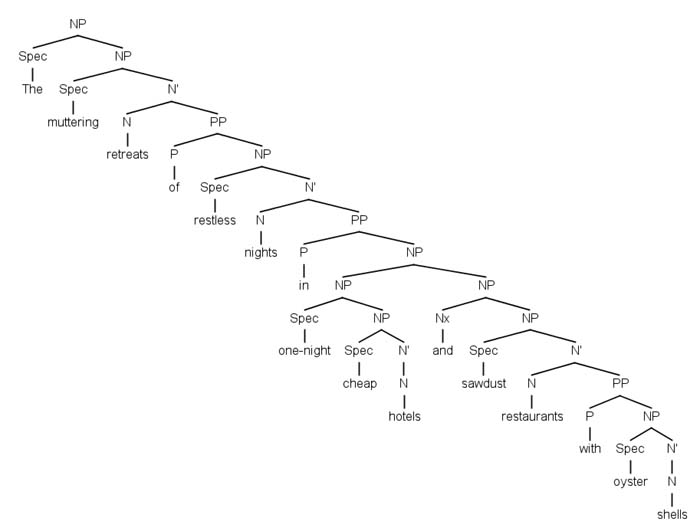
Image 3
These recursive loops are used by languages to generate infinite combinations out of a finite set of elements, but the speaker is pushing this recursiveness to its limits and so, he is defining his own paradox, the one of frustrating tendencies of change by means of enlarging time.
It seems to me that this is a way of taking Zeno�s space paradox (Bames, 1979) to time, and so, to language. This microcosm of words reflects its paradoxical movement -in a time that never ends- in its macrocosm of stanzas that try to repeat words, structures, sentences, and ideal spaces not letting change to take place, and so, not letting us to have more screenshots of the poem.
One of the most clear repetitions in the poem is:
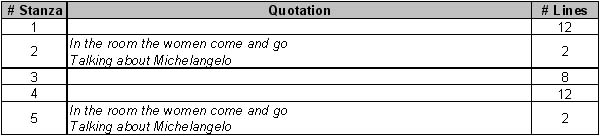
Table 5
This is a repetition of words, structure, sentences� Let us see what happens with what I have called �ideal spaces�:
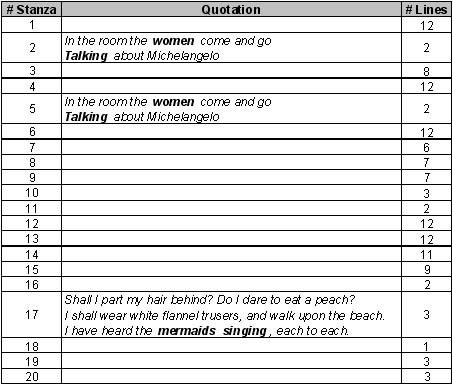
Table 6
The fact of frustraiting tendencies of change, obligues time to bend over itself, creating a dimension in which the perception of space is distorted until time gets out of the loop. This distorted space is the one that makes the speaker see �maremaids singing� instead of �women� �talking�, but the reference is the same in both cases.
Te fact of ending a poem with a �drowning� scene may seem pessimistic but, in this case, it means that time is free to continue causing change and so, progress -what is proper to its nature, and what has very deep philosophical implications that I would be very pleased to discuss in another moment-.