Context seems to be one of the last century�s re-discoveries1. Since Freud imprinted our cultural background with the idea of unconscious, we explain our fears and emotions in terms of (indexical)2 relations to our past experiences, what makes context a main point in the construction of our identity. Technical terms like �complex� and �unconscious� are now common words belonging to the lexicon of most speakers, and explanations for irrational behaviour such as phobias or depressions, which are indexed to past experiences even in non-educated social background.3 Einstein�s special and general principles of relativity �i.e. �For the physical description of natural processes, neither of the referent-bodies K, K� is unique [�] as compared with the other.� (Einstein 1962: 60)�, and Ortega y Gasset�s �I am I and my circumstance, and if I don�t save it I won�t save myself.� (Ortega y Gasset 1914: 43-44) are clear examples of this imprinting.
From 1964 to 1966, Joseph Weizenbaum worked on the design of what now literature call a ur-chatbot. ELIZA is a program �designed to permit it to play (I should really say parody) the role of a Rogerian psychotherapist engaged in an initial interview with a patient� (Weizenbaum 1976: 3)4. The importance of this program consists in the fact that ELIZA creates the illusion of understanding by means of paraphrasing and making local predictions, but �the �sense� and the contiguity the person conversing with ELIZA perceives is supplied largely by the person himself� (Ibis: 190). Let us see an example of a conversation that I have maintained with ELIZA in order to understand what this means:5
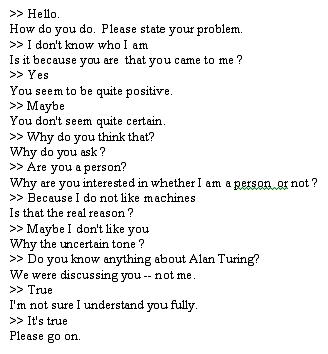
Image 1
In line 4 (�Is it because you are that you came to me ?�), ELIZA is making the local prediction that I was going to start chatting with her using an expression such as �I am/feel sad/depressed/bad� so that she could answer �Is it because you are sad/depressed/bad that you came to me?�. The predictions that ELIZA makes have to be with the structure of our answer, what contextualizes language making it possible that the system learns new structures while talking to people. This contextualization is, in fact, a kind of indexicalization as what makes you feel understood has to be with the fact that ELIZA indexes deictic expressions in a way that sounds natural to us.
The reason why people who already knew that ELIZA was a computational system got emotionally involved with �her� has to be with the fact that ELIZA was performing intelligence. This idea of �performing� is the one that relates to the latter sociolinguistical studies on gender. I am not saying that ELIZA is intelligent in the same way that a human being could be said to be intelligent, i.e. I am not saying that performativity creates reality, but it is true that performativity is the first stage to create identity. In 1992, Elinor Ochs based her Indexing Gender (Duranti et ales.1997: 335-358) on Althusser�s notion of performativity as a way of creating reality, what assumes that gender is performative. I am a little sceptic towards this assumption not because of the idea of gender being performative, but because of the basis of that idea on the fact that performativity �that is, active behaviour�, is understood as a source of being itself instead of a tool to create the context that will influence the individual�s identity.
In that article, Ochs explains how the indexicality that we have already seen, which was also applied to what some linguists call deixis6, may also take place in the sociological assumptions about gender. Let us take our chatbot again as an example of what she is saying:
In the same way that we were talking about how a machine could perform intelligence and how that intelligence could be recognised by users, we recognise gender characteristic features performed by people with which we are in contact. The big question comes when we wonder WHY users develop affective relationships with a machine while knowing the machine not to be affective, and the answer, according to Ochs, is that we index that intelligence that we perceive in ELIZA�s performance to the idea of human, what indexes emotional bonds. Applying this same mechanism to gender, identity, and social behaviour; Ochs is stating that what we understand by masculine OR7 feminine features are not features by themselves but the result of a combination of our gender performance and an indexed system in which language, stances, acts, activities, and gender relate to each other direct XOR8 constituitively.
The relevance of the case of ELIZA in this paper leans on the fact that it explains the relationship between different levels of indexicality and performativity, it relates them, and it lays the theoretical foundations of the role of context in language.
Bibliography
- Aristotle, Barnes Jonathan (ed.) (1995) The Complete Works of Aristotle: The Revised Oxford Translation Vol. 2, (United States of America: Princeton University Press).
- Duranti, Alessandro and Charles Goodwin (eds.) (1997) Rethinking Context: Language as an Interactive Phenomenon (Great Britain: Cambridge University Press).
- Levinson, Stephen C. (1983), Pragmatics, (Great Britain: Cambridge University Press).
- Lewis, Charlton T. and Charles Short (1962), A Latin Dictionary, (Great Britain: Oxford University Press).
- Mathews, P. H. (2007) The Concise Oxford Dictionary of Linguistics. (Oxford Reference Online. Queen Mary University of London: Oxford University Press. 31 Mar. 2008 <http://www.oxfordreference.com/views/ENTRY.html?subview=Main&entry=t36.e1591>).
- Ortega y Gasset, Jos�, (1914) Meditaciones del Quijote, (Madrid: Publicaciones de la residencia de estudiantes).
- Weizenbaum, Joseph (1976) Computer Power and Human Reason. From Judgement to Calculation, (United States of America: Freeman and Company).
Publicado el 05/09/2008
Por Esther Gimeno Mir�
