CIENCIAS Y LETRAS
| Portada: |
|---|
| Presentación 2007 |
| Presentación 2008 |
| Becas y Ayudas: |
| Estudiantes |
| Eventos: |
| Congresos |
| Presentaciones |
| Conferencias |
| Seminarios |
| Actuaciones: |
| Ballet |
| Artículos: |
| Opinión |
| Crítica Literaria |
| Crítica Dramática |
| Crítica Cinematográfica |
| Las Lenguas del Mundo |
| Literatura: |
| Novela |
| Relato Breve |
| Teatro |
| Poesía |
| Lingüística: |
| Lingüística Histórica |
| Lingüística Comparada |
| Gramática |
| Sintaxis |
| Sociolingüística |
| Recursos de Investigación |
| La Dibuteca: |
| Perros |
| Otros Animales |
| Retrato |
| Payasos |
| Bodeg�n |
| Humor: |
| Chistes |
| Vídeos | Comunidad: |
| Foros | Contacta: |
| Contacta |
|
La raz�n por la publicamos que este conjunto de ejercicios es la calidad de los mismos, que vali� a su autora una calificaci�n de 85 por la Queen Mary University of London (Corrector principal: Dr. Justin Fitzpatrick). Give a full derivation, from numeration to final step, for the sentence in (1). Label each step for the process involved in that step (e.g. merge, agree) and the principle of principles that require or allow this step (e.g. checking of uninterpretable features, hierarchy of projections, etc.). (1) John will open Parliament on Wednesday. 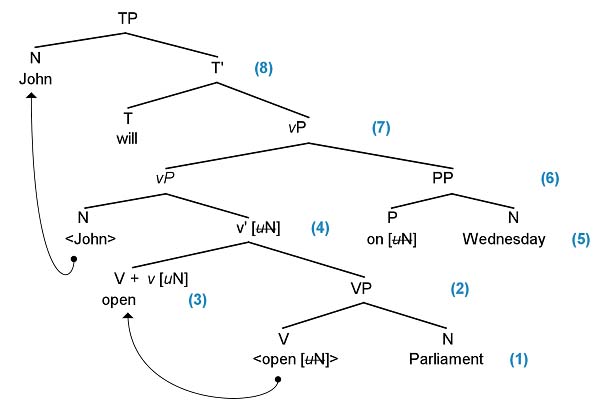 Tree 1Numeration: John [N], will [T], open [V, uN], Parliament [N], on [P, uN], Wednesday [N].
Problem 2: VP ellipsis, inflection, and binding. Consider the principle in (2), adapted from the ICVE (p. 198 of the Adger textbook). Please use this formulation, not the one in the textbook. (2) Parallelism Condition on υP-Ellipsis (or just Parallelism) This helps account for the fact that an elided υP always has the same interpretation as some other fully pronounced υP. So, as Adger notes, (3) makes sense, but (4) is strange, as it suggests that Julie's truck increased in virulence last year. (# is used when a sentence is grammatical but odd in meaning.) (3) Lloyd's car fell over a cliff last year... and Julie's truck did [υP...] too. (4) #Computer viruses increased in virulence last year... and Julie's truck did [υP...] too. Say, for each of the following sentences, what elided material is. Are these results consistent with parallelism?
These results are consistent with Parallelism because the antecedent υPs are identical as the elided ones in the second sentences: in (5).1., for instance, the elided material is the υP [eat mango], which is the same that appears in the first sentence �I will [eat mango]�. Now fill in the elided υPs in (6) as they are understood (i.e., give how you would pronounce [] if something were pronounced in this position). Then give the surface from the antecendet υP (that is, how the antecedent &upsilon is pronounced). Based only on comparison of these two forms, does it look like parallelism is respected in these cases?. (6) I ate mango. Gillian did [] too.
(7) Raffi makes pesto pasta. David does [] too.
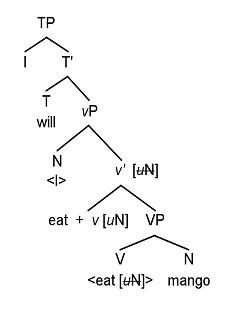
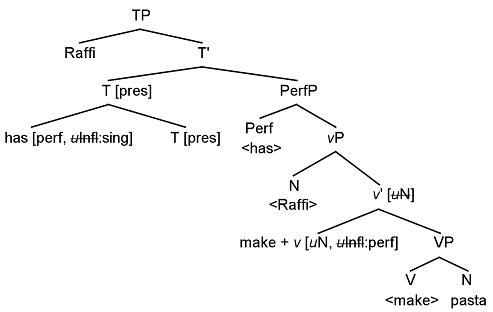
Now give full tree structures for the first sentences in (6) and (7) (i.e., the antecedent sentences). Include all structure, agreement, etc. Explain how these structures show that, despite appearances, parallelism is respected here. (6) 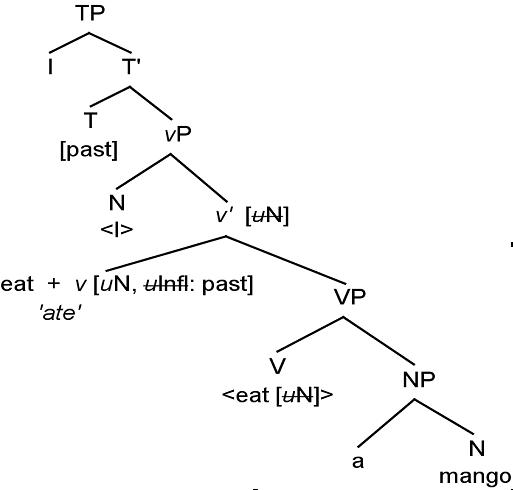 Tree 5(7) 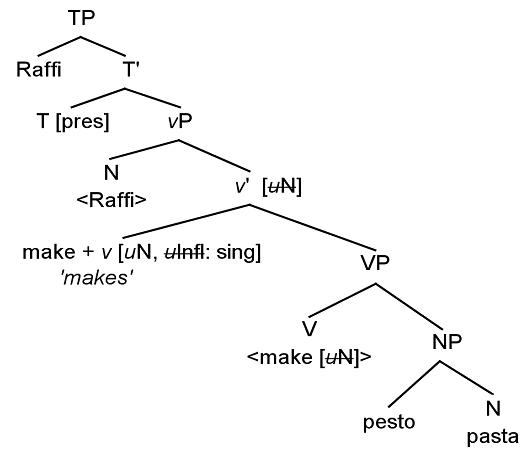 Tree 6In the first sentences, as they are complete sentences, tense features are pronounced in υ: T values [uInfl:] on υ; in (6) �eat� + υ [uInfl: past] is pronounced �ate� and in (7) �make� + υ [uInfl: sing] is pronounced �makes�. In the second sentences, the elided material is understood as the first sentences� υPs without the tense features: [υP eat a mango] and [υP make pesto pasta]. This is due to the fact that υ is elided, so it is impossible to pronounce tense features on it, and do-support is required to carry them. Thus, T is pronounced in elliptic sentences on the auxiliary: in (6) do [past] (�did�); in (7) do [sing] (�does�). Although elided υPs in (6) and (7) and their antecedents do not look like identical in surface, their structure is exactly the same �the only difference is where tense is pronounced; Parallelism, therefore, is respected in these sentences as well. The following examples are degraded for most speakers. Explain why. Make reference to parallelism in your answer. (8)
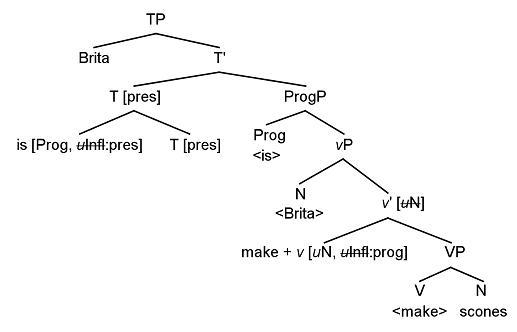
1. 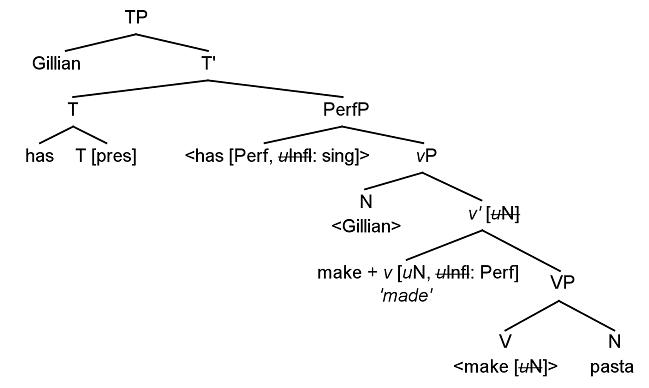 Tree 72. 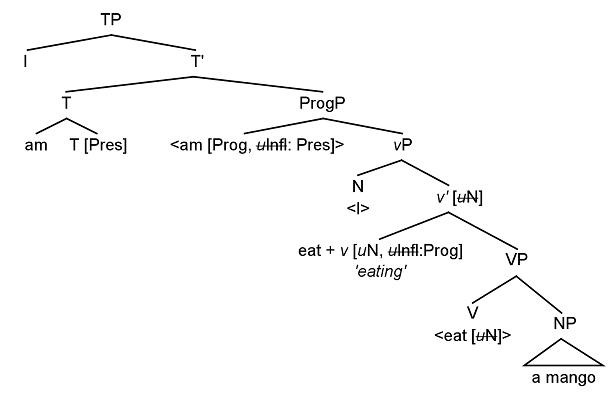 Tree 8On the one hand, the ungrammatically of (8) could be the consequence of an ill-formed VP-ellipsis construction: the auxiliary, which carries the tense, in the elided sentences must be the same as the one in the fully pronounced ones or, if there is only the main verb, �do� appears. In (8)1., for example, the verb in the elided υP [made pasta] has a valued uninterpretable inflectional feature Perf that Agrees with the Perf feature on the perfect auxiliary �has�; however, in the second sentence �David is [made pasta] too� the auxiliary is the progressive one, but it cannot Agree with the main verb �make� because it has already checked its uninterpretable inflectional feature (so it has already been deleted) and valued it. The same lack of Agreement, in this case between the perfect auxiliary and the verb already valued as progressive, happens in (8)2.: *I am eating a mango. Gillian has [eating a mango] too. As a result of this interpretation, sentences in (8) respect Parallelism as the elided υP is structurally identical as the one in the antecedent sentence. The problem is, in the VP-ellipsis constructions, the auxiliary does not Agree with the main verb, which is elided, and that is why they are degraded for most speakers. On the other hand, the ungrammaticality could be due to Parallelism is not respected: in (8)2, for instance, grammatical elided υP [eaten a mango] has not a structurally identical antecedent υP; the only υP in the sentence �[eating a mango]� has a different structure: the main verb has its uninterpretable inflection feature valued as a Prog because of the Agreement with the progressive auxiliary whereas the elided one has it valued as Perf, agreeing with the perfect auxiliary �has�. The problem in this case is that it does not respect Parallelism. First consider the following from p. 151 of the Adger textbook. (R-Expressions are "full NPs" like John and the woman. Other NPs, like pronouns and anaphors are not R-expressions.) (9) The R-Expression Generalization (or, Condition C) This helps to explain why he and John cannot corefer in (10). (As usual, subscripts are used to annotate coreference possibilities.) (10) Hej/*i thinks that Johni won't go to the party. But, his and John can be coreferent in (11), because his does not c-command John, as we see in the tree below (I have left out υP projections here.) (11) Hisj/*i mother thinks that Johni will go to the party. 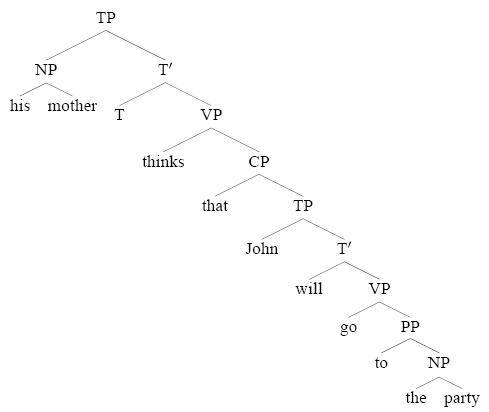 Tree 9Now consider (12). This example is well-formed for most speakers under a variety of meanings, including one with coreference as shown here. (12) Mary2 admires John1, but he1 thinks Sally3 doesn't []. Give two possible structures for the elided material in []. Include subscripts showing coreference. (Non-native speakers should ask me or another native speaker for these judgements.) The elided material in (12), as it is understood (always referring to John1), could be: (12)
Now consider what Condition C and Parallelism predict about these structures. Do these proposed grammatical principles make the correct predictions in this case? Explain your answer. Parallelism predicts (12)1. because the elided υP has the same structure as the antecedent υP �the only difference, as it has been analysed above, is tense is carried by auxiliary �do��, so we have the sentence: (13) He1 thinks Sally doesn't admire John*1. 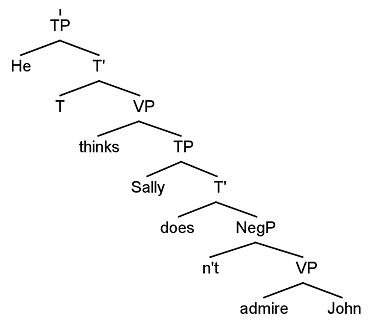 Tree 10According to Condition C, an R-expression �like �John�� cannot be coreferential with a NP that c-commands it. As �he� is c-commanding �John� in (13), this R-expression cannot refer to it and that is why (13) is ungrammatical. However, if Condition C is taken into account, is the elided material in (12)2., which gives the grammatical sentence (14): (14) He1 thinks Sally doesn�t admire him1. In this one, the pronoun can be bound by �he� because, although it is c-commanding it, they are not in the same VP (as the Pronoun Generalisation (revised) in the last Problem Set established). Nevertheless, the υP [admires John] and the elided υP [admire him] are not structurally identical, so, (12)2. contradicts Parallelism. Parallelism and Condition C in (12), therefore, contradict each other and the predictions they make about the elided material are only correct if the other principle is not taken into account.
Publicado el 04/09/2008
|
|||||||||||||||||||||||