 Leong
Family
Ancestral Hall Leong
Family
Ancestral Hall
Leong
Family
Ancestral Hall Leong
Family
Ancestral Hall
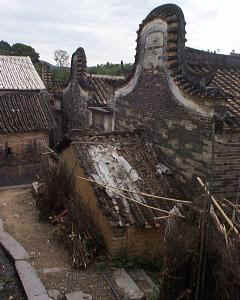 Leong Village Ancestral Hall Roof |
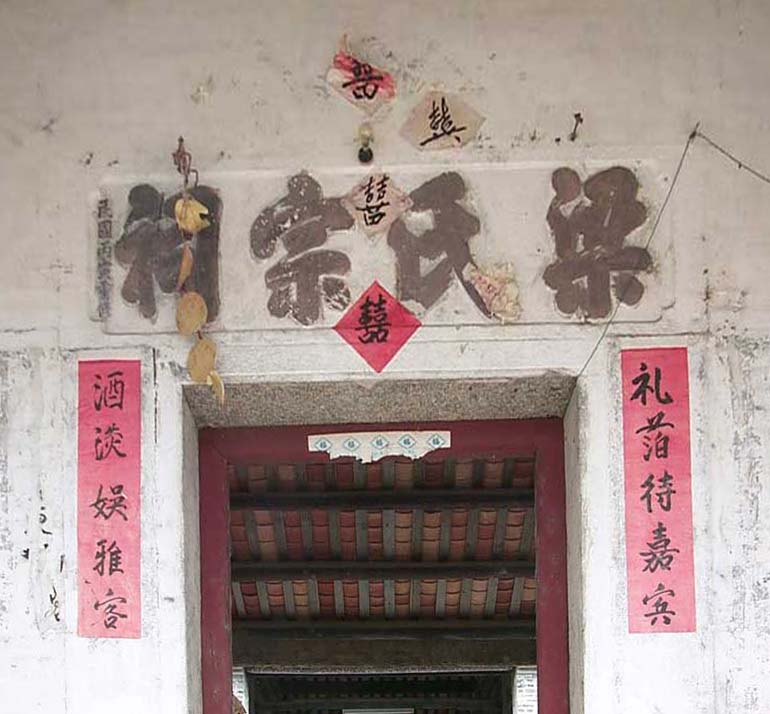 Leong Village Ancestral Hall Entrance |
The above Leong Family Ancestral Hall
is at least 1000 years old,
and has a special roof, that is called Wok Yee, in English, Handle of
the wok. This is probably because that is what it looks like.
This Leong village is located to the northwest of Nam Long, from
which Leong Yee Chong emigrated to the U.S. The four large
characters above door says,"Leong family ancestral
hall". Left banner: "Treat your elegant
guests with drinks/wine." Right banner: "Treat Visitors
with good food." Family records and ancestry would be kept in
this hall.
Both the Chan and Chong villages are in Nam Long, Zhongshan. The Chan village is Cha Sai (tea garden west). Leong Yee Chong's village is Lung Yuet Tau - Dragon, Month, Head according to its Chinese characters. Lung Yuet Tau is in the Nanlong (Namlong in cantonese) district or township. Nanlong is in Zhongshan County the town of Shekki (shiqi in mandarin) is the closest big town. Shekki is now known as Zhongshan.
Zhongshan: Guangdong, pop 1990
273.0K, pop 2002 316.6K,
lat. 22.53°N long. 113.35°E
See China maps to locate
the village.
In July 2002, Marcia Chan visited the
Nam Long district, in search
of family roots. She first visited Sum Gum Phun in the Sun
village, Jo Bu Tau, or in Mandarin Zuo Bu  ( ZuoBu, GuanLi District,
ZhongShan, Guangdong). He is Davis Sun and Dorothy
Murray's half-brother, from
their father Sun Kow's second marriage in 1935. The Sun village
was walking distance to the Yee Chung's village Lung Yuet Tau.
Gum Phun now lives in Guangzhou (Canton) and has a cousin with e-mail
access, if one wishes to communicate. They live in the Jo Bu Tau
village, a 15 minute walk through the fields to the Lung Yuet Tau, the
Leung village. Its a fairly large village.
( ZuoBu, GuanLi District,
ZhongShan, Guangdong). He is Davis Sun and Dorothy
Murray's half-brother, from
their father Sun Kow's second marriage in 1935. The Sun village
was walking distance to the Yee Chung's village Lung Yuet Tau.
Gum Phun now lives in Guangzhou (Canton) and has a cousin with e-mail
access, if one wishes to communicate. They live in the Jo Bu Tau
village, a 15 minute walk through the fields to the Lung Yuet Tau, the
Leung village. Its a fairly large village.
They entered the Lung village by the
back entrance and ask if anyone
would know of Leong Yee Chung, who had left the village over 135 years
ago.  They were directed to Leung
Gon, an 80-year old "village uncle". Unfortuantely, Leung Gon had
not heard of Leong Yee Chung. But when Marcia mentioned that his
son Leong Quan Bing had returned to the village in 1929 to marry, he
immediately recalled Quan Bing, and added that Bing's father had been
known in the village as Leung Seun Yau
They were directed to Leung
Gon, an 80-year old "village uncle". Unfortuantely, Leung Gon had
not heard of Leong Yee Chung. But when Marcia mentioned that his
son Leong Quan Bing had returned to the village in 1929 to marry, he
immediately recalled Quan Bing, and added that Bing's father had been
known in the village as Leung Seun Yau 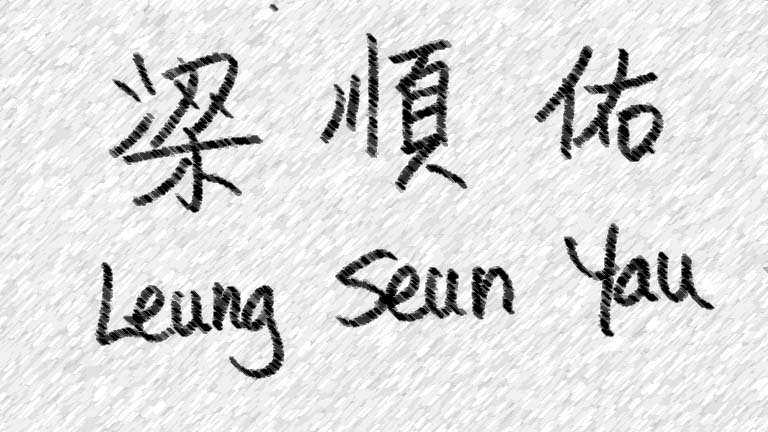 . In fact, he said Leung Seun Yau's house was
"right over there", a short walk away. Upon walking a short
distance through a narrow, 10 foot-wide lane to the house, they found a
nice brick house with the front doors locked. After taking the
picture shown below, they started to leave and met an old farmer
standing in the lane. "Do you live here?" they inquired.
The farmer replied, "Yes! Would you like to come into the
house?" The house was being rented to farmers from Szechuan
province.
. In fact, he said Leung Seun Yau's house was
"right over there", a short walk away. Upon walking a short
distance through a narrow, 10 foot-wide lane to the house, they found a
nice brick house with the front doors locked. After taking the
picture shown below, they started to leave and met an old farmer
standing in the lane. "Do you live here?" they inquired.
The farmer replied, "Yes! Would you like to come into the
house?" The house was being rented to farmers from Szechuan
province.
Naturally, they did not turn down
this opportunity. As they
opened the front door to the sitting room, a 12x15 foot area, they
looked up and were astouded to see four old, framed photographs high
upon the wall. The left-most was his first wife grandma Chong,
the second was Leung Suen Yau, to the right was his second wife, and
the fourth picture was of a young Chinese couple and their 3-4 year
old son. Grandma Chong's picture confirm that they had found Yee
Chung's home in China. Each picture was very large, perhaps 24x30
inches. The renter's belongings were on one side of the room;
whereas, what appeared to be original furnishings were pushed to the
other side. After returning to California, Dorothy Murray
positively identied the couple as Lee and Lily Chong, with son George.
The jacket George wore the picture was the same one seen in other
childhood photos. 
| from Ben Fong-Torres',
"Rice Room", of his visit to his mother's village: I took in the front room with pleasure. I hadn't yet seen the whole house, but there was a vibrancy about this room that indicated that my mother's family--my family--was doing all right. The room burst with colors, mainly lucky red and gold, on paper scrolls. I looked, with new appreciation, at prints of Chinese watercolor scenes, the kind I saw on calendars Chinatown banks and merchants handed out, and that my parents hung in every room. A portable stereo system sat atop a cabinet. As in every Chinese family home, a place of honor was reserved for portraits of deceased elders. On the back wall was a large, framed photograph of my grandmother. It was the same picture I'd seen so often as a child in Oakland. And along a side wall, several long frames held montages of photos, one of them devoted to my immediate family. There we were--in grade school, graduating from high school, getting married--our life histories hanging on a wall in a house in southern China ... Over tea, we talked about family, about life in San Francisco, about our common desires for reunions. "Their letters and those pictures," my cousin said, indicating the wall, "that's how we stay in touch. We look at them every day and think about you." (p. 248) |
 Alleyway |
 Pathway |
 Yee Chung's house No. 9 |
 Yee Chung's neighbor house No. 8 Door inscription: "Protect/Fight for your country" |
 Painting above doorway at Yee Chung house Poem inscription above door |
 Neighbor's large house |
 Villager spreading rice to dry |
 Backyard scene with mops drying and clothes hanging |
 Leung Yuet Tau Community Center |
 Village elder Leung Gon |
| More from Harold Ching's
monograph from Ron Chong on June 14, 2003: The county of Heong Shan (whose name was changed in 1925 toChungshan) is divided in turn into a series of ninedistricts (Doo), some covering less than 50 square miles. Under the Manchu dynasty the Doo was the smallest administrative unit for government purposes. The Nam Long region, from whence came many of the forebearers of Hawaii's Chinese population, is located in the eastern section of See Dai Doo, in northeastern Heong Shan, fronting the Pearl River Estuary. The area is only a 20-minute car ride to the southeast from Shekki, the county's capital seat and transportation-commercial center. While the Nam Long region with its specific dialectal population is located within See Dai Doo, it takes up only about 35 percent of the total land area of the Doo; the Nam Long area comprises what is estimated to be 50 to 55 square miles, with the Kee Gwan Highway meandering down through its center for eight miles. There are four subdivisions or "heong" which make up the Nam Long region. From north to south, these are Wang Moon Heong, followed by Foong Fau Heong, Gin Chee Heong and Wun Tai Heong. These four encompass a total of some 43 Nam Long-speaking villages. The Nam Long dialect ("Num Nong Wah") is one of three Min language strains found in Heong Shan today; Loong Doo and Sam Heong (we're supposed to be Heong Sam), the other two, also trace their distinct speech back to the Min Kingdom of central China, which reached its height of glory during the era of the Five Dynasties, around the 10th Century A.D. Detailed ancestral records were maintained starting immediately from that time (1070 A.D.) and were preserved in the ancestral halls in Hang Mei, the oldest and largest of the three main Ching villages in the Nam Long region. What we have in Hawaii is the complete set of the sixth edition, revised and updated in 1924. Copies of these volumes in China have apparently been destroyed. There is no information that any complete edition exists anywhere in the world, except these precious volumes in Honolulu. (Univ of Hawaii-Manoa, Asian Collection Library). In traditional Chinese style, the ancestral books were usually updated and printed every five to six generations. It was the family practice to designate a few elders on an "ancestral duty management committee" to supervise the management of ancestral lands which produced income for the ancestral rituals and parties, for maintenance of the ancestral halls, for providing needed supplies and for upkeeping the records with the pertinent data on birth and death dates, marriage and burial locations. Usually a scribe or archivist was hired to register the data coming in from different branches of the family. He usually served also as the attendant at the ancestral level--dusting, sweeping the floor, keeping things neat and in order, burning the incense and tapers, tending the oil lamps daily, and preparing schedules and supply lists for memorial rituals and feasts. Every five to seven generations an intensive campaign began to raise money for hiring research scribes to help put in order the complete genealogical record. If the records had been maintained and the names and data inscribed in the proper books, the task would not have been too difficult. But with the thousands and thousands of Ching descendants to account for, it because a steadily bigger and bigger task. A study of the books seems to indicate that, every four or five generations, the clans would be divided into different "fong" or sub-branches. That way, you could log your data under your great-great-grandfather's name (branch book); his volume would be catalogued under his great-great-grandfather's name, and so on down through the ages. Questions arise, in inspecting the "Ching Family Ancestral Register," why certain bits of information are treated as so vital in an individual's history, although seeming to the western mind of no great importance. Yet data we consider fundatmentally essential are treated casually, carelessly and often skipped. There usually are reasons for most of it. The records are kept to serve certain needs, in keeping with ancient practices and cultural traditions of Heong Shan's Nam Long people. It is understandable that, with the passage of the years and the tremendous increase of the family, such a mass of data accumulates that something inevitably gets lost in the shuffle. And those things that are treated as not too important get lost so much more easily. Birth dates and birthplaces, for instance, often do not appear in the records especially for less prominent individuals. The records are more consistent in including dates and places of death. Often the month and day of death are reported but the year is not available. The last edition of the Ching register consistently reflected birth and death dates by day, month and year only as far back as the mid- or late 17th Century for most branches of the clan. For a few generations prior to the 17th Century, the day and month of birth occasionally are recorded, but the year is not given. There are several probably explanations for this: a) There is a primary need to record the month and day of birth and death (the year is not important) for memorial rituals performed on the anniversary date--the birth ("sang ghee") and death ("see ghee). b) The specific year of birth and death are not of immediate use to distant descendants; in fact, on a few authentic ancestral tablets still being maintained back in the native villages are found the specific year, day and month recorded only as far back as one's grandparents. For the great grandparents there is only the day and month, with a reference to their age at death. When a man grows old and dies, the son puts his tablet at the head of the altar for worship. Then, in turn, he can "cast out the spirit" of his great-great-great grandfather's tablet and burn it after the proper send-off ceremonies. By this time, for reasons of economy (one can't keep up with memorial rituals for so many ancestors), it is permissible to remove the older generations' tablets or have them placed in the ancestral hall for mass worship. Therefore it is understandably difficult to retain the anniversary years in the records for all the ancestors in a cumulative report in the Chee Tong. For ancestors who lived before the 15th or 16th Century, there is no attempt to mention dates or the existence thereof, unless the person was of such prominence that the years of his birth and death are recorded in memorial tablets, cut into his tombstone or were recorded in other national or provincial documents. The double-edged sword of history could either vindicate or indict, according to the result of the editor's hindsight, long after one's death. But on the other hand, it would seem entirely possible that is some wealthy descendants were sufficiently ashamed of certain facts about a grandfather some six generations before, they could easily sway the verdict of history by "feeding lard to the mouth of the editor" for "smoother history (Chinese equivalent to saying "greasing one's palm"). Thus the crime or accusation made years before in the ancestral register is not only erased, but could be proved to be wrong, or excused as merely an incident of misunderstanding, or confusing phraseology. By and large, however, it seems most of the stories and biographical anecdotes were not terribly altered, unless the person was of some status, or there existed some records which the editors stumbled across a hundred or so years later, or a descendant demanded through "greasing" that his grandfather be vindicated by accepting an alternative explanation. Sometimes, however, an attempt to alter the record only made things worse if the editors came across information making the ancestor appear in a worse light--as in the case of the mother who imprisoned her daughter. But then again, she was only a concubine, not the primary wife, and probably took out her frustration on the daughter when she was not able to produce a son. |
| Ron Chong writes on October 16,
2005 phone call to China. Cary Chen phoned Aileen (Zhao Lian Chen) tonite. It was noontime there. She said she is 82 or maybe 85, her husband died 10 years ago and she has at least 2 daughters, one is in Hong Kong. A daughter-in-law answered the phone. Aileen lives with her daughter-in-law in Nanlang. Her mother's name was Leong Gum Yip (Golden Leaves) and her father was Chen Gui Au. Her grandmother was Leong Guen Ho, and her mother was simply Ah-Giu or Seun Yau Po (Leong Seun Yau's wife). Leong Gum Yip was the one who tended the gravesites after her mother Leong Guen Ho passed ... but everything has been cleared away for a future factory site (too bad). The gravesite was in Sai Gong village (Sand Hill). Leong Gum Yip had a sister in Shanghai who died several years ago in the '90s. There are no papers existing from Leung Seun Yau. Cary said they would have been destroyed in the cultural revolution anyways. Aileen's memory was quite good, she recalled all of the names of the 5 Chong brothers. She doesn't know what Leung Seun Yau's parents did, said it was too long ago. Aileen also married a Leong. Cary will be in China Nov 12 - 26. He may be able to see her then. We will try calling her after he returns. If you have any other questions let me know. We may be able to get some more details from her, but it doesn't sound like she knows a whole lot about Leung Seun Yau. |
| Ron Chong writes on April 2,
2003, We met with Cary Chen on Monday, and he gave us the letter he received from Eileen last month right after he left for Guangdong. "Eileen" is the name which I have given this lady; the phonetic Americanization could be Aileen or Allene. Eileen (Chen Zhao Lian), the owner of the house in the village, included her picture. She appears to be maybe 70 or more years old. (See attached photo.) She has very nice Chinese handwriting, showing that she is well educated, according to Cary. Eileen's letter briefly summarizes the family tree; she mentions that Jane Chong came from the Hun Mei village, that Jane's father is Chun Guan Zhi; and that Eileen's mother's mother married Bing's brother. Now this raises a good question because this couldn't be any of the Leong brothers -- possibly it could be a half-brother of Bing. Eileen mentions that Bing is the FIFTH son of Yee Chong. She said that Bing Chong was 30 years old when he returned to get married. (correct age in Chinese system). When I talked to Jeanette, she mentioned that Leong Yee Chong's first wife had a son and a daughter (Leong Kam Kiu, the mother of Tam Po Kwan). The son's name is not known, but Eileen probably knows. This son would have been the FIRST son from Leong Yee Chong, and that would make Bing the fifth son, and Look Chong the sixth son ... She said before the war, Bing sent money back to his sister-in-law. She mentions "Fat Yo," which would mean George Chong and claimed he would be about 60 (wrong!), and he was the son of the oldest grand uncle. (correct if you just count Tai's kids). Eileen said she now is the one taking care of the graves, but didn't mention who is buried there. Previously her sister-in-law had tended the graves. I am having Cary and another teacher take a closer look at Eileen's letter; I may not have gotten everything down correct when Cary read it back. We will have Cary write another letter to Eileen; he may be going over again in May, and for sure in September. Ron |
| Ron Chong writes on Nov 6, 2002, I got a first look at the videotape tonight. It is about 30 minutes long, although the rest of the tape covers Zhongshan City and Shanghai. Cary Chen hired a motorcycle guide to lead them to the village; they followed him in their minivan. Cary said there were no taxis. Villagers arriving at the bus station hitch a ride on the back of these motorcycles to get home. There was no village gate or entrance; Cary estimated that there were maybe 200 houses in the village. When they parked and walked in, the first person they met was Leong Gun, the elder. He took them to the house, but the farmer/renter was not home, and the house was locked. So they couldn't go inside ... rest of the time was spent outside the house interviewing Leong Gun. Leong Gun said he was 7 years old in 1929. The house was built around 110 years ago; the owner of the house, "Eileen", (Chinese name 'Lotus') lives in Nanlang. The elder lady said they could go back to Nanlang and get the key from Eileen, but she declined to take them because she gets carsick. The villagers referred to the house as the 'rich person's house'. Apparently the Leong family sent money back on a regular basis, at least until 1937. Leong Gun did not know if Leong Yee Chong is buried in the village; perhaps Eileen would know, he said. OK, so we didn't learn a whole lot more about our family, but at least we got the video taken on the freeway from Nanlang into the village, which was about a 15 minute drive. And we did get to see something of the village and more of the outside of the house. * * * * * Ron Chong writes on Oct 29, 2002: Great News! Just got word today that Cary Chen visited the Leong village. The whole village turned out for him. They took him on a tour of the village on bicycles! He did an on-camera video interview with elder Leung Gon. Gon was excited to see the 1922 family picture and the others we sent over, including the picture of himself, Gum Phun and Marcia. Recall that Leung Gon remembers Bing and Jane Chong's 1929 wedding in the village. Cary said that Yee Chong's house has an inscription above it giving the date it was built; the date is given in terms of the Qing Dynasty (1644-1911). We will see the video of the inscription and more when he returns. The village is about 20 to 25 minutes east of Zhongshan City (Shekki City), where he is staying. He also took videos of Zhongshan City, but did not have time to get over to Nanlang to meet the lady who owns the house. How did all this come about? Cary Chen runs an afterschool study program at our elementary school. When I mentioned to him in June 2001 that we were doing a family history project, he said that he has a business in Zhongshan City and would be glad to visit the village on our behalf. Actually his original mission was to visit our maternal Jow village, but when Marcia made the breakthrough visit last July, we had him switch destinations. He visits China several times a year and this was the first chance he had to get over to the Leong village. His trip was for a trade show in Zhongshan City. Thanks also to Marcia for making the connections last July. Good timing is everything! |
| Ron Chong writes on Oct
17, 2002, I had Cary Chen translate the letter that Leung Gon sent to Marcialast August. He remembers seeing the 1st wife often when he was young boy. He said her name was "Giu Ma", where Ma is "Auntie". He said she would now be 145 years old and that Leung Sean Yau would be 152 years old. (Both of these ages don't seem old enough). He didn't know Giu Ma's maiden name nor what village she came from. And he said he never met our great-grandmother (of course!). Cary recognized Leung Sean Yau's name in the letter. Leung Gon also said that many people from the US have come to the village to find their roots. The lady owning the Leung house he referred to as the granddaughter from the other side, and not the one related to Bing Chong (Bing Chong's name was mentioned in the letter). She lives in Nanlang and comes to the village often. But he didn't give her name. He extended an invitation to come visit the village to explore our history, good health to everyone and not to worry about him. * * * * * At Tim's suggestion I gave Cary a framed print of the 1922 family picture along with the names in English. Wonder if anyone in the village speaks English? * * * * * Cary is all jazzed up about doing this project for us. He said he will turn on the video camera 2 miles before getting to the village so we can have the experience going there virtually. And I asked him to be sure to get as much as he can inside and outside of the house. I sent along a tripod with him so he will use it to be on-camera along with Leong Gon. The best is yet to come ... _________________________ Ron Chong writes on Oct 16, 2002 I have met with Cary Chen, who will be in the Zhongshan (Shekki) area from Oct 19 to Nov 2 for a trade show. He has a business in Shekki City and has a driver and car at his disposal. Mr Chen lives here in Hacienda Heights. Mr Chen has offered to visit the Leong village for us and take a camcorder. I have given him a list of questions to ask the village elder, along with the pictures Marcia took in July. He is also taking a large b/w photo of Jeff, Judy and myself, hopefully to be added to the pictures on the wall. I asked him to do an on-camera interview with the elder, Leung Gon. If all goes well, we should get some valuable information from this trip. The #1 question is whether Yee Chung is buried in the village cemetery. He will see if he can get access inside the house and photograph whatever is inside. He said it is common for the houses to be rented out to Szechwan farmers because the local people have money now and don't have to work the fields. The Shekki area is becoming an important industrial center. _________________________ Some questions for Leung Gon, the village elder, Here are the questions I have for him: 1) Is Leung Seun Yau buried here? If so, where is the cemetery? (Leung Seun Yau died 4/27/1902 in Madera, California) 2) When was this house built? 3) What was the name of the first wife, and when was she born and died? 4) Who owns the house now? 5) When did the Leong family move from the house, and who were they? 6) Did he know Tam Po Kwan? They moved to Hong Kong in 1937. Tam Po is the grandson of the first wife. 7) When did the daughter (Tam Po’s mother) die? When was she born? 8) What does he remember about Bing Chong’s wedding in 1929? 9) Are there any old papers or pictures in the house from Leong Seun Yau? |
| Marion Wong Owyang of Isleton writes on 2/16/2003 "In China the people do hang the photo of the family on the wall. In the year 1986, I travelled with my sister Ida and brother James to Tai Ling village, we also saw our father and mother's picture hanging in the living room's wall. During that time the road was not paved. It was a dirt road like the farm ranch here in the Delta. Again in 1991 daughter Sharon and I also made a trip to the village. It was a big change. The road has been paved like here. Most of the farms were bought by developers from Hong Kong. Today it is a modern town, huge plants and factories and beatiful homes. My nephew even torn down the old brick building my dad's home and built a 3-story mansion. He used it as a vacation home. He is now living in SF." |
Send comments or materials to Feedback