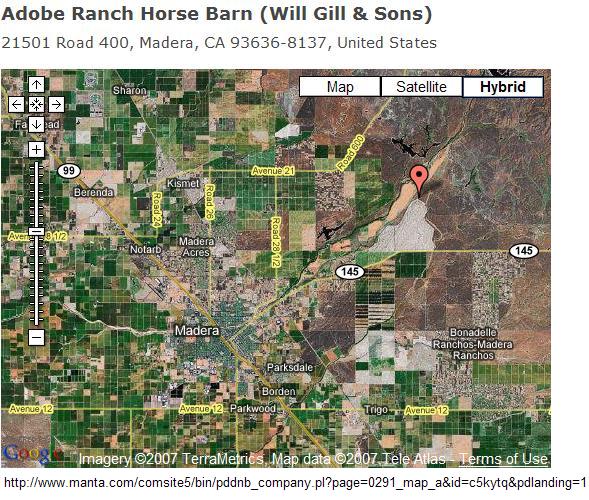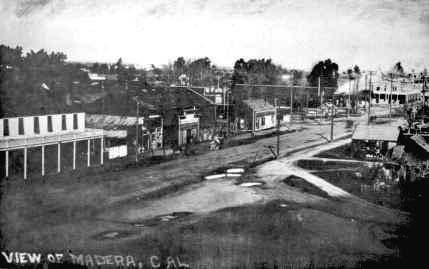
Town of Madera, east on Yosemite Ave, 1896

1895 Madera County Map
|
Town of Madera, east on Yosemite Ave, 1896 |
1895 Madera County Map |
Ref:
The Forgotten
Field: the
Forgotten People.
 Yee Chung became a prominent member of the Chinese community, if
not the most prominent Chinese man, and well known and respected in
Madera. During the rapid decline of Borden in the 1880's, he
continued to run his general store in Borden, but by the the mid-1990's
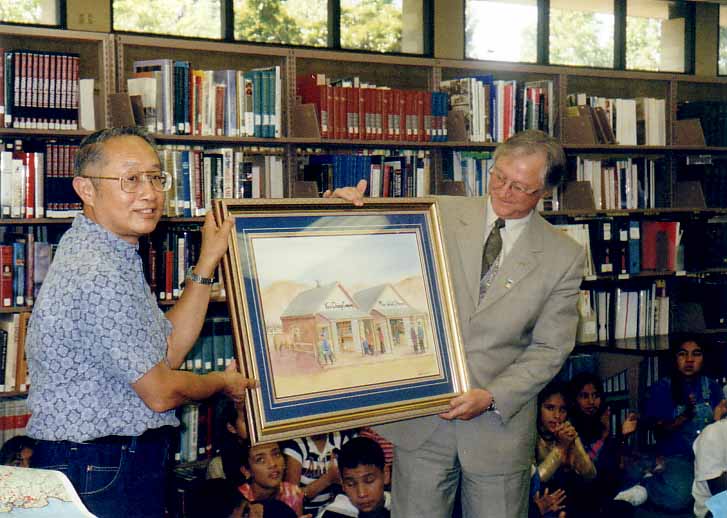
was forced to abandoned his store. Ron Chong presents a painting
from Yee Chung descendants to the Mr Gary Svanda, Mayor of Madera, at
the County Library on September
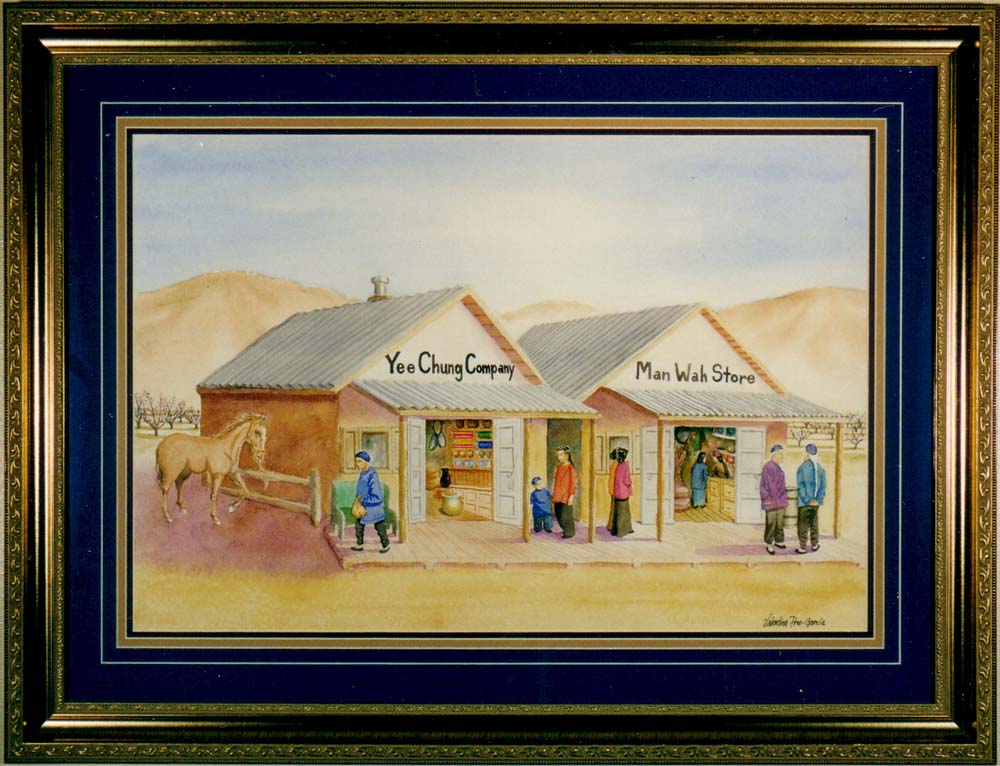
20, 2002. The artist conception shows how Yee Chung's and the
adjacent
Man Wah stores may have appeared in downtown Borden in the 1880-1890s.
Other
Madera dignataries present for the ceremony were: Madera County
Supervisor Ronn Domenici; Madera Unified School District Superintendent
Julia O’Kane;
school Trustee John Peters; City Councilwoman M.J. Nabors; and school
Trustee
Robert Garibay
Yee Chung became a prominent member of the Chinese community, if
not the most prominent Chinese man, and well known and respected in
Madera. During the rapid decline of Borden in the 1880's, he
continued to run his general store in Borden, but by the the mid-1990's
was forced to abandoned his store. Ron Chong presents a painting
from Yee Chung descendants to the Mr Gary Svanda, Mayor of Madera, at
the County Library on September
20, 2002. The artist conception shows how Yee Chung's and the
adjacent
Man Wah stores may have appeared in downtown Borden in the 1880-1890s.
Other
Madera dignataries present for the ceremony were: Madera County
Supervisor Ronn Domenici; Madera Unified School District Superintendent
Julia O’Kane;
school Trustee John Peters; City Councilwoman M.J. Nabors; and school
Trustee
Robert Garibay
Leveraging his Chinese farming heritage, he leased farming acreage on the Dorn Ranch a few miles southwest of Borden, and started a fruit orchard business. Yee Chung's new business effort succeeded, as he became a successful orchard farmer. He planted most of the peach, apricot, and plum orchards southwest of Madera. When the fruit were ready, Maderans would come to pick the fruit and box for shipment to markets in the city. The workers would camp out in the orchards rather than traveling back-and-forth to town. He would share his farming knowledge, and how to irrigate the orchards, prune the trees, and send the harvests to regional markets. In addition to farming fruit orchards, Yee Chung again used his general store experence to operate a store on the Adobe Ranch, which was owned by Brooke Morgan. Today, there is no physical evidence on the Adobe Ranch of the store's existence.
Within a short time, Yee Chong was profiting handsomely from his farming business. But, as often happens when one gets quick success and wealth, he turned to alcohol in his last two years. We are not sure why, but perhaps his 35+ years of hard labor and work to attain a measure of success was a contributing factor. Or, there was much stress and conflict in not having been able to return to China, or how the Chinese in general were not treated equally with the whites. For one, he could not purchase the land he farmed, even with his earnings.
Yee Chung became a truck farmer,
that is, he farmed on a large scale
and
shipped his produce to distant markets via truck or railroad. His
success in farming fruit orchards may have led to his boys to later
rent delta
farmland from 1912-1941. They too, were not allowed to purchase
the
land, but only rent, well into the twentieth century. U.S. Laws
prevented the Chinese from owning land, they could only rent from white
owners. After living on the Dorn Ranch, the family moved on to
the Emma (perhaps
a Roberts) Ranch, and finally another Robert's ranch. The nearest
neighbor to the Dorn Ranch was the Osborn family, about ¼ miles
away. The Osbornes had one child who attended school,
Hazel. In the 1929 testimonies,
his children could not recall whether he had any brothers or sisters in
China
or elsewhere, but only that their mother had one brother and sister in
China.
| "Not all of the residents of (Borden) Chinatown moved to Madera because of the lumber business. Yee Chung moved to Maders from Borden to farm. He planted most of the peach, apricot, and plum orchards southwest of town. Many people in Madera would come and cut fruit for Yee Chung, most of them camping out in the orchards instead of traveling back and forth to town. Besides having an orchard, Yee Chung also ran the store at the Adobe Ranch, which was owned by Brooke Morgan." from The Forgotten FIelds, the Forgotten People |
| The Chinese
laborers wanted to be more than
low-paid workers, and many wanted to be farmers themselves, working the
land for their
own benefit. The number of Chinese farmers and vegetable
gardeners in
Sacramento, Yolo, and San Joaquin counties grew from 119 in 1860, to
913
in 1880. Most did not have the money to buy large tracts of
land. However, they could enter agriculture through tenan
farming. In exchange for use of land and equipment and the
marketing of their crops, the Chinese tenant farmer raised fruit and
vegetables and divided the profits with the
white landowners. Despite success of some tenant farmers,
mos
Chinese in agriculture were wage-earning laborers.
"In 1893, the Pacific Rural Press wrote the contribution of the Chinese laborers: "The Chinese are the mainstay of the orchardist and thus far it must be said, form the only supply of labor which he can depend on. They are expert pickers and packers of fruit. It is difficult to see how our annual fruit crop could be harvested and prepared for market without the Chinaman." ref: Journey to Gold Mountain. |
The Exclussion Act of 1882 was highly effective in reducing Chinese immigration, that American workers succeeded in pressuring Congress into extending the act for ten more years. The Geary Act of 1892 required all Chinese to obtain certificates of residence within the year, and to carry a photo passport at all times. A Chinese person could be stopped at any time and forced to show the certificate. If he could not produce it, he would be detained until someone could bring his certificate, or vouch for him. The Geary Act effectively suspended the Bill of Rights for Chinese who failed to comply.
The Chinese Six Companies felt the Geary Act was unconstitutional, and advised Chinese in America not to sign the registration documents, and asked each to contribute one dollar to challenge its constitutionality. $60,000 was raised to fund a team of top constitutional scholars to abolish the law.
In a surprise decision, the U.S. Supreme Court found the Geary Act to be constitutional, leaving thousands of Chinese subject to deportation. As a result of this court defeat, the Chinese Six Companies lost prestige and moral strength, and was humuliated. With weakness that continued into the 1900s, the tongs seized control of San Francisco's Chinatown in the early 1920s. ref: Bury My Bones in America.
| There are more
people from Taishan county in
southern China living outside of China, than there are living in that
county. San Francisco Chinatown has traditionally had a lot of
Taishanese as well as Heungshan (that's the Leong county village
area).... Taishan is one
of the Seiyap (Say-yup) counties - the others being Hoiping,
Yanping,
and Sunwui (pinyin spellings - Kaiping, Enping, Xinhui). ref:
Marcia
Chan
The Taishan district had been self-supporting in mid-1800s, but by 1900 it was not. Dependence on money from Taishan men working overseas and declining farm productivity produced a society that could not do without foreign money. Remittance money received from overseas exceed agricultural output in the early 1900s. So much money was returned to their villages, that school construction flourished. New villages were built completely with foreign money as Gold Mountain workers retired to Taishan county. Other returnees brought manufacturing skills when they returned home. Bandit raids had always been a problem, but worsened in the early 1900s. In some areas, more men worked abroad for economic survival, than stayed in their villages. Guests from Gold Mountain and their families were favorite targets for kidnap and extortion, mugging, theft, or even killing. ref: Dreaming of Gold, Dreaming of Home |
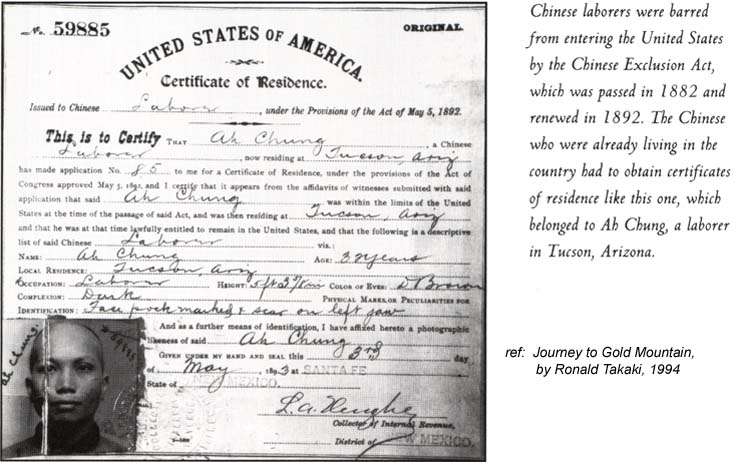 Chock Chee
Papers
Chock Chee
Papers During the registration period of Chinese in the United States (1893-94), Mr and Mrs Chong received Chock Chee in 1893, i.e. certificate of residence. Mrs Chong had registered under the name Sun Ho. Mr Chung had registered under the name Ah Bow or Leong Ah Bow. Both their Chock Chee papers were surrendered to the Superior Court in Madera in 1903, when Mrs Chong was obtaining some affidavits for her children while contemplating a trip to China. Ah Lin's original birth certificate is at NARA San Bruno archives. This document was used to verify residency for the proposed 1903 trip to China; what happened to birth certificates for her brothers and sister is undetermined. Mrs Chong testified he died in Madera Apr. 26, 1902.
However, 1929 documentation in
the Dept of Labor indicated that Yee
Chong's Chock Chee was used for Bing Chong's
request for return certificate
, and later forwarded to immigrations for proper disposition (or
disposal
since they could not find Yee Chong's file). On May 9, 1929, the
Dept
of Labor stated "This office has made unsuccessful effort to locate in
our
files record relating to Yee Chong, owner of enclosed document.
The certificate is
referred
to the Commissioner General of
Immigrations in Washington,
D.C. for cancellation."
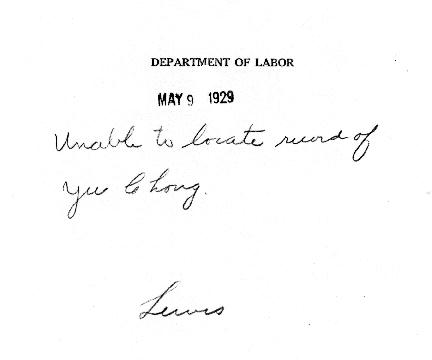
In Bing Chong's file, there is a 1929 note "unable to locate record of
Yee
Chong". Had the INS not taken the certificate, there would
have
been at least one picture of Yee Chong kept in the family.
 The Yee
Chung Children
The Yee
Chung Children Mrs Chong testified in 1929 that
all her children were born in the
store in the town of Borden, though she later recanted that four were
actually born on the Dorn Ranch. When asked why she refers to the
town as Madera,
she replied everyone calls Borden "Madera". Her testimony was
through
an interpreter. Their first child, Lee Chong, or Leong Quan You,
was
born on December 21, 1889. They would have six more children,
five
brothers and two sisters in all. Moy Leong (Leong Ah Mooey or
Chun
Mooey Leong) was born two years later on April 17, 1891. Her
younger
sister Lin (Tung Lin Leong or Lin Ah Leong) was born on Christmas Day,
1895.
Two more brothers Chew (Leong Quan Chew or Leong Ah Chew) and Sam
(Leong
Quan Sam or Leong Ah Sam) on October 3, 1893 and January 10, 1897,
respectively.
Bing L Chong (Quan Bing Leong or Leong Ah Bing) was born January 17,
1900
on the Dorn Ranch. Look Chong (Ah Look Leong) was born July 26,
1902.
Mrs Chong recalled in testimony that there was a fire in Madera (or
Borden)
when Lee was just a little baby. Many Chinatowns in valley towns
experienced
disastrous fires
, with the wood buildings burning quickly.
As his store business continued to
decline in the 1890s, Yee Chung
began
plant orchards on farmland 1-2 miles southwest of Borden. 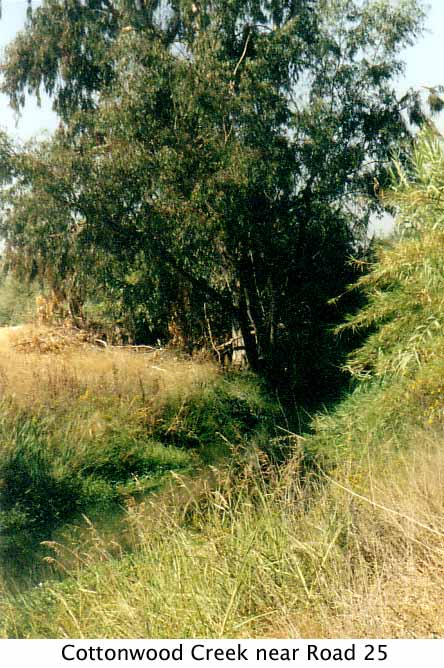 He leased
land on D. S. Dorn ranch lands. Dorn was apparently an absentee
landlord.
Despite owning title to substantial acreage, there was no stately
mansion
or ranch house on any of the properties, located immediately to the
west
and north of the Mordecai Ranch. Darryl Chong drove the Dorn
properties
in September 2002, in search of where the family had lived. He
was
hoping to find a large, elegant ranch house on Road 25, near Cottonwood
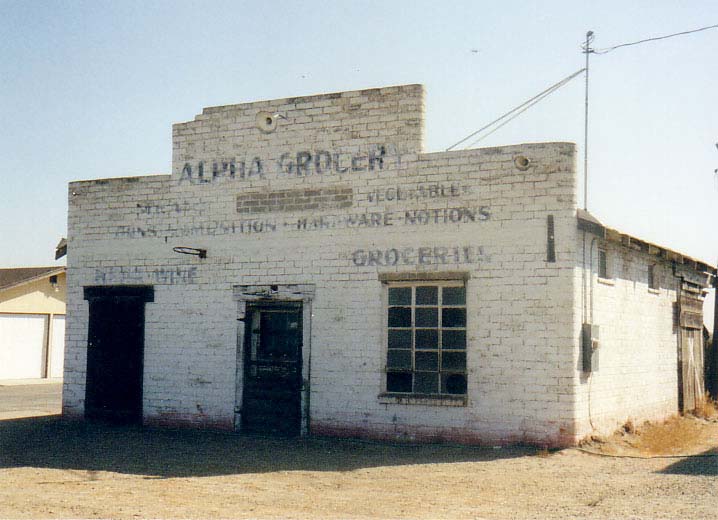
Creek, and ¾ mile to the old Alpha School.
The 1890 farm map did not show any house or buildings on the Dorn
properties
in 1890, so the structures would have had to been built since.
He leased
land on D. S. Dorn ranch lands. Dorn was apparently an absentee
landlord.
Despite owning title to substantial acreage, there was no stately
mansion
or ranch house on any of the properties, located immediately to the
west
and north of the Mordecai Ranch. Darryl Chong drove the Dorn
properties
in September 2002, in search of where the family had lived. He
was
hoping to find a large, elegant ranch house on Road 25, near Cottonwood
Creek, and ¾ mile to the old Alpha School.
The 1890 farm map did not show any house or buildings on the Dorn
properties
in 1890, so the structures would have had to been built since.
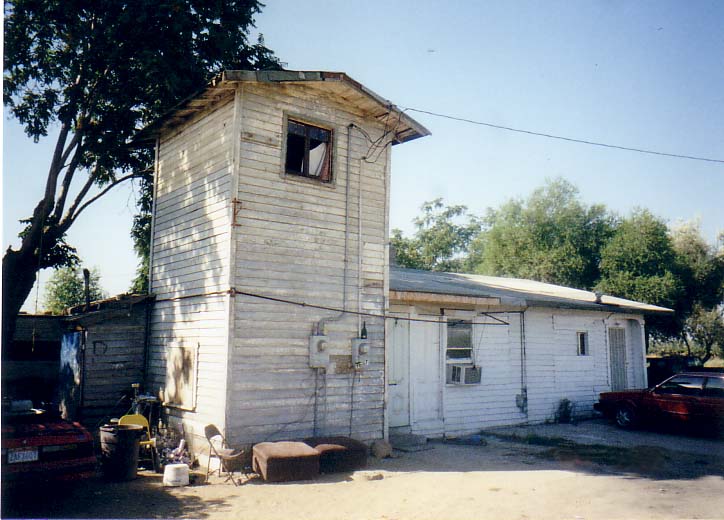
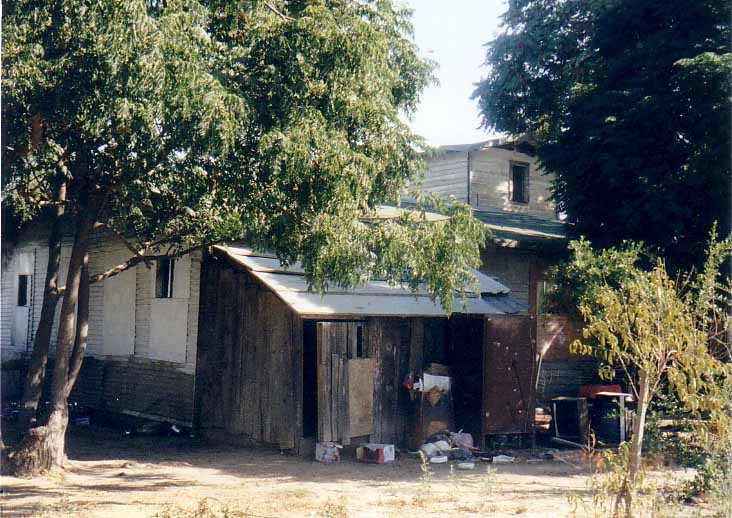
Instead, there was only one small,
dilapidated ranch house on the Dorn Ranch at 9637
Road 25,
about 200 feet east of the road along a dirt driveway. A farmer
of
Mexican origin was the current owner of the property. He had
purchased
the property and small vineyard 10 years prior, in 1992. The deed
stated
that the vines were planted 86 years earlier, or in 1906. His
family
lived in the house, which now has five bedrooms, including one in the
upstairs
tower. Originally, there was a second tower adjacent and to the
right
of the existing tower, but he tore it down as it was falling apart.
Although
the vines were first planted in 1906, that did not imply the house was
the
same age. From the looks of the house, it could have been much
older,
yet too small to be located on the 1890 farm map. Across from the
house
was a small wooden shed containing various tools, but no trace of any
Chinese
family having lived on the premises. The owner does not recall
seeing
any rusted steel safeboxes, that might contain the business records
kept
by Yee Chung from his store and farming businesses.
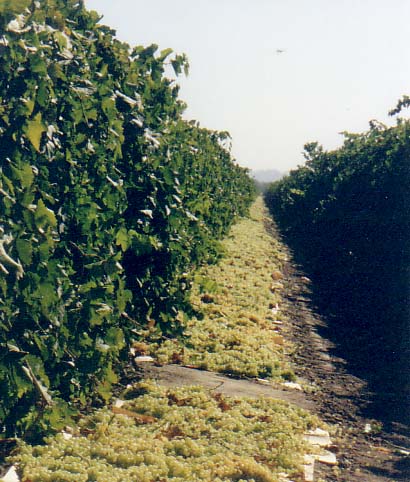
In 2002, one observes many
orchards on the old Dorn ranch
properties,
with substantial acreage for vineyards. The ranch lands were just
that,
orchards and vineyards, with very few building structures other than
this old house pictured below, and another small, somewhat newer ranch
house 1/4 mile to
the north -- but not necessarily on the old Dorn property. The
9637
Road 25 house and vineyard was up for sale in September 2002; but the
owner
says that grape prices are low, and land valuations are lower. He
wants
to retire from farming, and move his family to Madera for a better life
for
his children.
 |
 |
 |
 |
| From
Ah Lin's 1929 testimony, we
find:
Q. Did you ever live in
the town of
Madera? Q. On how many different
ranches do
you recall having resided in the County of Madera? In other words, after Yee Chung died in 1902 on the Dorn orchard, they left the Dorn Ranch in November 1904, and moved to the Emma Ranch, which was located within the Howard country school district. Lin was well aware of the distinction between Borden and Madera, so she did not mean Borden. So they may have lived within the town of Madera for less than a year, before moving to the Emma Ranch. Finally, they moved to the Robert's ranch which must have been closer to Madera, since they transferred to Alpha School on Nov 7, 1907. Confirming was the August 1903
Madera Mercury
article about the guy being peppered with bird shot In August 1906, the Madera Mercury reported the arson attempt on Mrs. Yee Chung's house, located about 4 miles from Madera. This must have been the Emma Ranch, which was west of Madera, based on the Howard School location. |
Ref:
The Forgotten
Field: The Forgotten People
Here is the kicker. Yee Chung purchased the Borden
Chinese Cemetery
in 1891 to preserve the cemetery for his countrymen. Eleven years
later,
Yee Chung would also be buried at the same cemetery. The cemetery
was
created in 1872 by and for the 2,500 Chinese laborers building the
Central
Pacific Railroad, which was later renamed the Southern Pacific.
Prior
to 1891, the Borden Chinese Cemetery was an unofficial burial ground
for
the Chinese railroad workers. The small lot measuring 150
by
250 feet was located on a corner of 1948 acres originally purchased by
William
S. Chapman in 1869 for $1.25 per acre, and later subdivided into
parcels
160 acres or larger.
When Yee Chung's friend and partner Man Wah died, it is reasoned that the Chinese community needed to establish the grounds as an official cemetery, as they could not otherwise allow a man of Man Wah Chan's stature to be buried in a Pottter's field. So Yee Chung bought it from a farmer at a highly inflated price of $200 for 1 1/3 acres of land on August 3, 1891. At the time, land was selling for around ten dollars per acre. He then sold it on May 17, 1898, to the Jung Wah Company in San Francisco for ten dollars. Jung Wah was a Chinese benevolent society that maintained Chinese graveyards.
Both Man Wah and Yee Chung were pillars of the Chinese community in Borden, indicated by articles written in the Madera Mercury. The United States Census Report for the year 1880 reported the entire Chinese population of Borden. Among these listed were two merchants, Yee Chung and Man Wah.
Converting
to 2000 dollars, Yee Chong paid the equivalent of $4000 for the
property in 2001 dollars. Though still the owner, the Jung Wah
Society has since
become defunct, resulting in nonpayment of property taxes. Until
the
site was given attention by the 1991-1992 sixth grade class at James
Monroe
School, to celebrate the book The
Forgotten Field: The
Forgotten
People, the grave site had been
designated to be protected from
other
uses. At least for now, the Borden Chinese Cemetery is being
preserved,
though it could use a major restoration. And ... Yee Chung, who
was
buried at the site, has not been
forgotten, and is now
being
recognized as a significant early Madera pioneer.
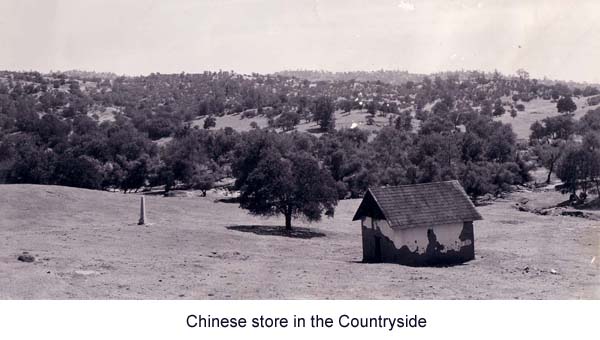 As a boy 12 and
13 years of age, Fred Patterson was many times a guest of the Man Wo
Chans
and on a few occasions had the privilege of eating a meal at their
table
and also often he would go from school and walk to Borden purposely to
get
some Chinese candy and then walk four miles home. Fred recalls
that
the shelves in the store were stocked with many cans of opium.
As a boy 12 and
13 years of age, Fred Patterson was many times a guest of the Man Wo
Chans
and on a few occasions had the privilege of eating a meal at their
table
and also often he would go from school and walk to Borden purposely to
get
some Chinese candy and then walk four miles home. Fred recalls
that
the shelves in the store were stocked with many cans of opium. |
 |
Old Maps, Prints and Articles of Historical and Genealogical Interest from California
(available at many main libraries in reference section)
1895 U.S. Atlas
Madera County
California Counties
- Borden, population 72, Fresno County, Post Office, Railroad
- Madera, population 950, Fresno County,, Post Office, Railroad
The Borden post office was
finally closed in 1906, with the
demise of the town, and merged into the Madera post office.
| 2/21/02
Conversation with
Bill Strobridge, one of the historians for Wells Fargo about
trying to find a Yee Chung
Company listing.
He checked the Wells Fargo directories and card files and couldn't find any listing. The directories really were for LA, SF and Sacramento. Wells Fargo, he said, dealt with the Chinese and didn't exclude them. He thinks Yee Chung used his horse to make deliveries ... He found a 1906 headcount for Borden which gave 40 souls. Wells Fargo never had an office in Borden. In 1918 the government was going to take over the express companies, and the companies were so ticked off that they THREW THEIR RECORDS AWAY! Too bad. Wells Fargo Historical Section,
San
Francisco Main Office: (415) 396-4157.
|
Send comments or materials to Feedback