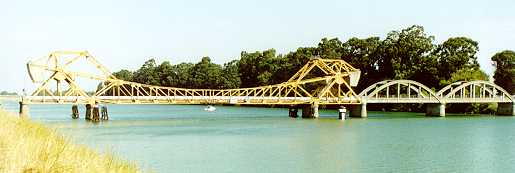
Isleton Bridge
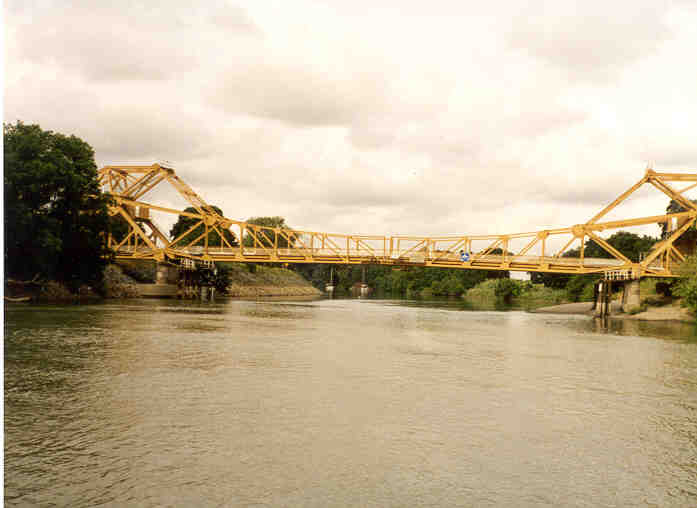
Steamboat Slough Bridge
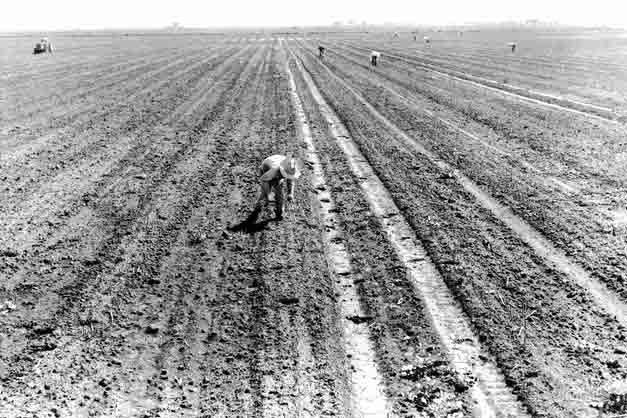
Ryde Asparagus Farm, 1940
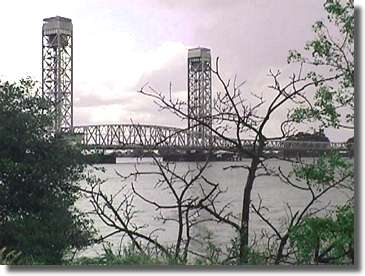
Rio Vista Bridge
|
Isleton Bridge |
Steamboat Slough Bridge |
|
Ryde Asparagus Farm, 1940 |
Rio Vista Bridge |
Yee Chung became very successful
at farming the fruit orchards,
planting
most of the early fruit orchard acreage southwest of Madera, and
selling
the crops to markets up and down the Central Valley. He was very
well-known in Borden and Madera, and assimilated into the
community.
He would teach white farmers in the art of operating the fruit
orchards.
It was reported he was the "whitest" Chinaman in Madera. He had
learned
English over the years, which allowed him to make friends with white
farmers
and businessmen, to lease the D. S. Dorn ranch from white landowners,
and
to hire Chinese laborers in the area. But with success came a
sudden
death in April 1902, exactly three months before his last son Look was
born. There was a big court fight in the Madera County
Courthouse,
between the coroner and Yee Chung's family over who would get rights to
administer his estate. A fist fight broke out between the two
lawyers,
over allegations that Yee Chung had a second family in China, and that
therefore his Madera children were "illegitimate". The family's
lawyer
won both the fist fight settled at the local gym during the recess, as
well as the court case. The family continued to live in Borden on
the Dorn ranch for awhile, before moving to the Emma and Roberts
ranches,
living off the estate money and money from marriage of their daughter
Moy
to a merchant, Sun Kow, from Coulterville. But the estate money
ran
out by 1910, and the family was forced to take to the train to San
Francisco
and move into a rooming house in San Francisco. Life was a
struggle while in San Francisco, to keep food on the table with the
meager
earnings from the oldest sons Lee and Jue. But they soon realized
their low-paid jobs would leave them in poverty, quite apart from the
good
life they had from the store and farms they lived in Borden.
Jue Chong never got married, but
achieved his greatest success by
the
plow invention. Jue and his younger brothers Look and Sam were
very
good with farm machinery, and mechanically inclined. Bing was
more
into accounting and keeping the ledger books, having had some high
school
education. Jue Chong had the original idea for the
asparagus plow, and with the technical and hands-on help of his
brothers, they were able to invent and refine the asparagus plow into
the first reliable plow that could churn the old fields without
breaking down. In order to obtain US Patents, they partnered with
Tony Miller, since awarding US Patents to Chinese, even American born
citizens, would have not been possible. Tony Miller also became
the front-man, for marketing the plow services to major asparagus
landowners and corporations, including Del Monte. All in all,
this was a great team. Tony and the brothers worked together, and
hunted together.
In order to buy into the
partnership, the Chong brothers loaned Tony Miller the money to buy
into the partnership. Together, they farmed and crafted,
invented the asparagus plow in 1926. This automated plowing of fields
previously used for
asparagus
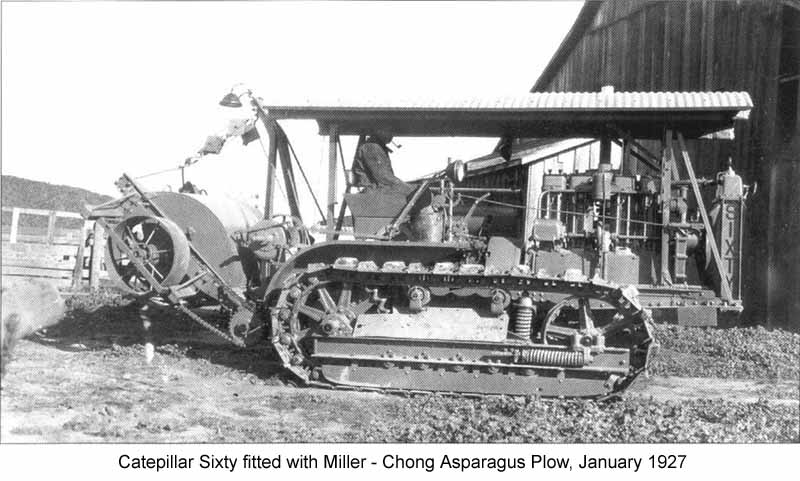
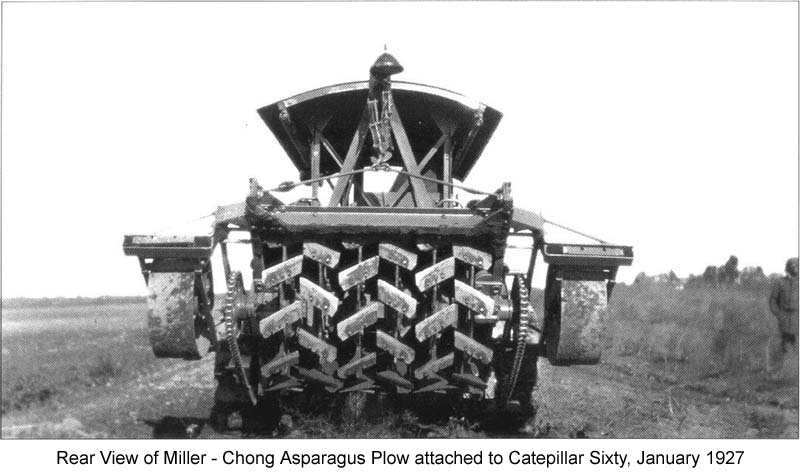
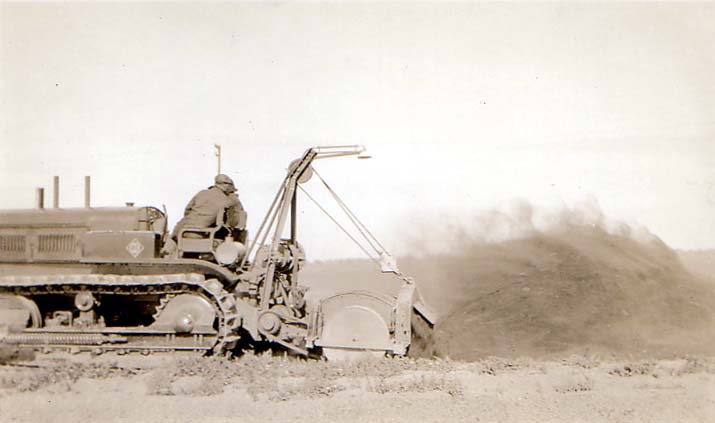
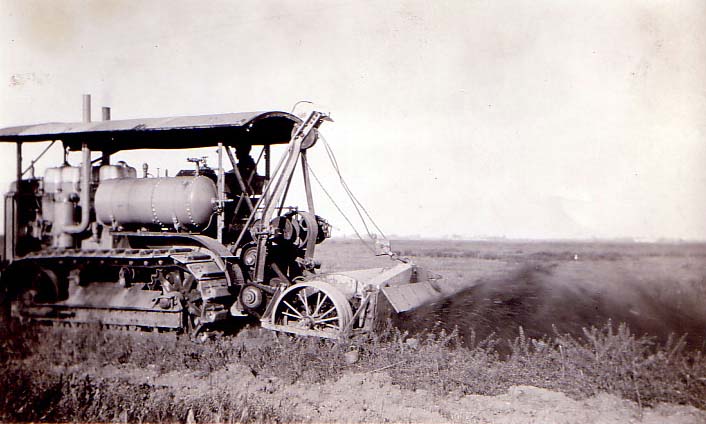
crops . The two pictures
below show their early plow design
in
January, 1927. Miller and the Chong brothers would eventually be
awarded seven U.S. Patents for design of the blades and the plow
machinery.
They later would manufacture more than 90 asparagus plows, each
unit
numbered and improving upon the prior design. Miller and Chong
maintained
their shop at the McCarthy ranch, where they constantly crafted and
sharpened
the blades for the plows, and manufactured the machinery. In
1933,
with his brother-in-law Chan Tai Oy's Tong Sun Company facing
bankruptcy,
and very few people having much income or money for investment, Jue
Chong
offerred to provide the financial capital for Tai Oy start a new
produce
company, the General Produce Company. The old company was allowed
to go bankrupt, and the original Tong Sun partners not involved in
Genral
Produce. Instead, three of the Chong brothers became equal
partners
with Tai Oy: Jue, Bing, and Sam. The investment would prove
to have long-term benefits to the family. Bing became most
involved with the produce company, while his brothers continued to farm
and operate the plow business.
When Bing, Sam, and Jue moved to live in Sacramento, the plow business
was turned over to Look Chong -- who continued to live on the Wolf
ranch. When Look died in 1960, Donald Leong went to look for the
latest plow invention, with its latest refinements in steel blade and
drum technology. They were auctioning off all the old
equipment, and remaining plows. He asked May Chong, who
responded, "Knowing the business was coming to an end, Look took a
torch to the latest plow investions and destroyed it -- so its
inventions would remain secret!"
One would think that its not just
welding steel together, and designing a suitably rugged gearbox, but
also the blades and other components had to be heat treated to attain
greater toughness in the steel blades, maintaining sharpness, while
avoiding excess hardening embittlement that would cause cracking.
When they first developed the plow, the high speed rotating drum and
its numerous blades imposed a huge torque on the drum and its drive
train. The brothers Bing and Sam invented an extremely rugged
gearbox to withstand the huge forces, while matching the power output
of the current tractors. Catepillar turned them down, when
Catepillar was shown their design -- they said Catepillar would have
new, stronger gearbox when Catepillar design it themselves. So
the brothers approached another gearbox manufacturer, who helped them
with grinding the gears and welding the components into a useful
device. At first, the torque being handled by the gearset was too
large, and the case would fail. To reduce the load, the number of
cutter blades on the drum was reduced to avoid breaking the case.
 |
 |
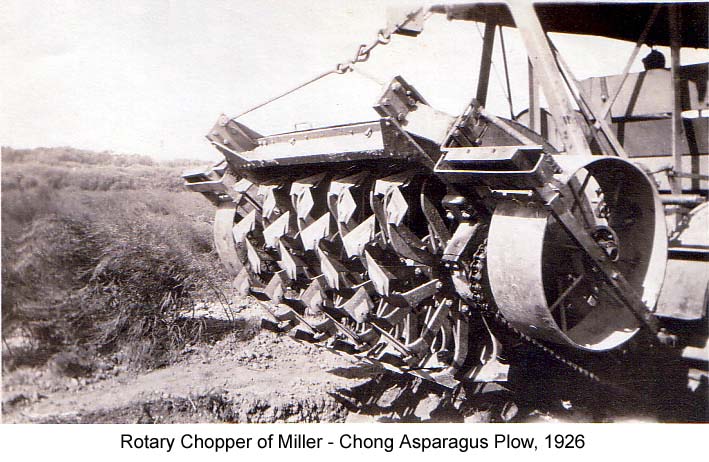 |
Because the Paris Brothers crafted a rotary asparagus plow of similar design, Miller and Chong filed a claim for patent infringement against Leon Paris of Rio Vista, and Fred Paris of Berkeley. The lawsuit focused on the claimed novel cutter blade design, whereby the leading and trailing blade edges were "substantially" equi-distant from the rotation axis. Both plows used a rotary design, whereby large blades, or claws, were mounted on steel beams to a chain-driven, horizontal axle, which was powered from the tractor engine. The plow would spin in the forward direction at about 190 rpm. Tony Miller and the Chong brothers made money by subcontracting plowing of asparagus fields, digging up roots of old asparagus plants no longer productive. The business was highly profitable, and competitive. Asparagus harvesting was performed daily by hand. The Miller and Chong plow was so good that they could guarantee their work; that is, they would warrant that no more than a small fraction of 1% of the asparagus plants would re-grow. Prior plots by other people could not provide the same guarantee, and their plows were usually scrapped after trials. In many instances, the farmers would not pay for the work, so Miller and Chong performed the work for no cost. But in each case, the farmers eventually repaid for the plow services.
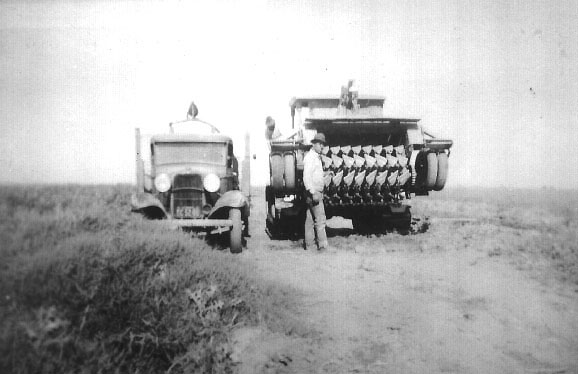 From
Mary O'Connell on the Asparagus Plow: Tony Miller and Jue
Chong
were in the Rio Vista area with their asparagus plow in the
1930's.
Photographs of the Miller & Chong asparagus were taken by Al Avila,
copied onto 35 mm slides by Irwin Anderson, then given by Raymond
Anderson
to Mary B. O'Connell of the Rio
Vista Museum .
From
Mary O'Connell on the Asparagus Plow: Tony Miller and Jue
Chong
were in the Rio Vista area with their asparagus plow in the
1930's.
Photographs of the Miller & Chong asparagus were taken by Al Avila,
copied onto 35 mm slides by Irwin Anderson, then given by Raymond
Anderson
to Mary B. O'Connell of the Rio
Vista Museum .
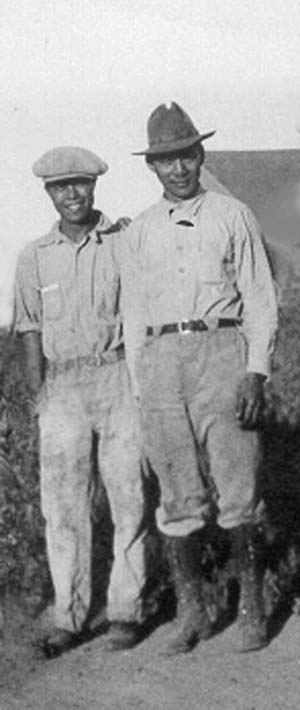
References: Irwin (b. 1928); Raymond (b. 1921). The person above standing next to the asparagus plow is likely Tony Miller, who was tall; whereas, Jue Chong was short. The picture was taken ~1933-37.
 From
Raymond Anderson, September 2001: Ray remembers
Tony
Miller who had farmed in the Ryde area, and recalls Miller partnering
with
Jue Chong on a ranch just up river and west of the Isleton
Bridge,
now Frank Silva's place. See Jue Chong and Tony Miller at the
right
at the McCarthy Ranch in 1931. The Paris Brothers of Rio
Vista
also designed an asparagus plow, and copied key features of the Miller
& Chong plow. The Paris Brothers manufactured their plow both
for resale and for working asparagus fields near the Antioch Bridge
until
about 1935. As a result of the Paris Brothers patent
infringement,
Miller & Chong filed a lawsuit that went on for several years in
the
1930's. Ray in not certain how the lawsuit was settled. He
also recalls a dispute between Miller and Jue Chong, but it did not
affect
their partnership. Ray did not recall Sam or Look Chong at the
ranch
assisting with the plow design and maintenance.
From
Raymond Anderson, September 2001: Ray remembers
Tony
Miller who had farmed in the Ryde area, and recalls Miller partnering
with
Jue Chong on a ranch just up river and west of the Isleton
Bridge,
now Frank Silva's place. See Jue Chong and Tony Miller at the
right
at the McCarthy Ranch in 1931. The Paris Brothers of Rio
Vista
also designed an asparagus plow, and copied key features of the Miller
& Chong plow. The Paris Brothers manufactured their plow both
for resale and for working asparagus fields near the Antioch Bridge
until
about 1935. As a result of the Paris Brothers patent
infringement,
Miller & Chong filed a lawsuit that went on for several years in
the
1930's. Ray in not certain how the lawsuit was settled. He
also recalls a dispute between Miller and Jue Chong, but it did not
affect
their partnership. Ray did not recall Sam or Look Chong at the
ranch
assisting with the plow design and maintenance.
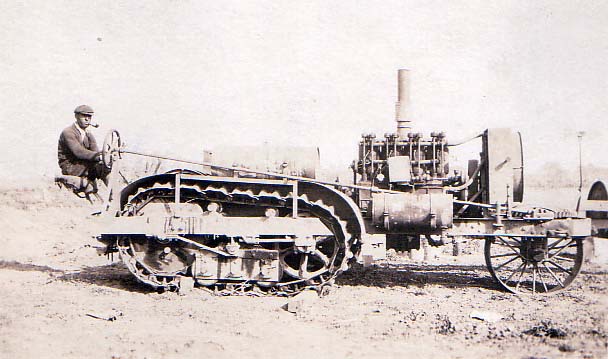
The first tractor to pull the Miller & Chong asparagus plow was a Caterpillar Sixty (2 ), it did not have enough power. Their original Cat Sixty had a 4-cylinder gasoline engine with 72 horsepower, and 12,360 pounds of pulling power, and three-speed transmission. For greater pulling power, Miller & Chong switched to the new Caterpillar RD 8 with a big diesel engine, and put in an extra transmission to give it enough torque at the right speed. Note the massive Cat D-8 with plow in photo below right, ~1931-37 (D-8 introduced 1931). There is extra room between the seat and back of the hood. The extra length was necessary to insert the extra transmission for increased gear reduction and pulling power. The plow was driven at high-speed ~200 rpm via a chain-drive off the tractor engine. The plow created quite a dust storm and tremendous amount of noise. Until the Cat RD-8 was manufactured, most tractors were underpowered, which required the novel invention of the asparagus plow to pulverize the ground.
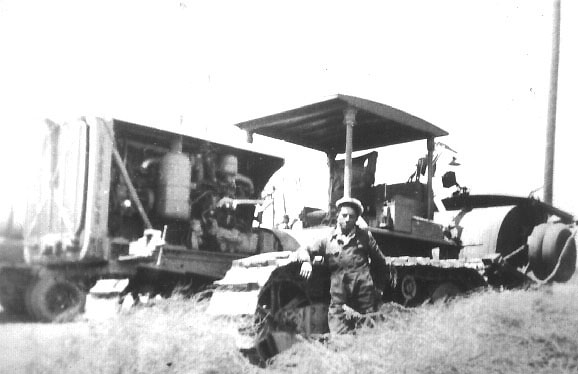
Al Avila and his brother worked for Miller and Chong, driving their tractors to plow the asparagus fields. One time, while Al's brother was raising the plow, the hoist mechanism didn't work. While trying to get it up one evening, he lost an arm or leg. Ray doesn't remember which; but from the patent drawing, he probably got an arm or leg and clothing caught in the chain mechanisms. The crew did not find him until the next morning, in much pain. He survived the accident. Ouch. Shown standing alongside the Cat RD-8 with Miller & Chong plow is probably Al Avila's brother (picture below taken in the 1930's); Al was born 1929. Irwin and Raymond's father, Holger Anderson, had a sheep and grain farm in the Montezuma Hills above Rio Vista.
 Ray
recalls 1937, when he and his dad Holger Anderson had their Cat 60
hauled
on a contracted cliber truck with a tag axle trailer from their
Montezuma
Hills ranch to Sherman Island, where they had a small farm with
asparagus
and other crops. They took the Cat 60, since it was the
biggest,
meanest tractor they had, and would surely get the job done
quickly.
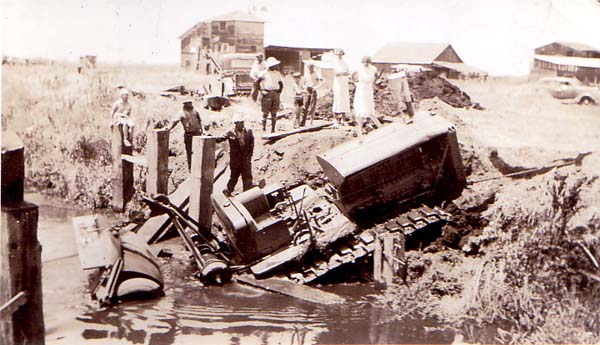
While they were there, the Miller & Chong Cat RD-8 with plow was
working
the fields on the Barofaldi Land next door and got stuck. The
crew
said the land was so soft they were constantly getting stuck, and their
tractor had insufficient power to pull the plow in the soft
ground.
So the Andersons used their Cat 60 to pull it out. Irwin was just
8 at the time. Holger decided against paying to have their
tractor
hauled back to their farm above Rio Vista, and decided to drive the Cat
60 back. For their return, they had only a half set of tractor
street
shoes, meaning one street shoe on every other location. Ray
vividly
and humorously recalls driving the monster Cat 60 across the Three Mile
Island Bridge and breaking loose some cement on the bridge supports,
caused
by the tractor inducing high vibrations in the old bridge. At the
time, the Three Mile Island Bridge was a rotating design like the
Sacramento
I Street Bridge. They finished crossing the bridge and proceeded
to the east end of the Rio Vista Bridge. To avoid damaging the
Rio
Vista Bridge, they left the tractor at McKinnon Ranch, and went looking
for more shoes. They went to the Catepillar dealer, which
informed
them that Jue Chong probably had an extra set in their shop. So
they
went up to the Miller & Chong ranch just north and west of the
Isleton
Bridge on Grand Island. When Jue Chong saw and recognized Holger
Anderson, Jue gave them a half set of street shoes. Jue said to
keep
them, since he no longer needed them. But the incident cost
Holger
$500 for the bridge repairs. The Miller & Chong later became
the Silva Brothers Ranch, where Silva's wife still lives.
Ray
recalls 1937, when he and his dad Holger Anderson had their Cat 60
hauled
on a contracted cliber truck with a tag axle trailer from their
Montezuma
Hills ranch to Sherman Island, where they had a small farm with
asparagus
and other crops. They took the Cat 60, since it was the
biggest,
meanest tractor they had, and would surely get the job done
quickly.
While they were there, the Miller & Chong Cat RD-8 with plow was
working
the fields on the Barofaldi Land next door and got stuck. The
crew
said the land was so soft they were constantly getting stuck, and their
tractor had insufficient power to pull the plow in the soft
ground.
So the Andersons used their Cat 60 to pull it out. Irwin was just
8 at the time. Holger decided against paying to have their
tractor
hauled back to their farm above Rio Vista, and decided to drive the Cat
60 back. For their return, they had only a half set of tractor
street
shoes, meaning one street shoe on every other location. Ray
vividly
and humorously recalls driving the monster Cat 60 across the Three Mile
Island Bridge and breaking loose some cement on the bridge supports,
caused
by the tractor inducing high vibrations in the old bridge. At the
time, the Three Mile Island Bridge was a rotating design like the
Sacramento
I Street Bridge. They finished crossing the bridge and proceeded
to the east end of the Rio Vista Bridge. To avoid damaging the
Rio
Vista Bridge, they left the tractor at McKinnon Ranch, and went looking
for more shoes. They went to the Catepillar dealer, which
informed
them that Jue Chong probably had an extra set in their shop. So
they
went up to the Miller & Chong ranch just north and west of the
Isleton
Bridge on Grand Island. When Jue Chong saw and recognized Holger
Anderson, Jue gave them a half set of street shoes. Jue said to
keep
them, since he no longer needed them. But the incident cost
Holger
$500 for the bridge repairs. The Miller & Chong later became
the Silva Brothers Ranch, where Silva's wife still lives.
Ray said they planted the 'grass roots
very deep; as the 'grass grew
older it was nearer the surface, so the plow only went as deep as was
necessary.
They used the plow to dig up old roots from asparagus plants no longer
useful for production. So the plow did not have to plow deeply
for
this operation. The asparagus plow would grind up the ground and
roots about one foot deep, leaving finely pulverized soil in its wake,
ready for planting other crops. Donald Leong said the plow was so
effective, that if you walked onto the plowed field you could sink into
the soft ground up to your knees! Perhaps, the chopped asparagus
roots and dirt made a fluffy, lightweight mixture.
During 1935-37, the Andersons dug up their last asparagus plants from their Sherman Island ranch. Italians and Portugese ran most of the asparagus farms, which moved on to the Stockton area in the late 30's. Subsequent attempts to replant asparagus on the same fields did not produce lasting yields, having depleted the ground.
Ray recalls another interesting incident for those familiar with striped bass fishing under the "towers" south of Rio Vista. The towers refers to the two huge towers that allow the main power lines to traverse the Sacramento River. One tower was on Sherman Island, and the other on Montezuma Hill. Their crew had been working on a 12 foot high windmill tower under the Montezuma hills end of the electric lines, when a large ship was steaming up the channel. The ship forgot to lower its boom, and caught one of the power lines. His crew heard a very loud snap, as the line broke. They scurried down from the windmill as fast as they could, and ran for cover. Luckily, no one was hurt.
Another possible source of information is August Coreia of Isleton, who attended Isleton Schools, and was friends with Al Avila. His association with Avila, who worked for Miller & Chong, may offer further insight. August Coreia referred to Dayly Lee of Walnut Grove for more information. Dayly is living in Sacramento, but still farming on Ryer Island. Mabel Rogers of Isleton recalls her brother drove the tractors for the Miller and Chong plow.
Sam Chong's step-grandson Mike Lim had heard that Jue and Sam Chong's plow design had been stolen, and perhaps patented. He heard his grandfather had to modify their plow design. because of another plow design that had copied the Miller and Chong plow features. Miller and Chong were granted seven U.S. Patents on the plow and implements from 1929-1933, and the Paris brothers at least five U.S. Patents from 1933-1937. In reality, Tony Miller and the Chong brothers sued the Paris brothers for patent infringement on their blade design for the asparagus plow. The Miller and Chong vs Paris Brothers lawsuit in the U.S. District Court ran from 1934 to1936, shortly after both groups were granted plow patents in 1933. The long running patent dispute was eventually settled unfavorably to Miller and Chong, having focused on one patent involving the blade geometries. The patent was deemed to be "not a valid invention," and Miller and Chong had to pay court costs of $160. This could have led to Jue Chong getting ulcers, and may have led to his early death at 48. Jue Chong worried a lot, perhaps over the patent disputes.
Fred F. Paris (1891-1964)
of Berkeley was a Stanford graduate,
working as an excavation contractor. His experience with rotary
trench
plows lent to design of an asparagus plow for his brother Leon A. Paris
(1892-1967). Americo Vernon Avila, 1929-1993, born CA, died
Solano
Co, Al was about 65 when died per August Coreia's wife. Tony
Stephen
Miller, 1897-1985, died Sacramento Co. Holger Walter Anderson
(1883-1941):
immigrated from Denmark, and died in Solano County.
The following picture are from
the Bing Chong family picture albums and archives, currently maintained
by Bing's wife Jane Chong (2001).
 |
 |
 |
 |
Eddie Chan of Sacramento (1913-2001): Jue lived on a ranch, but he died pretty young in 1941, just 48. The asparagus plow quite famous, indeed. They made a lot of money. Because patents are granted only for 17 years, Tony Miller and Jue Chong's patent would have expired by the late 1940's. Now a lot of people have asparagus plows. Jue made a lot of money, when money was scarce in those days. Jue's savings was instrumental in providing the necessary capital to help start General Produce in 1933. What about Sam? He maintained the asparagus plow, lived on the ranch, then married Rose Chong and he moved up to the corner house at 13th and W Streets in Sacramento. Then Look got married to Dan Yee's sister May. Look died when he was 59 years old. Look spent his life farming a big ranch, across the river and just north of Isleton. Jue Chong told him, "Don't farm that ranch, it's too big for you. You're gonna lose your butt." And sure enough, he put the money into the ranch and lost everything. He made the mistake of going into partnership with a white accountant, who embezzled all the money from Look's share of the plow business. Being an accountant, his partner manipulated the books, and took Look for a bundle of money. When they caught up with the accountant, he committed suicide.
Ed Jow of Sacramento (1927-2001): Ed remembered Jue Chong as being a nice guy. He said he was aced out of the money for the asparagus plow. Whether it was his partner or someone else, he didn't know since he was a teenager at the time. Ed said the Chong brothers, Sam, Look and Jue always bought them ice cream ... as for LE Chong, he said the guy was always grumpy. Ed past away just one month at end of September, shortly after being interviewed.
Connie King of Locke (2001: Connie King knew Jue Chong from when she was a waitress in Isleton. He used to come in for lunch. In one of their first encounters, he paid 15 cents for a meal, then left 10 cents on the counter. She gave him back the 10 cents, but then he told her it was for a tip. She didn't know what a tip was, and that was her first one. Jue was a quiet, soft-spoken gentleman. She thought Jue Chong was a very nice person. She made $25 a month at the restaurant. In those days you were expected to leave the family at 15 or 16 and go out on your own, she said. She remembers when Lois died, that it was especially hard on Grandpa Di Hong Jow, that he would go out in the yard every night crying out for her. She believes it was Steamboat Slough that her father used to rowboat across to visit the Jows. In Isleton, grandma Jow and her mother used to get together a lot and talk about everything. Unfortunately they used a different dialect which she was unable to understand. Yes, she remembers them talking about the two Jow sons, but that they left town.
Continued
Asparagus (Asparagus officinalis var. altilis L.) is a hardy perennial vegetable native to the seacoasts of Europe and eastern Asia, where it has been cultivated for over 2,000 years. It was a well known and valued vegetable to both the Greeks and Romans. Early settlers brought asparagus to North America, where it has been grown in home gardens since colonial times. Commercial asparagus production began in this country in the middle of the nineteenth century. The word asparagus comes from the Greek asparagus, meaning shoot or sprout. Tips for growing asparagus. Be sure soils are at a high fertility level prior to planting new asparagus. It is a good practice to plow under a green manure crop such as alfalfa or vetch, or to plow under 10 or more tons per acre of barnyard manure. Plow under deeply all fertilizer materials. The asparagus roots can grow 10 feet deep, thereby taking advantage of deeply plowed manure.
Two years are required to establish an asparagus field, but once into production plantings endure from 10 to 20 years. Average yields in California and Washington are between 2,500-3,000 pounds per acre.


