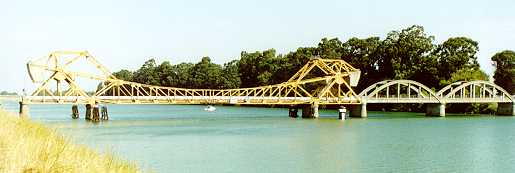
Isleton Bridge
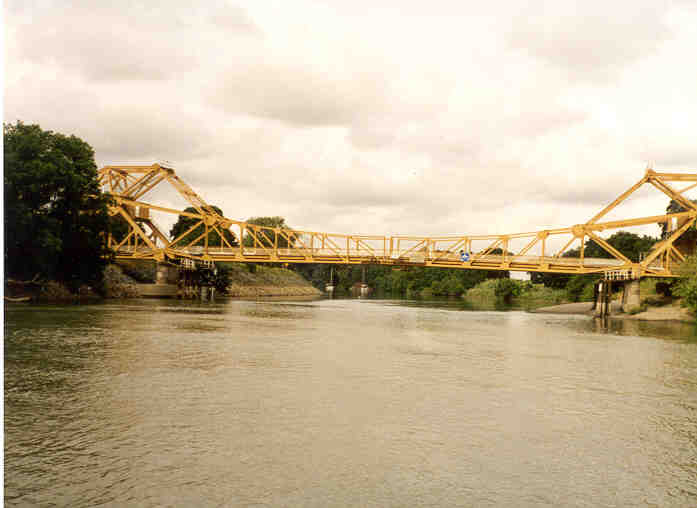
Steamboat Slough Bridge
|
Isleton Bridge |
Steamboat Slough Bridge |
The brothers were registered for the draft, but exempt from service during the First World War. Bing Chong voted for the first time in the Isleton district in 1921, as he turned 21 years of age. Getting voting rights was a big achievement for the Chinese, because only citizens could vote, and immigrant Chinese could not be naturalized and obtain citizenship. That is why you will not find Yee Chung in the voter rolls for Madera County in 1880-1900.
The 1922 family picture with everybody was taken for Grandma Chong's daaih sangyaht (big birthday). Oy Chan would drive down the river and cook a gourmet dinner for the whole family at their house on the ranch in Isleton. He was a great cook. On holidays and special occasions, everyone in the family would get together in Isleton, a large festive scene with up to a hundred or more people.
Family Photo ID¹s
corresponding to the reference numbers on the
1922 family portrait.
According to Eddie and Mae Chan, the photo was taken at the
Beleney
Ranch on Leary Road near Ryde.
| 1 | Daniel Chan | 7 | George Chong | 13 | Grandma Chong | 19 | Sun Kow |
| 2 | Edward Chan | 8 | Davis Sun | 14 | Mrs Lee Chong (Lilly) | 20 | Lee Chong |
| 3 | Thomas Chan | 9 | Grace Sun | 15 | Edward Chong | 21 | Jue Chong |
| 4 | Violet Chong | 10 | Mrs Chan Tai Oy (Lin) | 16 | Minnie Sun | 22 | Sam Chong |
| 5 | Marjorie Chan | 11 | Wallace Chan | 17 | Florence Sun | 23 | Bing Chong |
| 6 | Dorothy Sun | 12 | Mrs Moy Sun | 18 | Chan Tai Oy | 24 | Look Chong |
Lin said her sister Moy and husband Sun Kow and their family moved from Coulterville in Mariposa County to the McCarthy Ranch near Ryde in 1922. Grandma Chong asked Moy to move, so that she should cook and wash for the brothers. Moy cooked breakfast, lunch, and dinner for not only the brothers, but also other farm workers, and did their laundry. Moy worked really hard for her family and brothers. During canning season, she would also work at the cannery until late in the evening. Dorothy said her father Sun Kow had a restaurant was right across the street from the cannery, at the north end of Isleton. In 1922, Sun Kow sold his Coulterville Store for $500, and he and Moy moved to the McCarthy Ranch with the brothers.
The Isleton cannery was on the east side of H Street and Main Streets. Sun Kow Restaurant at Main and H Street. Japanese town was on Main St between F and H St. Chinatown was further west between F and E St. White town was to the west of B St.
Isleton Map
 But
Lee was
very extravagant; he did not know how to save
money. He used to drive a Stodson, and he
had a Packard for a beet truck. These were expensive,
luxury cars.
Lee was good to the farm workers, and even provided a motel for the
field
workers. Connie King said Lee Chong was one of the first Chinese
to
have an automobile in the area, right after the first World War.
But
Lee was
very extravagant; he did not know how to save
money. He used to drive a Stodson, and he
had a Packard for a beet truck. These were expensive,
luxury cars.
Lee was good to the farm workers, and even provided a motel for the
field
workers. Connie King said Lee Chong was one of the first Chinese
to
have an automobile in the area, right after the first World War.
Ping Lee of Locke and Walnut Grove recalls as a little kid that Lee Chong farmed on Leary Road right across the Sacramento River from Vorden. The rest of the brothers were farming asparagus and all that, down by the Isleton Bridge. Ping said the whole family was farmers. They weren¹t sharecroppers who farmed only pear orchards; they were open land farmers who grew vegetables and fruits.
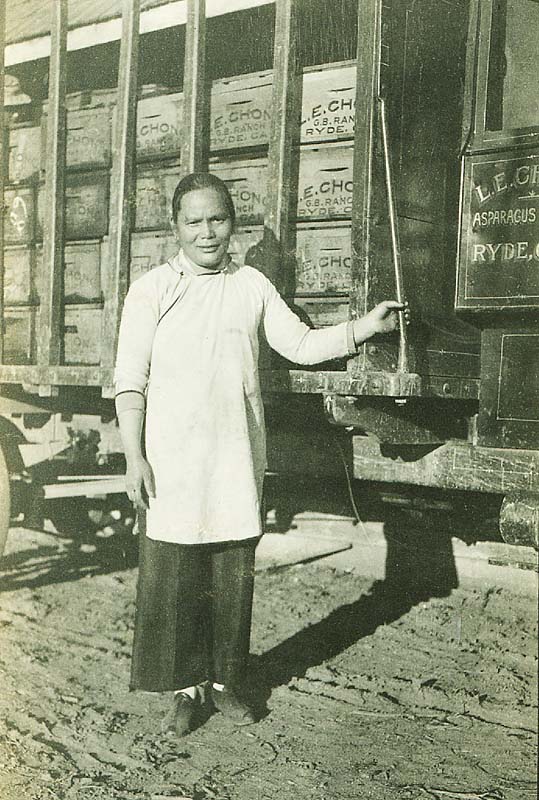
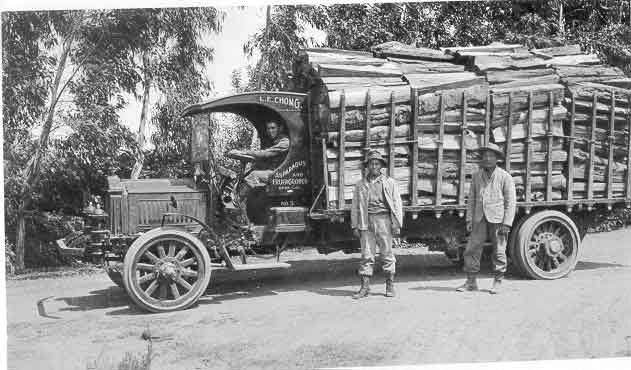
The above 1929 picture with Sam Chong driving the truck on the Beleney ranch says: "L. E. Chong, Asparagus and Fruit Growers, Ryde, CA, No. 3." Jeff Chong identifies the truck as a Packard with 4 cylinder engine, and a gear ratio of 9:1 or 10.66:1. An old, long-stroke, flathead 4 with that kind of gearing would have a top speed not much more than 35 mph, if that. The speed listed is 11-12 mph at 1000 rpm, with a redline of about 3000 rpm or less. The lighter 2½ ton truck is listed as 27 mph at 1800 rpm. And, with solid tires, one probably would not want to go much faster anyway!
Farm tractor - Sam Chong
Farm Packard truck - Bing Chong
Farm Pickup
| "
We're all Cousins, Pioneer Portugese Families of the Sacramento Area
" excerpt follows: "MANUEL COQUIM Jr., the son of Manuel
and
Victorina (Anastacio) Coquim, was called to California by his father
from
Gafanha da Cal da Vila, Ilhavo, Portugal, in 1920, at the age of 17.
The
senior Manuel Coquim then returned to Portugal and took the rest of the
family to Sao Paulo, Brazil."
"Manuel Jr. lived and worked on farms in the Delta around Ryer Island, Terminous, and Sherman Island. At one time he worked for a Chinese farmer, Lee Chong, driving plow horses, tractor and trucks. He also worked for Mr. Zacharias, whom many called "Jack Rice" because of the difficulty pronouncing his name." |
 After
working
on the Beleney Ranch for seven years, Jue Chong and his brothers left
Lee,
so they could run their own ranch operation and have control of its
finances.
Jue Chong did not agree with Lee's spending excesses, as he was not
sharing
the money. Grandma Chong kept a lot of money hidden in her
room.
Since she favored Lee, the other brothers felt that Lee spent
excessively
on extragant purchases. The brothers had a big fight.
Minnie
Mock recalls that Grace Sun said it was like the "Hatfields and
McCoys".
Ping Lee recalls the three Chinese that first owned automobiles were
Lee
Chong, his dad Lee Bing and Chauncey Chew; right after the first world
war
they had the cars.
After
working
on the Beleney Ranch for seven years, Jue Chong and his brothers left
Lee,
so they could run their own ranch operation and have control of its
finances.
Jue Chong did not agree with Lee's spending excesses, as he was not
sharing
the money. Grandma Chong kept a lot of money hidden in her
room.
Since she favored Lee, the other brothers felt that Lee spent
excessively
on extragant purchases. The brothers had a big fight.
Minnie
Mock recalls that Grace Sun said it was like the "Hatfields and
McCoys".
Ping Lee recalls the three Chinese that first owned automobiles were
Lee
Chong, his dad Lee Bing and Chauncey Chew; right after the first world
war
they had the cars.The old McCarthy ranch had neither
electricity nor running water
even as
late as WW II. Dorothy Sun Murray said Mrs McCarthy didn't
want electricity for fear of crop dusters running into the wires.
 Dorothy
also recalls
when she used to sneak into grandma's room to
peek into the cash
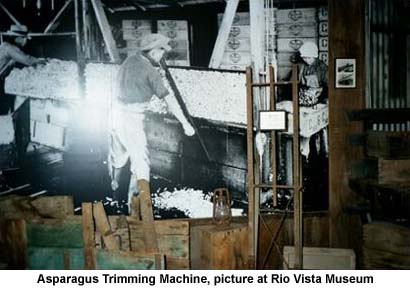
box she had stored in the sewing machine. The Rio Vista
museum
has a wall-sized picture of workers using a large saw to cut off the
ends
of the 'grass, shown at the left. The 'grass was stacked on a
long
frame, and the saw was used to cut off the excess ends. Irwin
said
the canneries used to dump all of the asparagus butts into the river,
where
they would build up in the backwaters, rot and cause a big smell!
Dorothy
also recalls
when she used to sneak into grandma's room to
peek into the cash
box she had stored in the sewing machine. The Rio Vista
museum
has a wall-sized picture of workers using a large saw to cut off the
ends
of the 'grass, shown at the left. The 'grass was stacked on a
long
frame, and the saw was used to cut off the excess ends. Irwin
said
the canneries used to dump all of the asparagus butts into the river,
where
they would build up in the backwaters, rot and cause a big smell!
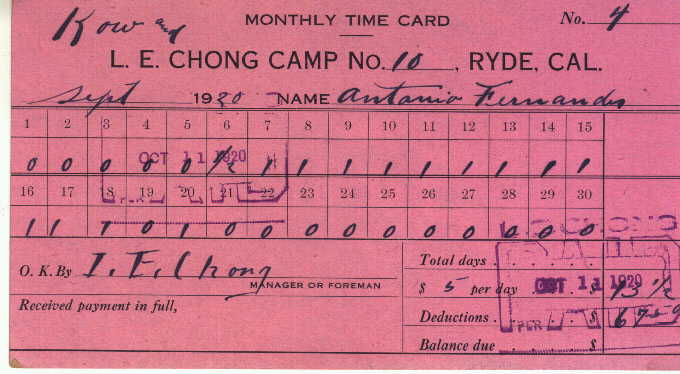
Before the brothers left, Lee had started to form a new company with Sun Kow, named Kow and Chong. After his brothers left and Sun Kow moved to the McCarthy Ranch, Lee kept Sun Kow's name and renamed his company to Sun and Chong. The latter seemed more American, and so was used instead, i.e. "sun". Having a Chinese name was difficult, and he must have struggled with the name for his business. The time card shows Kow and LE Chong's Camp No. 10 in Ryde, California. Dorothy Sun had many time sheets like this one dated September 1920. Wages were $5/day; for 13.5 days, Antonio Fernandez earned $67.50 for the month. If that was a farm laborer, then Kow and Chong were paying a good wage, much better than the common $1/day. Also, a ledger sheet showed Sun Kow loaned LE Chong $1000 in 1921. In early 1928, Lee moved from the Beleney Ranch to the still-larger, 880 acre E. L. Shelly Ranch near Howard Landing Ferry.
According to Eddie Chan, Jue and his brothers began farming on the McCarthy Ranch with Sam, Bing and Look in the Isleton area, farming 80 acres in pears and asparagus. His home was on the west side of the Isleton bridge. Were they successful in farming? They could hardly make a living … farming was bad, they could not get a decent price for pears and asparagus from the canneries. But they were smart, and resourceful, as they were able to recognize that contracting plow services for other farms could be a more profitable business, while other asparagus and pear farmers went broke in the 1930's.Ryer Island / Grand Island Map
Grand Island and Isleton Farm Map
Aerial View of Isleton, Isleton Bridge, McCarthy Ranch
Aerial view of Grand Island, Ryde, Walnut Grove
| The county
lease books (Books S-T, p.
293-295, microfilm roll 9) had the following information:
John C McCarthy, Alice McCarthy (owners) leasing to: Leong Quon Jue (Jue Chong), Leong Quon Bing (Bing Chong) on December 15, 1923. This was a 10 year lease starting November 1, 1923. The total rental was $9,000 payable in installments beginning 1/1/1924 ($2,000) and 8/1/1924 ($4,000). With like sums for the term of the lease. The brothers were to plant fruit trees, the varieties as agreed upon by the owner. The brothers were required to dig out and replace old trees. |
George Chong was lucky, as he started first grade in 1922-23 school year, when his father was living on the George Beleney ranch. This allowed him to go to the Beaver Union School, in the middle of Grand Island, a mile east of Ryde. Beaver Union was integrated, with whites, Chinese, Japanese, and Filipino students. On the other hand, once the Sun Kow family moved from the Beleney ranch to the McCarthy ranch, which was in the Isleton school district, the Sun children had to go to the segretated "Oriental" school in Isleton. That must have seemed really odd to Moy, having gone to integrated schools with her brothers and sisters in Madera, twenty years earlier. But the Asians had no representation in government, and could not protest. Laws were continually passed to satisfy white special interest groups, who felt their race was supreme and all Asian races of lower class. No matter how unfair or racist, laws were upheld even in the U.S. Supreme Court.
| A History of
Japanese Americans in California: Historic Sites
Three ... school districts in Sacramento County (Courtland, Isleton, and Walnut Grove) also practiced de facto segregation before the legislative amendment of 1921. In the office of the River Delta Unified School District, the first Register for Public School for Walnut Grove in September 1908 lists a teacher, I.M.C. Smith, who had 16 Asian children in her classroom. By September 1920, a year before the amendment was passed, the Register was labeled "Oriental School." Ten years later, 62 students attended the White school, 29 attended the Migratory School, and 222 attended the Oriental School. Segregated schools in Walnut Grove continued until 1942, when all Japanese Americans in California were interned, leaving Filipino and Chinese students in the Oriental School. Financial considerations were apparently the deciding factor in desegregating the schools in 1943. In Isleton, a decision was made to segregate Asian children after the Christmas holiday of the school year beginning in September 1909. All Asian names disappeared from rosters of the previously integrated classrooms in January 1910, and segregated class lists appeared. Similarly, the Courtland Bates Oriental School was built around 1922, although segregated classrooms had been in effect for years before. |
Bing Chong invested in the grocery business in Grass Valley around 1926 for 1½ years with Ping Lee's cousin David Leong, Look Chong, a former boxer in Courtland, and Ed Owyang. Bing was only 26 and Look just 24, as they made their foray into the grocery business. The four of them ran the Quality Market in Grass Valley, selling meat and groceries. Look was the youngest of the four guys who went into grocery business. The boxer only died a couple years ago at 90 something (~1999).
While living on the Beleney ranch,
grandma Chong would periodically
take
a horse and buggy from Isleton to Coulterville, to attend the birth of
another child of her daughter Moy, or to visit her grandchildren.
 She
packed a
pistol under her seat, and presumably she
knew how to use it to defend herself.
She would travel two days and nights to travel from Ryde to
Coulterville.
How did she travel at night? Bing Chong recalls accompanying his
mother
with a brother on some trips. When darkness fell the brothers
would
walk ahead of the buggy with a lantern, to lead the way. They
never
got lost, as the horse knew the way, and just needed the lantern to
follow
the trail. As they would leave the flatlands of the valley, the
old
road through the foothills included many long grades, which steadily
gaining
elevation to Coulterville.
She
packed a
pistol under her seat, and presumably she
knew how to use it to defend herself.
She would travel two days and nights to travel from Ryde to
Coulterville.
How did she travel at night? Bing Chong recalls accompanying his
mother
with a brother on some trips. When darkness fell the brothers
would
walk ahead of the buggy with a lantern, to lead the way. They
never
got lost, as the horse knew the way, and just needed the lantern to
follow
the trail. As they would leave the flatlands of the valley, the
old
road through the foothills included many long grades, which steadily
gaining
elevation to Coulterville.
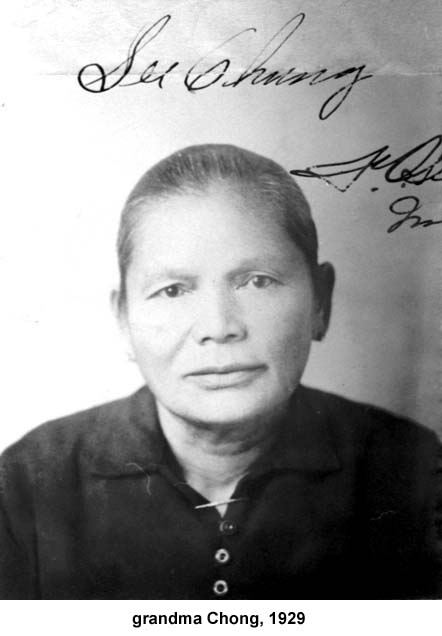
She was quite a woman, and very independent, resourceful, and undoubtedly very brave. Her use of English was not good, some grandchildren would call pigeon English, particularly when berating others in the family! Some descendants felt she was a stern woman; she had to be to raise so many children, keep them in line, and raise them well. But family members closest to grandma for several decades offerred that grandma was a women who really tried hard to assure her children were raised well, and they achieved measures of success. She must be given high praise for what she achieved as a single-parent family, and for the extremely difficult times and struggles following the death of her husband. They struggled to survive after they moved to San Francisco, having to literally beg for food at times, while the older children worked. Even after moving to the Grand Island farm, she worked as a mid-wife to bring in extra money when money was tight. Grandma Chong favored the boys in the family, particularly Lee, and treated her girls more sternly. That was the culture, as many Chinese would rather have boys than girls. Grandma Chong's 1929 picture is shown at left.
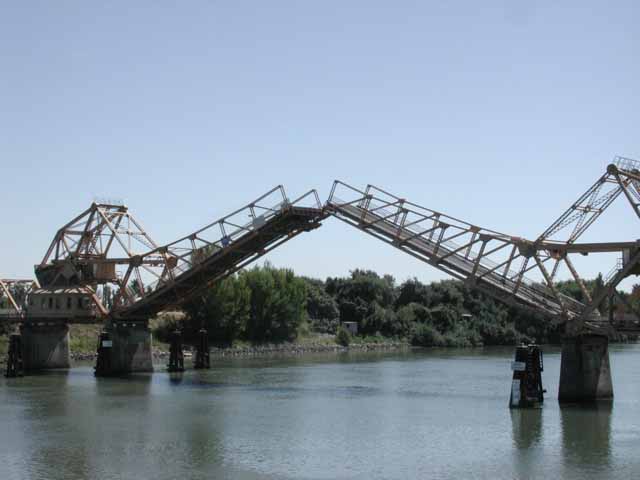
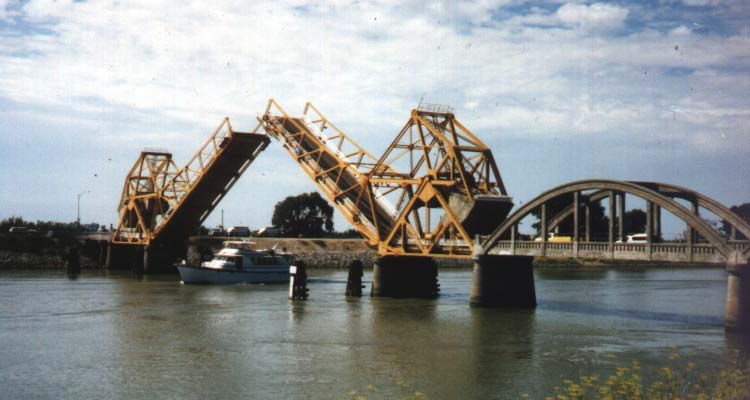 In
one incident, grandma Chong was talking
across the Isleton Bridge, when a large boat approached. The
bring bell began to ring, and grandma was
caught on one of the middle spans. As the bring began to raise,
she
quickly realized her fate, and she would have to hang on for dear
life. Once the boat passed, the bridge lowered and grandma was
able to proceed to
her destination. But that was quite a scare.
In
one incident, grandma Chong was talking
across the Isleton Bridge, when a large boat approached. The
bring bell began to ring, and grandma was
caught on one of the middle spans. As the bring began to raise,
she
quickly realized her fate, and she would have to hang on for dear
life. Once the boat passed, the bridge lowered and grandma was
able to proceed to
her destination. But that was quite a scare.

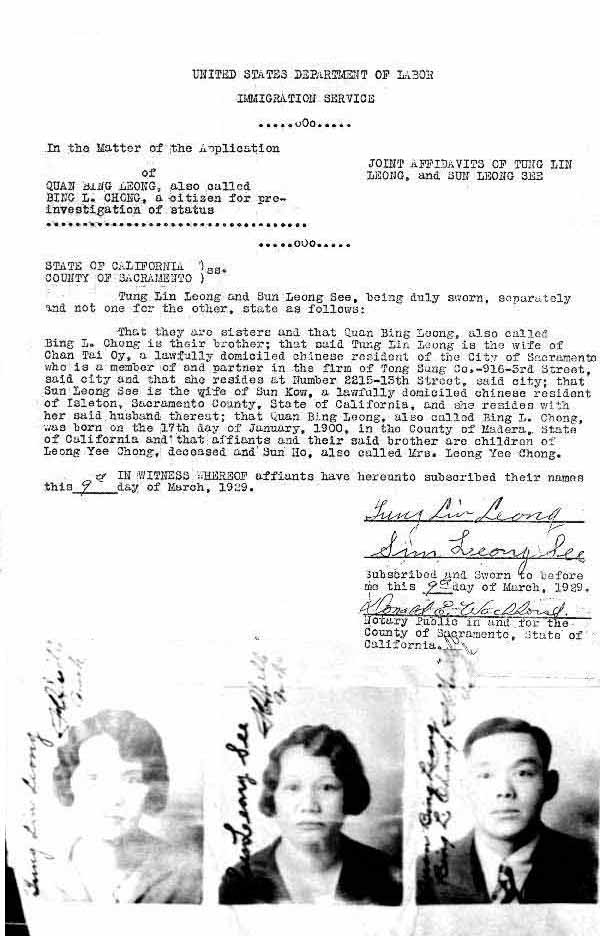
China Trip "This was part of a sworn affidavit given in 1929 when Bing Chong, Davis Sun, Tom & Eddie Chan & Tung Lin Chan went to China." From left to right: Eddie, Gwai Mei Go, Davis, Tom, Lin, and Bing. This is a priceless picture! On the back side: "On board the Canadian Pacific Line ship, Empress of China, April-May 1929". Gwai Mei Go was the one who took the family back to China. He had just graduated from the University of Washington. Lin and Moy's joint affadavit for Bing's later re-entry. Here is a link to RMS Empress of China and her background, http://www.maritimematters.com/empofaus.html
 During the
1929 trip to China, the Chan brothers Eddie and Tom visited their
ancestral village, and attended a school to learn Chinese culture and
language
at Ling Nam College in Guangzhou. They had special classes there
just
for overseas Chinese. They stayed at the school for three months,
and
were taught us how to write Chinese characters, hold the brush and make
ink.
After their stay in Guangzhou, they went to the village of Luk Yi Tau,
in
Zhongshan County, where Bing Chong got married. Everyone’s
surname
in the village was Leung.
During the
1929 trip to China, the Chan brothers Eddie and Tom visited their
ancestral village, and attended a school to learn Chinese culture and
language
at Ling Nam College in Guangzhou. They had special classes there
just
for overseas Chinese. They stayed at the school for three months,
and
were taught us how to write Chinese characters, hold the brush and make
ink.
After their stay in Guangzhou, they went to the village of Luk Yi Tau,
in
Zhongshan County, where Bing Chong got married. Everyone’s
surname
in the village was Leung.
Bing
Chong visited his father's village and family in China, and told his
children
that he paid respects at his father's grave site. The other widow
Yee
Chung was much older than Bing's mother, having been married around
1860
and having three daughters by 1865. Dorothy Sun remembers
that
her father purposely sent her brother Dave to get a wife, which Davis
did
not know. But when he found out, and he got so scared. He
wired
his mother Moy for money and came home all by himself. Dorothy
recall
Davis saying, "Scared the sh.. out of me ..." When Marcia Chan
visited
the village in July 2002, the "old uncle" in the village still
remembered
"Leong Quan Bing" returning to the village to marry, and the Leong
family
home.
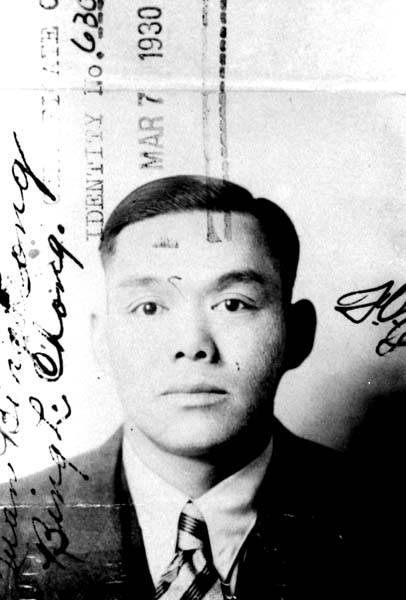
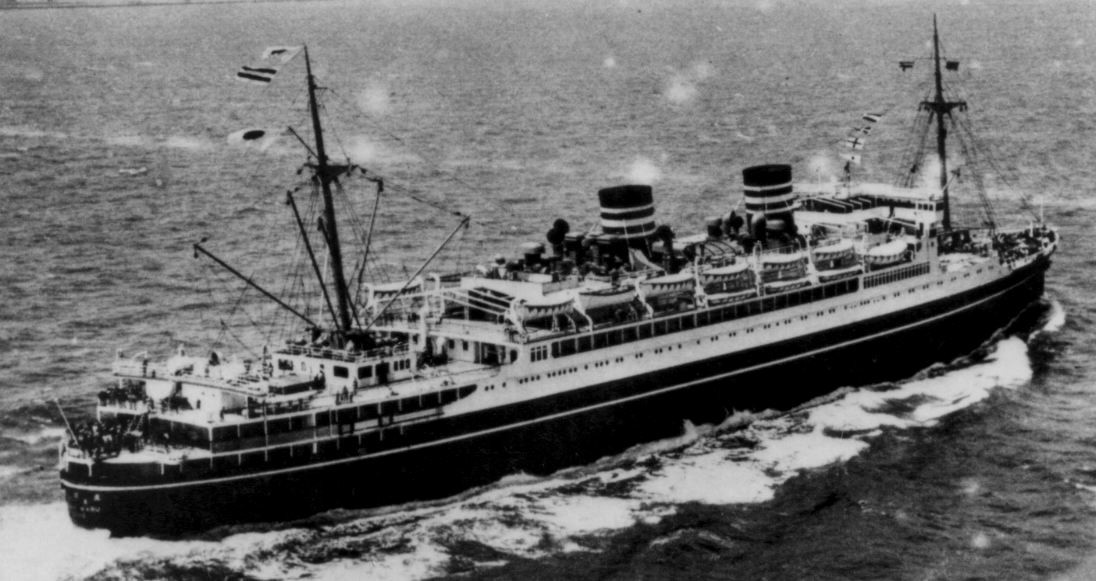
Bing Chong and Davis Sun returned
from China on the Asama Maru by
way of Hong Kong, leaving in December 11, 1929, and returning on
January 2, 1930. The Asama Maru is shown underway below.
Bing was classified a farm laborer, and Davis a student, being only 16.
From Connie King: Connie also knew our grandma Chong, saying she was called Quan Eu's. She used to come to visit her mother. People called her "bay paw". She walked with a cane because she limped a little. Connie says that "Bay" means cripple, "Paw" means grandma or old lady. The big house that Lee Chong lived in Isleton, with his brothers and sisters, was just south of town as you came back up on the levee from Isleton itself. The house burned down a long time ago and I think it was where there are still a few old palm trees standing alongside an abandoned driveway, looking quite out of place.
Ping Lee of Locke Recalls the Chongs and Chans
 Courtland bridge
| 1922
Cable Act passed. It
decrees
that "any woman marrying an alien ineligible for citizenship shall
cease
to be an American citizen." A white women who is widowed or divorced
from her husband can regain citizenship. Nisei women do not
regain their citizenship under any circumstances (until 1931, when the
law is amended). The 1922 Cable Act established that a married
woman citizen who married an
alien ineligible for citizenship that is a Chinese, Japanese, or an
immigrant
from India shall cease to be a citizen of the United
States. The
Cable Act applied only to women
November 23, 1923. In Ozawa vs. U.S., the U.S. Supreme Court rejects naturalization for Japanese immigrants on the grounds that Japanese, like other Asians, could never assimilate with white Americans. In Takao Ozawa v. United States, the Supreme Court declared that Japanese were ineligible for U.S. citizenship. "Free white persons" were made eligible for U.S. citizenship by Congress in 1790. "Aliens of African nativity and persons of African descent" were similarly designated by Congress in 1870. Due to some ambiguity about the term "white," some 420 Japanese had been naturalized by 1910, but a ruling by a U.S. attorney general to stop issuing naturalization papers to Japanese ended the practice in 1906. Ozawa had filed his naturalization papers in 1914. In 1922, the U.S. Supreme Court judged that since Ozawa was neither a "free white person" nor an African by birth or descent, he did not have the right of naturalization as a Mongolian. 1924 The Quota Immigration or National Origins Act, also known as the "Japanese Exclusion Act," stops further immigration from Japan. Did not apply to Filipino immigration, since the Philappines was a U.S. territory. 1930 Congress amended the 1924 act to allowed wives of Chinese citizens to legallly enter the U.S., but only if they had been married prior to 1924. 1934 Tydings-McDuffie Act made Philappines independent, and limited Filipino immigration to 50/year. 1936 The Cable Act is repealed. |
| Date: Sat, 05 Jan 2002
13:45:23 -0500
(EST) From: [email protected] Subject: Re: 1920-21 Walnut Grove dispute between Chinese and Japanese farmers To: Mr. Chong: I found some of the files that contain documents pertaining the activities of Chinese Americans in question. According to them, the organization they established was called the American Chinese Cooperative Farmers, headquartered in Courtland. As I noted, the funding came mainly from a Chinese immigrant business man, perhaps owner of Wo Chong Co., in Courtland. The membership, however, consisted solely of American-born Chinese, who were not subject to the Alien Land Law because they were American citizens. This actually answers your question; Chinese American citizens attempted to take over tenancy from Japanese immigrants by distinguishing them from their "rivals" in economic/racial competition under white elite control in the delta on the basis of their *citizenship* status. Because most American-born Japanese (Nisei) were still under legal age at that time, they could not enter into contractual relationships with white landowners on their own to evade the Alien Land Laws. (As you probably know, most Nisei were born between the 1910s and the 1930s due to the particular immigration pattern from Japan.) On the other hand, many native-born Chinese Americans were already adult and thus able to conclude tenant contracts legally. That's the context in which the above organization emerged and why this particular instance of interethnic competition took the form of Japanese IMMIGRANTS vs. Chinese American CITIZENS. But I think the basic reasons were how completely white elite controled the political economy of the delta and what a small economic "pie" both Asian groups had access to under such rigid white hegemony. In a nut shell, they had to struggle against each other over that small pie for daily survival rather than cooperating with each other to challenge white control. FYI, here are the names of the leaders of the ACCF.I should have some more documents in other boxes. As I locate them, I will send you more information. If you know any of these individuals listed above, I would appreciate your input as well. Sincerely, Date: Fri, 04 Jan 2002
15:29:38
-0500 (EST) Thank you for your message. As far as I know, the dispute never became a full-fledged court case. According to the accounts in local Japanese newspapers, a group of Chinese Americans formed an organization with the financial backing of a Chinese immigrant businessman in Courtland, which filed a complaint against white landowners and their Japanese tenants at the Sacramento court. The Grand Jury investigation was conducted, but it apparently was halted because the Japanese Association of American in SF started a few test cases challenging various clauses of the Alien Land Law, including the ban on lease and cropping contracts. The local DA apparently wanted to wait until the legality of the Alien Land Law became clear. Since the Japanese side lost the test cases at the US Supreme Court by 1923, the WG dispute became moot, and I never seen any account regarding the activities of the Chinese American organization. I have some documents regarding this organization, which are still in some of the boxes I have not opened after my move from California to Pennsylvania. When I locate them, I will gladly share them with you. Meanwhile, I also published an essay dealing with Chinese-Japanese relations in Walnut Grove. It may be of your interest, too. Here is the information. Eiichiro Azuma, "Interethnic Conflict under Racial Subordination: Japanese Immigrants and Their Asian Neighbors in Walnut Grove, California, 1908-1941," Amerasia Journal 20:2 (1994): 27-56.The reason I took up this subject, interethnic conflict among Asians before WWII, stemmed from the same concern and question you indicated below. The more I did research, however, the more I realized how unlikely interethnic cooperation was before the war. In the article above, I attempted to make sense of why suce was the case, the understanding of which would I believe enable us to avoid the same trappings of ethnocentrism that seems to have influenced how Asian immigrants had behaved and seen each other before the 1960s. Please contact me freely if you have any other question. Sincerely, Ngin Jang's 2nd wife is Helen
Jang, living in Sacramento in 2002 and is not that old, and very
attractive.
She married Ngin after his first wife died, and speaks excellent
English,
as do all the Chews. Mrs Jang is very knowledgable about old
Courtland
and still has many old documents in her possession. I also
know
the daughter of Chauncy Chew very well. Her name is Edna and she also
knows
a lot and is sharp as a tack! Marion Owyang Wong of Isleton
also knows the second wife of Ngin Jang, and a family member of
Chauncey
Chew. Marion suggest Lincoln Chan of Courtland, whose father
farmed
that area during that time, may also be able to provide information on
the
ACCF. A hone call to Mrs Helen Jang was made
in
August
2002, but she had no knowledge of the ACCF or possession of any ACCF
documents
that her husband left behind. She had married from China in 1935,
long
after the ACCF activities. D Chong. |
| 3/1/02.
I finally got my copy of the 30
page Azuma article via our library, courtesy of SJ State Library.
"Interethnic Conflict under Racial Subordination: Japanese Immigrants and Their Asian Neighbors in Walnut Grove", California, 1908-1941, Eiichiro Azuma, Amerasia Journal, Vol 20 No 2, Spring 1994. p 27-56. As I had suspected, the Chong brothers were very likely involved in the conflict between Japanese Issei farmers and Chinese-American farmers. They had to be, as they were the biggest Chinese-American open-land farmers in that time period. Read-on to discover our heritage documented in Azuma's article; see paragraph in quotes near the end. Azuma wrote the article in 1994 when he was curator of the Japanese American National Museum in Los Angeles, at the time with a masters degree. He is now in the history department at the Univ. of Pennsylvania. Recall that a group of 40 Chinese-American farmers filed a lawsuit with funding from a wealthy Chinese immigrant, believed to be the owner of the Wo Chong Store in Courtland (where our grandma Di Hong Jow got loans). The 1913 Asian Land Law directed at the Japanese Issei restricted land ownership. Their children were still too young to enter contracts for land purchase as American citizens. The 1920 California amendment to this law further restricted them from farm leases, forcing them to share crop, i.e. cropping contracts in which they worked for the land owner in exchange for a crop-shares In 1920, the American Chinese Cooperative Farmers (ACCF) began a campaign to drive out the Japanese farmers, to free up more land for Chinese American farmers to lease. Anti-Japanese pamphlets were distributed to the white landowners, warning that landowners renewing leases would be fined and in violation of law. At first, nearly all white farmers refused to renew leases with the Japanese farmers. In Nov 1921 it was reported in Ofu Nippo that some landowners in Ryde on "central" Grand Island refused to renew their contracts with Japanese farmers, and Chinese Americans took their place. In Jan 1922, the Chinese farmers in ACCF hired a white attorney and filed with the district attorney a complaint against 47 white landowners, who allegedly leased farms to the Japanese. 40 Chinese-American farmers were involved. The DA called for a grand jury investigation in Courtland, Walnut Grove, and Isleton. But because a Supreme Court case was underway, the investigation was not followed by local law enforcement. Finally, on Nov 19, 1923, the Supreme Court in Webb vs O'Brien upheld the ban on Japanese farm lease including cropper contracts. This was disaster for the Japanese farmers, and left for "open season" for Japanese tenancy in the delta. "Chinese-American farmers seem to have taken advantage of such a situation. Although no comprehensive statistics are available, a few lease contracts made by Chinese Americans, which suddenly appeared in the Sacramento County record book after the Supreme Court ruling, testify to that fact. On December 1, 1923, Jue Chong and Bing Chong, both citizens of the United States, leased a 170-acre orchard for ten years, while Henry L. Yuen leased a forty-acre asparagus farm for four years on December 18. In both cases, their landowners had used Japanese farmers previously. Doubtless, the Alien Land Law offered an opportunity to many other Chinese American farmers in the delta as well. After 1923, Japanese farming population reduced by half within only three years, and their acreage decreased by a quarter between 1920 and 1926. Thereafter, the majority of Japanese immigrants submitted themselves to working as farm foremen under employment agreement which they considered as the approximation of mere laborers. They put up with such a comedown because they thought that it would be only temporary. The Issei believed that their American-born children, the Nisei, would restore the strength and return to the status of actual farmers by virtue of the American citizenship." (Jue and Bing Chong leases noted in Sacramento County, Lease Book S, 293-296, 345-348, and Book T, 5-7) ASIDE: Lee Chong was still on the very large 560 acre Beleney ranch on Leary Road in 1923; In 1928 Lee farmed the huge 880-acre E. L. Shelly ranch near Howard Landing Ferry in late 1920s. After Lee moved to south Isleton in early 1930s, Look and May Chong moved onto the Shelley ranch to open-land farm until 1941. No wonder Ping Lee of Walnut Grove says that Lee Chong and his brothers were well known to be the biggest "open-field" farmers in that era. They must have learned well from their father Leong Yee Chong in Madera, who farmed orchards ~1896-1902.. Although we were led to believe that Jue, Sam, Bing, and Look split from Lee to the McCarthy ranch in 1920, the 1923 map shows the acreage of the McCarthy ranch as 169.7 acres -- a perfect match for the 170-acres Eiichiro Azuma reported Jue and Bing leased for 10 years in 1923. There also was a 40 acre Lembach farm, 4 farms north of McCarthy ranch. Perhaps someone can check the Sacramento County Lease Book to determine which farm they leased on Dec 1, 1923. Its quite possible the brothers stayed together, until the Supreme Court opened the door to Jue and Bing gaining a farm lease, in which case they were still together when they took the 1922 family portrait photo. From tidbits I'd heard, its possible not only the brothers were all together with grandma Chong, but also with Sun Kow family. Sun Kow and Lee Chong had time card receipts for their workers in Sept 1920, so the Suns and Chongs could have been together on the Beleney ranch for up to least three years, i.e. until the BIG fued--otherwise known as the big scrap, fight, or battle. Grace Sun had said it was like the Hatfields and the McCoys! D Chong |
| December
29, 2008. Darryl Chong and his daughter Jill visited Connie King at her home in Locke, and lunched at Big Al's restaurant. She recalled our Chong ancestors, and the close-knit friendship of Connie's mother with the eldest grandma Leong Chong Shee in Isleton. One of the odd twists in land laws was that the Chinese, American born citizens could not purchase land to farm. The first-generation, non-citizen Japanese could not lease land after the Supreme Court Webb vs O'brien on Nov 19, 1923. Yet, Japanese, American born citizens could purchase land to farm, but sadly, these lands were generally taken away during the World War II relocations, being forced to sell within 24 hours or lose to a new owner via emminent domain. |