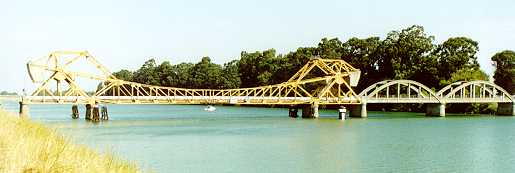
Isleton Bridge
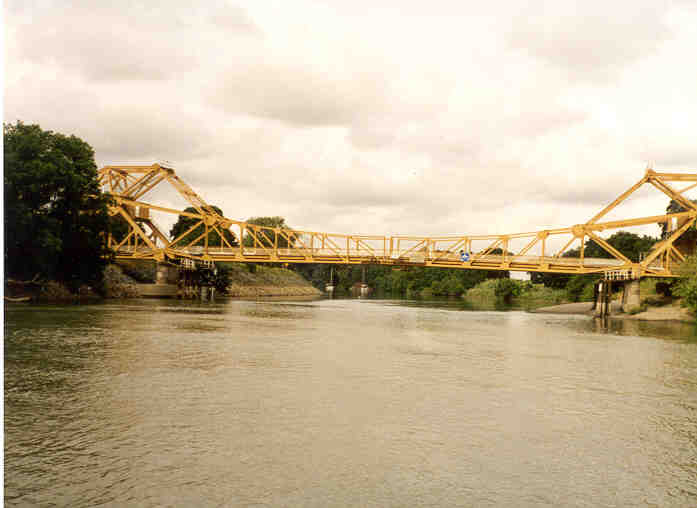
Steamboat Slough Bridge
|
Isleton Bridge |
Steamboat Slough Bridge |
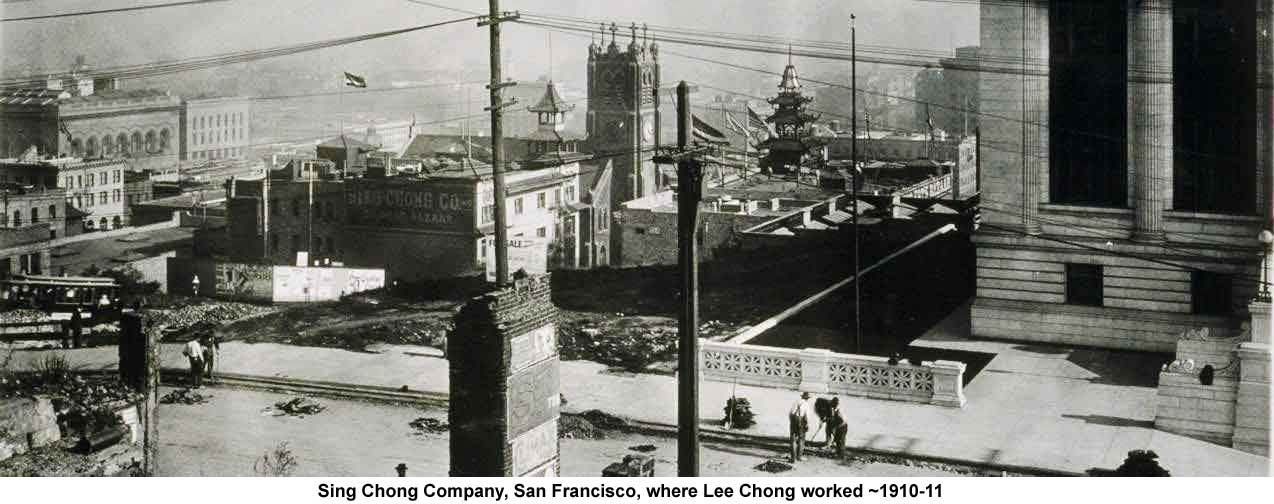
In 1910 with money running low, Lee and Mrs Leong Chong moved the family by train to San Francisco, except for Moy, who was living in Coulterville. Lin recalls being just 15 at the time, and living in Chinatown in housekeeping rooms on Sacramento Street between Jackson and Kearny Streets. Being in his early 20's, the oldest son Lee Chong worked while in San Francisco at the Sing Chong Co. to help support the family. The Sing Chong Co can be seen left of center in the 1906 picture below [click to enlarge], surviving the big earthquake. Some brothers, including Bing and Look, attended school in San Francisco. Since Sam had only a sixth grade education, one can surmise that both Sam and Jue did not attend San Francisco schools, since Sam was already 12 when they moved. They may have worked, too, but its not known for certain. Moy never lived in San Francisco, and visited the family in San Francisco just once for Lin's wedding to Oy Chan in 1912.
Lee first worked at the Sing Chong Company in Chinatown in San Francisco, shown above. The Sing Chong Building was built after the 1906 earthquake at 601 Grant Avenue, and represented an attempt to make Chinatown the "oriental bazaar" of the city. It was constructed in reaction to an attempt to relocate Chinatown to Hunters Point, and made an architectural statement. But working in low paying jobs in San Francisco was not the way to make a living or support the family, so Lee Chong moved in 1911-12 to the George Beleney ranch on Leary Road , just north of Ryde. The ranch was located on Grand Island, across the river from Isleton and Walnut Grove. The founder of Locke, Lee Bing, owned a small farm on the other side of Leary Road; Lee Bing one of the few Chinese to own farm land. Because he was native American and spoke fleunt English, Lee was able to help manage the farm laborers and gain the confidence of the Beleney family. On December 10, 1912, Lee and Jue Chong signed a lease agreement for the entire Beleney ranch. The initial lease was for one year at $14,000 per year, with a five year extension upon satisfactory completion of the first year.
In December, 1913, Lee married to Lily Look ( Look Hon Lin or Low Look), of San Francisco at 24 years of age. As customary, the marriage was arranged. At the end of December 1914 when his first son George was born in Courtland, his occupation was listed as "farm laborerm" yet records show clearly he leased the farm, rather than being a common laborer. See delta map covering Isleton to Sacramento, or Grand Isleton and Isleton ranch maps. See also aerial view of Grand Island, Ryde, Walnut Grove .
Its presumed that Lee and later Jue Chong must have sent money back to grandma Chong to support his remaining brothers and sisters in San Francisco. Once he was established and married, Lee Chong helped move the rest of the Chong family from San Francisco to the Beleney Ranch in 1915. Thus, the Chong family was able to return to their roots in farming. Lee made lots of money and spent lots of money. He bought Packard trucks, expensive cars, the best horses, and even had a motel for the workers.
The ranch on Leary Road was located about 1.5 to 2 miles north of Road 220 east of Ryde. Lee used to travel often to San Francisco. During World War I, the price for pears and other produce was high, and those in farming generally profited. However, the prices for farm products fell after the war ended, making farming a more difficult business through the 1920's and particularly the 1930's. Ping and On Lee's father, Lee Bing, farmed asparagus on a ranch opposite the Bellamy Ranch during the 1920's. During the depression Lee Bing lost $80,000 in asparagus, and 1000 acres that he had owned. Those depression times were tough.
The Chongs were not sharecroppers. That is, the family rented or leased the farms. With sharecropping, an English-speaking Chinese labor "boss" offers to take care of hiring all the Chinese and other labor. They would split the proceeds from the farm products. The land owner would provide the equipment and maintain the farm; whereas, the labor boss takes care of all expenses for the hired labor. The land owner has no business in knowledge of what the labor is paid. Ping Lee recalls that Lee Chong was an open-field farmer, with various farm crops including asparagus, as opposed to an orchard farmer. At the right is the central kitchen on the Beleney ranch, shown in 1918.
If you go north on Leary Road , from road 220 just to the east of Ryde, Leary Road crosses a ditch and makes a little zig-zag north. Their farm is on the left (west) side of the road, probably another 1/4 or 1/2 mile. It was quite a walk from Beaver Union School. Proceeding further north on Leary Road, one comes up to the Sacramento River levee.
 |
 New Years Card from Chan Tai Oy to L. E. Chong |
On May 12, 1912, daughter Tung Lin Leong married Tai Oy Chan, who had become manager of the Tong Sun Company at 916 3rd Street in Sacramento. She recalls being only seven or eight when her father died. Upon marrying, Lin moved with Oy Chan from San Francisco to Sacramento. Oy was seven years older than Lin, being born on January 21, 1888 Chinese calendar. He had come to America the first time on 1905, but did not get through Angel Island immigrations. So he had to travel to and stay in Yokohama for two years, where he learned Japanese, before making a successful entry to America on the second attempt. When he first arrived, Oy first worked as a cook for his uncle who sponsored him as a paper son. The Tong Sun Company stocked fish and produce, and in 1926 started a smaller, branch office in Reno. By 1929, the combined Sacramento and Reno operations had $450-460K in annual revenue, 80% in Sacramento. They had ten active partners who invested $1K each, and six inactive partners in China who also invested $1K each. But with the Big Depression, customers were unable to pay their bills causing their revenues to drop precipitously, and Tong Sun & Company went bankrupt.
Grandma Chong testified in 1929 that in
1915 she moved the family
from San Francisco, taking the night boat from Sacramento before
arriving in Isleton,
to live on the "Beranni" farm. 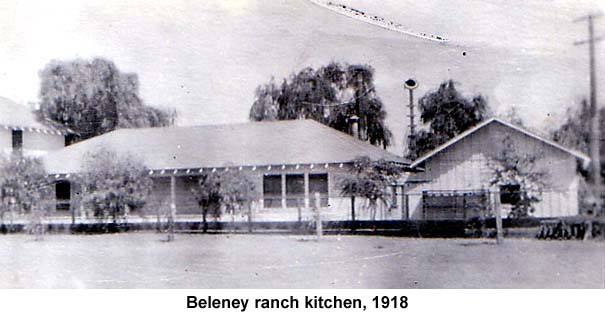 Being they left Madera in 1910, and
Mrs Chong and Bing's testimonies stated they lived in San Francisco for
just
three years prior to moving to Isleton, what happened from 1914-15 is
uncertain.
Or, they moved to the Beleney ranch once Lee and Jue sign the farm
lease.
By 1915, grandma Chong was 42, and her five sons 26, 22, 18, 15, and
13,
respectively. They lived and farmed on that ranch for six or
seven
years until 1921. In her testimony. grandma Chong actually was
referring
to the Bellamy farm, mispronouncing r's for l's to the interpreter, a
stereotypical
mistake.
Being they left Madera in 1910, and
Mrs Chong and Bing's testimonies stated they lived in San Francisco for
just
three years prior to moving to Isleton, what happened from 1914-15 is
uncertain.
Or, they moved to the Beleney ranch once Lee and Jue sign the farm
lease.
By 1915, grandma Chong was 42, and her five sons 26, 22, 18, 15, and
13,
respectively. They lived and farmed on that ranch for six or
seven
years until 1921. In her testimony. grandma Chong actually was
referring
to the Bellamy farm, mispronouncing r's for l's to the interpreter, a
stereotypical
mistake.
None of the children attended
Isleton schools, which maintained a
segregated school for Chinese and Japanese. Instead, some
attended schools in Sacramento.
Mrs Chong said that Bing and Look moved to Sacramento to attend the
main
high school, Sacramento High, and lived with Oy and Lin Chan on I
Street.
Bing attended school in Sacramento from 1915-18, and Look from
1915-19.
Testimonies state they did not graduate, with Bing completing at least
one
year of high school. But it was significant that they were sent
away
from their Isleton home for more schooling, probably because the
Isleton
schools were segregated, with a separate school for Asians.
 During 1918, Lee Chong sent a
large photograph to their village in
China,
which was rediscovered in July 2002 to be framed and hanging in the
front
sitting room, alongside pictures of an 1887-1889 photograph of Yee
Chong
and grandma Chong. The photograph is the oldest, picture of Lee
and
Lily Chong, when they were in their late twenties.
During 1918, Lee Chong sent a
large photograph to their village in
China,
which was rediscovered in July 2002 to be framed and hanging in the
front
sitting room, alongside pictures of an 1887-1889 photograph of Yee
Chong
and grandma Chong. The photograph is the oldest, picture of Lee
and
Lily Chong, when they were in their late twenties.
California land laws had been passed prior to World War II and were in effect throughout the War. Opposition to immigration from Japan led a number of states to pass Alien Land Laws, which barred Japanese immigrants from buying or leasing farmland in the early 1900s. This resulted in a lawsuit by 40 Chinese farmers near Walnut Grove against Japanese farmers in 1920-21, declaring that the Japanese did not have a right to rent or lease farmland. However, the interethnic lawsuit did not go to trial, and proceeded only to the Grand Jury stage as the U.S. Supreme Court validated the Asian Land Law against a Japanese group. Quite unfairly, the Japanese farmers were deemed highly undesirable, since they sought land ownership; whereas, most Chinese were content to sharecrop or lease farms.
They denied "aliens ineligible to citizenship" land ownership rights given to citizens and other aliens. "Aliens ineligible to citizenship" meant Asian aliens since they were the ones who were ineligible for naturalization under U.S. immigration laws. However, many Chinese were American born, and not truly aliens; whereas, the competing Japanese farmers were all Nisei who had just arrived in the United States. The Alien Land Law of 1913 (also known as the Webb-Heney Bill) provided that:
"Aliens not eligible for citizenship and corporations in which the majority of the stock was owned by ineligible aliens had to comply with the land ownership provisions of any treaty existing between the countries involved. The U.S.-Japan Treaty of 1911 made no mention of any right of Japanese aliens to own land."
It also provided that the State could take over any land found to be in violation of the law. Aliens were limited to renting or leasing farms for a maximum of three years, after which they would have to move and hopefully establish another farm lease. The Japanese and Chinese farmers were fighting for the small slice of American life offerred to them, and fought over rights to rent the delta farms. The Japanese had felt their were of higher class than the Chinese, whose roots were often traced to poor areas of China. But the American-born Chinese felt they had greater rights than the new Japanese immigrants.
The Alien Land Law of 1920 enacted further restrictions. It prohibited the transfer of land to noncitizens by sale or lease. Aliens not eligible for citizenship could not hold land in guardianship for their children who were citizens. If it was determined that land was purchased in one person's name, but with money from an Asian alien, the land would automatically become state property. "Despite the punitive provision of the Alien Land Laws, evasions were largely ignored. Between 1912 and 1946, only seventy-six escheat proceedings were filed in California under the Alien Land Laws."
In 1952, the California Supreme
Court found the Alien Land Law of
1913 unconstitutional in Fujii Sei v. State of California. In 1956, all
Alien Land
Laws were repealed in California by popular vote.
Continued
____________________________________
Send comments or materials to
Feedback