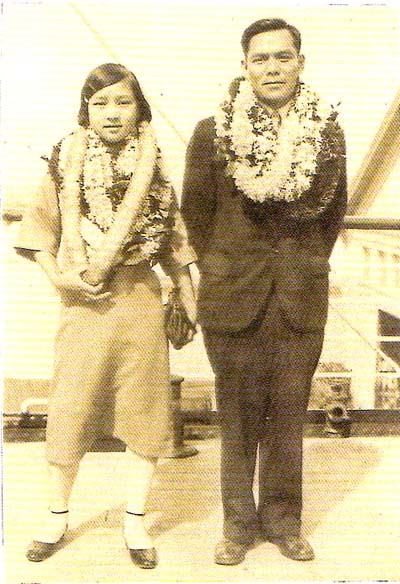
Bing and Jane
newlyweds, 1929
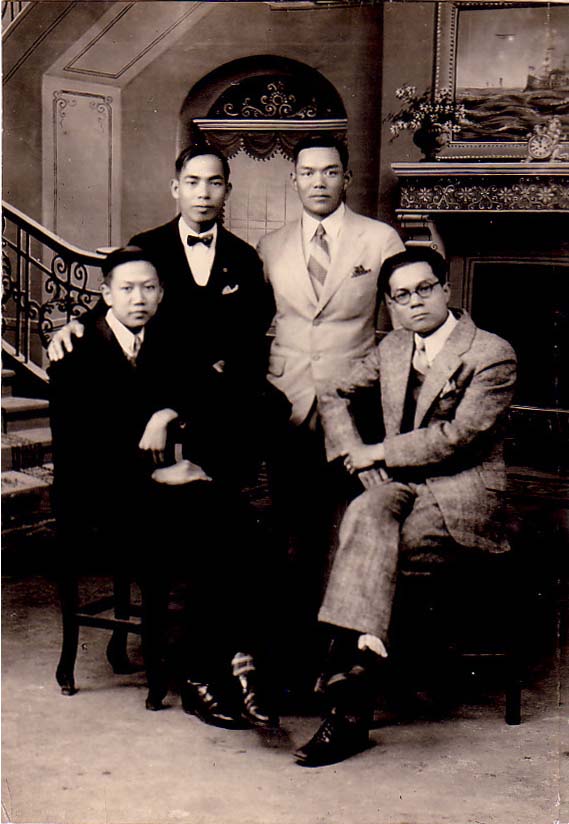
Davis Sun, ..., Bing Chong, ...
|
Bing and Jane newlyweds, 1929 |
Davis Sun, ..., Bing Chong, ... |
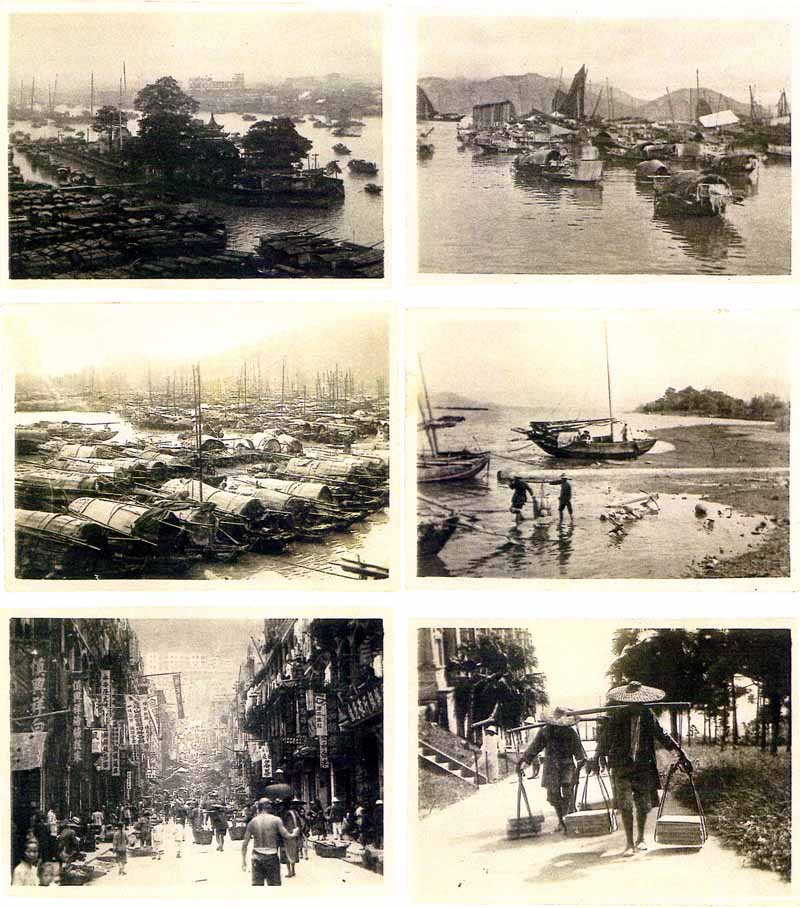
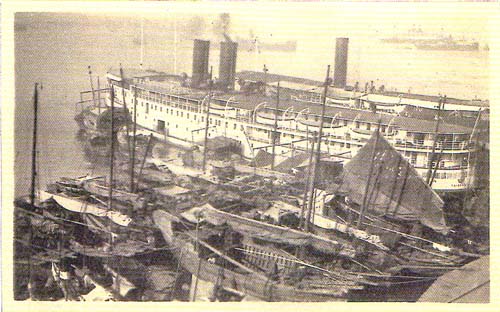 On the 1929 trip to China, Bing
Chong went to meet the other widow
of Leong Yee Chong and her family, and to visit his father's gravesite
and pay respects to his father he hardly knew. Bing the was only
child to return to China,
to visit his family and father's grave. At that time, Japan had
invaded
Manchuria and the Chinese were boycotting Japanese goods and
Japanese
ships, like the NYK Line that went out of San Francisco. They
took
a train, the Canadian Pacific Line, up to Victoria, then took a ship,
the
Empress of Asia all the way to Hong Kong. It took 28 days to
cross
the Pacific. After arriving, they took a rickshaw to Macau, and
then
a ferry boat up to Guangzhou! They didn’t have many roads in
those
days. More photos from Bing
Chong's
trip to China.
On the 1929 trip to China, Bing
Chong went to meet the other widow
of Leong Yee Chong and her family, and to visit his father's gravesite
and pay respects to his father he hardly knew. Bing the was only
child to return to China,
to visit his family and father's grave. At that time, Japan had
invaded
Manchuria and the Chinese were boycotting Japanese goods and
Japanese
ships, like the NYK Line that went out of San Francisco. They
took
a train, the Canadian Pacific Line, up to Victoria, then took a ship,
the
Empress of Asia all the way to Hong Kong. It took 28 days to
cross
the Pacific. After arriving, they took a rickshaw to Macau, and
then
a ferry boat up to Guangzhou! They didn’t have many roads in
those
days. More photos from Bing
Chong's
trip to China.
Although marriage was not the
reason for the trip, while he was
there the
Leong family arranged for Bing to meet and marry the daughter of a
fabric
shop owner from a nearby village, Louh Jung (?). Two
families
were good friends, and had known each other. They met, "dated" a
number
of times, and were married in Luk Yee Tau (or Leung Gnee Tung) village
in
Nam Long. He named his new bride Jane, as the family knew her in
the
U.S. She was from a village adjacent to Nam Long Heui. Bing
was
29 years old, Jane was younger, about 18. Because Jane's
family
was into business, and not peasant villagers or farmers, the family was
assured
that they would marry, and both return to the United States
together.
|
From Sophie Tam of Hong Kong, to Ron Chong in 2002: The Leong village was too poor to have a decent shop, so they travelled to Shanghai, where Bing and Jane met Tam Po Kwan. A dowry is the collection of wedding gifts which a bride presents to her husband. They didn't go to Shanghai to specifically see Tam, he just happened to be going to high school there.The Tams came here in 1984 after the freeway was built. They were standing around wondering what to do when they happened to meet a neighbor who just happened to have Bing's new address. That's why Tam's family was making fun of him for making the trip and finding no house, no Bing Chong family. However after 55 years, Tam was determined to find the family. She said Bing is her father's mother's brother, or really half-brother, or her grandmother is Jane's sister-in-law. Allison Sekikawa, Jane's grand-daughter, remembers meeting them, and she also went over to Hong Kong with Jane, Barbara and Jeanette where they had dinner with the Tams. She said Tam Po wanted her to stay in Hong Kong to teach English. The Luk Yi Tau village name may have changed, although when I talked to Dorothy this week, she said she recalled the name as Leong Yi Tau. Sophie said there are only about 3 family names from that area, so everyone comes from the same villages. The other side of her family is Tam. |
| The Exclusion Act of 1924 was designed to prohibit the immigration of Japanese. While unlimited immigration was allowed for Ireland, Italy, and Poland, only 105 per year were allowed from China. While encouraging European men to bring in their wives to the U.S., the tightened law completely banned entry of women from Japan, China, Korea, and India. Even wives of U.S. citizens were excluded. Further, any American women who had married a Chinese nationalist would lose his or her citizenship. Until 1930, almost no women from China entered California, the Gold Mountain. ref: On Gold Mountain. |
Ship on which Bing and Davis returned Dec 1929 -
Jan
1930
Asama Maru
1929(Albatros AL-50)
|
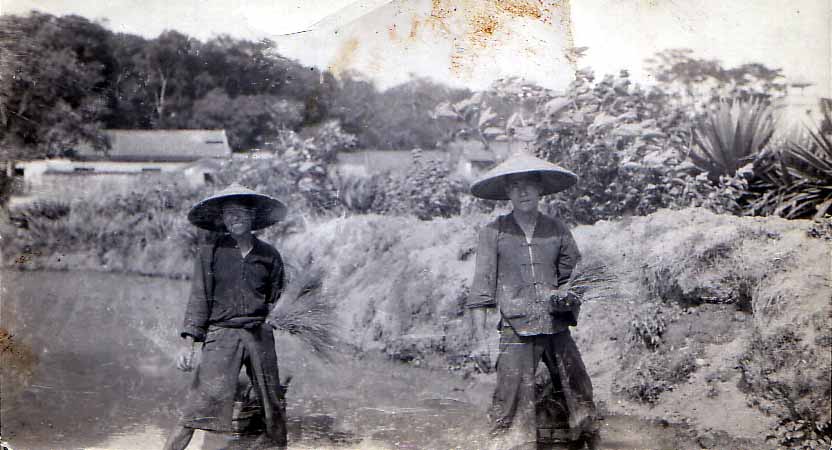 Leong rice farm workers |
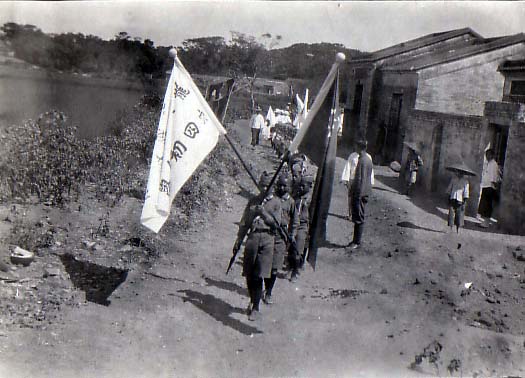 Leong village school children |
Because Bing and Jane's children were in the segregated Isleton district, Tony Miller suggested they move to get into the Ryde district, which was not segregated. They did not need any special privilege to attend Beaver Union, since there were many other nationalities there, Japanese, Phillapino, etc.
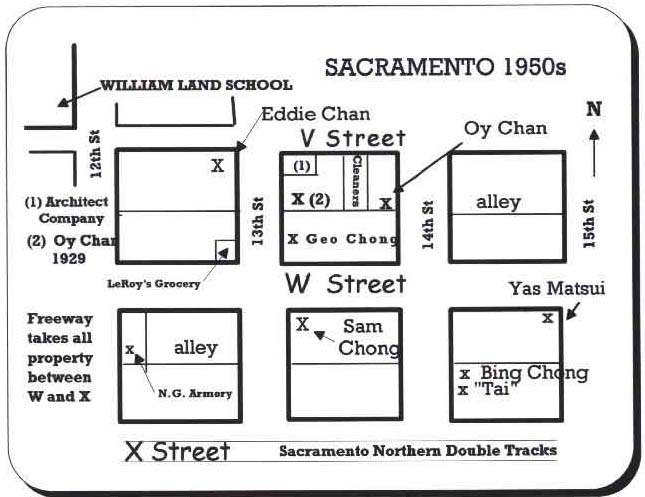
Around 1936. Bing and his brothers moved from the McCarty Ranch to the Wolf Ranch, which was just south Ryde. The Wolf Ranch was within the Beaver Union elementary school district. Donald Leong had already started school at William Land in Sacramento, having stayed with Oy Chan on 14th street, so he changed schools to attend Beaver Union close to home.
In 1941, Bing built two homes on
14th street, between W and X
Streets. Bing's family moved into the larger home adjacent the
concrete alley, and grandma Chong, Sam, and Jue lived next door.
Jue had dinner earlier in the evening at Jane's house on 14th street,
but was not feeling well.
He returned to his home next door, and died there. He was in good
health
at the time, though he did die from a coronary. Others have said
he
had ulcers, and had just underwent an operation.
When Bing and others moved to
Sacramento, Bing and Sam helped Look
buy the Wolf Ranch, which Look and May moved onto. Look could not
afford by himself. They thought the ranch would stay in the Chong
family for
a long time, being that Look was much younger. But Look and May
never
had children, and when Look died suddenly at an early age, the ranch
passed
to May, and the next year to Dan Yee's family when she too, died
unexpectedly.
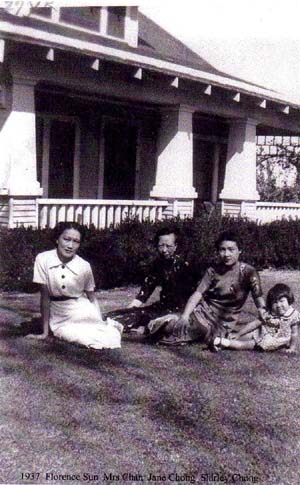 Florence Sun, Mrs Chan, Jane Chong, Shirley Leong |
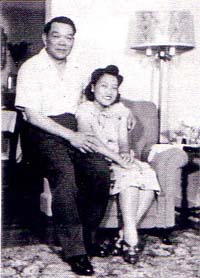
Bing and Jane, 1948 |
 Bing's
children attended William Land School, shown at the left in
1930. William Land was a very large, modern school for its
era. It had a
separate cafeteria at the left-end of the main building, and large
auditorium with 2nd floor balcony seating on the opposite end.
The childrens playground
area was protected by the two wings, with 3rd/4th grades on the 11th
Street
side, and 5th/6th grades on 12th Street side. The school had a
pre-school,
and kindergarten through 6th grades. The school was later
demolished
and re-built to modern earthquake standards. When contracters
tried
to knock down the building, it would not fall. They had to go to
extreme
measures to bring the structure down. Perhaps, the original
building
was sufficiently strong to handle any earthquate in the Sacramento
region.
Bing's
children attended William Land School, shown at the left in
1930. William Land was a very large, modern school for its
era. It had a
separate cafeteria at the left-end of the main building, and large
auditorium with 2nd floor balcony seating on the opposite end.
The childrens playground
area was protected by the two wings, with 3rd/4th grades on the 11th
Street
side, and 5th/6th grades on 12th Street side. The school had a
pre-school,
and kindergarten through 6th grades. The school was later
demolished
and re-built to modern earthquake standards. When contracters
tried
to knock down the building, it would not fall. They had to go to
extreme
measures to bring the structure down. Perhaps, the original
building
was sufficiently strong to handle any earthquate in the Sacramento
region.
Bing always had large metal fish tanks in the back yard stocked with large black bass, and a large vegetable garden area; they had a swing set in great-grandmother's backyard that all the kids played on. Bing was often in his workshop, located in the garage, which housed his table saws and other equipment. He was always doing and making things for practical use.
Many family gatherings were held
at Bing's 14th Street home, which
had been expanded to 5 bedrooms and a downstairs room. On many
occasions, the Chong families would go ocean perch fishing at Point
Reyes, now a national park, or digging after horse neck clams at
Bolinas Bay. They would dig
up small, white cockles from the rocky reef on the ocean side, then at
low
tide use a rope system to ferry passengers in a ten foot aluminum boat
across
the bay slough to the mud flats at out-going tide. Of course,
Bing
built a a novel gas powered siphon to drain the hole of bay waters, to
keep
the sand from collapsing on the hole as we dug for the clams. The
poor
clams did not have a chance against Bing's clan. This was all a
lot
of fun, especially running around stomping on the mud flats and causing
the
clams to shoot their load (of water).
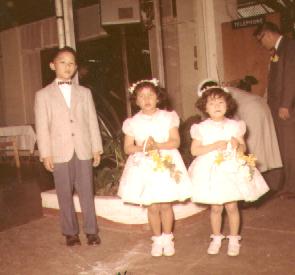
Darryl Chong, Linda & Karen Leong at Shirley's wedding |
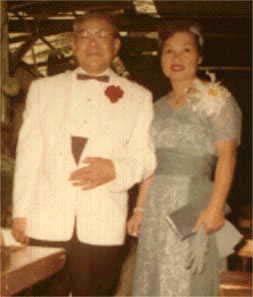
Bing & Jane Chong at Shirley's wedding |
Bing Chong was in charge of his brothers' finances, because of his training as a book keeper for Sun Sun Wo store in Coulterville. Dorothy Murray has the original ledgers from the store which show Bing Chong's neat and legible hand writing and his signatures for many of the orders and receipts. Bing later used this experience to manage the accounting books at General Produce, along with Davis Sun who served as the head cashier. David Sun's brother-in-law Ed Mock was also in charge of accounts payable/receivables for many years. Ed was married to Minnie Sun.
One of Bing Chong's
grand-daughters remembers her grandpa just as
many others descendants had, ... a kind, loving, generous man who
extended his heart and his home to all of his family, friends and even
strangers. It is because of his deep commitment to our family
that the family is still so close. now there are four generations
of us who gather on Sundays to not only bake bread ... but to share in
each other's every day lives ...
something we all know grandpa Bing would have loved to see and be a
part
of. Even more than twenty years after Bing's passing, grandma
Jane
still cooks every Sunday for 40-50 now, with in-laws and great-grand
children.
This tradition was started by grandpa Bing and has continued through
the
decades into the 21th century, a tradition going back 50-60 years or
more. When asked why she continues to host the weekly
family gathering, and cook up at least one large pot luck entrie, Jane
responded, "If I didn't do it, who would?" She is an amazing
woman.
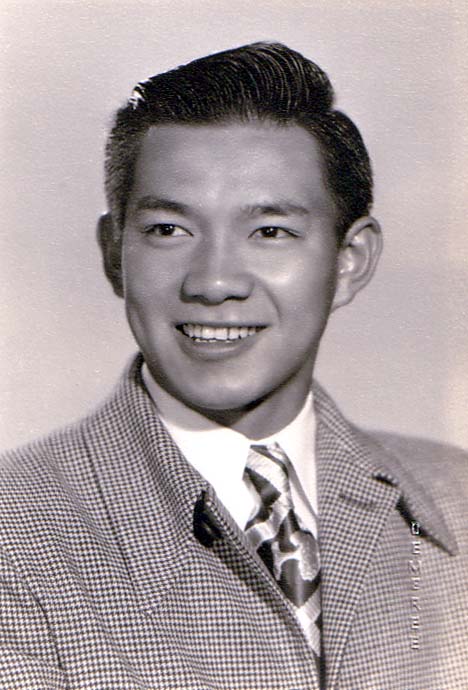 Donald Leong |
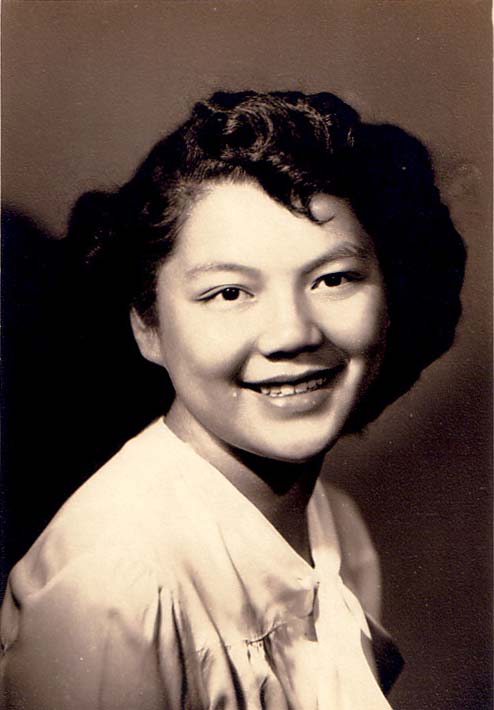 Barbara Leong Fong |
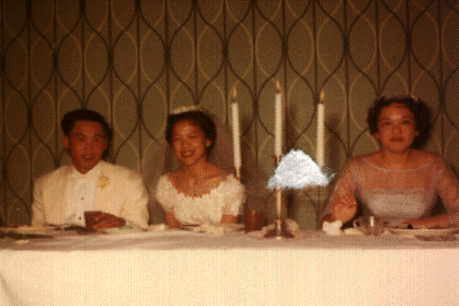 Lyle Lai, Shirley Leong Lai, Jeanette Leong Fong |
Shirley graduated from UC Berkeley, and
did her teaching intern at
William Land School. She died very young and suddenly at a young
28 from leukemia
cancer. She was very personable, and well liked by
everyone. The
sisters Shirley, Jeanette, Barbara and others used to play lots of Ma
Jong
in the living room on 14th Street. The youngest sister
Nancy
attended William Land Elementary School in Darryl's class, and were
good
childhood friends before moving on to California Junior High.
Both
William Land School and California Junior High have since been
demolished and rebuilt to new earthquake standards. The new
schools are the same
only in name, and do not invite one to revisit for childhood
memories. At the left are Lyle and Shirley Lai at their wedding
with sister Jeanette Fong. Their high school, C. K. McClatchy
still resides in its original location and buildings, standing to the
rigors of time. For many families, several generations have gone
to McClatchy as the school still maintains a good reputation for
academic standards.
Dorothy Murray recalled Ann Chong
made all those wedding dresses for
Uncle Bing¹s daugther Jeanette. Ann made Chinese
dresses, and the girls dyed their hair to match the dresses. If
the girl had a purple dress, she had purple, lavender hair.
Blonde became blue hair.
That was the most beautiful wedding, as she still remembers.
 |
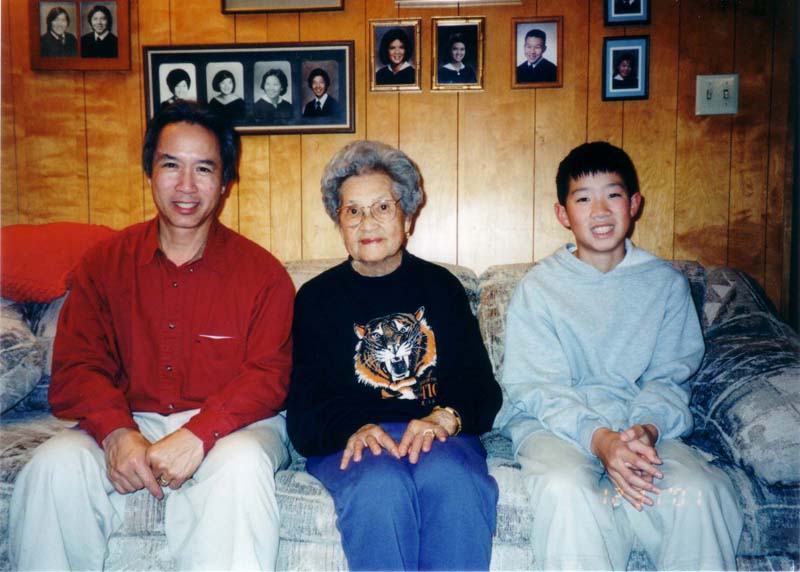 |
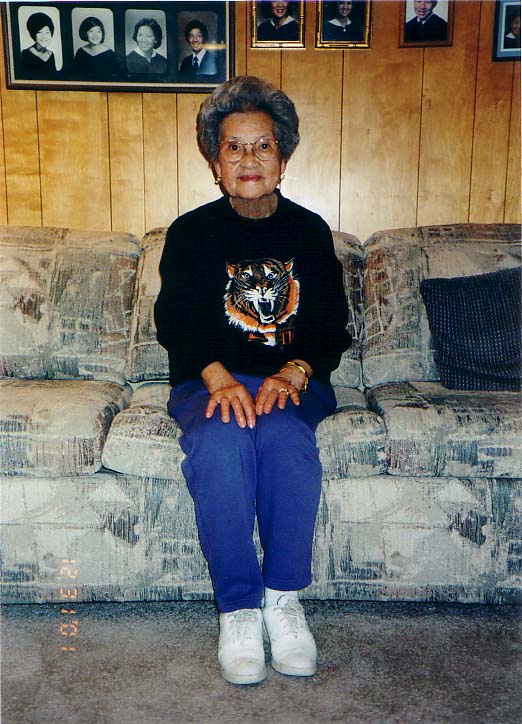
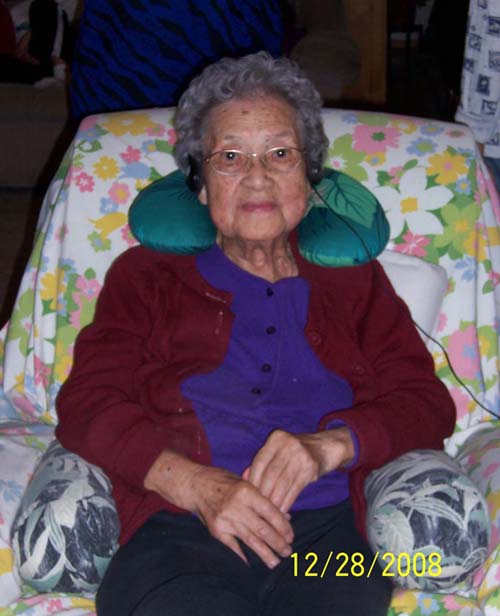
At the left is Jane Chong on
Sunday, Dec 30, 2001, the day of her
weekly
family dinner gatherings at her spacious custom-built brick home in the
South Land Park district. All her children and grandchildren
gather
for dinner, for the get together among relatives, cousins, brothers,
and
sisters. For this occasion, Darryl and Kurt Chong (12)
(i.e. great and
great-great grandsons of Leong Yee Chong) visited with grandma
Jane, and her grown "children", to revisit the old times in family
history,
to share and exchange information how Jane met Bing, our life growing
up
as a family, schooling, their achievements, migration from the farm to
the
big city, Sacramento, and giving respect to family elders. The
family
remains extremely close knit to this day, with grandchildren electing
to
remain in Sacramento for their careers, and all living in the South
Land
Park district near Jane's place. Jane still contributes a main
dish
to her weekly event, and loves to be surrounded by her family and
grandchildren. She said that "many older folks do not like to
have so many people around, prefering quiet and peace." But
having had these gatherings every week
for the last five decades has allowed her to get used to it, and
actually enjoy the company. This is the life she knows, welcomes,
and prefers ... at ninety years old.
| From
Ron Chong on June 13, 2003: While in Hawaii this past week, I went to the Hawaii State Library to check their Chinese American holdings in the Hawaii and the Pacific Room. This monograph was found: The Ching Family Chronicles, by Harold Ching and Douglas DL Chong, 1987. H 929.2C 5046 Pako Drive, Lihue, Kauai. HI 96766-9344. (Ching lived on Kauai. Judy's mother also lived in Hanapepe in Kauai, and knew Ching when he lived there. Ching was a well-known reporter for the Honolulu Star-Bulletin and died at 90 in 2000. Judy's mother suggested we look up some of the books he wrote). OK, in the early chapters of this 100 page monograph, Ching writes about the various dialects in Heong Shan County, and in particular "Nam Long" where his Ching ancestors lived. (I recall that Jane Chong is a Ching, and that our relative in Nanlang, Zhao Lian (Allene) Chen said that Jane is from the Hang Mei village. I'm not sure if the "Nam Long" region mentioned in the monograph is the same as Namlang. Ching writes: While the people of many villages do their marketing at Nam Long Hee, it is interesting to note that this shopping center is totally surrounded by Ching villages: On Dung, Tien Bien and HANG MEI are located directly across the street while the Sai Chien and Hup Sui Hau are behind the marketplace. Nam Long Hee is the Chinese version of a "shopping center" or "shopping mall" with its "swap meet" type of open stalls, restaurants, department store, specialty stores, jeweler, herb and western doctors, dentist, temple, hotel, and Chinese-style "condos" which line the back streets leading up to the back villages of Sai Chien, Hup Sui Hau and In Saan Jai. The Ching clan has three main villages. According to history, Tien Bien near the center is the smallest in size, On Dung is named after the original Ching settlement to the north, and HANG MEI, the largest, is the oldest and CONTAINS ALL THE ANCIENT ANCESTRAL HALLS OF THE EARLY CHINGS. The western limits of the Nam Long area extend to the Bui Tau village (is this the Sun village???), nestled against the mountainside. By far the largest clan is the Chun family, which settled 16 villages throughout Nam Long. They are followed next by the Wong clan who settled 10 villages. The Ching clan, although also one of the largest, settled only 10 villages, many populated solely by people with the single surname, Ching. The LEONGS, Yuens, Lums, Wongs ("Emperor" or "Sam Wak" Wongs), Hees and Yims comprise the other large clans. Through the centuries these Nam Long clans lived and died within this narrow region, intermarrying within their clans and seldom taking wives from outisde their district. The only frequent exception were the great number of wives from Ngai Hau, Choy Hang and other close-bordering villages favored by Nam Long men ... The book goes on to document some 26 or 27 generations of the Ching clan, and that there is a family genealogy taking up a whole bookshelf in the University of Hawaii Asian collection. "The (family) books are updated and printed each five to seven generations--or a period of 100 to 150 years--copies are lost, stolen or destroyed, thus making compilation rather difficult. Because of the thin rice paper the old Chinese used, one can easily imagine how books disintegrated in the terribly humid weather of Heong Shan, amidst the mold, mildew and bugs. Even in Hawaii, old Chinese log books from the turn of the century are thoroughly crumbly and bug-eaten--so "jee saai" that most of them have been dumped." "In many of the pre-17th Century entries, the register (16th Century) clearly states, "Information on specific year has been lost," or "Information was in an old edition which has been lost." "In certain specific cases the day and month which does exist could have been taken from old tablets in the Chee Tong or in a home, or from family log books which have survived." "For ancestors who lived before the 15th or 16th Century, there is no attempt to mention dates or the existence thereof, unless the person was of such prominence that the years of his birth and death are recorded in memorial tablets, cut into his tombstone or were recorded in other national or provincial documents." "While the Chinese are sensitive about their immediate forebears, it seems that a remote ancestor's deeds and crimes are not of as much consequence. The belief is that their souls had long moved on to higher spiritual realms or were on their way to transmigration into different existences; and if they had been good or bad in their earthly life, they had already been rewarded or punished in their next life." "The birthplace is of no consequence but the death place is very important if the closest of kin ever wishes to retrieve the bones of that ancestor." "Each of the Ching villages maintained its own records and tablets in its "Jaap Seang Tong," or mixed surname ancestral hall, but the Chings always tried to get the essential information recorded also in the books at the main ancestral hall in HANG MEI." (He also said most of the village books were destroyed in the cultural revolution). "There seems to be a reason for indicating the village the bride came from and the villages of the sons-in-law, since one frequently did keep up with the maternal side of the family. Sometimes there was also the need to find where one's great-grandmother came from." "This is also the reason for indicating where or who father's sisters married. Back in China, it was found, people keep up with "loy wong" or descendants frequently down to the fourth generation (ie us!), thereby maintaining a complex network of kin that they are very clear about." Also of interest in the library was "Chuck Hum Village" (1994) a hard-bound pictorial essay by Jack Yuen. This village appears to be somewhat north of the Leong village, but the pictures look familiar to the scenes we have seen in Luk Yee Tau |
 |
|
Continued
___________________________
Send comments or materials to
Feedback