Chong Family History up to 1880
[home
][1880][1890][1900][1910][1920][1930][1940][Lung Yuet Tau][Borden][Ryde][Plow]
Leong Yee Chong, an early Madera
Pioneer
In Gold Mountain, Grandpa Leong Yee
Chong was more commonly known as
Yee Chung, Yee Chong, Ah Bow, and Leong Ah Bow. Since Yee Chung
was the name commonly used by the Madera Mercury, the
Madera Tribune, and in the community, he will be referred to as Yee
Chung,
rather than his actual Leong Yee Chung.
 The 1880 Madera county tax
rolls established that Yee Chung was born in January 1844.
Family
members say he was born in the Chinese village Luk Yee Tau, Louh Leung
(Leung
surname). The village is in Nam Long. Dorothy Murray said Luk Yi
Tau
could be seen up on a hill from where they were visiting ( see interview
).
Her driver was from the place but didn't want to return because he
had run away from the place. His family was purported to be of
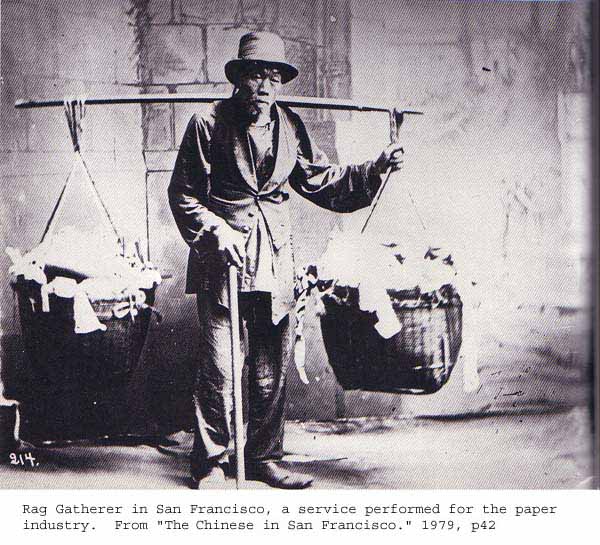
the ragman class, perhaps like the rag
gatherers in San Francisco who sold the rags to the local paper
industry.
The 1880 Madera county tax
rolls established that Yee Chung was born in January 1844.
Family
members say he was born in the Chinese village Luk Yee Tau, Louh Leung
(Leung
surname). The village is in Nam Long. Dorothy Murray said Luk Yi
Tau
could be seen up on a hill from where they were visiting ( see interview
).
Her driver was from the place but didn't want to return because he
had run away from the place. His family was purported to be of
the ragman class, perhaps like the rag
gatherers in San Francisco who sold the rags to the local paper
industry.
Yee Chung had two wives, like so many
other Chinese
immigrants. Before coming to the U.S., he had heard of
fortunes made at Gold Mountain, as America was known in China.
During the California gold rush of
1849, there were stories in China that gold was so easy to find, that
you
could find it on the streets. A Chinese man could travel to Gold
Mountain, and return a wealthy man for life.
Although a few Chinese who journeyed to the U.S. did proper and
return to China with riches in silver and gold, many more found life in
the U.S. to be hard work, and labored on railroads at low wages, or
spent all their days mining for little gold. For many, they were
barely able to make enough for their own survival, let alone send extra
money to their families in China. Still worse, life was hard and
they were not allowed to assimilate into the white population.
Others wished they could could return to China, but their work did not
allow them to save the funds necessary for the return trip.
Yee Chung
married his first wife
in China, before coming to the U.S. His arrival year has yet to
be determined, but it is believed he came to America around 1865, as
the Central Pacific began importing many Chinese
workers to construct the railroad. His first wife in
China
was much older than his second wife,
Mrs Yee Chung, alias Sun Ho, who was
not born until 1871. The difference in family name of Chung
versus Chong is due to phonetic spelling, i.e. how it sounds. The
family later changed the spelling to Chong. The family's real
surname is Leung,
or Leong, but reversed upon entry to Leong Chong, because all the
sons names are Chong, i.e. Bing Chong, Sam Chong, Lee Chong, and so
on.
His younger daughter Lin's maiden name was Lin Leong Chong (Ah Lin,
Leung
Dung Lin) and older daughter, Ah Moy (Moey, or Dung Muih), and the sons
are
Leung Gwan Yiu, Leung Gwan Bing, Leung Gwan Jue, ... Luk, ...
Sam.
Its rather confusing with all the variations in names for the same
person,
particularly with the spelling of their names being highly variable.
However, Yee Chung could not become a
citizen of the United
States. The 1790 Naturalization Law had restricted citizenship to
"whites" only, and that Chinese were not "white". In other words,
no matter how long he lived in the U.S., he could not be naturalized
and obtain citizenship. However, the U.S. Constitution provided
that anyone born in the U.S. would automatically become U.S.
citizens. So there was a legal means to
obtain citizenship, but only for one's children. But with men
out-numbering women by 15:1 or more, finding a wife was very difficult,
particularly
with most Chinese women here in the period were forced into
prostitution
by their "owners."
| "The Chinese
who went to California were
called gam saan haak, 'travelers to Gold Mountain'.
Americans often called thyem 'Celestials', from an old name for
China: the Celestial Empire. Although this term was not an
insult, it sometimes had a rather mocking, belittling tone."
"Americans also called the
Chinese
"coolies'. Coolies were unfree laborers who were kidnapped,
forced, or tricked into leaving their homes and made to work in a
foreign country against their wills. Thousands of Chinese were
forced into coolie labor in places such as Cuba and Peru, but few, if
any, of the Chinese in California were coolies. Instead, most of
the Chinese migrants came to America on the credit-ticket system.
Under this system, a broker would loan money to a migrant
to buy his ticket, and the migrant would in turn repay the loan, plus
interest, out of his earnings in the new country."
The 'Old West' has become an
American folk
legend, recalling imges of cowboys and Indians, sheriffs and
outlaws. "But there were also many Chinese faces in the Old West,
and their presence often been overlooked. In California, a
quarter of the total work force in the late 19th century was Chinese."
ref: Journey to Gold Mountain
|
| Chinese
Historical Sites in California. As "aliens ineligible for
citizenship", the Chinese were not allowed to file gold mining claims,
and white miners resented their success at finding gold in the
abandoned claims they were permitted to work. Without the right to
vote, hold public office or gain state employment, their future in
California was uncertain. In spite of this, the Chinese became part of
their communities, no matter what their station in life. Chinese
communities, "Chinatowns", sprang up in almost every city and town in
California. The Chinese quietly pursued almost any business opportunity
available to them, achieving success for the most part in service
industries, such as laundry services, restaurants and fishing. The
Chinese immigrants also provided a resource for cheap, thankless, hard
labor, filling occupations the white residents of California didn't
want. This was especially true in the case of the Transcontinental
Railroad. Many Chinese lost their lives in the grueling, dangerous
construction of
the railroad, as they carved its path through the High Sierra. |
| "By 1900, one
of every four employed Chinese
men
in the country was a laundryman. The 'Chinese laundryman' was an
American phneomenon, not a transplant from China. 'The Chinese
laundryman
does not learn his trade in China; there are no laundries in China,'
siad
Lee Chew, a laundry worker who came to America in the early
1860s.
'The women there to the washing in tubs and have no washboards or flat
irons.' In China, laundry work was a 'woman's occupation', and
men did not 'step into it for fear of losing their social standing.' "
"The Chinese laundrymen were
pushed into
laundry work because it was one of the few opportunities open to
them. The 'Chinese laundry' was a retreat from the mainstream
economy, with its limited opportunities for Chinese workers.
Chinese men opened laundries not because they wanted to wsah and iron
clothes, but because laundries gave them
a chance to work." ref: Journey to Gold Mountain
|
Bing Chong's wife Jane informed
Helen Quan at the 10/13/01 Delta
Reunion that Yee Chung's wife in China had at least one daughter, and a
(perhaps older) son from his first marriage. A grandson of his
first wife visited Sacramento looking for Bing Chong a shortly after he
had died in 1979; the grandson was about 70 at the time. A
neighbor referred him to Jane
Chong's new address in South Land Park district, and visited Jane, and
some
of her children.
 Ron Chong talked to Yee Chung's
grand-daughter in Hong Kong, Sophie Tam,
who informed that Yee Chung had only one daughter from his first wife.
One
of his grandsons, Tam Po Kwan, came looking for the Bing Chong family
in
Sacramento in 1984, five years after Bing had past away. He came
with a daughter, Sophie Tam, and found that the new Interstate 80
freeway
replaced the enter block between W and X Streets. When Bing
married
Jane, they went to Shanghai to shop for her dowry. The Leong
village
was too small to have good shopping areas. At that time, Tam Po
Kwan
was going to high school and met them there. This was why Tam
went
to Sacramento, to meet the family again after some 55 years in
1984.
The Tam family had ridiculed him for even trying to find Bing's family,
but Tam was persistent because he had come half way around the world to
try to find them.
Ron Chong talked to Yee Chung's
grand-daughter in Hong Kong, Sophie Tam,
who informed that Yee Chung had only one daughter from his first wife.
One
of his grandsons, Tam Po Kwan, came looking for the Bing Chong family
in
Sacramento in 1984, five years after Bing had past away. He came
with a daughter, Sophie Tam, and found that the new Interstate 80
freeway
replaced the enter block between W and X Streets. When Bing
married
Jane, they went to Shanghai to shop for her dowry. The Leong
village
was too small to have good shopping areas. At that time, Tam Po
Kwan
was going to high school and met them there. This was why Tam
went
to Sacramento, to meet the family again after some 55 years in
1984.
The Tam family had ridiculed him for even trying to find Bing's family,
but Tam was persistent because he had come half way around the world to
try to find them.
Sophie recalls standing around
wondering what to do, when they
happened to bump into an old neighbor at a supermarket. The
neighbor
just happened to know the family's new address in South Land Park, i.e.
where they moved some twenty years earlier. He met the family at
the
South Land Park home, and stayed in contact for several years. Mr
Tam
was 74 when he visited, and was a teacher, with children who lived in
Hong
Kong. Jeanette referred to him as her half, first-cousin.
After
obtaining a copy of the business card he left with Jane Chong, we
researched
his name on the web, and found that he died in 1998. Tam Po Kwan
has
descendants in Hong Kong, who set up a half million (HK) dollar
endowment
fund in memory of Mr Tam.
Ron Chong spoke with Sophie Tam by
phone. Tam Po Kwan's
mother's
name was Leong Kam Kiu ("golden beauty"), and was an only child.
She
married a Tam, and had two sons and two daughters. She was
47-years
old when she gave birth to her youngest child, Tam Po Kwan.
Hence,
Leong Kam Kiu was born in 1863, further supporting that Yee Chung was
in
China until 1865. Having a child at that age was really
unusual,
and they did not want to be seen with a young child. And in the
Chinese
custom she was 48 years old! The husband 'deserted' the wife, and
after the first child, went to Honolulu. He came back every 10
years,
each time fathering another child, with Tam Po being the last.
The
husband eventually returned to China, where he died. Sophie does
not
know the name of Yee Chong's first wife.
Tam Po Kwan had three daughters and one
son, with Sophie the oldest
sibling (b. 1952). She retired from a career in banking and was a
school teacher at a childrens home in 2002. She can be reached
through her sister Florence's email. Florence
works in Hong Kong for the US Commerce Dept. All of the
siblings
live in Hong Kong, where the family has been since 1937. They
have
never visited Yee Chung's home village, partly because of the turmoil
going
on in the mainland, though they are close by in Hong Kong.
Tracing family history is not
done much in China, first because of
too many Chinese with the same last names, and second because of all of
the
upheavals and changes going on; village names change as well.
Villages
are being torn down. The Zhongshan area is one of the richest in
China
now because of industrialization, and the whole landscape has
changed.
Although the Tam family has been to the area, they never tried to look
for
the Leong village. They just don't pay much attention to family
history
back there, as surprising as it may be. There are probably
300,000
or 400,000 Leongs in Hong Kong alone ... the same for Tam ... Sophie
has a sister in Hong Kong, Florence Tam, who works for the U.S.
Consultate in its Business Information Center.
| Tam Po
Kwan. Mt Tam died in 1998,
verified
by a web search at hkbu.edu.hk. The site of Hong Kong
Baptist University in Kowloon, phone 852 2339 7400 provided this
info:.
He was the son of a son of Yee Chung in China, from his first wife--who
was much older than our grandma Chong.
Mr. Tam was well-known in
Chinese
medical circles. When he died, the family established a memorial
scholarship in his name at Hong Kong Baptist University, which Ron
Chong found from the Internet. It was HKBU which forwarded my
request to Tam Po's family, which eventually made its way to Sophie Tam.
Mr Tam Po Kwan Memorial
Scholarships. In
1947, Mr Tam Po Kwan founded the Chinese Medical Institute in Hong Kong
and
has served as its Principal until 1998. In May 1998, an endowment fund
of
$500,000 was established by relatives and friends in memory of Mr Tam.
The
scholarship recipients must be students pursuing the course of Bachelor
of
Chinese Medicine and BSc (Hons) in Biomedical Science. One HK
Dollar = 12.5 US Cents
Tam Po Kwan
- Principal, Chinese Medical
Institute
- Hon. President, Waseda Acupuncture
Moxibustion College, Japan
- Permanent President, Cultural
Centre of
Chinese Medicine, H.K.
- Permanent President, Society of
Practitioners of Chinese Herbal Medicine
- Hon. Permanent President, Assoc.
of
H.K. & KLN. Practitioners of Chinese Medicine.
- Chairman, China Society of
Practitioners
of Chinese Herbal Medicine
|
242 Nathan Road, National
Court
4th Floor Flat B. and D.
Kowloon, Hong Kong
TEL 3-674659
The U.S. Consulate's Business
Information Center maintains an extensive reference collection of
U.S. suppliers of products and services, both published and in
electronic format. These resources are readily available to Hong Kong
and Macau importers free of charge. To use the facility, simply make an
appointment by calling 2521-1467. Fax inquiries are also welcome. The
Business Information Center is open in the morning and afternoon,
Monday through Wednesday, and in the morning, Thursday and Friday. The
address is:
21st Floor, St. John's Building
33 Garden Road
Central
Hong Kong
Phone: 2521-1467
Fax: 2810-0970
E-mail: [email protected]
|
Central Pacific Railroad
Being that U.S. Census Report in
1880 established Yee Chung was born in January 1844, he could have
married his first wife by 1860 at 16 years of age. Assuming 4-5
years is required to have three children, Yee Chung most likely did not
leave China until at least 1865, coinciding with the major increase in
import of Chinese for Central Pacitic railroad construction.
| The Central Pacific RR was
chartered in 1862,
and the Golden Spike ceremony occurred at Promontory, Utah in
1869. See Central Pacific RR
. "The first
Chinese were hired in 1865 at approximately $28 per month to do the
very dangerous work of blasting and laying ties over the treacherous
terrain of the high Sierras. They lived in simply dwellings and cooked
their own meals, often consisting of fish, dried oysters and fruit,
mushrooms and seaweed." By summer of 1868, 2700 Central Pacific
RR workers were Chinese; by the end of the project, 15,000 Chinese
workers had been hired. Perhaps when the Southern Pacific
RR took over the Central Pacific RR, employee records and salary
history
were retained for the
Chinese workers .
In regards to the possibility of
finding
employee records for Chinese workers, the chance is nil. See
REPORT OF THE
JOINT SPECIAL COMMITTEE TO INVESTIGATE CHINESE IMMIGRATION ,
excerpt follows:
Q. You do not pay the individual Chinaman
when he
works for you? A. We pay the head man of the gang.
Q. Some head man ?—A. He is a
laborer among
them.
Q. You do not pay them in the
same manner
that you pay white men ?—A. In the same manner, except that we cannot
keep the names of the Chinamen; it is impossible. We would not know Ah
Sin, Ali You, Kong Won, and all such names. We cannot keep their names
in the usual way, because it is a different language. You understand
the difficulty.
It is not done in that way because they are slaves.
And
they came as the gold miners had come before
them, from the same regions of Kwangtung province on the Canton
delta,
mostly from the sea�swept maritime districts of Sunwui and Toishan, in
the area known as Sze Yup. They came by the thousands and tens of
thousands.
So many young men wished to come that the ships of the Pacific Mail
Line,
which brought most of them, were often overloaded by their captains
with
a third too many passengers.
|
 It is alleged that Yee Chung came from
China
to work on the Central Pacific Railroad (ref: Marjorie Loui,
1970; Bing Chong family). Its
believed that when work on the Central Pacific tracks in the San
Joaquin
area was complete in 1872, Yee Chung went into gold mining in the
foothills
near Madera. He made enough money to start a business in Borden
in
the 1870's, and to buy a wife from a white family using her as a
maid.
The Central Pacific Railroad map shows the tracks in 1878.
It is alleged that Yee Chung came from
China
to work on the Central Pacific Railroad (ref: Marjorie Loui,
1970; Bing Chong family). Its
believed that when work on the Central Pacific tracks in the San
Joaquin
area was complete in 1872, Yee Chung went into gold mining in the
foothills
near Madera. He made enough money to start a business in Borden
in
the 1870's, and to buy a wife from a white family using her as a
maid.
The Central Pacific Railroad map shows the tracks in 1878.
The San
Joaquin Valley Railroad Company
was organized February 5,
1868. After completion of the transcontinental railroad,
the Central Pacific launched the construction of a
line down the San Joaquin Valley in
December 1869. By 1872
the railhead had reached Goshen, about 40 miles south of Fresno.
Subsequently, construction of the section from Goshen on south to Los
Angeles was turned over to the Southern Pacific which had been acquired
by the Central Pacific in 1870. By 1875 the Southern Pacific was
surmounting the Tehachapi Mountains in a line that
zig-zagged back and forth up the slopes, running through 17 tunnels to
the
summit, which was reached by the middle of 1876. Concurrently in
March
1875, 330 Chinese tunnel diggers also started the attack on the last
barrier
to Los Angeles, the boring of the 6,975-foot-long San Fernando Tunnel,
the
longest west of the Appalachians. The force soon increased to
1,500,
including 1,000 Chinese. The line to Los Angeles was completed by
1876. Only after completion of the railroad to Los Angeles did a
sizable number of Chinese migrate to Los Angeles.
| "In February
1865, 50 Chinese workers were
hired
by the Central Pacific to work on the transcontinental line." As
they proved their worth, more were hired and praised by company
president Leland Stanford as "quiet, peaceable, industrious,
economical", ready and able to learn all the different types of work
required to build a railroad. Company superintendent Charles
Crocker said they prove nearly equal to white men in the amount of
labor they performed, and were much more reliable. In
head-to-head tests, they actually out-performed the white railroad
workers. When white workers protested, they were told they would be let
go, and only Chinese be hired. Within two years, the Central
Pacific Railroad employed 12,000 Chinese laborers. Ninety percent
of its entire work force was Chinese. Another contributing factor
was their labor costs were less, and white workers earned similar
wages, plus food and lodging.
"I do not believe they are going
to remain
here long enough to become good citizens," Crocker told the legislative
committee, "and I would not admit them to citizenship." Crocker
and others like him thought that Chinese should be allowed to enter to
work temporarily,
but they would have to go back ot China before they could
become settled in American communities. They would be replaced by
other workers fresh from China, who would be sent home in their
turn. They would fill
the need for workers in American factories without making the country
less
white. Anti-Chinese laws, economic exploitation, and racial
antagonism
would make the Chinese eager to leave America after a short time.
Under this system, the Chinese would remain forever foreign, always
"strangers"
in America. ref: Journey to Gold Mountain
|
Burlingame Treaty of 1868
The Burlingame Treaty between the
United States and China guaranteed
protection for the civil rights of Chinese in America. This
treaty recognized the free migration and emmigration of Chinese into
the U.S. as visitors, traders, or permanent residents. The treaty
also gave the Chinese the same rights and privileges for travel and
residence, as enjoyed by other most favored nations. The Chinese
Six Companies in San Francisco played a major role in the final terms
of the Burlingame Treaty. They felt it was necessary to formally
free the Chinese in the U.S. from "wrongs" and to protect Chinese lives
and property. The companies pointed out that federal protection
would encourage Chinese investment in the U.S.,
and promote trade with China.
From [email protected].
The
Chinese Six companies is
the same as the Jung Wah Association in San Francisco. It is the merged
entity of six village associations, hence the name. All the Jung
Wah Associations throughout the country are loosly linked, but to my
knowledge are separate and are independently operated by each's board
of directors.
Civil Rights Act of 1870
The Civil Rights Act of 1870
improved the legal status of Chinese in
the U.S. This allowed Chinese legal defense to point to the
federal laws, to better assert their status and refute discriminatory
California laws. This act was influenced by the Burlingame
Treaty, which provided the impetus for the Chinese community in San
Francisco to seek protection to life and property through
Congress. The reason was that the courts had left them
defenseless, as laws did not permit Chinese to testify in
court against whites, and unable to seek justice through the legal
system. Another motivation was prior California state laws for
the foreign miners tax, which had been directed specifically against
the Chinese miners. They were willing to pay the miners taxes,
but only if all other miners
were taxed equally. The California foreign miners tax imposed in
1852
was overturned by the U.S. Supreme Court in 1862, in Ling Sing vs
Washburn .
Yee Chung Arrives in Borden
Darryl Chong proposes that Yee Chung
quit the railroads in 1872, and
went into gold mining for 3 years, perhaps at Coarsegold Gulch.
After profiting in gold, he settled in the large Chinese community in Borden , becoming a store
merchant in 1875. At this time, Borden
was a booming small town; whereas, Fresno was much smaller and Madera
not
yet formed. Note by 1979 Yee Chung's store appeared on the county
tax records, and may have been in earlier records. The town was
named after Dr.
Joseph Borden , who was such a gracious host to Governor Leland
Stanford when Stanford visited the town after completion of the
railroad line, that Stanford felt the town should be renamed from
Arcola to Borden.
If Yee Chong had continued working on
the railroads all the way
to Los Angeles, he would more likely have settled in Los Angeles rather
than
ever becoming a gold miner or settling in Borden. Thus, 1872 is a
reasonable
year for Yee Chung quitting railroad work.
The following
comes from the February 11,
1874, issue of the Fresno Expositor. It is interesting to note that
Borden is not even one year old at this time. It is described as
follows:
"Borden--This thriving
village is
destined to grow rapidly. Messrs. Hintman and Ebel are erecting a large
building, 150 feet long, for a billiard saloon. They propose to
put a sufficient number of first class tables to meet the needs of this
growing young railroad town. Morton and Anderson are erecting a fine,
two-story saloon. A fine hotel is now open for guests. The rooms are
elegantly furnished, and the house is warmed by earthen pipes passing
through the several rooms. In addition Borden at present contains two
stores, one owned by Col. J.R. Jones, and the other by Simon, Jacobs,
and Co. There are three butcher shops two saloons and a blacksmith
shop. The Western Union Telegraph Company have established a telegraph
office here."
This is hardly the "tent city"
that has been
inacurrately described on the E. Clampus
Vitus monument first dedicated in 1966 at the Borden Chinese
cemetery, but
then one can hardly be surprised. They probably weren't sober when it
was
inscribed.
|
| The following
is from: History of
Fresno County with Illustrations, 1882
Borden is located on the line of
the Southern
Pacific Railroad, distant from Fresno seventeen miles. It was
once a lively business place, when Fresno City was nothing but a barren
plain.
In 1873, Hintman & Ebel
erected a large
building for a saloon. A hotel was opened by E. J. Wilson.
At this time, it contained two stores, one by Col. J. R. Jones, and the
other by Simon, Jacob & Co, three butcher shops and two
saloons. At
this time, it had aspirations for the county seat, then about to move
from
Millerton. It received several votes in the contest.
In 1874, it had two stores, two
hotels, and
one restraurant, one butcher shop, two stables, two blacksmith shops,
one barbara shop, and one physician. But now the town reminds one
of the many deserted mining towns.
The principal merchan of Borden
still occupies
for his store the same old "shanty" build by Mr. Jones, when Borden was
in its infancy. While the building is a relic of the past, and
has seen its best days, the proprietor, Mr. Manasse, does a good
business. Mr. H. Levy is another merchant commanding a good trade.
It is surrounded by a rich
farming
country. A number of large farms are located in the immediate
vicinity, several of which are irrigated by water taken from the Fresno
River. The neighborhood was originally known as the Alabama
Settlement. The town contains three hotels, three stores, a
livery stable, blacksmith shop, two or three saloons, and a number of
dwellings.
|
In NARA files 28713/5-5 for Bing
Chong, there was a Department of Labor
stamp on May 9, 1929, that they were " Unable to locate
the record of Yee Chong ."
So far we have not found any trace
of Yee Chong at the NARA San Bruno office, and perhaps this is the
reason. Based on written accounts of Yee "Chung" in the Madera
Mercury in 1902, future searches at NARA will focus of Yee Chung,
rather than Yee Chong, which may have been his original name upon
entry. However, detailed immigration records were not kept prior
to 1884, so his entry records may never be found.
Borden Property Tax Records
A search of tax rolls by Bill Coate,
Madera County Historian on
8/22/01 revealed:
TAX ROLLS FOR 1879
Yee Chung
& Co. Located in
Borden. One house in Borden valued at $500
Goods, wares, and merchandise valued at $400
One Spanish horse valued at $15
Taxes paid on November 29th, 1879
TAX ROLLS FOR 1880
Yee Chung
& Co. Located in
Arcola. (This is another name for Borden)
Improvements situated in town of Borden in Chinatown,
valued at $500 (This is the house).
It is actually the Goods, wares, and merchandise
valued at $400.
One horse valued at $15.
TAX ROLLS FOR 1881
Yee
Chung Located in
Arcola
One house in Chinatown in town of
Borden, South side of (Chinaman) R.R. Track, valued at $500.
Goods, wares, and merchandise valued at $400.
TAX ROLLS FOR 1895
owned wagon, a
watch, and harnesses, along
with a horse
Goods, wares, and
merchandise valued at $300.
paid $6 in taxes.
|
"Madera County was developed by
adventurous
white men ... and hardworking Chinese"
"The City of Madera was created
as the
terminus
for a marvelous 63 mile long V-shaped wooden lumber flume which
descended
at an even grade from the mountains to the valley floor. Chinese
workers
built the flume."
"When the Southern Pacific
Railroad came
through, Chinese laborers laid the tracks. And when a spur line
was extended from Berenda to Raymond, Chinese built it."
"Vast ranches here and elsewhere
through the
state often were bordered by mile after mile of low stone walls ... all
built by the Chinese."
"Deep holes were dub in the
Madera for clay by Chinese who operated two brick making yards here."
"They also mined the streams for
gold, often
following the white men, making their livings from the leavings in
stream beds abandoned by Whites who left to look elsewhere for
fortunes."
"And everywhere, in both the
mountains and the
valley, they were excellent farmers, growing the vegetables needed to
keep miners and merchants healthy."
"Local ranchers who respected
their talents
sought the advice of the Chinese on both livestock raising and
gardening, often hiring them to plant their crops."
"Several mining camps in the
mountains were at
time almost entirely Chinese and in Madera, they developed several
areas known as Chinatowns."
"Few Chinese are mentioned in
the history
books, but they contributed enormously to the development of Madera."
Above is an assessment from
teachers and
students of the project: "The Forgotten Field: The
Forgotten People"
|
Continued
Send comments or
materials to
Feedback