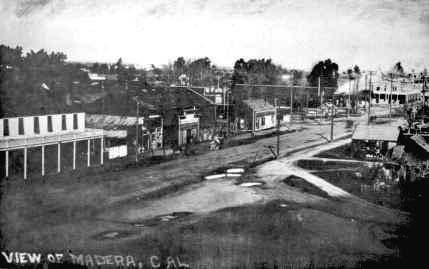
Town of Madera, east on Yosemite Ave, 1896

1895 Madera County Map
|
Town of Madera, east on Yosemite Ave, 1896 |
1895 Madera County Map |
Yee Chung listed on the Borden Chinese Cemetery site, is our ancestor Leong Yee Chong, with a slight difference in spelling. His wife Mrs Leong Chong testified in 1929 his death date was April 26, 1902. (7/25/01 note: according to Bill Coate, Madera County historian, Yee Chung is our man; see below).
 The
death records on the Bordon
Chinese Cemetery page were taken from a book by the Madera
historian
Bill Coate. The book is just on the Chinese in Madera County. I just
used the death records, but it has copies of newspaper articles and
much more you will want. You can contact Bill through his Madera
Method Project to find out where to obtain a copy.
The
death records on the Bordon
Chinese Cemetery page were taken from a book by the Madera
historian
Bill Coate. The book is just on the Chinese in Madera County. I just
used the death records, but it has copies of newspaper articles and
much more you will want. You can contact Bill through his Madera
Method Project to find out where to obtain a copy.
Borden had mostly disappeared by the turn of the century in favor of Madera. From looking at the names in the 1900 census for Township 1 (includes Bordon) and Township 3 (Madera) it appears that with the exception of a few cooks all the Chinese had settled in one community in Madera. I have attached the two census pages which included this group. It appears that the bottom of the pages smeared as they are this way on every copy I have seen. Maybe this will help you locate you ancestors. Feel free to ask more questions. Good hunting, Ken Doig, Madera GenWeb.
OK, looks like Bill Coate has our man ... he has a news story dated May 2, 1902 giving an account of Yee Chong's funeral at 9:30 am ... he was quite prominent in the community ... people from Fresno came to pay respects ... burial took place in the Borden Cemetery as we know, there were offerings of food at the grave site ...
According to Coate's records, Yee Chong was a partner with Man Wah who had the store next door to the Yee Chong store. Yee Chong was a truck farmer. However the press account gives Yee Chong as being a partner with Man Wah ... he said this may or may not be correct, and that Yee Chong may very well have had a separate store.
Man Wah died in 1890 and Yee Chong is given as his alleged partner. There was a huge dispute in Borden because the authorities wanted to have an autopsy on Man Wah, which the family refused to allow.
Going further to 1906, he has a written account of a dispute involving Tai, Ah Moy and Sun Kow. Seems like the Kow's gave Tai a helping hand and asked for Ah Moy's marriage to Sun Kow in return ... He said that the Kow family in Coulterville was fairly wealthy, especially compared to the people in Borden ... there was argument of going through with the deal, but Ay Moy married Sun Kow anyway.
Coate is confident that his students will uncover more information on Yee Chong because of his prominence in the community ... Coate also has the 1892 Historical Atlas of Fresno County and we will be able to locate the Dorn and Robert farms when we go up. They will also work on getting the location of the Yee Chong and Man Wah stores. He said there are no pictures in the records.
The Madera Courthouse fire in 1906: He said none of the records were destroyed, that the fire was upstairs in the granite building ... his students went through the mortuary records, plus they have info on everyone who was buried in the Borden Cemetery. He also has the 1880 census records.
In the meantime, his students will have 2 weeks to do some research prior to our August 15 visit ... our plan would be to meet at Coate's school, Sierra Vista Elementary. We would hope to get their by early afternoon to meet with the students who are helping with the research. School lets out at 2:30 pm. Coate's school number is 559 674-2879. Its a regular year round school.
The Borden Cemetery, he said, probably
had 100 to 200 burials.
The original markers were wood and destroyed by fire. The 7
replacement gravestones there now were done by someone who had an
elementary knowledge of Chinese, done in something he described as
grade school characters.
Bill Coate replied on 7/25/01 that he is now certain that our great-grandfather was the man known in Madera as Yee Chung. According to the newspaper, when he died, he was operating a fruit farm on the "Dorn" ranch. He is reported to have had a wife and seven children, one of whom was Ah Moy who later married the Coulterville merchant. Mr. Chung's obituary made the front page. This was a somewhat unusual for the times. He is reported to have had a store in Borden, prior to coming to Madera. Here is the kicker. It was Yee Chung who preserved the Borden Chinese Cemetery. He bought it from a farmer at a highly inflated price of $200 for 7/10 of an acre in 1891. At the time, land was selling for around ten dollars per acre. He then sold it to the Jung Wah Society for ten or fifteen dollars.
Truck Farming. The horticultural practice of growing one or more vegetable crops on a large scale for shipment to distant markets. It is usually less intensive and diversified than market gardening. At first this type of farming depended entirely on local or regional markets. As the use of railroads and large capacity trucks expanded and refrigerated carriers were introduced, truck farms spread to the cheaper lands of the West and South, shipping seasonal crops to relatively distant markets where their cultivation is limited by climate. The major truck farming areas are in California, Texas, Florida, along the Atlantic Coastal Plain, and in the Great Lakes area. Centers for specific crops vary with the season. Among the most important truck crops are tomatoes, lettuce, melons, beets, broccoli, celery, radishes, onions, cabbage, and strawberries. See L. C. Pierce, Vegetables (1987); O. A. Lorenz and D. N. Maenad, Handbook for Vegetable Growers (3d ed. 1988).
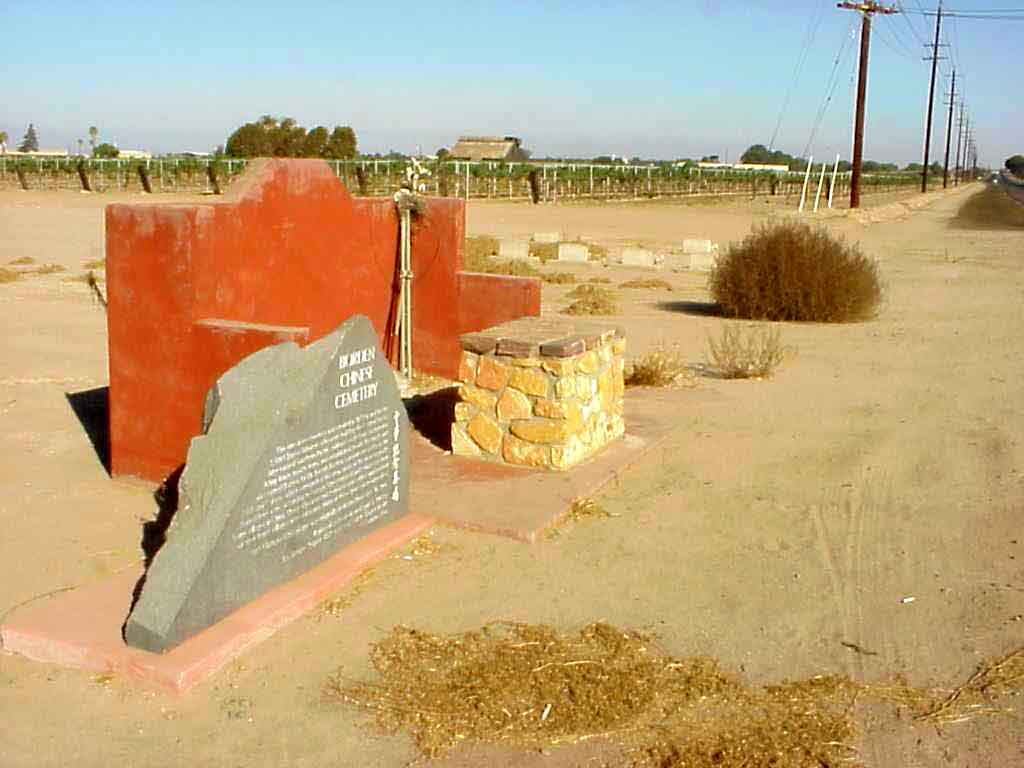
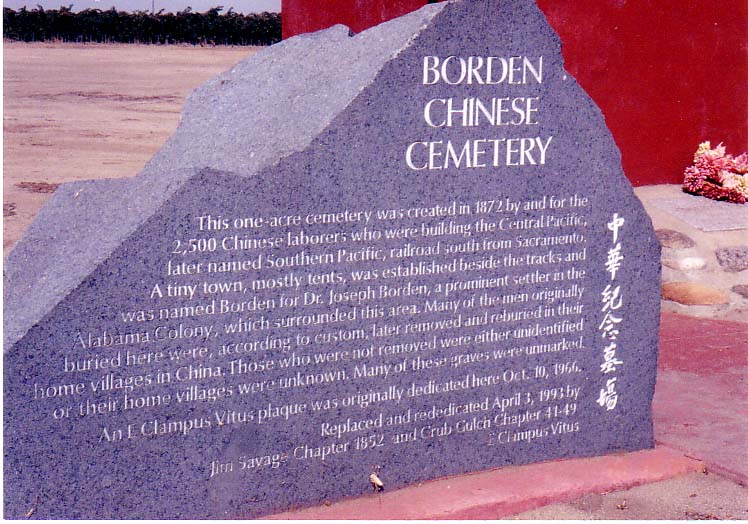
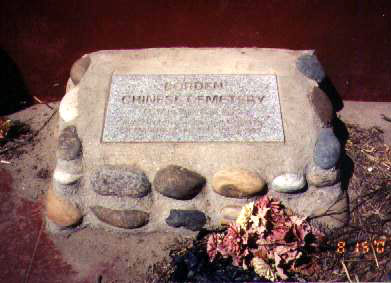
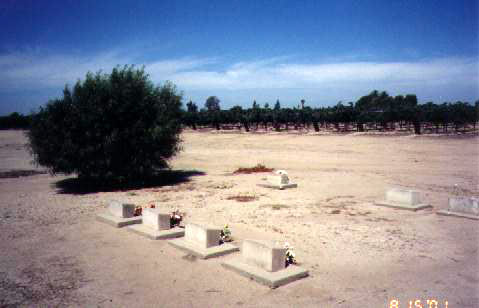
Borden Chinese Cemetery (pics from Grub Gulch chapter of E Clampus Vitus)
 |
 |
 |
 |
See also 1998 pictures from the Berkeley Digital Library sunset
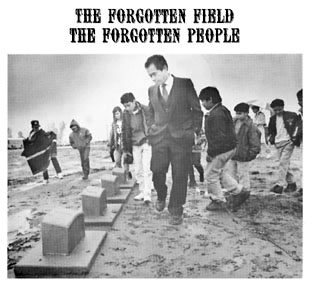 The Forgotten Field is an ineresting story on how the Madera
projects got started: Author Riving Stone got personally
involved with the students, came to the school and gave them a big pep
talk on how and why they should bring back hidden history to
light. This was in 1985. If anyone can spend some time at
the Bancroft Library at the University of California at Berkeley, there
are other treasures waiting to be found ...
The Forgotten Field is an ineresting story on how the Madera
projects got started: Author Riving Stone got personally
involved with the students, came to the school and gave them a big pep
talk on how and why they should bring back hidden history to
light. This was in 1985. If anyone can spend some time at
the Bancroft Library at the University of California at Berkeley, there
are other treasures waiting to be found ...
Chinese immigrants came to Madera County during the California gold rush. Many stayed on to work on local ranches and the Southern Pacific Railroad. Later they built their own communities and businesses. By the turn of the century, the Chinese community in Madera County had a 50 year history in this area.
In the early 1920's, a disastrous fire wiped out Madder's Chinatown, and its inhabitants decided not to rebuild; most moved to larger cities like San Francisco and Los Angeles. By the 1930's few traces of the Chinese in Madera County remained. Their cemetery, however, was one notable exception.
The Borden Chinese
Cemetery , four miles south of Madera, had been a burial ground
since the 1870's. For decades the Chinese laid their countrymen to rest
in the one acre parcel, but when they left the area, the field fell
into disuse, became weed choked, and was generally forgotten. 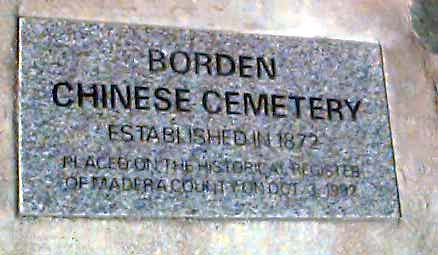 Chinese immigrants came to Madera County during the California gold
rush. Many stayed on to work on local ranches and the Southern
Pacific Railroad. Later they built their own communities and
businesses. By the turn of the century, the Chinese community in Madera
County had a 50 year history in this area.
Chinese immigrants came to Madera County during the California gold
rush. Many stayed on to work on local ranches and the Southern
Pacific Railroad. Later they built their own communities and
businesses. By the turn of the century, the Chinese community in Madera
County had a 50 year history in this area.
In the early 1920's, a disastrous fire wiped out Madder's Chinatown, and its inhabitants decided not to rebuild; most moved to larger cities like San Francisco and Los Angeles. By the 1930's few traces of the Chinese in Madera County remained. Their cemetery, however, was one notable exception. The Borden Chinese Cemetery, four miles south of Madera, had been a burial ground since the 1870's. For decades the Chinese laid their countrymen to rest in the one acre parcel, but when they left the area, the field fell into disuse, became weed choked, and was generally forgotten.
In January, 1992, the sixth grade
classes of James Morn School, upon
learning that the story of the Chinese in Madera County had never been
told, decided to fill this vacuum by investigating the Borden Chinese
Cemetery. The students conducted their own title search, poured
over census reports, death records, and old newspapers and compiled
the first serious study of the Chinese of their county. They unveiled
their work in a special ceremony on Change Min Day, 1992.  The Forgotten People, The Forgotten People
remains the most definitive study of the Chinese experience in Madera
County. See also
The Forgotten Field; The Forgotten People .
The Forgotten People, The Forgotten People
remains the most definitive study of the Chinese experience in Madera
County. See also
The Forgotten Field; The Forgotten People .
BORDEN: 3
miles southeast of Madera along the
Southern Pacific Railroad, north of Avenue 12 and divided by Highway
99. The area was populated in 1868 by families from Alabama and was
called Across after a plantation in Alabama owned by one of the
settlers. When the railroad came in 1872 the name became Borden, for
Dr. James Borden, a leader of the community. Borden PO was opened in
1873, closed for 3 months in 1896, and closed in 1906 in favor of
Madera. The exact coordinates of Borden: 36 55 48 x 120 01
32. Borden was only 3 miles from Madera; it was included in
Madder's Township #1. Madera didn't become a town until
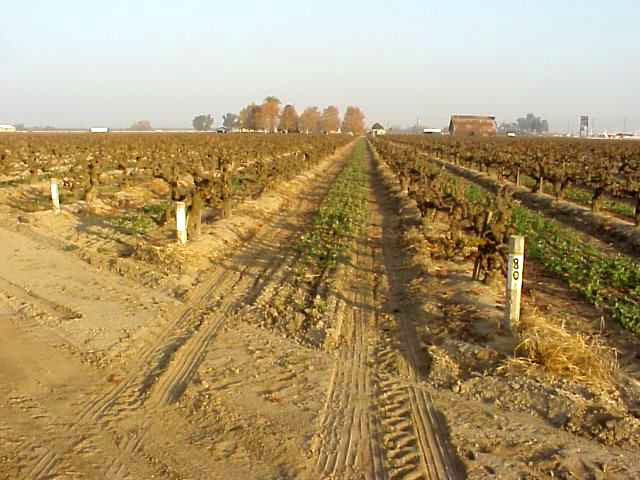
1907. Attached is a picture of Borden; not much to see
except some dusty vineyards. We must have passed by countless
times on 99. Don't recall a sign for Borden Road. Borden
was in District 1 (one) in Madera County:
http://www.cagenweb.com/madera/1900-1.htm, according to Kenneth Frank
Doig, Madera GenWeb <[email protected]>, 6/11/01. Madera
County records show that HC Borden was Justice of the Peace in Township
3. Also, many of the voting records were lost in 1906 when the
Madera courthouse burned, but the Chinese did not vote in those days,
anyway. Only census data would have everyone.

|

|

http://memory.loc.gov/cgi-bin/map_item.pl (1877)
On the web, there is an old map company which has the Great 1891 Atlas of Fresno County. One of the pages is for Borden and the surrounding area with land owners indicated. Ron rolled the dice and ordered a copy. If lucky, we would have found the exact location of the Leong family farm... The Borden map showed the layout of the town, 12 blocks. Nearby land gives landowner names, but no Chinese on there. Most of the land owned by Miller & Lux families.
A first impression of Madera County by a Tennessean: "The appearance of the country in general was not what I had expected to see. The through train does not stop at Borden, so I had to go to the next town to get off which is Madera.
I walked back to Borden and found that Mr. Etter had just left. I had some trouble to get out to where he lived. I walked a good deal during the day. Whatever beauties this climate possesses in winter, I found it rather warm to walk much with a coat on in the summer. The thermometer registered 102 in the shade. Drinking water warm, yards dry, bare and dusty. A great many have their garden in the yard, where they can irrigate with the windmill from the well.
Wheat in this community is not near so good as I expected to see it, but they remind me that this is a newly settled neighborhood, and that they have not had time to beautify their houses and fix things up generally -- and that most of the wheat that I see is first year's land, and a good deal of it put in too late and wet.
When I see more of the country and get better prepared to write about its merits and demerits, I will probably write again.
I want to say in conclusion, that I received an exceedingly warm and hearty reception from the homes of my Tennessee friends here."
C. F. BONNER.
Borden, Cal., May 20, 1886.
1900 Madera Co Third Township Census (1) (2)
History of Fresno County with Illustrations, 1882 p 118 Alabama settlement pioneers
p 119 The settlement abandoned, 1874-75
p 185 Fresno county population, 1870
p 194 Fresno county exports, 1880
p 198 Madera Flume & Trading Company, 1878
p 199 Borden founded
Beth Moreno June 19, 1976 For twenty years, the Chinese
continued to labor in the mining camps of what is
now Madera County. Then in 1872 the
Central Pacific Railroad laid its tracks
through the San Joaquin Valley, changing
the demographics of the local
Chinese community tremendously.
Many workers came out of the hills to
obtain employment with the railroad, and
many of them stayed in the valley.
The line began at Lathrop, near
Stockton, and as it came south, numerous
railroad towns were created in its
wake. Averaging a mile per day, more than
2,000 Chinese workers laid tracks across
the Chowchilla River and headed
toward the Fresno River. By the
summer of 1872, the town of Berendo and
further south, Borden, were established.
Borden was created near what
was then known as the Alabama Settlement. The
end of the Civil War had left many areas
of the South desolated and impoverished.
In 1868, three plantation owners from
Alabama and Mississippi were delegated by
a company of their friends to go to
California and select lands for new homes. After
an investigation this advance guard
decided on certain lands in what was then
Fresno County, along Cottonwood
Creek. The soil was reported to be of great
fertility.
The three men, S.A. Holmes,
C.A. Reading, and L.A. Sledge, visited the locality,
returned to Stockton to file on the
lands, and purchased building materials. This trio
of plantation owners built small
two-story houses on their claims and then sent for their friends
in the south to come and join them.
The ex-Confederates sailed
to San Francisco and were brought by riverboat
to Stockton. There they bought
additional supplies and proceeded south by horse
and wagon to a rendezvous with Holmes,
Reading and Sledge.
These first settlers in what
is now the Madera County portion of the San Joaquin
Valley tried to start life anew in
a treeless expanse of plains with no neighbors
closer than 25 miles.
The nearest towns were Millerton and Firebaugh, and of
course there was no railroad
at that time. One of the leading members of the
settlement was Dr. Joseph
Borden, his wife, and their five children.
When Governor Leland
Stanford, president of the Central Pacific Railroad, made
his tour in 1872, inspecting the
newly laid tracks, he was overcome by southern
hospitality when he reached the
Alabama settlement. Dr. Borden invited Stanford
to his home, where the Governor
stayed the night. The next morning, Stanford let
it be known that this railroad
town was to be named Borden, in honor of his
gracious host.
Many new businesses
were quickly established in Borden, and one of the
first was a store opened by Man
Wah (also known as Man Wa Chan and Wan Wo Chan),
a Chinese trader who had started
in the placer mines and later opened a store
on the Fresno River, not far from
that of James D. Savage. Man Wah's store in
Borden was a general merchandise
store, and he quickly gained a reputation
for fair dealings with his Anglo
neighbors. It was told by survivors of the colony
that Man Wah and later his partner
Yee Chung, extended
credit to the hard pressed
residents of Borden, sometimes when aid from other
sources was withhold. Man
Wah prospered sufficiently to import an "expensive"
bride from China.
Borden developed over
the next few years into a prosperous place on the map of
Fresno County and attracted a
large number of Chinese, many of whom had helped
lay the Southern Pacific tracks in
1872. Within a short time a "Chinatown" developed
in Borden, the first such
community in the San Joaquin Valley between the Chowchilla
and San Joaquin Rivers. It
lay on the west side of the tracks on what is now the
intersection of Avenue 12 and
Highway 99.
The mortality rate
was high among the Chinese, so a small cemetery was early
established at the southwest
corner of Section 32, Township 11, and South
Range 18. The dimensions
were 150 by 250 feet. In this plot, the Chinese
laid their departed loved ones to
temporary rest.
The California Lumber
Company laid a 54-mile flume to transport logs. Instead
of ending at Borden, a site was
chosen closer to the Fresno River which became
the town of Madera.
Borden went into a decline.
Not all of the residents of
Chinatown moved to Madera because of the lumber
business. Yee Chung moved to
Madera from Borden to farm. He planted most
of the peach, apricot, and plum orchards
sourthwest of town. Many people in
Madera would come and cut fruit for Yee
Chung, most of them camping out in
the orchards instead of travelling back
and forth to town. Besides having an orchard,
Yee Chung also ran the store at the
Adobe Ranch, which was owned by Brooke Morgan.
|


