















 |
| Should the death penalty be reinstated? |

South Africa's geography
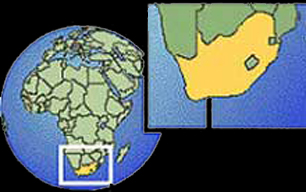
South Africa occupies the southern tip of Africa, its long coastline stretching more than 2 500km from the desert border with Namibia on the Atlantic coast southwards around the tip of Africa and then north to the border with subtropical Mozambique on the Indian Ocean.
The low-lying coastal zone is narrow for much of that distance, soon giving way to a mountainous escarpment that separates it from the high inland plateau. In some places, notably the province of KwaZulu-Natal in the east, a greater distance separates the coast from the escarpment.
Although the country is classified as semi-arid, it has considerable variation in climate as well as topography.
The great inland Karoo plateau, where rocky hills and mountains rise from sparsely populated scrubland, is very dry, and gets more so as it shades in the north-west towards the Kalahari desert. Extremely hot in summer, it can be icy in winter.
In contrast, the eastern coastline is lush and well watered, a stranger to frost. The southern coast, part of which is known as the Garden Route, is rather less tropical but also green, as is the Cape of Good Hope - the latter especially in winter. This south-western corner of the country has a Mediterranean climate, with wet winters and hot, dry summers. Its most famous climatic characteristic is its wind, which blows intermittently virtually all year round, either from the south-east or the north-west.
The eastern section of the Karoo does not extend as far north as the western part, giving way to the flat landscape of the Free State, which though still semi-arid receives somewhat more rain. North of the Vaal River the Highveld is better watered and saved by its altitude (Johannesburg lies at 1 740m; its annual rainfall is 760mm) from subtropical extremes of heat. Winters are cold, though snow is rare.
Further north and to the east, especially where a drop in altitude beyond the escarpment gives the Lowveld its name, temperatures rise: the Tropic of Capricorn slices through the extreme north. This is also where one finds the typical South African Bushveld of wildlife fame.
Those looking for an opportunity to ski in winter head for the high Drakensberg mountains that form the eastern escarpment, but the coldest place in the country is Sutherland in the western Roggeveld Mountains, with midwinter temperatures as low as -15ºC. The deep interior provides the hottest temperatures: in 1948 the mercury hit 51.7ºC in the Northern Cape Kalahari near Upington.
Average temperatures in ºC
Summer Winter
Cape Town 20 12.6
Durban 23.6 17
Johannesburg 19.4 11.1
Pretoria 22.4 12.9
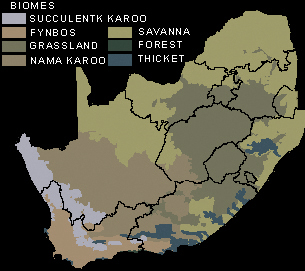
South Africa has seven major terrestrial biomes, or habitat types - broad ecological life zones with distinct environmental conditions and related sets of plant and animal life.
Select A Province
| Eastern
Cape Northern Cape Western Cape Free State Limpopo North West KwaZulu-Natal Gauteng Mpumalanga |