













 |
| Should the death penalty be reinstated? |

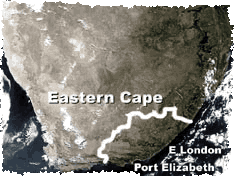
Eastern Cape
Situated in the south-eastern section of the country, the Eastern Cape is endowed with great natural beauty, particularly in the rugged, rocky cliffs and dense green bush of the stretch known as the Wild Coast. The Indian Ocean here is temperate.To the north-west the province borders on KwaZulu-Natal and meets the southern tip of the Drakensberg range; further south, mountains and hills predominate, the northern section in the dry Karoo being flatter.
The long curve of coastline, large area (at nearly 170 000 square kilometres covering 13.9% of the country) and the considerable east-west and north-south distances it covers provide the province with extremely varied vegetation.
Situated on Algoa Bay is Port Elizabeth, the largest city. The capital is Bisho and other important towns include the port of East London and, inland, Umtata, Uitenhage and Grahamstown.
The main industrial centres are Port Elizabeth, East London and Uitenhage, the latter known for its automotive manufacturing industry. There is much fertile land and agriculture is important. Fruit, especially pineapples, form a significant crop; coffee and tea are also cultivated. Maize and sorghum are grown and cattle farming is of particular significance as a subsistence activity; sheep farming predominates in the Karoo.
There is excellent potential for forestry - the coastal areas receive good summer rainfall and have a moderate climate, becoming more sub-tropical to the north-west. The Tsitsikamma National Park on the southern border is home to dense indigenous forest.
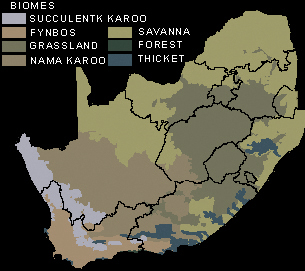
South Africa has seven major terrestrial biomes, or habitat types - broad ecological life zones with distinct environmental conditions and related sets of plant and animal life.
Select A Province
| Eastern
Cape Northern Cape Western Cape Free State Limpopo North West KwaZulu-Natal Gauteng Mpumalanga |