













 |
| Should the death penalty be reinstated? |
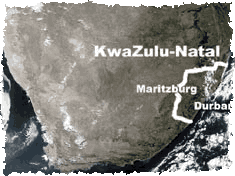
KwaZulu-Natal
One of the greenest and best-watered areas of the country is KwaZulu-Natal which accordingly, although it has only 7.6% of the area, is the second most populous province.Lying in a broad strip with the Indian Ocean as its western border, it borders on Swaziland and Mozambique to the north. Its western border is marked by the dramatic Drakensberg mountain range which has several peaks well over 3 000m, and its topography combines mountainous areas, rugged green hills and deepcut valleys.
Between the mountains and the humid, subtropical coastline is savannah grassland, but there are also areas of indigenous forest here and along the coast. The largest of its many rivers is the Thukela.
It is a summer rainfall area, with a climate that ranges from extremely hot along the coast in summer, to heavy snow on the mountains in winter. The Midlands are drier than the coast and can be very cold in winter.
KwaZulu-Natal has two capitals: the more southern Pietermaritzburg (the province's second-largest city) and Ulundi, the traditional capital, in the north (the two capitals a reflection of the province's coalition government). Both are inland. The largest city is Durban. South Africa's two biggest harbours are situated in Durban and Richard's Bay - the latter a comparatively small town, its harbour specialising in bulk exports, especially coal which is mined in the interior. Heavy minerals are mined at Richard's Bay. Durban's is the busiest port in sub-Saharan Africa.
Other major towns are Ladysmith, Newcastle and Estcourt.
A world-renowned feature of the northern coastline is the St Lucia Estuary: the Greater St Lucia Wetlands Park is a World Heritage Site (as is the uKhahlamba Drakensberg Park). There are several game parks in KwaZulu-Natal.
The fertility of the soil and comparatively good rainfall - more than 1 000 mm a year - make agriculture central to the economy. Sugar cane and tropical fruit are major products of the coastal belt. Dairy, stock and vegetable farming are important inland. Other land uses include forestry and tea plantations.
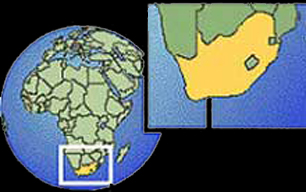
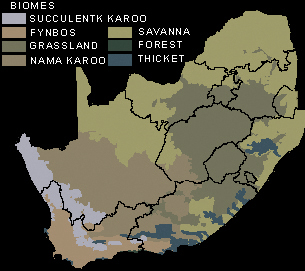
South Africa has seven major terrestrial biomes, or habitat types - broad ecological life zones with distinct environmental conditions and related sets of plant and animal life.
Select A Province
| Eastern
Cape Northern Cape Western Cape Free State Limpopo North West KwaZulu-Natal Gauteng Mpumalanga |