









 |
| Should the death penalty be reinstated? |
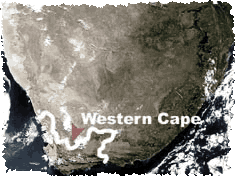
Western Cape
If three pyramids are the symbol of Africa's far north, then a flat-topped mountain is the symbol of its far south. Inner Cape Town nestles in the curve of Table Mountain at the start of the hook-shaped Cape Peninsula, which ends in the needle-point cliffs of Cape Point.The erroneous belief that this is the meeting point of the Indian and Atlantic Oceans persists. This is actually further south at Cape Agulhas, but certainly the waters of the eastern bay of the peninsula are warmer than the Benguela-chilled western waters.
The Peninsula, world-renowned for its beauty and home to the major urban concentration, is in the province's far south-west but may reasonably be regarded as its heart. At a total area of 129 370 square kilometres, this is the country's fourth-largest province but is dealt with here in third place for the convenience of keeping the three Cape provinces together. It is slightly smaller than the Free State although each occupies about 10.6% of South Africa's land area. Like the Eastern Cape, the Western Cape is topographically and climatically varied. It has a temperate southern coastline fringed with mountains; here the typical vegetation, especially in the western section, is the famed fynbos. To the north it stretches deep into the Karoo plateau; its western coast is extremely dry.
The winter rainfall of the peninsula and its mountainous neighbouring inland area provides ideal conditions for the cultivation of grapes, with numerous vineyards producing excellent wines. Other fruit and vegetables are also grown here, and north and east of Cape Town wheat is an important crop.
The southern coastal area is also fertile; fishing is the most important industry along the west coast. Sheep farming is the mainstay of the Karoo, and other forms of husbandry take place in the better watered parts of the province. While various industries are active, particularly in the Cape of Good Hope area, tourism is extremely important economically.
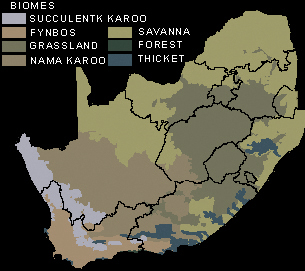
South Africa has seven major terrestrial biomes, or habitat types - broad ecological life zones with distinct environmental conditions and related sets of plant and animal life.
Select A Province
| Eastern
Cape Northern Cape Western Cape Free State Limpopo North West KwaZulu-Natal Gauteng Mpumalanga |