
|
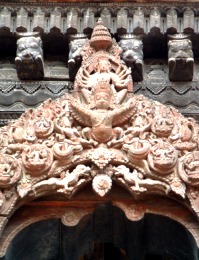
Wood
Carving, Patan
Virtually all of Nepal's art, except for works by a
handful of little-known contemporary artists, is religious in nature and expresses
both Hindu and Buddhist iconography. Religious expression in art has taken
the form of stone, wood, terra-cotta, and metal statuary, as well as paintings
on canvas and paper. Much of this artwork is on display in temples and palaces
throughout the Kathmandu Valley and other parts of the country. There are
also five museums in the Kathmandu Valley devoted to the art of Nepal (one
in Kathmandu, one in Patan, and three in Bhaktapur).
The Malla dynasty, which lasted from 1200 to 1769, witnessed a flowering of
the arts, primarily in the 17th and 18th centuries. Sculptures of Buddhist
and Hindu deities in bronze, wood, and terra-cotta from this period are on
display at the National Museum.
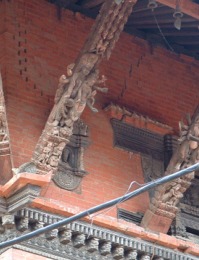
Arguably the most famous works of art in Nepal are the erotic roof struts
on many of the country's pagoda temples. These carved wooden struts display
men, women, and animals in various graphically erotic poses.
The decorative arts have long been a part of Nepali
culture, and almost no household item went undecorated until recently when
the plastics entered the markets. Water pots, vases, and pitchers, traditionally
made of brass and copper, are beautifully decorated with simple patterns.
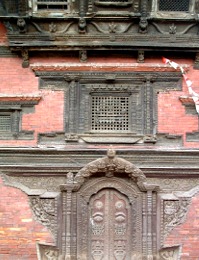
Wood carving, which was centered here, was used on everything from butter
churns and knife scabbards to windows and door frames. Today,
the roof struts and windows of the Malla period are the main attractions of
the Kathmandu Architecture..
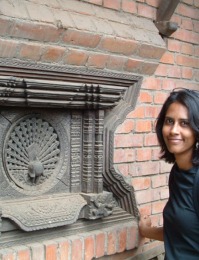
The peacock window on Bhaktapur's Pujari Math, a former Hindu priests' home
and now the National Woodcarving Museum, is considered the finest example
of the wood-carver's art, though the windows on the Kumari Bahal on Kathmandu's
Durbar Square are even more beautiful.
*** One unusual form of folk art still practiced today is the painting
of bicycle rickshaws, trucks, and buses with colorful designs and sometimes
even landscapes. Keep your eyes open for such rolling artwork as you walk
the streets of Kathmandu.
Wood
& Architecture in Kathmandu
From the start of the Malla period woodcraft along
with architecture started to thrive and reached its pinnacle when the Valley
was divided into three Kingdoms. As the three kings rivaled each other to
improve the magnificence of the country, more beautiful crafts were created
to outdo the others. Most of the woodwork and wood sculpture adjunct to
architecture in different forms are from the Malla period.
For example, King Pratap Malla of Kathmandu, being fond of the Viswarupa
of Lord Vishnu, had it created in wood and placed it over the Hanuman Dhoka
in his palace. These crafts have survived many calamities or have been quickly
reconstructed after their destruction. Each of the three kingdoms have their
own Durbar Square, which were the most extensively decorated of all places
in the kingdoms and each had a temple for Goddess Taleju erected as she
was the personal deity of the kings.
The wooden artifacts of those days are usually sculptures of deities, demons,
and animals, tudals (small columns to support overhanging roof but exclusively
decorated), carved and lattice windows revealing intricate designs and peacocks,
and doors, pillars as well as others. The woodwork in Kathmandu seems independent
from outside influences except for the fact that the designs of these woodworks
were essentially based on Holy Scripture, stylized mythical structures,
related to the paintings in different texts, or conventional designs such
as curves, lotuses, flowers, and fire. Some of the ancient wooden sculptures
found are