
|
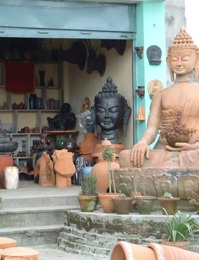
Pottery
in and around Bhaktapur
Pottery flourishes in Patan and Thimi, a locality near
Bhaktapur. Common forms of pottery are terracotta oil lamps used to light
homes during the festival Dipawali, and flower pots decorated with peacocks
and elephants.
Bhaktapur is well-known for giving continuity to this age-old profession.
It has survived modernization and augments Bhaktapur’s unique identity in
preserving heritage. Since there is no special season for using such vessels,
the business of making pots keeps the local potters occupied through the year,
except during planting season when they are totally occupied in the fields.
Pottery is a way of life for these people, and they have become so habituated
to it that they have no fixed hours for sitting at the wheel, creating new
pots. In Bolachhen or Talakwa which is popularly known as Potters’ Square,
the inhabitants proudly boast of it as the traditional place for making pottery.
True to its name, this square is never free of pots drying in the sun. Khutruke
or the piggy bank is the most popular item produced here and plays a very
crucial role in their business.
Shiva Prasad Prajapati, one of the potters says “If it were not for these
khutrukes, our livelihoods would completely die out. Around 100 of these are
produced in a day. But depending on the situation, sometimes almost half of
them get destroyed while making them and there are other times when all hundred
turn out excellent”. This is a problem they have to face at all times and
with any vessel they make. The breakage is usually caused by insufficient
sunlight.
Suryamadhi a few minutes walk from the Dattatreya is another area famous for
pottery. However, the products found here are quite different from the ones
available at Potters’ Square. Here, the potters are predominatly occupied
in making such pottery as Sanli or vessels for drinking alcohol and Dhau bhega
or curd containers. On the other hand, the people of Thimi are famous for
making huge utensils. With changing times, the shapes and designs of their
products have also been modified. Merging new ideas to the traditional, these
contemporary styles are much in demand. The traditional products include pots
and huge vessels which are especially made for household purposes like cooking,
washing laundry, preparing and keeping alcohol, etc. The smaller ones comprise
of vessels like Khutruke, water container, bowls to drink alcohol besides
candle-stands. With the advent of plastic utensils, the use of earthenware
is on a decline, which has an immediate impact on the pottery market.
Pottery also has a potential market among tourists as well as expatriates,
these potters produce small decorative pieces.
Their use seems to be fading with time. Previously people came into town and
stayed the night and headed back loaded with earthenware. 75 year old Jagat
Bahadur Prajapati reminisces, “I walked all the way to Tistung, Palung and
other such places all alone, carrying these goods in a kharpan on my shoulder
and a ‘laltin’ lamp in my hands. Though difficult, it was a joyous walk which
usually lasted for three days.”
He further states “Unlike today, it was very peaceful back then. One never
had to worry about being attacked by a Maoist. In fact people would welcome
me to stay at their homes and offer lunch and dinner.”