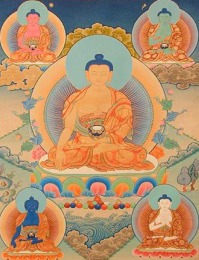
Tanka
Painting
A tanka (than-ka) is a portable religious painting on cloth. It is, in western
Tibet, usually painted on coarse cotton weave which has been sized with a
mixture of animal glue, chalk, and water. In paintings wider than eighteen
inches, there is quite often a verticle seam joining two pieces of cloth because
the local looms did not produce wider pieces.
Pigments are either mineral or organic, producing rich colors compared to
the garish modern chemical paints used in present day tanka painting. The
painting is set in cloth borders which are supplied with rods at the top
and bottom so that the painting may be hung or rolled up for storage or transport.
The western Tibetan paintings in the Koelz collection quite often have only
a plain dark blue cloth at the top and bottom of the painting.
Since tankas are portable, there is no guarantee that any tanka was actually
painted at the monastery where it was acquired. There are several aids to
stylistic analysis available to the art historian: comparison with dated tankas;
original wall paintings in situ in dated buildings; identifiable historical
subjects within the paintings; types of materials used for both paintings
and boarders; and literary references.
The styles of painting in Ladakh seem to have been largely influenced by the
different religious movements which came into the country over the centuries.
Although Tibetan art cannot be understood without knowledge of the doctrines
of Mahayana
Many of these have borders, often of brocade, on all four sides. The borders
on central Tibetan paintings have an iconography of their own which surrounds
the subject of the painting. In essence the painting along with its borders
encompasses the entire universe; the painting rises from its source as if
on a lotus pedestal and is symbolically surrounded by the earth below, the
sky above, and the Buddhist teachings on either side.
I
am putting in this category as i was particularly interested in the art form,
and i think even though on the expensive side, this is truely a genuine thing
to carry back home from Nepal or Tibet
Styles of Tanka Painting
The Tibetan art historical sources credit the Nepalese style of painting as
the major source for the develpoment of the Tibetan styles. The Nepalese style
itself developed from the earlier Indian Pala style. The influence of the
Kashmiri style was also felt, particularly in the style of western Tibetan
painting.
The development of various Tibetan styles reflects in several cases the incorporation
of Chinese infuences into the basic Pal-ri style. Such is the example of the
oldest style of Tibet itself, Man-ri. The beginnings of this style of painting
are credited to Manla Tontrop in the early fifteenth century, and the major
characteristic of the style is supposed to be the tradition of Chinese influences
from the Mongol period.
The second Tibetan style was born 150 years later, in the mid-sixteenth century,
under the hand of Jamyang Khyentse Wangchuk. The Khyen-ri style also showed
Chinese influence in the addition of certain formalistic conventions, a new
background treatment, and much attention to detail. This style later merged
with the "new" Man-ri to become the nineteenth-century Lhasa or Central Tibet
style of painting.
The third and most complex Tibetan style was Gard-ri, or Karma Gard-ri, which
was founded by Trulku Mankha-trashi during the second half of the sixteenth
century. The style grew from classical Man-ri sources and was the Tibetan
style most strongly influenced by Chinese painting.
The seventeenth-century beginnings of Man-ri Sarma, or the New Man-ri style,
are attributed to Choying Dorje. The use of richer colors and meticulous attention
to detail are characteristics of this school, said by Kongtrul to have been
influenced by Kashmiri style.
The movements mentioned above all have their roots in either central or eastern
Tibet, but there are several other styles of painting which; though from outlying
areas, are represented in the collection.
Drug-ri is the name given to painting in the style of Bhutan. The seventeenth-century
painter Trulku Mipham-chopel seems to have introduced painting as a disciple
to Bhutan with a style that was a combination of classical Man-ri and Khyen-ri.
The outgrowth of these styles, combined with an indigeneous Bhutanese palette,
produced a distinctive Bhutanese style.
The style of Guge, Guge-ri, a district in western Tibet recorded in the chronicles
as having once been under the rule of Ladakhi kings, was first discussed by
Giuseppe Tucci who had traveled in that area in 1933 with Captain E. Ghersi.
John Huntington has also written on the painting style in the Guge region
from the tenth century, citing first the kashmiri influence, then the Nepalese,
and finally the influx of the New Man-ri style with the dominance of the Gelukpa
or Yellow hat sect by the beginning of the eighteenth century.
Sometimes painting styles are also designated by the name of the sect which
uses them rather than by geographic region--for example, Kadam-ri painting
of the Kadampa sect. There are also minor movements which have developed out
of local traditions, and there are paintings broadly designated as "folk"
paintings.
In summary, the styles of painting practiced in Ladakh seem to have been largely
influenced by the different religious movements that came into the country
over the centuries. The early Kashmiri influences are well documented in the
twelfth-century paintings. There seems to be no documentation of extant wall
paintings of the Gelukpa building-period of the fifteeth century, but influences
from Tibet proper would also have come from the Drigunpa additions in the
sixteeth century. Many of the same influences which were felt in Ladakh by
the sixteeth and seventeeth centuries seem also to been felt in Guge. Paitings
at Tsaparang Monastery in Guge, published by Giuseppe Tucci, bear a strong
resemblance to some of the Ladakhi paintings in the Koelz collection and at
Basgo for instance. The latest artistic infusion from a new sect seems to
have come from the Bhutanese Drukpa in the seventeeth century. The training
of monks in either Lhasa or Bhutan would have kept the channels of communication
open for changes in the local styles of painting.