
|
Bhaktapur,
"Khwopa", or "City of devotees"
On our second day in Kathmandu, we came across another
really nice taxi driver who acted as our guide for the last day in kathmandu.
His name was Ravi Lama, we told him how much time we had and if he could suggest
what we could do in the mean time. He then Suggested patan and so we drove
on...
** I can not
help but mention that Ravi charged us NR 700 to take us all over the place
and was very helpful and stayed with us for more than 10 hrs. For all that
NR is app 10 Dollars! This was as we landed up paying twice the amount he
expected. Please- if you visit Nepal, use the services by the local people.
Their cars are not fancy and they are not air conditioned. Firstly you do
not need air conditioning in Nepal, and secondly the car takes you from point
A to B, thats all that matters...
Coming back to Bhaktapur...Renowned for its elegant art, fabulous culture
and indigenous lifestyle. Majestic monuments,the native Newars best known
for their long history of craftsmanship, the ancient city is also the "Living
Heritage" .Bhaktapur is more like an open museum, and the ambiance here is
such that it instantly transports you back into the centuries
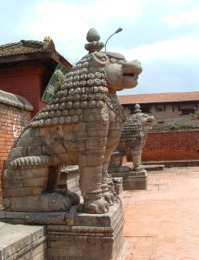
The Durbar Square—a World Heritage site listed by the UNESCO. Strewn with
unique palaces, temples and monasteries. Amongst all this to admire is the
exquisite artwork in wood, metal and stone in the palatial enclave .Adding
to all this are the Himalayas that makes the backdrop of the city. Stretching
all along the township, the panoramic Himalayain the skyline keeping a watch
over the city’s splendor.
At 1,401 meters above sea level, spread over an area of 6.88 square kilometers.
It grows from a collection of villages strung along the old trade route between
India and Tibet. The capital city of the Greater Malla Kingdom till the 15th
century AD, Bhaktapur was founded in the 12th century by King Ananda Malla,
but it was only in the early 18th century that this city took its present
shape. It was at that time that many of Bhaktapur’s greatest monuments were
built by the then Malla rulers.
Wood
& Architecture influences in Bhaktapur
Monumental masterpieces in Bhaktapur are innumerable,
and each is more attractive than the other. Mostly terra-cotta structures
supported by carved wooden columns, elaborately carved struts, windows and
doors, gilded roofs and pinnacles, open spacious courts all around and,
above all, the fascinating divine images presiding over the monument—many
edifices have many things in common, yet their varied shape, size and designs
make the one even more wondrous than the other. Furthermore, each of their
components reflects the religious belief, social outlook and the economic
status of the builders, and the monuments in all carry along a rich artistic
tradition of the native Newars.
In Bhaktapur, one confronts a smaller or larger monument almost at every
ten or twenty steps.
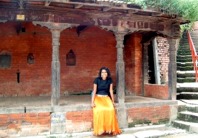
The presence of various monuments in Bhaktapur is still awe-inspiring.