There is an area scientists now call the "Life Zone" where a planet is just far enough away from the Sun that it's radiation and heat will not destroy organic life, but close enough that it does not spend it's time in an eternal icy age.
Only at this tenuous distance is life possible, and our Earth lies within this favorable zone.
Of all of the planets in our Solar System, none other has this distinction; Mars is too far away, and Venus and Mercury are too close for life to be possible as we know it. Here we find Gaia, or Mother Earth, a living being whose Nature seeks to produce increasingly evolved and varied species of life over its vast lifespan.
In addition, the Earth has the distinction of being the only inner planet with a moon, a satellite only found in the greater or outer planets, such as Jupiter, Saturn, Uranus, Neptune and even Pluto. The importance of the Moon to the evolution of life on the Earth cannot be underestimated due to the intimate and critical relationship between the Moon and the gravitational forces which create tidal motion. Without the rhythm of the moon's cycles, no life could evolve on the Earth.
Mother GAIA
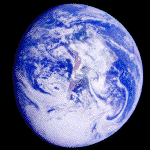
Therefore, the Sun AND the Moon are both essential for life on Earth to have evolved at all. On our tiny blue marble, a miracle has happened which cannot be dismissed as a chance occurance. The presence of organic life (especially in the abundant evolutionary diversity with which we find life on Earth flourishing) can only be the result of the manifest will of an intelligent lifeform like Gaia, striving to create other lifeforms in which to see her reflection and know herself better.
Humankind appears to hold the position at the top of the food chain, having no real predators, and unwittingly becoming the voice, the spokes-species, for Mother Gaia. We have a great responsibility as the stewards of Gaia to speak for her, to give her voice. We cannot look at the influence mankind has had on Gaia, even in just the last century, without seeing the profound changes we have created.