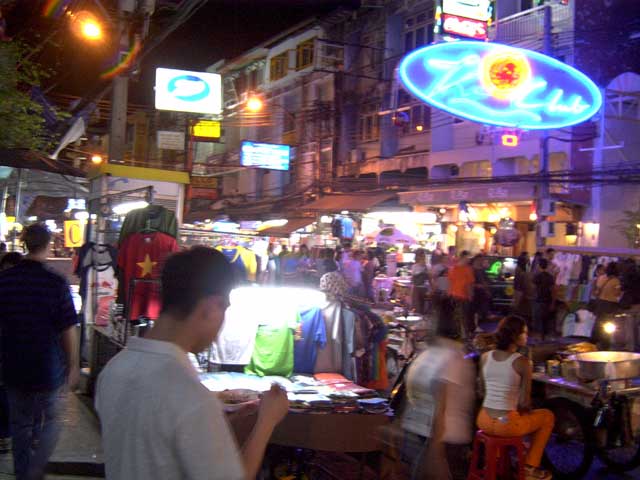
| What really brings me to Bangkok? The culture, people, temple, attractions? None of these come into the mind as I booked my flight. But, all is answered towards the end of the trip. There's certainly no better word to describe how vibrant and friendly a city like Bangkok has existed. Despite the short stay, the experience and all the encounters had all proven that Bangkok was the right destination for a holiday. Arriving on 19 Sep 2003 (Friday) without a reserved accomodation, making my way to the backpackers' district at Khao San area under the hot sun (33 degree celsius) was indeed a challenge. Looking like a tourist in distress, I was surprisingly approached by a kind local Thai (who doesn't speak a word of English!) who unknowingly directed me to Banglampoo district (near Khao San Road). The kind deed from this local Thai touched me quite a bit and really, he made me felt at home. On my own judgement, I managed to find my way to a relatively isolated guesthouse in Tanao Road. After a quick cold shower, followed by a rest and having settled down, it was then time to kick off a Thailand adventure. Thailand is located in the centre of South East Asia sharing common borders with Myanmar, Laos, Cambodia and Malaysia. 5 of its distinctive regions in central, southern, northern, eastern and north-eastern, each has its own unique natural and cultural attributes. Of the 60 million people, 80% are ethnic Thais, 10% Chinese, 4% Malay plus Lao, Mons, Khmers, Indians and Burmese - reflecting the country a long history at the crossroads of South East Asia. This trip to Bangkok wasn't a long one so I intended to fully utilise all the available time I could have to see as much as I could. Off Banglampoo area, in particular and around Khao San Road, the stretch is definitely home to a very lively traveller, where backpackers call it a backpacker paradise, not only because of a mass of budget accomodations. In the evening, the 200-metre long street is closed and becomes a delightful square for people to gather, to meet, to shop. On both sides, the shops, restaurants line up as an extensive market with a huge range of goods, from cheap cloths to Thai handicrafts to used travel guide books. Furthermore, one could do or discover any of the following here, after 10 am : - get hair done in a 'rasta style' - pierce your tongue, tattoo you body with any decoration - surf the net for FREE for 30 minutes in 'The Connection' - have any international recognised certificate or identification tag 'created' in an hour (Believe me, it looks too real to tell the difference!) - enjoy a jug of local Thai beer in a pub, while chatting away with other backpackers - braving the gut to taste roasted scorpions - source for the most economical airfare or tour packages from the rows of competing travel agencies Overall, Khao San is both referred to as a locality, as well as, a foreign district. While indulging in an atmosphere as a backpacker, one is also treated to a surrounding with local Thai culture. The cosmopolitan mix of eternal activity doesn't stop the local Thais from coming here. This friendly and enticing place is exactly where both the locals and foreigners come to enjoy. |
| Thailand - Land of A Thousand Smiles |
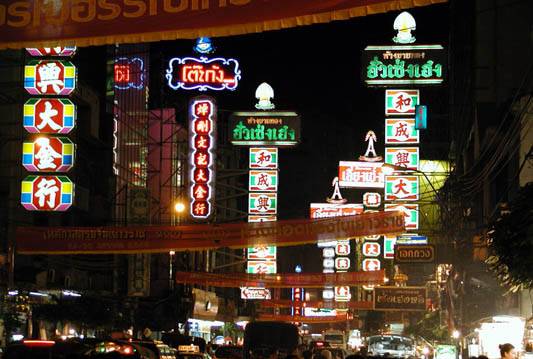
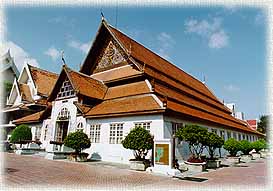
| Starting early on Saturday morning, I made my way towards Sanam Luang (Royal Ground) wanting to visit the nearby Grand Palace. But the palace was not opened to the public in the early hours as the royal family was offering prayers in there. With the guidance and recommendation from the local Thais and a kind tuk-tuk driver, Suban drove me to visit Wat Indhara first. Wat Indhara was the only Thai temple I visited in Bangkok. What made the temple known was the existence of Luang Pho To, the most gigantic Buddha statue with alm bowl in the hands on a lotus petal base. To be exact, the statue faces east and is 32 metres high, 11 metres wide. King Rama IV of Chakri dynasty built it in 1869 AD. It was said that Luang Pho To has miraculous power to bless everyone with success, especially if they vow that they will present a fish head of the mackerel type, a boiled egg and a lei of flower. One thing I notice about Thai temple is that other than being sacred, the hall and exterior are solemnly decorated in a very typical Thai architectural structure. After staying to say a few prayers, I made my way back to the National Museum. I have always felt that to know about a particular country in detail, a visit to the local museum would likely tell all in a more comprehensive manner. The National Museum claims to be the largest of its kind in all of South East Asia. Back to the year in 1874 His Majesty King Rama V opened the 1st public museum to exhibit the previous royal collection of King Rama IV and other objects in general topics at the Concordia Pavilion inside the Grand Palace. In the later years, the museum was transferred to 'Wang Na' a once palace of the Prince Successor in 1926, it became the 'Bangkok Museum' and then developed to be National Museum when it was organised under the Department of Fine Arts in 1933. The collection are national cultural heritage with the emphasis on art, archaelogical and cultural objects which are dated from as early as pre-history up to present day. 3 main galleries are : - the Gallery of Thai History located at Sivamokhaphiman hall with the pre-history gallery at the rear of the building - History of Art and Archaelogical collections are presented in 2 buildings : Dvaravati Srivijaya and Lophuri in south wing; and Lanna, Sukhothai, Ayutthya and Rattanakosin are in the north wing - For the galleries in the old palace buildings, variety of minor arts and ethnological collections are exhibited. They include gold treasure, enamel wares, mother of pearl inlay, musical instruments, wood carving, entertainment articles, textiles, ceramics, royal regalia, palanquins, old weapons, and stone inscriptions, etc. Royal Cremation ceremonial exhibits and chariots are housed in the Cremation Chariot Hall. The museum also has a monumental value in itself as a palace to the front. Many buildings are displayed in original purpose such as Bhuddhaisawan Chapel where the Buddha Sihing was enshrined. European and Chinese furniture are shown in Issarerachanusom, or King Pin Klao residence. Tamnak Dang or the Red House, Sala Samran Mukhamst and other pavilions are examples of Thai architecture. Spending about 2.5 hours, the museum did serve as a good place to learn about the full range of Thai culture, history, and of the traditional significance of Buddhism to the Thai way of life. The visit was definitely most educational and rewarding. In my opinion, the best time to be in Yaowarat (Chinatown) was when the place was swarmed with people. Not wasting a second, I headed for Yaowarat on a Saturday evening. At one glance, the size and the numerous lanes shocked me, very much to my delight. It's probably 4 times as large as compared to the Ladies' street in Kowloon. The narrow Sampeng Lane has a colourful history of murders, drugs gang wars and prostitution. Today, it is less dangerous as a primarily wholesale market which ranges from textiles to preserved food and inexpensive household products. That Talat Kao (Old Market), not far away, is a complete Chinese food market where all types of Chinese delicacies are available. The most popular and famous is the shark's fin soup that is known to be good for the complexion. Nakhon Kasem, known as the Thieves Market, is a second hand market for Thai and Chinese antiques, pawn shop goods, porcelain, brass, furniture. The name comes from the fact that once upon a time this was where stolen goods would turn up, but it's unlikely that one can find anything illegitimate today. Walking towards Phahurat's Little India is like entering 2 different worlds. Inhabited by the Thai people of Indian origin, the confined alleys accomodates a number of authentic Indian restaurants, particularly those offering North Indian cuisine. There's really so much to see in Yaowarat. The most amazing thing is how every possible space is used in the shops here and street vendors resort to setting up shop anywhere they can. The Chinatown of Bangkok, after all, seems to inherit a style of its own as compared to the other Chinatowns in other parts of the world! |
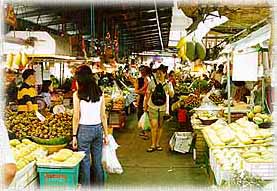
| Bangkok doesn't lack for markets, and they are generally the cheapest place to shop. This doesn't necessarily reflect on the quality of the goods and either, and some excellent bargain are in for the taking if you know where to look. Chatuchak Weekend Market is still pretty much the undisputed king of them all. Early on a Sunday morning, I took the BTS skytrain all the way to Mo Chit Station (N8) to see what the world largest weekend market has to offer. Covering 35 acres of land, containing over 15000 shops and stalls, 300000 visitors come each day and they spend an estimated total of 30 million baht (US$750k). The whole area is segregrated into districts depending on the types of goods sold. It can be frustrating to walk through the extremely disorientating alleys which are narrow and cramped. The range of products on sales is extensive - from the smallest souvenirs to food, trendy fashions, antique intricate wooden carvings, household accessories, adorable fluffy puppies, flowers, etc. The most essential part as you make purchase is that bargaining is expected, if not mandatory. The prices are generally substantially cheaper than the city shopping centres. To be truthful, in Bangkok, bargaining is a skill that one ought to acquire especially in Chatuchak Weekend Market. |
 |
| [Home] [Photo Album] [Japan] [Poland] [Hungary] [Czech] [Germany] [Thailand] [Taiwan] Last Update : 26 November 2003 Copyright @ 2003. All Rights Reserved |
 |
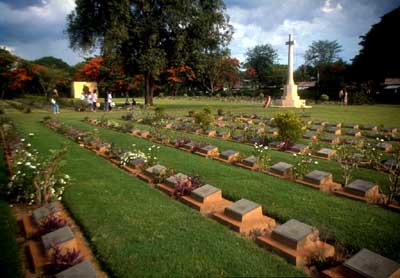
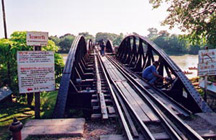
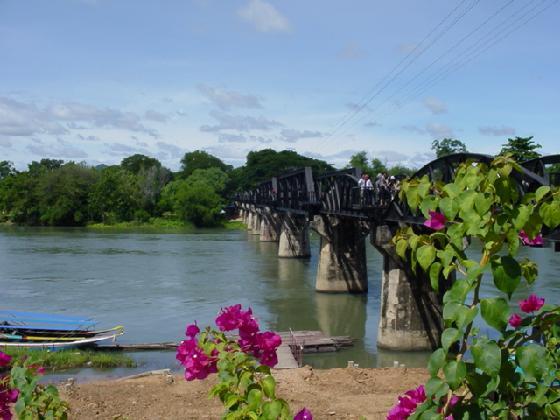
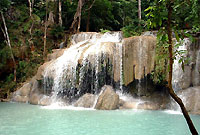
| For tourists who had read up about Japanese Occupation of South East Asia during WWII would probably have read about the historical Bridge Over River Kwai. Yes, Kanchanaburi is the site of the world famous Bridge Over River Kwai. Being Thailand's 3rd largest province, Kanchanaburi covers an area of 19486 square km. The provincial area is noted for rugged natural beuaty where mountains and river valleys have inspired development of hydro-electric power and where labyrinthine reservoirs provide further scenic elements to the province's natural beauty. So, naturally, I was very excited about exploring Kanchanaburi. The very 1st site that we visited was the War Cemetery on Saeng Chuto Road. Back in 1905, British engineers surveyed the indormitable terrain for a projected rail route and forthwith declared impossible to build. The Japanese Imperial Army, however, did it in 17 months during war-time condition. The immaculately maintained enclave contains the remains of 6982 Allied POWs who perished during the contruction of the 'Death Railway' mostly due to sickness, malnutrition, lack of medicine and medical care. Every year on 25th April, friends and relatives of Allied POWs come to visit their graves. The historical fact above the construction of the Death Railway, Bridge Over River Kwai and the Allied POWs were documented in out next site visit at the JEATH Museum. JEATH is the acronym of the nations involved in the Death Railway, namely : Japan, England, America and Australia, Thailand and Holland. The 1st thing you will come across is the bamboo hut with a collection of photographs and paintings of the atrocities inflicted on the POWs. The structure is a realistic reconstruction and was built by a monk Wat Chaichumpol, in the form of a replica of Allied POW's quarters in a Death Railway detention camp. There are also collections of artifacts and physical memorabilia dating from WWII. On display was also a large bomb that was dropped to destroy the bridge over River Kwai and railway track to prevent the transportation of Japanese army between Thailand and Myanmar. Looking at the pictures, reading the transcripts while staring at the items left behind by the POWs, it made one wondered how anyone could endure and survive in such harsh condition. The message is clear, that is the JEATH Museum has been built not for inflicting hatred but rather to warn the present and future generation how terrible war is and why peace should always be maintained. Standing on the open platform of the JEATH museum oversees the Bridge Over River Kwai. Internationally famous, made known by the academy award winning movie and books, the black iron bridge was constructed with dismantled steel spans brought from Java, by the Japanese army and reassembled under Japanese supervision by Allied POWs as part of the 'Death Railway' linking Thailand and Burma. Still in use today, 2 of the original spans (with round shape) were knocked down by Allied bombimgs to disrupt the railway operation. The fallen round spans were then replaced with angular spans as it appeared at present. I spent some few quiet minutes walking on the railway track, trying to visualise the ordeals the POWs went through. About 60 km from town on Route 323 Highway, we were next brought to the Sai Yok Noi Waterfall, located within the Sai Yok National Park. The park was designated on 27 Oct 1980 as the 11th national park of Thailand, with a total area of 500 square km. The waterfall, being the main attraction, is most breathtaking as one can feel the power of the spring water that falls from the 20 m cliff. Every fall regenerates more sprays upon an impact. Tempted to feel the might of the water, I removed my sandals and carefully crawled my way along the smooth floor to where the water assembled. At that moment, it is all about enjoying the feeling of playing with flowing water; without the thought of the present peril. Having soaked myself wet in water, I took a short stroll up a small mountain, covered by mixed deciduous and dry evergreen forest with bamboos. If you observe carefully, you will find little mammals such as squirrels, bats and birds which are ready to surprise you any moment! By mid-noon, we were already experiencing elephant ride and bamboo rafting at Song Nuk Elephant Camp. Throughout the ride, we all learnt to understand why elephants were still being used as a mean of transport in dense forest and broad rivers. The modern mode of transport is virtually impassable in these dense areas. As the name implies, the raft is built by binding thick bamboo stems together tightly. Tourists like us are led to sit on the raft (under thatched roof) while 2 of the rafters skilfully row in the water of River Kwai. What is most rewarding is the scenic view of the forest covered mountains, that faces the high cliff. The serendity is probably the perfect vacation of privacy one can ask for. |
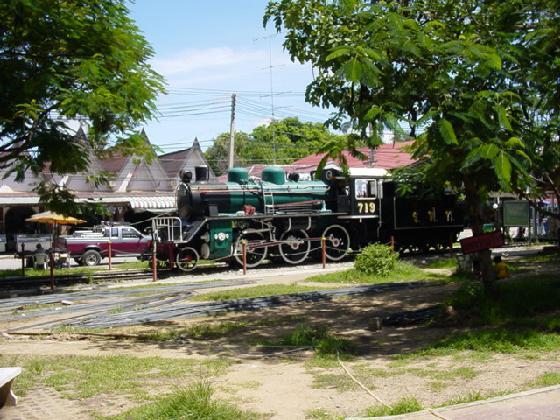
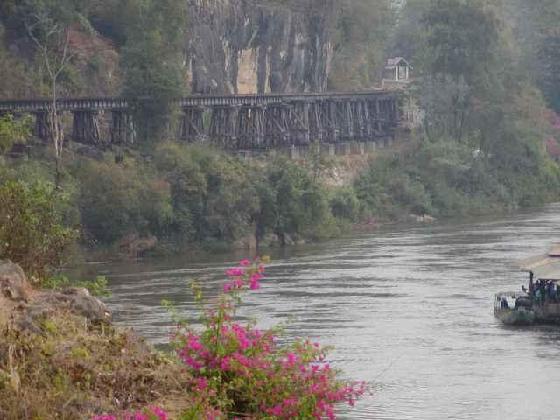
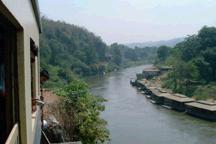
| Touring Kanchanaburi would be less complete if one has not hop on to ride on the diesel-run locomotive that runs parallelly along River Kwai. Before concluding for the day, from Nam Tok station, we alighted the train that was heading for Saphan Kwai Yai station at 1515 hours. The interior of the train was equipped with wooden seat; clean, spacious and comfortable. Seated alone by the open window, I was getting excited as I was aware that this was a one-time experience on the 'Death Railway'. True enough, the train creeps through scenic and thrilling natural terrain, hugging the mountainside at a dizzy height over ragging river far below. Passing luch tropical forests on a sheer cliff side overlooking River Kwai, the area surrounding was mesmerising. You can see the river floating below and lots of green vegetations. The beautiful landscape was probably one of the best I had ever seen in my life. The journey includes a pass through the impressive Wampo Viaduct and Hellfire Pass; both were tracks built by POWs. Throughout the 2.5 hour ride, the picturesque view of River Kwai captivated my thought so much so that the stunning landscape was still embedded in the mind even till today. Honestly speaking, I missed Kanchanaburi very much even after leaving Bangkok. Despite the pace of modernisation in Bangkok, I felt heart-warming to be able to spend some peaceful time in remote places like Kanchanaburi. It's the perfect place for people who delight in natural surroundings and pleasures without sacrificing basic comforts. About the local Thai people, I would say that they are considered the friendiest people on earth. Not one, but many local Thais like the stranger who directed me to Khao San; Suban (tuk-tuk driver), guesthouse's landlord and staff, and many unknown local Thais who directed me, all had an easy-going, friendly nature that tourist were quick to appreciate and to feel comfortable. For the very first time abroad, I feel very much at home It is also important to remember that Thai people are deeply religious as Buddhism and traditional values place great importance on family, friends and social harmony. Looking back, coming to Bangkok was the best decision I had made this year. The questions now is: when should I return to the Land of A Thousand Smiles again? |
 |
 |
| Khao San - Backpacker Paradise |
| Bangkok National Museum |
| Bangkok's Chinatown |
 |
 |
 |
| World Largest Weekend Market |
| Kanchanaburi War Cemetery |
| The Original Black Iron Bridge |
 |
 |
 |
 |
 |
| Bridge Over River Kwai |
| Sai Yok Noi Waterfall |
| Diesel-Run Locomotive |
| Passing the Viaduct |
| Overlooking River Kwai and Green Vegetation |
 |