 |
|
 |
|
Advert Here |
 |
| The earliest mention of Radcliffe appears in the Domesday Survey of 1086 when it was a Royal Manor held by Edward the Confessor. After the conquest, when land was apportioned, Radcliffe was given to Nicholas Fitzgilbert de Tablois who then assumed the name of the Manor as his surname, thus becoming Nicholas de Radcliffe. The arms are the Ancient Arms of the Radcliffe family while to this, the red rose of Lancashire and the red cross (voided) of Pilkington, have been added. The Lion of England - used by the now defunct Urban District Council of Radcliffe - has been retained for old associations sake. It stands on a mural coronet (reserved for civic heraldry) and rests a paw upon a pheon, taken from the arms of Egerton. The supporters (bull and lion) are the those of the Radcliffe family crest, but with their colours altered to black and white to represent the local coal, cotton and paper manufacturing industries. The fleurs-de-lis is taken from the Arms of Lancaster. |
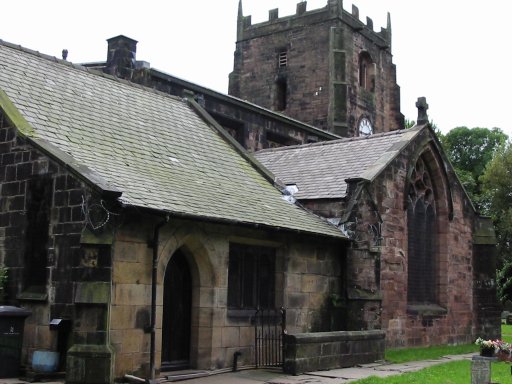
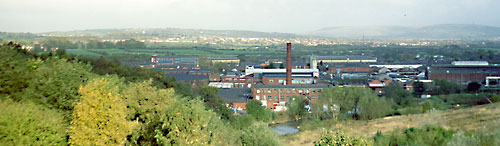
| Sadly the town no longer has working coal, cotton or paper industries which is somewhat ironic as the inscription on the coat or arms, "Industria Ditat" translates into "Industry Enriches". Radcliffe was granted the "Borough" charter on September 21st 1935 and ceased to exist as an independent autonomy during the boundary changes of the 1970s. As a town, Radcliffe now comes under the control of Bury Metropolitan Borough Council. Churches The earliest recorded reference to a parish church dedicated to St Mary the Virgin is from 1202. Parts of the current church may date from the 13th century, and the tower dates from 1665. St Thomas's church was founded in 1819, though the present building dates from 1864. St John's was established in its current site in 1897. Methodism became strong in Radcliffe during the late 18th and 19th centuries, and there are were several Wesleyan chapels. Industry The Industrial Revolution of the eighteenth century marked the beginning of the progress of Radcliffe to a town of varied industries. The medieval origins of the town have been somewhat obscured by this later industry, and indeed, most of the mills that followed have now also gone. Before the Great War, Radcliffe had over 60 mills manufacturing textile goods, plus 15 spinning mills which bleached, dyed, raised and finished cloth. The first mill in Radcliffe was probably the one started by the Peel Family, one of whose members, Sir Robert Peel, became famous as the founder of England's police force. The Bealey family operated a bleaching business at Bealey works and contributed to the prosperity of the town. Cotton, however, was the main industry and the Pioneer Mill on the banks of the Irwell was the largest such mill in the area. The East Lancashire Paper Mill, started in 1862, provided considerable employment up until 2001, when it closed down. Many of the archives of the company are preserved at Bury Archives. Coal is the only mineral to have been mined in Radcliffe and the mining of it dates back to the Middle Ages. The largest colliery, Outwood Colliery, opened in the 1840's and closed in 1931 due to a fire. The site is now featured as part of the Irwell Valley Sculpture Trial. Finding out more Radcliffe Library is the main source of local history information for the area. The library holds a wide range of local history materials including books, old Radcliffe Times newspapers and old maps. A website dedicated to the history of Radcliffe can be found by clicking HERE. Our Yahoo Group contains many old pictures of the town and gives you the ability to contact others who are also interested in the towns history. |
 |
 |