THE HOLE STORY
(Beyond the basics-part 1)
By Walter Kulikowski
At times fishing conditions can cause a spoonplugger
to begin probing depths located in or near the sanctuary of fresh
water fish. Buck Perry has stated, "if we have presented lures on
'known structures' thoroughly, and are still not catching fish, we
are not fishing deep enough." Such a conclusion suggests that the
fishermen could eventually end up placing their lures in or near
the deepest water of a specific area, or the entire lake.
In many "natural lakes" throughout the country fish are
provided "sanctuary" in deep holes rather than channels. The
formation of these holes is due almost exclusively to the impact
of "glacial shifting" that occurred many years ago. Some natural
lakes offer a variety of holes made up of various shapes and
sizes, as opposed to others containing only one. While the number
of holes a lake is comprised of can be advantageous to the
fishermen, it is the "characteristics" of these holes that
determine whether interpretation and lure presentation will be
easier or more difficult. Please note Figure (A).
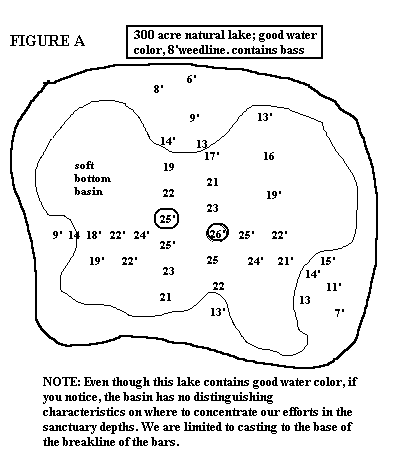
By converting this overhead view of Figure (A) to a
side view, you would be able to visualize that the characteristics
of this particular lake basin is similar to that of a "frying
pan," that is to say it is relatively flat almost everywhere
except near the sides. We have no real guidelines on where to
concentrate our efforts "deep." Therefore, we would consider this
lake as "unfavorable" if we had to go in or near the sanctuary
depth.
Figure (B) depicts quite a contrast to that of Figure (A) in
that you have more "definition" to each of the holes you see in
the figure below. If we were to convert each of these individual
holes to a side view, we would visualize the letter "V" in our
minds rather than that of the "frying pan" in Figure (A). Figure
(B) offers isolated "holes" that are more confined and much more
"sculptured" than that of Figure (A). This provides the fishermen
with more of a "focus point" on where to present lures deep. This
factor is vital because we must be accurate in our presentation
when working in or near the "sanctuary depth" of the fish. In
lake-types such as Figure (B) the fisherman is provided with more
of a "target" and has the advantage of having a school of fish
"hemmed in " if you will, to a greater degree. (Lake Size could
also be figured into this equation.)
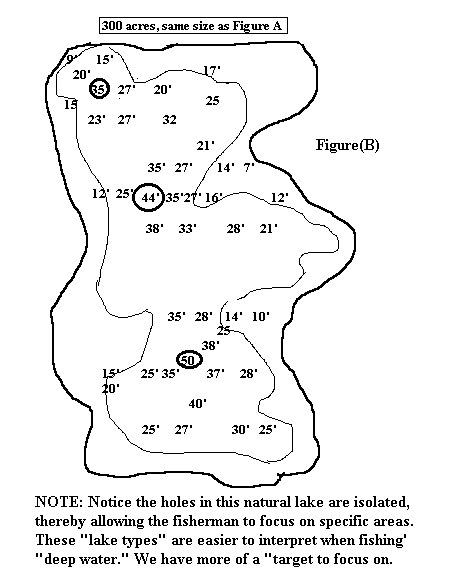
Similar to bars, humps etc. the two most important
distinguishing features to take note of when selecting a lake
where "deep lure presentation" may be necessary, is how their
respective basins are formed. Again I would refer you to Figures
A&B and note the contrast. This can be crucial when fishing
during certain times of the season such as late fall or early
spring, when fish migrations are limited to these deeper sections
or "sanctuary depths." In part 2 we can begin to discuss more of
the "specifics" on possible "techniques of lure presentation,"
concerning these "deep water/sanctuary situations.
TOP
OF THE PAGE
RETURN TO HOME
PAGE