















Fall 2003
"Post-War Conflict"
- This event was held on Monday, September 22nd, 2003 at the
Multi-Purpose Room in John Jay College. UNSA had invited a guest speaker: Sean
Dunne, who is the Chief of Operations of the Electoral Division of the
Department of Political Affairs, United Nations. Mr. Dunne lectured about the
United Nation's role in the political reconstruction following conflict. He also
spoke about the instability in these countries and its affect on the
socioeconomic development and humanitarian situation in the region. For examples
he used Sierra Leone, East Timor, Liberia, Somalia, Sudan, Afghanistan and
Iraq.
- Minutes of the "Post-War Conflict" Event
UNSA's First General Meeting for Fall 2003
- This General Meeting took place on Wednesday, October 1, 2003 at 3:00 PM in Room 3232 North Hall. The agenda of the meeting was introducing new members to the club, selection of countries for the 2004 NMUN Conference, and outlining club events and purpose for the coming academic year. The meeting also expanded on the club's newsletter, website, the Security Council Simulation at Yale University, Spring 2004 Model United Nations Conference for High School students at John Jay College, and other club issues.
UNSA's Second General Meeting for Fall 2003
- This General Meeting took place on Wednesday, October 8, 2003 at 3:00 PM. The agenda of the meeting was an introduction to the 2004 NMUN Conference.
UNSA's Third General Meeting/High School MUN Task Delegation for Fall 2003
- This General Meeting took place on Thursday, October 16, 2003 at 3:00 PM. The agenda of the meeting was an introduction to the 2004 Model High School Conference that will be hosted by UNSA.
Student Debate on United States Foriegn Policy
This event took place on October 22, 2003 at 3:30 PM in the Multi-Purpose room. In this event, four UNSA members assumed to be ambassadors of the US government and defended criticisms aimed at US foriegn policy. Vincenzo Sainato represented US interest in free trade, globalization, and international economics; Tricia Rawh defended US foriegn policy in Latin America, the "war on drugs", NAFTA and the FTAA; Brian Rawh defended US poicy in Africa, the HIV/AIDS pandemic, and the continent's socio-economic development; and Mohammad Faridi defended US policy in the Middle East, particularly Palestine, Iraq, US's "War on Terrorism" and the war in Afghanistan. The event was very successful as students debated each other on US foreign policy and understood the complexity in international relations.
General Meeting/High School MUN Task Delegation for Fall 2003
This General Meeting took place on Thursday, November 6, 2003 at 3:30 PM. At this meeting, Mr. S. Leslie of the UNA-USA informed students on how to host a model UN Conference. He also touched upon how to run meetings and essentials of creating a background guide.
The New Population Order
On November 5th, 2003 United Nations Student Association presented the third major event for this Fall semester. The event was titled "The New Population Order - Issues of Crime and Order". The guest speaker for this event was Dr. Joseph Chamie, Director of Population Division, Department of Economic and Social Affairs and United Nations Secretariat in New York. Dr. Chamie enlightened students on many issues related to population and how its' increase of affects our way of living, and more specifically, the crime rate. Furthermore, he discussed problems of developing as well as developed nations, population and development issues, international migration, among other issues. After the lecture by Dr. Chamie, there was a Q & A session. UNSA's Vice-President, Anila Duro, awarded Dr. Joseph Chamie in appreciation of his time dedicated to John Jay community. Refreshments were served at the end.
Globalization of Human Rights
UNSA members were invited to attend a seminar titled "Globalization of Human Rights" at the United Nations Headquarters on December 10th, 2003. The event took place on the United Nations Human Rights Day and is in collaboration with a book launch by the United Nations University Press. The book is titled Gloabalization of Human Rights and it is edited by Dr. Jean Marc Coicaud, Acting Head of United Nations University's Office in New York; Dr. Michael Doyle, Professor, SIPA, Columbia University, and Amy Gardner of Princeton University.
The Panelists for this event were:
Philip Alston, Professor of Law at the New York University School of Law; Jean-Marc Coicaud, Acting Head of the UNU-Office in New York; Michael Doyle, Professor of International and Public Affairs at Columbia University; Amy Gardner, Princeton University; Bertrand Ramcharan, Acting High Commissioner for Human Rights; Johan Scholvink, Director of the Division for Social Policy and Development, (UN Department of Economic and Social Affairs).
Spring 2003
In the Spring 2003, UNSA had taken an active role around the John Jay College campus. Its primary task was to prepare students for the National Model United Nations (NMUN) conference. In addition to that, it also sponsered lectures around campus related to its purpose. UNSA's accomplishment for the Spring 2003 semester follow.
- National Model United Nations Conference
- April 15 to April 19 2003, New York City
The 2003 NMUN conference was sponsored by the National Collegiate Conference Association. The conference which took place in the Hilton New York from April 15th to April 19th 2003 was a fascinating experience for John Jay College students who were assigned to represent the Republic of Peru in twelve (12) committees. Prior to the conference, participating students were required to prepare papers summarizing Peru's position in regards to the three (3) issues that were discussed in each committee. The position papers required immense research, staying at school till 2 AM, translating websites and newspaper articles from Peru�s national language Spanish into English, digging out grassroots research from Peruvian newspapers, and Peruvian Ministries of Economy, Education, Health, etc. After hours spent at researching and translating, students were often dispirited to learn that their research was not relevant to the issues of position paper. But the overall experience of researching about a country of a different culture, language, and society than their's, about issues to which they had never heard about, was a great and significant experience of their lives; opening up many new possibilities and a unique and diplomatic understanding.
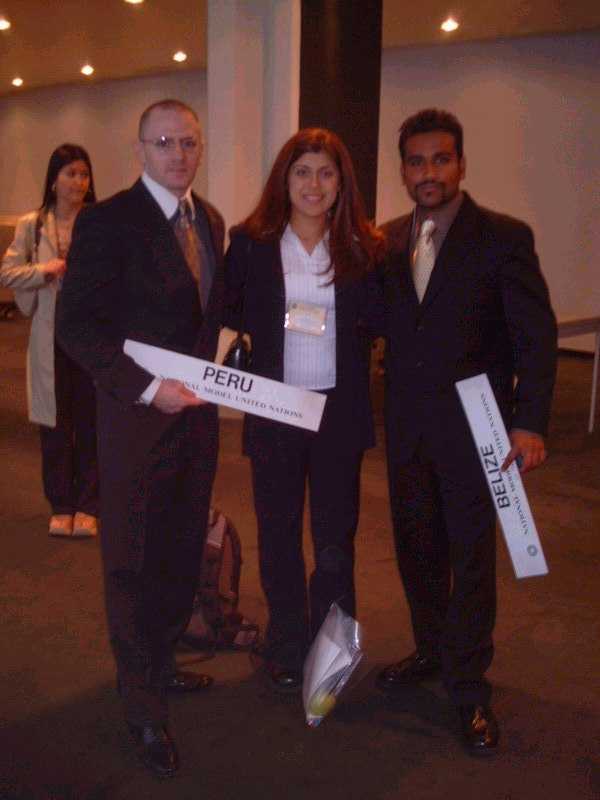
Jason Roderiques (left) along with delegates from other colleges at the NMUN Conference
Representing Peru at the Conference meant that students had to put aside their own personal prejudices and attitudes and advance Peru�s interests unconditionally. It required immense patience, understanding, and a perceptive attitude to advocate something even if it runs afoul of your personal beliefs. The conference allowed students to scrutinize issues such as globalization, world poverty, health issues, sustainable development and free trade, non-proliferation, education, etc, from Peruvian perspective, steering them to understand the aforementioned issues from the perspective of a developing state. Such an experience gave a diplomatic understanding to the students personal perspective.
In the next few days, the position papers that were prepared prior to the conference by John Jay College students will be added to this site. In addition, a few reviews of the the NMUN conference will also be added to this site.
UNSA General Meetings for Spring 2003
To prepare thoroughly for the NMUN conference, all UNSA members attended a meeting every Friday at 3:30 PM starting from the begining of the semester till the end. During the meetings, Professor George Andreopoulos who was also UNSA's Faculty Advisor for Spring 2003, evaluated the students research and made suggestions. Professor Andreopoulos also routinely interviewed students privately in regards to their performance. As the conference approached, meetings were also often held on Saturday mornings in addition to the Fridays. They usually lasted for about three (3) hours in which students also had a chance to evaluate eachother's research and make suggestions. Usually after the meetings ended, most students went out to the local bar to socialize and have a drink. Even at the bar, the discussions took an academic direction (consistent with the John Jay College tradition) in which students often debated about issues relevant to international law, United Nations, human rights, etc. The most notable and amusing debates and discussions were between UNSA's new President Jason Roderiques, new Treasurer Mohammad Faridi, and the Society's President Antigona Kukic.
During the last week of school, UNSA held elections for its executive board members. At the meeting Jason Roderiques was elected President. Jason is also known by the nickname "general" because of his military background and attitude. Anila Duro was elected Vice-President, Mohammad Faridi was elected Treasurer, and Riaz Khan was elected Secretary of the club. All four students had taken part in the NMUN conference and were also voted in by acclamation. During this last meeting, Professor Andreopoulos apluaded the club's performance at the NMUN conference and their active role at the campus. Professor Andreopoulos will not be at John Jay College for the 2003-2004 academic year and Professor Jacque Formeron was selected the new Faculty Advisor of the club until Professor Andreopoulos's return. Upon the meeting's end, students vowed to perform even better at the next year's NMUN conference and take an even more active role in promoting UNSA's committment at the campus.
UNSA's Events and Lectures at the John Jay College Campus
Domestic Responses to 9/11
This event took place on March 27th, 2003 at 6:00 PM in room 630T. This event was a joint effort by UNSA, the Office of Provost, the Center of International Human Rights at John Jay College, and the Society of International Law, Justice, and Human Rights. The event was a panel discussion which was held in collaboration with William Paterson University. The panelists were Sheila Collins, Department of Political Science, WPU, Michael Principe, Department of Political Science, WPU, Barry Latzer, Department of Government, John Jay College, and Professor Avram Bornstein, Department of Anthropology, John Jay College.
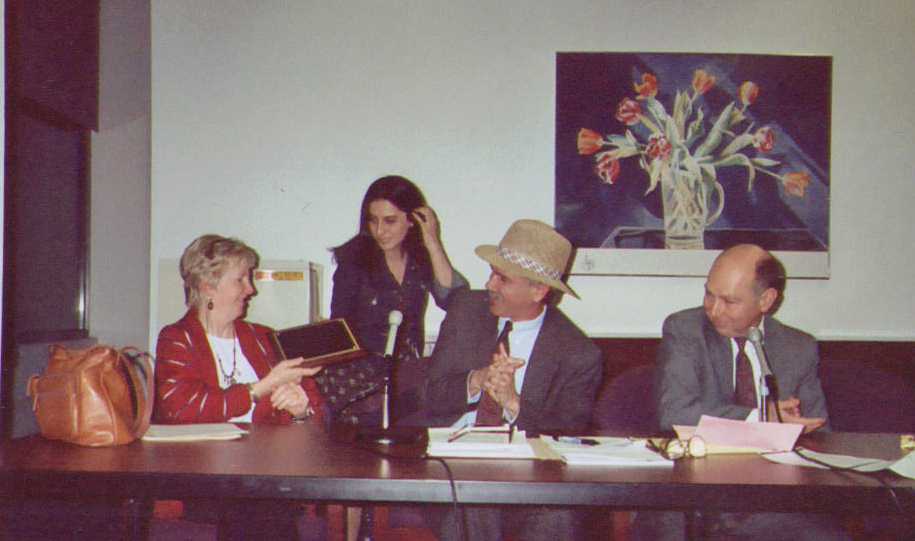
Antigona Kukic awarding Sheila Collins an Award of Appreciation
The panel discussion covered more issues than the one assigned by its title. Due to the high tensions of the Iraq War at that time, the discussion turned out to be a debate about the new war rather than the domestic consequences of the events of September 11th, 2001. Sheila Collins outlined her analysis of the then current situation, followed by Michael Principe, Barry Latzer, and lastly Avram Bornstein. The panel was followed by a question/comment session. At the end of the panel, the panelists were given honoraria by UNSA and the Society. In addition to the rigorouslly intellectual and analytic discussion that took place, the event also helped strengthen academic relations between John Jay College and William Paterson Univeristy.
Activism at Home and Human Rights in Palestine
This event took place on May 8th, 2003 at 3:00 PM in room 1212N. The event was organized by the Society of International Law, Justice, and Human Rights and was co-sponsered by UNSA. The event was a lecture and a presentation by Professor Avram Bornstein, Department of Anthropology, John Jay College. Avram Bornstein is also a member of the International Solidarity Movement. He lectured about the current human rights situation in the Occupied Territories of West Bank and Gaza and showed slides of himself, family, and other activists helping to promote the human rights sitution in the Palestinian territories. The lecture lasted for about one hour and was followed by a question/comment session for about fifteen minutes. After the question/comment session, Avram Bornstein was awarded an Award of Appreciation by the Society and UNSA. Refreshments were served at the end and students were able to interact with the lecturer in regards to activism in the United States and how they can help aleviate and better the human rights of Palestinians.