|
|
|
||
|
Our History
A Union is Born
The Turbulent Years
The Conspiracy Trials
The Beginning of the
Morrin Era
The Depression and a New
Deal For Labor
World War II
Ironworkers Grow in the
1950's Part Two Part Three
John H. Lyons Jr.
Elected President
The Tradition Continues
Pathways to the 21st
Century Under The Leadership of General President Jake West
|
Part Four
WHITE CARD IRONWORKERS
Farther up the Pacific Coast, shortly after the New York strike situation gathered momentum in 1924, new forces of dissention were stirring. Wobbly leaders took over a Seattle local of Ironworkers, and the so-called "Western District Council" was formed. This outlaw organization sought jurisdiction and control of all local unions in the West, and even endeavored to extend as far east as Montreal, Canada. Infiltration into other unions in the west was easy, for at that time a transfer card was equivalent to a passport into any Iron Worker local. The movement thus spread up and down the West Coast, and these workers soon became known as "White Card Ironworkers." At the request of Seattle Ironworkers, who wished to remain loyal to the International, the Iron Worker Executive Council took the secession matter to court in order to protect the interest of the membership, their property and their rights. The Seattle court not only ruled in favor of the International, but also rendered judgment against the secessionists. A former business agent of the Seattle Local was found in default of more than $8,000 to the Union. He was also the first President of the "Western District Council." Court action also proved effective in gaining back for Local 118 in Sacramento, its property, and its finances. For several years the "White Card Ironworkers" continued to operate along the West Coast. In April of 1928, a conference of all the business agents of the Western local unions was held in San Francisco to work out plans and policies for the rehabilitation of the union where outlaws had invaded the ranks. "A lenient and forgiving attitude" was adopted toward the "well-meaning but ill-advised former members," unlike the harsher attitudes of other International Unions who were also combating dual secessionist movements in their ranks. Later that year, 1928, the A. F. of L., the Building Trades Department, and the Metal Trades Department met in Los Angeles and decided to carry on an aggressive organizing effort up and down the West Coast, but especially in the San Francisco Bay District. Within a year, most of the "White Card Ironworkers" were reinstated, and the gravest threat to Ironworker unity was dissolved.
At the convention the delegates upheld the action of the General Executive Board to expel J. J. McNamara former Secretary/Treasurer of the International Association and up to June of 1927 he was the Business Agent and Financial Secretary of Local No. 22, Indianapolis, for submitting false audit reports. J. J. McNamara was supposed to appeal to the convention, however, he never appeared.
As outlaw Ironworkers were returning to the fold on the West Coast, and slow progress was being made in the unionization of the New York area, the stock market crashed, an the bust of the late 1920's gave way to bread lines in the early 1930's. Initially, the 1929 stock market crash had little impact on employment of Ironworkers. From July 1, 1929 to June 30, 1930, the union added 3,440 new members to its ranks, a gain comparable to the fiscal year preceding the crash. Financially the Union also prospered. On July 1, 1928, there was a total of approximately $647,000 in the treasury and approximately $652,000 four years later on July 1, 1932. While other unions were experiencing wage reductions of fifty percent. the average reduction of all Ironworker amounted to sixteen percent. Finally the Iron Workers managed to secure two important working agreements. It appeared that the long struggle in the Metropolitan District of New York might be leading towards a settlement. A Union agreement for all bridge and structural steel erection was negotiated. A year later a Bridge Erector's agreement went into effect covering the nationwide jobs of fair contractors in the Structural Steel and Bridge Erectors' Association. Ironworkers took a wage reduction and worked six days a week so that these fair employers could compete with unfair contractors. Depression and unemployment finally caught up with the Iron Workers within two years after the crash as building construction nearly came to a halt. Of course, all labor organizations suffered during this time, especially the building trades. The Iron Workers lost nearly fifty percent of their paid membership, dropping to 14, 504 men in good standing. Such a loss completely offset any gains made during the massive organizing campaign in the late 1920's. In spite of the deadly effects of the depression, nearly every Iron Worker local remained intact while the International sought work for them everywhere possible.
Scroll to the top and click on
The Depression and a New Deal For
Labor - 1930 to 1940 - Part One
[Home]
[Officers]
[Upcoming
Events] [Links
to Other Unions] |




 hile most of the international's efforts
were concentrated in the New York area, the International Workers of the
World (I. W. W., called the Wobblies) and "One Big Union"
advocates were gaining strength on the west coast. A dual
organization known as the United Association of Bridge and Structural
Ironworkers, tried to take over the San Francisco Bay area just as the
country was recovering from the depression and unemployment of the early
1920's. This organization sprang up after the International
Executive Board was forced to revoke three charters in San Francisco and
Oakland, as many other International Unions did to combat a wave of union
radicalism. Before the charters were revoked, however, a handful of
local leaders auctioned off the local unions' property, furniture,
automobile, and a cemetery plot, valued at several thousand dollars, and
sold them for one dollar. Within a few months the locals were
reorganized, the dual union dissolved, and outlaw members
reinstated. The division was settled for a short time at least.
hile most of the international's efforts
were concentrated in the New York area, the International Workers of the
World (I. W. W., called the Wobblies) and "One Big Union"
advocates were gaining strength on the west coast. A dual
organization known as the United Association of Bridge and Structural
Ironworkers, tried to take over the San Francisco Bay area just as the
country was recovering from the depression and unemployment of the early
1920's. This organization sprang up after the International
Executive Board was forced to revoke three charters in San Francisco and
Oakland, as many other International Unions did to combat a wave of union
radicalism. Before the charters were revoked, however, a handful of
local leaders auctioned off the local unions' property, furniture,
automobile, and a cemetery plot, valued at several thousand dollars, and
sold them for one dollar. Within a few months the locals were
reorganized, the dual union dissolved, and outlaw members
reinstated. The division was settled for a short time at least.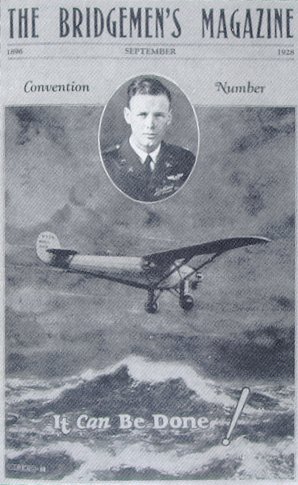
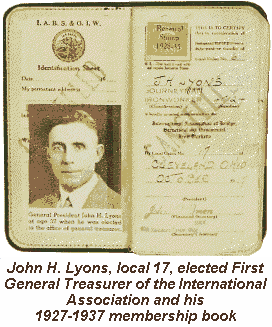 At
the Twenty-Third International Convention which was held September 17th to
the 22nd, 1928 at the Hotel Missouri in St. Louis, Missouri, P. J.
"Paddy" Morrin was reelected General President. It was at
this Convention that the office of Secretary/Treasurer was divided into
separate offices. William J. McCain was elected to be General
Secretary of the International Association and General Organizer John H.
Lyons of Local 17, Cleveland, Ohio was elected to be the first General
Treasurer of the International Association. Later on, John H. Lyons
Sr. would be elected General Secretary and then General President making
him the only person to hold all three offices in the history of the
International association.
At
the Twenty-Third International Convention which was held September 17th to
the 22nd, 1928 at the Hotel Missouri in St. Louis, Missouri, P. J.
"Paddy" Morrin was reelected General President. It was at
this Convention that the office of Secretary/Treasurer was divided into
separate offices. William J. McCain was elected to be General
Secretary of the International Association and General Organizer John H.
Lyons of Local 17, Cleveland, Ohio was elected to be the first General
Treasurer of the International Association. Later on, John H. Lyons
Sr. would be elected General Secretary and then General President making
him the only person to hold all three offices in the history of the
International association.