|
|
|
|
|
||||
|
Our History
A Union is Born
The Turbulent Years
The Conspiracy Trials
The Beginning of the
Morrin Era
The Depression and a New
Deal For Labor
World War II
Ironworkers Grow in the
1950's Part Two Part Three
John H. Lyons Jr.
Elected President
The Tradition Continues
Pathways to the 21st
Century Under The Leadership of General President Jake West
|
Part Four WHAT HAPPENED AT
OUR Meanwhile, on the evening when John J. McNamara was first kidnapped, the police illegally broke into the Unions safe and removed papers as well as $400.00 which was never returned. At the time the police entered the International's office, President Ryan noticed a mysterious figure who began searching the union's file and papers. This person turned out to be Walter Drew, Commissioner of the National Erectors Association. Totally disgusted with the police and their violation of the law. the officers of the Executive Board tried to call the Union attorney, Leo Rappaport. Since it was a weekend and very late and many of the executive Board members were from out of town, they did not know how to reach the attorney. Finally, they were able to get in touch with him and Attorney Rappaport arrived around 2 a. m. Not content with just searching the offices of the International's headquarters, Burns supposedly had a tip that John J. McNamara had rented a barn outside of town. Burns and some men, as well as a group of reporters, left to search it. They returned claiming they had found two quarts of nitroglycerin and fifteen sticks of dynamite in a piano box. Burns then returned to the offices of the International in the American Central Life Building demanding a key to a vault in the basement. Burns went into the basement followed by reporters and supposedly found seven packages of dynamite weighing 200 pounds along with percussion caps and many yards of fuse, plus a dozen small alarm clocks.
WHAT WAS THE ATTITUDE OF THE PUBLIC? Union members and even a large
segment of the general public all over the United States felt that the
entire event looked staged. It was discovered that after Burns'
salary was cut off by the Mayor of Los Angeles, he borrowed $10,000 from
friends and would only be able to repay it if he was able to get the
$100,000 reward. Many Americans saw this as another frame-up
similar to the Hay Market Affair, Debs' trial after the Pullman Strike,
and the Haywood-Moyer-Pettibone Case of 1907. This latter case
involved "Big Bill" Haywood and two other members of the Western
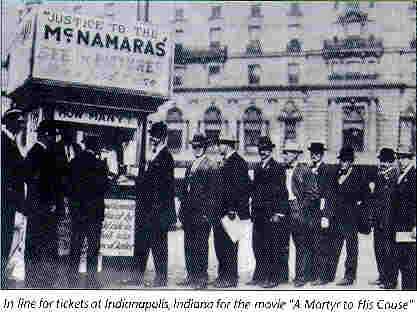
Federation of Miners who were accused of a murder in Idaho. Trade Unionists and the General Public throughout the country had an opportunity to witness the production of a motion picture titled "A MARTYR TO HIS CAUSE" which was produced to raise money for the McNamara brothers' defense and to show the public how a citizen was dragged from his home and friends and spirited to a distant part of the nation contrary to law and the traditions of the United States.
CLARENCE DARROW HIRED TO DEFEND THE McNAMARAS
Darrow finally agreed to take the case under the following conditions: The labor movement would raise $20,000 out of which Darrow would receive a fee of $50,000 after expenses. The union movement agreed to his terms and our union began a fund raising effort to help defray the costs of the trial. McNamara buttons, stamps for the backs of letters were sold. The following appeared in the September, 1911 issue of The Bridgemen's Magazine.
Darrow arrived in Los Angeles at 9:15 a. m. on May 14, 1911 surrounded by reporters. He went directly to the jail where the McNamara brothers were being held. He then went to see John Harrington, who had been representing the McNamaras up to this point and would continue to assist Darrow. John Harrington was also a candidate on the Socialist Party ticket for Mayor of Los Angeles. His election looked certain, but it all hinged on the outcome of this case. It did not take Darrow long to realize that the evidence, whether true or false, against the brothers was overwhelming and it would be impossible to get a fair trial in Los Angeles. "Otistown".
Scroll to the top and click on "The Turbulent Years 1906 - 1912 - Part Five"
[Home]
[Officers]
[Upcoming
Events] [Links
to Other Unions] |
||||





 They were kidnapped from Colorado by Pinkerton Detectives, handcuffed, and
taken in a special train to Boise, Idaho, to stand trial. Clarence
Darrow, who had defended Debs after the Pullman Strike, was regarded as
the Lawyer of the oppressed. He successfully defended Haywood and
the other defendants and saved them from hanging.
They were kidnapped from Colorado by Pinkerton Detectives, handcuffed, and
taken in a special train to Boise, Idaho, to stand trial. Clarence
Darrow, who had defended Debs after the Pullman Strike, was regarded as
the Lawyer of the oppressed. He successfully defended Haywood and
the other defendants and saved them from hanging.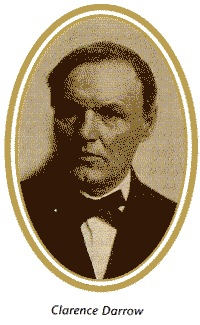 Samuel
Gompers and other union leaders in the American Federation of Labor felt
that Clarence Darrow would be the ideal lawyer to defend the McNamara
brothers. But Darrow, now in his early fifties was exhausted.
His wife, Ruby, had made him promise her that in the future he would only
take only easy cases. At first Darrow refused pleas from Gompers and
Ryan to take on the case. Then he received the following telegram
from Gompers.
Samuel
Gompers and other union leaders in the American Federation of Labor felt
that Clarence Darrow would be the ideal lawyer to defend the McNamara
brothers. But Darrow, now in his early fifties was exhausted.
His wife, Ruby, had made him promise her that in the future he would only
take only easy cases. At first Darrow refused pleas from Gompers and
Ryan to take on the case. Then he received the following telegram
from Gompers.