SITUATION ANALYSIS ON HIV/AIDS
IN EASTERN NEPAL
-
1. Introduction :
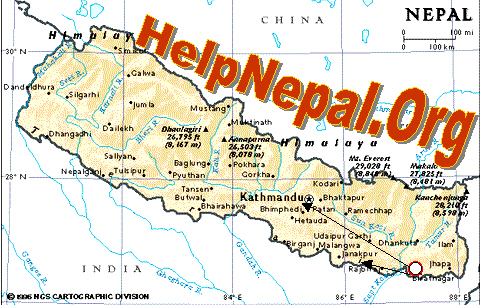
The eastern development region has three zones, Mechi, Koshi and Sagarmatha.
There are 16 districts in this region. Out of 16 districts five are in Terai
region while other 11 districts are in hill region. The problems of HIV/AIDS
infection and its spread in Terai is mere than in the hill region. This due to
cross border prostitution illegal sales of drug at the border and loose
administration as well .
2. Necessity of Situation Analysis:
A situation analysis puts the HIV epidemic in its social, economic and cultural
context in a give Region/Country. It looks at who is infected or is vulnerable
to infection and tries to explain why. It looks for explanations not just in
people's behavior, but in the social, economic and cultural situations which
under lie that behavior.A situation analysis
looks specially at situations that may be relevant to HIV, the factors that
favor or impede its spread, and the factors that favor or impede achieving the
best possible quality of life for those living with HIV and their families.
Since the analysis explains the current situation , it helps to identify
opportunities for changing that situation.
3. Location of Study : Eastern Region.
4. Starting date : September 1, 2000
5. Duration : - 15 days
6. Objectives :
· To find out main factors that spread HIV/AIDS
· To point out or indicate the priority areas for
future programme (demography, education, communication, political social and
economic factors, governance and human rights)
· To carry out the survey with a view to present an overall
picture of social, economical, political, cultural and structural factors that
make people vulnerable to the epidemic HIV/AIDS.
-
7. Activities carried out under the
project.
-
- (a) Identification of institutions in the area of HIV/AIDS, IDUS
AND CSWS.
- (b) Collection of information on above mentioned areas
- through
-
I. Available documents and formal data
II. Round table discussion with
GOs, NGOs and INGOs
-
(c) Focus group discussion with
-
I. IDUS, PLWHAS & CSWS
-
II. Community members of the society (Target group)
-
(Primary data collection)
-
(d) Compilation, tabulation and analysis of data.
(e) Interpretation of analysed data and result
(f) Problems faced
(g) Suggestion / recommendations.
-
8. Activity : Identification or institutions in the
area of HIV/AIDS, IDUS & CSWS
-
The following institution have been found involved in above mentioned areas.
Table : 1 List of institution working in the field of HIV/AIDS prevention.
S.N.Name of institutionsDistrictLocation
Morang
1.Help GroupMorangBiratnagar 11
2.Koshi Zonal HospitalMorangBiratnagar
3.HIV/AIDS coordination section, DDCMorangBiratnagar
4.Action AIDMorangBiratnagar
Sunsari
1.District HospitalSunsariInaruwa
2.Punarjeevan KendraSunsariDharan
3.District AIDS coordination, DDCSunsariInaruwa
Jhapa
1.District HospitalJhapaJhapa
2.Blood BankJhapaJhapa
Siraha
1.District HospitalSirahaSiraha
2.Save the Children U. K.SirahaLahan
Saptari
1.District HospitalSaptariRajbiraj
2.Blood BankSaptariRajbiraj
Actibity B: Collection of information on above mentioned areas (IDUS,
PALWHAS & CSWS)
- Round table discussion with concerning autherities was organized and necessary
informations on HIV/AIDS were recorded as a base for primary data collection and
also for desk review. In round table discussion the main actors from GOs, NGOs
and INGOs were involved. The main aim of this discussion was to taher/collect
data/ material for desk review adn discuss main findings, conclusions and
recommendations. This meeting was organiged conclusions and recommendations.
This meeting was organized twice at Biratnagar. There were good supports an
atmosphere of welcome in meetings.
Activity C : Focus group discussion for primary data collection .
Focus group discussion with IDUS, CSWS & PLWHAS
S.NDescriptionNumber of ParticipantAddressMethedology
1.Questainers were prepared to cover the comprehensive report on
IDUS7Biratnagar:- 21, 22, 20, 18, 11, 15, 16,Questioning
2.Questainers were prepared to cover the comprehensive report on CSWS7Biratnagar
: - 22Questioning
3.Questainers were prepared to cover the comprehensive report on
PLWHAS7Biratnagar : - 16, 11, 20, 19Questioning
Total21
Focus Group discussion with community members from Priority areas (Field
Report)
Target Group : Truck drivers, drug addicts, social workers.
S.N.DistictLocationNumber of people interviewedPopulation
1.MorangBiratnagar:1, 11, 21, 205015,650
Urlabari (VDC)4022,0.31
Total90
2.JhapaDamak5049,179
Kakarbhitta4025,429
Total90
3.SunsariDharan10084,186
Itahari5033,980
Total150
4.SirahaLahan5010,000
Total50
5.SaptariBhardaha307,232
Total30
Grand total410
The key
informants for focus group discussion were divided into three categories, IDUS,
CSWS & PLWHAS. They were approched and interview taken in various places as
suitable to them. They were asked to know possible number of HIV/AIDS, IDUS
& CSWS work of Gos, NGOs & INGOs in the area and methods
regulated by them.
The primary data collection was also taken by faking interview with suspected
people social workers and youths having high risk behaviours. For this purpose 8
vulnerable sites were selected and 410 people were interviewed.
Result : -
The round table discussion with GOs, NGOs, & INGOs was encouraging. The
participation of members was 100%. Generally information given by them was not
uniform. However, some of the common answers included that the drug problem was
serious and HIV pravalance was increasing. Most of them felt that poverty,
unemployment sharing of syringes, girls trafficking and cross-border prostiution
and illigal sales of tidijesic injection were the main causes of HIV/AIDS spread
in Nepal. Most of them believed in the increasement of HIV/AIDS was in
geometrical ratio. It was guessed that there were 12000-15000 drug addicts in
eastern region and 80 % of them used Tidigesic injection bhy sharing common
needles. The number of PLWHAS in eastern region was estimated as 10,000
12,000.
The focus group discussion with IDUs (7) indicated that most of them were
unmarried and belonged to middle class family and lived in joint family. The age
group varied from 18-29 years. All the drug users started using drug at the age
of 16 and started with Phensidal. At present most of them are using tidijesic
injection with common, unsterilized needles.
Focus group discussion with PLWHAS was amazing in the fact that they were
careless for life. Out of 7 PLWHAS one was married. Their health status was
poor. They belonged to middle class family. They were frustrated and physically
weak. They knew the mode of HIV infection. They were socially discarded. They
were not capable to treat themselves. They didn't know about the counselling
services and health care programe. All PLWHAS had multiple sex partners.
Result of Blood samples tasted for HIV in feb. 1998 (RAR Survey)
S.N.Mode of drug useTarget groupLocationTotal numberHIV +Hepatic
"C"Hepatic
"B"
1.InjectionIDUSBiratnagar9228394
2.InjectionIDUSDharan1033938-
The above data indicates that on an average 38-39 % IDUS have HIV+ in their
blood and virus of hepatitis C and B also.
Focus group discussion with CSWS(7) showed a clear cut back ground and reasons
of prostitution, Poverty, unemployment, illiteracy and divorce were the main
reasons of prostitution. Most of the sex-workers had multiple male sex-partner
who were found to be truck drivers, helpers, factory labours and riksha pullers.
Safer sex practice was found to be nil. Most of the male sex-partners were
alcoholic and belonged to low grade family. Most of the CSWS were found to be
unknown about AIDS & STDS.
Focus group discussion with target group at 8 sites of Morang, Sunsari &
Jhapa district was encouraging and helping. Most of the members (60%) of target
group were found to be unknown about HIV/AIDS & STD, their mode of
transmission and hazards in the society. 40 % of the target group were found to
be aware of HIV/AIDS and they estimated the number of HIVs in eastern region
might exceed 15,000.
PROBLEMS
-
· Difficulty in organizing focus group discussion with
IDUS, CSWS
& PLWHAS.
· Difficulty in getting correct answers from above clients.
· Difficulty in finding real data regarding
HIV/AIDS, IDUS & CSWS.
· Female participation in focus group discussion is
nil.
· No coordination among local NGO's, INGO's & GO's.
· No multi-sectorial integration of HIV/AIDS
prevention activities.
Challenges / Threats
-
· Lack of education in women folk.
· Lack of health services in women folk.
· Increasing number of IDUs every year.
· Increasing number of HIVs even after the
implementation of prevention programme.
· Lack of rehabilitation centre.
· Lack of actual data on HIV/AIDS and STDS.
· Lack of extension program for prevention of
HIV/AIDS in the country.
· Problems of girls trafficking.
· No social acceptance for HIVs.
· Wrong concept against HIV/AIDS.
· Lack of coordination among NGOs, INGO's & GO's.
Areas to be addressed
-
· Cross border prostitution and drug abuse .
· Trafficking of girls.
· Democracy, good governance, women empowerment
& poverty illeviation.
· Political commitment
Suggestions / Recommendations.
-
The following suggestion are made to combat with the fetal disease,
HIV/AIDS engulfing the entire country.
-
1. HIV/AIDS education :
-
(Safer Sex, Condom use, Safe injection, Peer education & STDS.
HIV/AIDS, mode of infection, preventive measures, awareness)
-
2. Counseling : (Detox Counseling, pre & post counseling,
family counseling, individual counseling, referrals)
3. Primary Health Care Services : (General medicines, referral
services, general dressing of burns & abbesses)
4. IEC Distribution : (HIV/AIDS,
STDs, Condom and safer sex, HBV/HCV, overdose safer injection)
5. Prevention Materials distribution
: ( Condom, Bleach)
6. Treatment & rehabilitations :
(Detoxification, Meditation, Yoga, Vocational trainings, psycho-socio-religion,
therapy, work therapy.
Conclusion and Comments:
To sum up ways and means adopted for prevention activities on HIV/AIDS
seem to be inadequate and not well managed. The Government commitment is
manifest. NCASC is hoever facing many problems. Through DACC has been set up in
most of the districts of Nepal to bush up HIV/AIDS prevention program but
budgetory constraint lack of communication between the centre and districts has
retarded the progress. DACCs have not been actively mobilized as resource
allocation to the districts has been poor. Resource constraint is acutely felt
address the need of various sectors including training, counselling and care and
support program STD services and condom promotion activities have not been able
to prnetrate into the majority of the areas especially in the backward areas of
Terai and remote hilly areas. Health workers and NGO's need proper training for
HIV/AIDS & STDs management & care. Poverty, illitracy, ignorance,
socio-culture barrier, cross border prostitution, illigal sales of drugss and
migration etc can be attributed as such factors which have increased the
dimensions of our problems.
In view of similar epdemiological trends found in SAARC countries, the need to
establish same kind of Sub regional center with in one of these countries is
greately by felt. Knowledge information and experiences can be shared among the
member countries through the centre and mutual help & cooperation can be
shared to prevent drug abuse and HIV/AIDS infection in this region.
Months September:- 2000
S.N.Acttivity123456789101112131415161718192021
1.Identification of Institutions in the area of HIV/AIDS, IDUs, CSWs
2.Collection of information
3.Focus group discussion with IDUs, PLWHAs & CSWs
Focus group with target group
3.Compilation, tabulation & analysis of data
4.Interpretation of analyzed data and result
5.Interpretation of analyzed data and result
Fig 1 : Graphic presentation of activities .
|
| |
|