










"The
Revolution is over. I am the Revolution."
--Napoleon Bonaparte I
"He is certainly
not a revolutionary before the beginning of
the Revolution. But Bonaparte welcomes the Revolution.
He feels that the Revolution is going to open up French
society, abolish privileges and hierarchies. Bonaparte
was a man of his times and to be 20 years
old in 1789 is really important. Napoleon’s
destiny and the destiny of the whole country
become the same."
--Antoine DeBaecque, PBS' Napoleon
 In
the summer of 1792, Napoleon journeyed to Paris, and
on August 10 witnessed the storming of the Tuilleries
Palace.The French Republic
was proclaimed that Fall. On
January 21, 1793, the king was executed. The queen
and thousands more followed him to the guillotine.
A month later, Maximilien Robespierre, the austere,
moralizing leader of the French government,
vowed to save the Republic from its enemies at
any cost. In the summer of 1794,
Robespierre’s government fell. On July 27, the
guillotine he made bloody came down on his own
head. The Terror was over.
In
the summer of 1792, Napoleon journeyed to Paris, and
on August 10 witnessed the storming of the Tuilleries
Palace.The French Republic
was proclaimed that Fall. On
January 21, 1793, the king was executed. The queen
and thousands more followed him to the guillotine.
A month later, Maximilien Robespierre, the austere,
moralizing leader of the French government,
vowed to save the Republic from its enemies at
any cost. In the summer of 1794,
Robespierre’s government fell. On July 27, the
guillotine he made bloody came down on his own
head. The Terror was over. By 1795, a fragile peace was established within France. But the armies of the kings of Europe - Austria, Spain, Prussia, Great Britain – were bent on destroying the new French Republic. Pulling together the remnants of the army, France prepared for war, promising to help "all peoples rise against their rulers." General Bonaparte led his victorious army into Milan on May 5, 1796. Napoleon made himself the head of a provisional Italian government. Those who resisted his rule were shot. His soldiers sacked towns and burned villages. The greatest treasures of Italian art were looted from palaces and shipped to Paris.
Napoleon’s successful campaign in Italy convinced him that he was destined to be a great leader. He personally negotiated the Treaty of Campo Formio with the defeated Austrians, bringing vast new territories under French control. The people of Paris welcomed their returning hero. They looked to Bonaparte to end the political chaos into which the Revolution had descended once again.
But
the time was not right for a coup. Not wanting to fade in
the public eye, he sought to sustain his glory by further
conquests. On May 19, 1789 he set sail with an army,
headed to Egypt.
When he returned to France over a year later,
he was greeted by cheering crowds. The campaign in
Egypt, a military disaster, had been a propaganda
triumph.
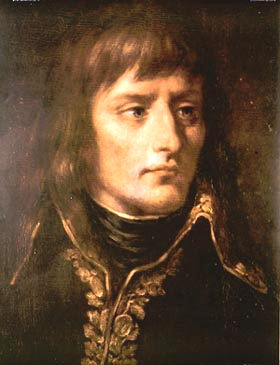 Within
three years of coming to power, Napoleon completely reorganized
France. He set in place a strong, centralized government
with a tightly structured bureaucracy. He built new
parks, bridges and quays along the Seine, as well as
canals, reservoirs, and roads. He founded the Bank of
France, which assured French businessmen credit at a
reasonable rate. Slowly the economy revived, and prosperity
returned to France. All of Europe was in awe.
Within
three years of coming to power, Napoleon completely reorganized
France. He set in place a strong, centralized government
with a tightly structured bureaucracy. He built new
parks, bridges and quays along the Seine, as well as
canals, reservoirs, and roads. He founded the Bank of
France, which assured French businessmen credit at a
reasonable rate. Slowly the economy revived, and prosperity
returned to France. All of Europe was in awe.
In 1801, Napoleon signed an agreement with Pope
Pius VII - the Concordat
– making Catholicism the official religion of France.
It restored harmony between Rome
and Paris, and it ended the internal religious split that had originated
in the Revolution. Napoleon had no personal use
for religion, but he understood its political value.
Napoleon also signed the Treaty of Mortefontaine with the Unites States, and sold the Louisiana Territory to Thomas Jefferson’s government. In March 1802, he convinced England to sign the Treaty of Amiens, temporarily ending their war against France.
Napoleon also reformed France's legal system with the Code Napoleon. He oversaw the codification of a new system of laws – the Civil Code or Code Napoleon – which abolished feudal privileges and established the equality of every man before the law.. He forced the nations he had conquered to accept the new laws he had created for France, undermining the centuries-old foundations of European civilization. The monarchs of Europe arrayed their armies against Bonaparte. But time and time again, Austrian, Russian, and Prussian troops were defeated by the citizen-soldiers of the French Republic.
Napoleon felt that
he embodied the spirit of the Revolution through his
rule. But had no patience with those who demanded greater
liberty. He crushed those who spoke out against him, making
a sham of parliament and free elections.
"Napoleon believed in government for the people but
not by the people. He took the French back to what
they probably wanted at the time, which was a friendly
monarchy, a benevolent monarchy, or at least it
gave the appearance of being benevolent."
--Owen Connelly, PBS' Napoleon
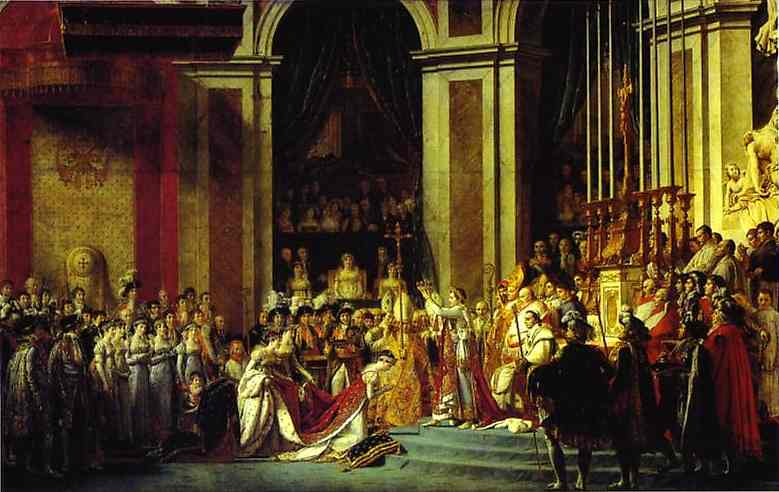
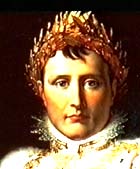
On December 2, 1804 the imperial procession made its way through Paris. In spite of the cold, a half million cheering spectators lined the streets. A little more than 10 years before, the French had beheaded a King. Now, they were crowning an Emperor.
A
Senate proclamation and a vote of the people — both carefully
arranged by Bonaparte himself - had given him what he
wanted. He was about to become Emperor Napoleon I.
Napoleon wanted the ceremony to glow with the
aura of religion. Pope Pius VII had been brought from
Italy to sanctify the occasion.
"He has the genius of making the Pope come to
Paris, which gave the everything a sacred air. It
is God who confirms that the changes that took place
during the Revolution are forever established."
--Jean
Paul Bertraud, PBS' Napoleon
As
he walked to the throne that awaited him, his brothers supported
his mantle. He would soon grant them each kingdom over
their own: Joseph became King of Naples and Spain,
Louis was named King of Holland and Jerome named King
of Westphalia. He created the Confederation of the Rhine,
consolidating the fractured German kingdoms, annexed
Holland and Rome, and founded the Grand Duchy of Warsaw
in Poland. Soon Napoleon’s empire would bring 70 million
Europeons under his rule.
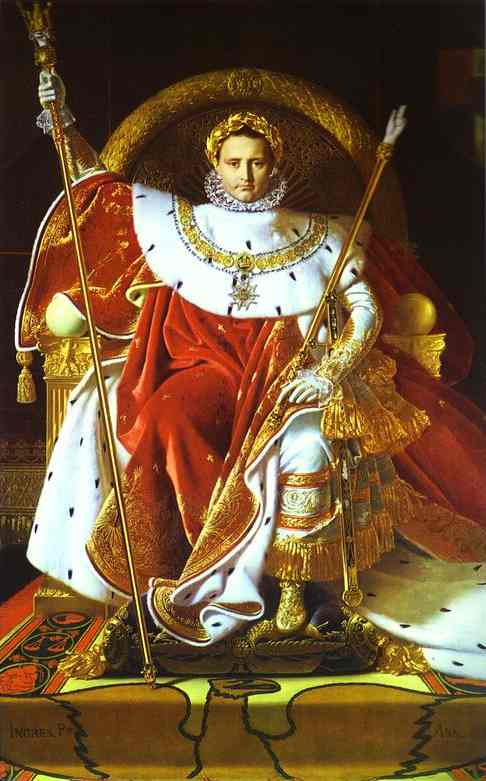
Napoleon had inherited the ten-year-old struggle between revolutionary France and the monarchs of Europe, who were determined to crush the Revolution before it spread.
Discontent with Napoleon's iron-fisted rule grew throughout the empire. He narrowly escaped two assassination attempts and a kidnapping plot, all somehow overlooked by his eagle-eyed head of police, Joseph Fouché. By 1808, Fouché and Napoleon’s former foreign minister Charles-Maurice de Talleyrand had joined in a plot against Napoleon. Victories on the battlefield failed to silence opposition to his rule. The people of Spain, who he thought would welcome him, fought French troops with grim determination. Pope Pius VII excommunicated Napoleon and was consequently arrested. Alexander broke the Treaty of Tilsit with France by trading with England, openly challenging Napoleon’s power.
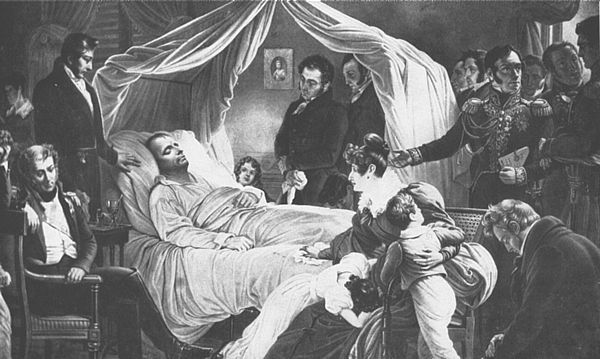
On April 12, 1814, Napoleon was forced to abdicate his throne after allied Austrian, Prussian and Russian forces vanquished his army and occupied Paris. Banished into exile on Elba, he returned less than a year later to challenge the weak Bourbon king who had replaced him. Although he was welcomed by the people of France, the allies, now joined by England, once again dealt him a defeat. Napoleon was forced to renew the war if he was to remain on the throne of France. On June 22, 1815 he was forced to abdicate again.Napoleon at first hoped to reach America; however, he surrendered to the commander of the British blockade at Rochefort on July 3, hoping to obtain asylum in England. Instead, he was sent into exile on the island of St. Helena. He would never hold power again. There he spent his remaining years, quarreling with the British governor, Sir Hudson Lowe, and dictating his memoirs. He died on St. Helena, after long suffering from cancer, on May 5, 1821.