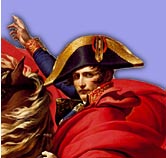











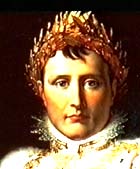
--Napoleon Bonaparte I
On December 18, 1793, cannons of the Revolutionary army under the command of twenty-four-year-old Major Napoleon Bonaparte destroyed ten English ships anchored in Toulon's harbor. After his distinguished part in dislodging the British, Napoleon gained national recognition and was promoted to the rank of brigadier general. Throughout the winter of 1794-1795 Napoleon was employed in the defense of the Mediterranean coast. Then, in April 1795, he was ordered to Paris, and in June he was assigned to the Army of the West. He refused this position, pleading poor health. This refusal almost brought an end to his military career, and he was assigned to the Bureau of Topography of the Committee of Public Safety. Because of his refusal, Napoleon was in Paris when the royalists attempted to overthrow the Directory on October 5, 1795. Mobs of Parisians joined national guardsmen bent on toppling the Republic. The government called on Napoleon to repel the attack and defend the Tuileries. Napoleon put down the uprising of thirteen Vendémiaire by unhesitatingly turning his artillery on the attackers, dispersing the mob with what he called "a whiff of grapeshot." Three weeks later he was made a full general, commander of the Army of the Interior.
The Italian Campaign
 On
April 2, 1796, Bonaparte led his army forward into Italy.
He was badly outnumbered. His 38,000 French soldiers
faced 38,000 Austrians and their allies —
25,000 Piedmontese. Bonaparte's plan was to
isolate the Austrians from the Piedmontese,
then conquer each separately. In just two weeks, he broke the back
of Piedmont’s army, crushing their troops
with lightning attacks at the battles of Montenotte
and Mondovi. One Piedmontese officer would
later complain: "They sent a young madman who
attacks right, left, and from the rear. It's
an intolerable way of making war." On April 26, Piedmont surrendered.
Bonaparte demanded gold and silver, and paid
his troops the first real money they had seen
in years. "Soldiers," he said, "we thank you."
As the Austrians fled eastward,
their rear guard hoped to slow Bonaparte down
by making a stand at the little Italian village
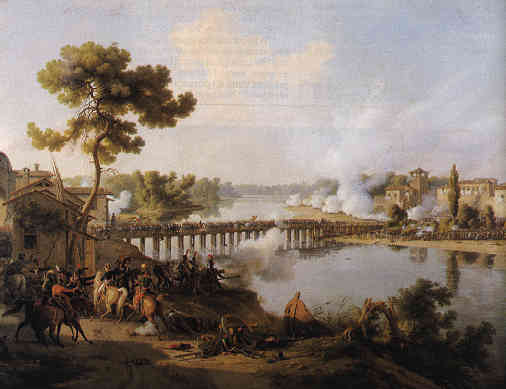
of Lodi.The
Austrians fortified a narrow wooden bridge in Lodi with fourteen
cannons and three battalions, and dared Bonaparte
to cross it. Bonaparte ordered a simple frontal assault
on the bridge. The French made it halfway
across the bridge but fell back under a vicious
hail of fire. Bonaparte urged them forward and,
in a final charge, they stormed across. The Austrian guns
fell silent. It was not a great
victory. The Austrian army had in fact escaped. But
Bonaparte had won the respect and devotion of his men.
On
April 2, 1796, Bonaparte led his army forward into Italy.
He was badly outnumbered. His 38,000 French soldiers
faced 38,000 Austrians and their allies —
25,000 Piedmontese. Bonaparte's plan was to
isolate the Austrians from the Piedmontese,
then conquer each separately. In just two weeks, he broke the back
of Piedmont’s army, crushing their troops
with lightning attacks at the battles of Montenotte
and Mondovi. One Piedmontese officer would
later complain: "They sent a young madman who
attacks right, left, and from the rear. It's
an intolerable way of making war." On April 26, Piedmont surrendered.
Bonaparte demanded gold and silver, and paid
his troops the first real money they had seen
in years. "Soldiers," he said, "we thank you."
As the Austrians fled eastward,
their rear guard hoped to slow Bonaparte down
by making a stand at the little Italian village
of Lodi.The
Austrians fortified a narrow wooden bridge in Lodi with fourteen
cannons and three battalions, and dared Bonaparte
to cross it. Bonaparte ordered a simple frontal assault
on the bridge. The French made it halfway
across the bridge but fell back under a vicious
hail of fire. Bonaparte urged them forward and,
in a final charge, they stormed across. The Austrian guns
fell silent. It was not a great
victory. The Austrian army had in fact escaped. But
Bonaparte had won the respect and devotion of his men. "He came out
all sweaty and grimy and covered with gunsmoke. The troops liked
that. They began calling him the Little Corporal right there. It
was, 'You identify with us.' You're our corporal."
--Owen
Connelly, PBS' Napoleon
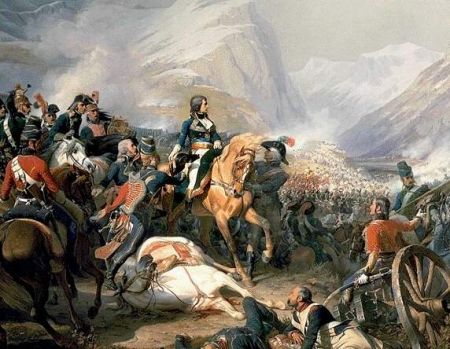 "They haven’t seen anything yet," Napoleon told
one of his generals. "In our time, no one has the
slightest conception of what is great. It is up to
me to give them an example." While
he ruled in Italy, Bonaparte never stopped chasing the
Austrians. Throughout the autumn of 1796, he whittled
away the Austrian army with victories at Castiglione,
Bassano and Arcole. In March 1797, just two
months after routing the enemy at Rivoli and
driving them from northern Italy, he crossed
the Alps into Austria itself, and by April 7,
1797, was within seventy-five miles of Vienna. Napoleon forced the Austrians to sign the Treaty of
Campoformio on October 17, 1797. The treaty gave France the territory
west of the Rhine and control of Italy. Napoleon returned to
Paris the hero of the hour.
"They haven’t seen anything yet," Napoleon told
one of his generals. "In our time, no one has the
slightest conception of what is great. It is up to
me to give them an example." While
he ruled in Italy, Bonaparte never stopped chasing the
Austrians. Throughout the autumn of 1796, he whittled
away the Austrian army with victories at Castiglione,
Bassano and Arcole. In March 1797, just two
months after routing the enemy at Rivoli and
driving them from northern Italy, he crossed
the Alps into Austria itself, and by April 7,
1797, was within seventy-five miles of Vienna. Napoleon forced the Austrians to sign the Treaty of
Campoformio on October 17, 1797. The treaty gave France the territory
west of the Rhine and control of Italy. Napoleon returned to
Paris the hero of the hour.
The Egyptian Campaign
Napoleon did not wish to remain idle in Paris; nor did the government wish to see a popular general in the capital without a command to occupy him. Therefore, an expedition to Egypt was proposed. Strategically, the expedition would extend French influence into the Mediterranean and threaten British control in India. In the summer of 1798, Napoleon eluded a British fleet, captured the port of Malta, and on July 1, landed with 35,000 soldiers in Egypt.
Napoleon quickly captured Alexandria, and then on July 3, led his soldiers across the desert toward Cairo — and a looming battle. Remarkable for their courage, pride, and cruelty, the Mamelukes waited fearlessly for the French armies. On July 21, 1798, after marching two weeks across the desert, Bonaparte’s armies came within sight of the pyramids — and 10,000 Mamelukes drawn up on horseback across the sands.
"Napoleon just organized
his army into five gigantic squares. These
are men kneeling and standing and firing
so you got a continual rolling fire. The Mamelukes
rode around the squares and were shot at by
that square and by this square. The French
lost thirty men, the Mamelukes lost probably
five or six thousand."
--Donald
Howard, PBS' Napoleon
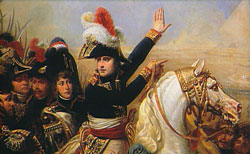 The Battle of the Pyramids was over in
an hour. Three days later, Bonaparte led his
army into Cairo. Napoleon reorganized the government,
the postal service, and the system for collecting taxes; introduced the
first printing presses; created a health department; built new hospitals
for the poor in Cairo; and founded the Institut d'Egypte. During the French
occupation the Rosetta Stone was discovered, and the Nile was explored
as far south as Aswan.
The Battle of the Pyramids was over in
an hour. Three days later, Bonaparte led his
army into Cairo. Napoleon reorganized the government,
the postal service, and the system for collecting taxes; introduced the
first printing presses; created a health department; built new hospitals
for the poor in Cairo; and founded the Institut d'Egypte. During the French
occupation the Rosetta Stone was discovered, and the Nile was explored
as far south as Aswan.
The
Second Italian Campaign
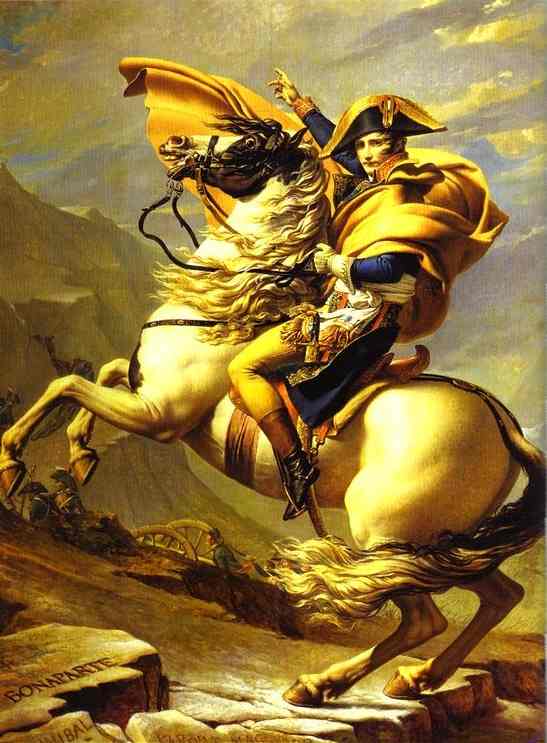 France was still fighting Great Britain
and Austria, and Bonaparte conceived a daring
plan to catch the Austrians by surprise.n
the Spring of 1800, he took his soldiers over
the Alps — 40,000 men, field artillery, trekking
across treacherous layers of snow and ice through
the Great St. Bernard Pass. Not since the Carthaginian
general Hannibal had an army attempted such
an outlandish offensive. On the morning
of June 14, he faced the Austrians at Marengo,
just forty-five miles from Milan. By the end of the
day, there were 6,000 French casualties, but nearly
twice as many Austrians had been killed or wounded.
The French had won. This victory, which
Napoleon always considered one of his greatest, again brought Italy under
French control.
France was still fighting Great Britain
and Austria, and Bonaparte conceived a daring
plan to catch the Austrians by surprise.n
the Spring of 1800, he took his soldiers over
the Alps — 40,000 men, field artillery, trekking
across treacherous layers of snow and ice through
the Great St. Bernard Pass. Not since the Carthaginian
general Hannibal had an army attempted such
an outlandish offensive. On the morning
of June 14, he faced the Austrians at Marengo,
just forty-five miles from Milan. By the end of the
day, there were 6,000 French casualties, but nearly
twice as many Austrians had been killed or wounded.
The French had won. This victory, which
Napoleon always considered one of his greatest, again brought Italy under
French control.
Early the next year, the Emperor of Austria ordered a halt to the fighting and signed a treaty with France. Great Britain followed the year after. For the first time in ten years, all of Europe was at peace.
The Ulm-Austerlitz Campaign
"He will swing in across Germany and cut off the
leading Austrian forces before the Russians
can come up. His plan is just hit first, hit
with mass forces, and catch these boys before
they can all link up."
--Colonel John Robert Elting, PBS' Napoleon
"Napoleon knows that the
enemy is aware that he is in a difficult position.
So he will exploit it like in judo - he will use
a seeming weakness and turn it against the enemy.
He will make the enemy believe he is afraid."
--Michel Keratraut, PBS' Napoleon
"And that is where his
genius reveals itself. He’s going to make the enemy
think that he is weaker than he actually is to draw
the enemy into an attack."
--Jacques Garnier, PBS' Napoleon
He had summoned two divisions of soldiers from Vienna. They had covered the seventy miles in only two days. Napoleon had put reinforcements where they were least expected, and faster than anyone thought possible. His troops, exhausted after their long march from Vienna, struggled to hold on. As the sun began to rise, Napoleon’s army appeared out of the mist. On top of the Pratzen, the Tsar watched the French materialize out of the valley. By 9:30 am, the French controlled the Pratzen Heights, demolishing the center of the allied position. Napoleon swept across the battlefield and attacked the allies from behind. By five o’clock, Austerlitz was silent. Nine thousand Frenchmen were killed or wounded, along with 16,000 Russians and Austrians. The Tsar and his army retreated. But the Austrian Emperor himself, Francis I, came to sue for peace. Austerlitz had raised Napoleon’s star to new heights. He had won his greatest victory, the victory of which he would always be the proudest.
The Prussian Campaign
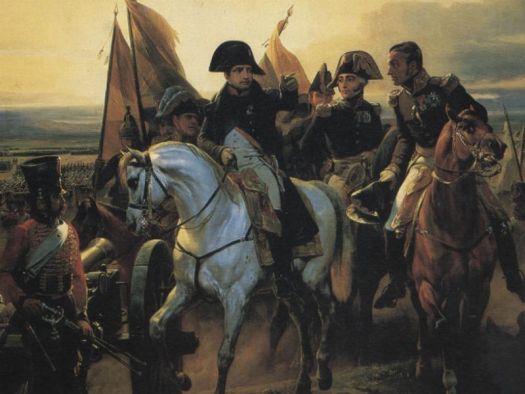
Alarmed by France’s growing power, the Prussians now challenged Napoleon, who made short work of them. "The idea that Prussia could take the field against me by herself," he said, "seems so ridiculous that it does not merit discussion." Defeating the Prussian army at the battles of Jéna and Auerstädt, Napoleon captured 140,000 prisoners and left 25,000 dead or wounded. The might of the Prussian army had been entirely crushed in October of 1806..Napoleon entered Berlin in triumph. Prussia was reduced to a second-rate power, and the fighting moved eastward into Poland as the Russians belatedly came to the aid of their defeated ally. Napoleon was in Warsaw when he was stunned by the news of a surprise Russian attack. He struck back at once, first at Eylau, just 130 miles from the Russian border, then, later in nearby Friedland.
"When the Tsar met Napoleon he had one goal in mind: to find a peaceful solution that would benefit him. And the first thing he said to Napoleon in French was... 'Sir, I hate the English as much as you do.' And Napoleon said, 'So we have made peace.'"
--Oleg Sokholov, PBS' Napoleon
France rejoiced at the
signing of the treaty between the two giant powers.
Once again, peace in Europe seemed secure.
The Peninsular War
Because a naval war was no longer possible, Napoleon introduced the Continental system, or blockade, designed to exclude all British goods from Europe. In this manner he hoped to ruin the British economy and to force the "nation of shopkeepers" to make peace on French terms. On November 30, French troops entered the Portuguese capital of Lisbon and closed the country's ports to English ships. Spain, alarmed at France's aggression, began to question their alliance with Napoleon. By 1808, Napoleon had installed his brother Joseph as the king of Spain and sent 118,000 soldiers across into Spain to insure his rule. Determined to bend the Spanish people to his will, he had decided to make Spain a part of his empire. Napoleon could never imagine that some people loved their countries as much as he loved his own. On May 2, the Spanish people rose up against the French army in Madrid.The French retaliated, killing thousands of Spaniards. It was the start of a brutal, no-holds-barred war, marked by savagery on both sides. The French tortured and mutilated their prisoners; the Spanish did the same. Thousands died, but there was no decisive victory. Napoleon would keep his armies in Spain for five years, unable to break the will of the Spanish people.
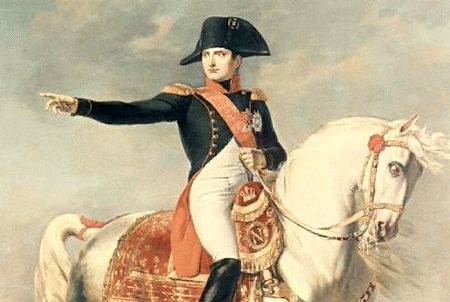 English
troops were welcomed when they landed in Portugal.
Their commander Sir Arthur Wellesley, later known as the Duke
of Wellington, defeated Junot's dispersed army at Cintra
on August 30, 1808. Two months earlier, General Dupont's
18,000 men were forced to surrender. Napoleon was
furious. After
sweeping aside the Spanish forces, Napoleon arrived
in Madrid on December 4, 1808. He immediately turned
his attention to the English forces, eager to strike
a blow at his most aloof enemy.
Unfortunately, Napoleon was compelled to leave his force
in Spain under the command of his marshals because Austria,
which had suffered defeat at Napoleon's hands three
times, was once again preparing for war.
Wellington's combined force of English, Portuguese and Spanish
soldiers steadily drove the French from the Iberian Peninsula.
On January 19, 1812, Wellington beat the French at
Ciudad Rodrigo. By July of the same year, he defeated
General Marmont at Arapiles. Finally, Wellington routed
the remaining French troops under Joseph's command in
1813, driving the French army over the Pyrenees back
into France. The
French army suffered 300,000 casualties during the
six-year campaign. Napoleon's power faded as the death
toll reached ever higher.
English
troops were welcomed when they landed in Portugal.
Their commander Sir Arthur Wellesley, later known as the Duke
of Wellington, defeated Junot's dispersed army at Cintra
on August 30, 1808. Two months earlier, General Dupont's
18,000 men were forced to surrender. Napoleon was
furious. After
sweeping aside the Spanish forces, Napoleon arrived
in Madrid on December 4, 1808. He immediately turned
his attention to the English forces, eager to strike
a blow at his most aloof enemy.
Unfortunately, Napoleon was compelled to leave his force
in Spain under the command of his marshals because Austria,
which had suffered defeat at Napoleon's hands three
times, was once again preparing for war.
Wellington's combined force of English, Portuguese and Spanish
soldiers steadily drove the French from the Iberian Peninsula.
On January 19, 1812, Wellington beat the French at
Ciudad Rodrigo. By July of the same year, he defeated
General Marmont at Arapiles. Finally, Wellington routed
the remaining French troops under Joseph's command in
1813, driving the French army over the Pyrenees back
into France. The
French army suffered 300,000 casualties during the
six-year campaign. Napoleon's power faded as the death
toll reached ever higher.The Austrian War
Austria launched a campaign to liberate neighboring countries from Napoleon's rule. Hoping to inspire large-scale revolution throughout the Confederacy of the Rhine, Austrian troops invade Bavaria on April 8, 1809, proclaiming a War of German Liberation. But the people of Bavaria, who had profited from Napoleon's earlier defeat of Austria, rallied once again around Napoleon as he assembled his troops for battle.
Two weeks later, Napoleon battered the Austrians, forcing them to retreat back across the border. He then swooped down on Vienna once again, capturing the city on May 13. Even with the capital in enemy control, Emperor Francis I refused to sign a peace treaty. Napoleon would have to crush the massive Austrian army to bring him to the negotiations table.
The Russian Campaign
"Napoleon had an army twice the size of the Russians. There were so many that the Russians didn’t dare fight. They started to retreat because they didn't have a choice. They had to retreat. But while they were retreating, they were, in fact, weakening Napoleon's army."
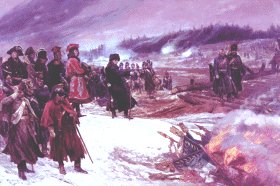
Six months before, he had crossed into Russia with more than a half million soldiers, confident of victory. Now, on December 5, rumors of a coup in Paris forced him to abandon his troops and head back to the French capital.
Lützen to Elba
Clinging to the hope that one decisive battle could turn his luck around, Napoleon rallied France for yet another campaign in central Europe. He battered the Allies at the battles of Lützen on May 2, 1813. The two sides signed the Armistice of Pleiswitz a month later, giving each side time to recover. With little time to maneuver, both Napoleon and the Allies turned to Austria, hoping to persuade them to enter the war on their side.
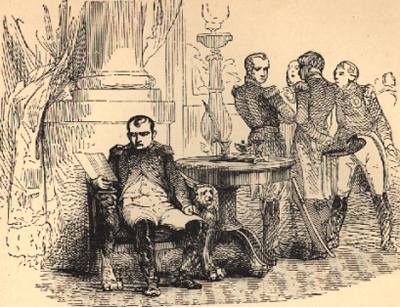 On August 12, 1813,
Austria declared war on France and joined the
Allies on the battlefield.n the fall of 1813,
the Allies caught Napoleon at Leipzig where they
outnumbered him two to one and punished his armies
in a bruising battle that lasted three days.
Napoleon
dealt them a defeat at Hanau on October 30, but
the legend of Napoleon’s invincibility was over.
His armies were now in retreat everywhere in Europe.Holland was
lost to the Empire on November 13. The Austrians
occupied Switzerland on December 30, threatening the borders
of France. The tide of war was running against Napoleon;
in two months he lost 400,000 men.
On August 12, 1813,
Austria declared war on France and joined the
Allies on the battlefield.n the fall of 1813,
the Allies caught Napoleon at Leipzig where they
outnumbered him two to one and punished his armies
in a bruising battle that lasted three days.
Napoleon
dealt them a defeat at Hanau on October 30, but
the legend of Napoleon’s invincibility was over.
His armies were now in retreat everywhere in Europe.Holland was
lost to the Empire on November 13. The Austrians
occupied Switzerland on December 30, threatening the borders
of France. The tide of war was running against Napoleon;
in two months he lost 400,000 men.By the beginning of 1814, Napoleon was again in Paris when he learned that the Allies had invaded France itself. Throughout the winter and spring, Napoleon defeated larger Allied armies at Brienne, Champaubert, Montmirail, Montereau and Rheims. It was a desperate campaign, and Napoleon fought with all his old brilliance. But 85,000 Frenchmen stood no chance against 350,000 allies.
On April 12,
1814, Napoleon picked up a pen and renounced
his throne. Once master over an empire of seventy million
people, he would now become the emperor of the tiny
island of Elba. His enemies thought Napoleon's exile
would bring peace to Europe. Napoleon had other
plans.
The Waterloo Campaign
Napoleon was exiled to the island of Elba, where he was sovereign ruler for 10 months. As the alliance of the Great Powers broke down during the Congress of Vienna and the French people became dissatisfied with the restored royalists, Napoleon made plans to return to power. Sailing from Elba on February 26, 1815, with 1,050 soldiers, Napoleon landed in southern France and marched unopposed to Paris, where he reinstated himself on March 21. Louis XVIII, the Bourbon king, fled and thus began Napoleon's new reign: the Hundred Days. The news hit Europe like a bombshell. "The Devil," his enemies said, "has been unchained."
By the end of May, the British and Prussians had two armies in Belgium. Austrian and Russian soldiers were on the way. Napoleon's only hope for survival was one last, desperate gamble. He planned to drive a wedge between the British and the Prussians, and defeat them before the Austrians and the Russians could arrive. Napoleon raised an army, and marched toward Waterloo. Wellington commanded 68,000 men, but he was counting on 72,000 more - the Prussians, led by Marshal Bleucher von Wahlstatt. Beaten by Napoleon at the village of Ligny on June 16, Bleucher withdrew his troops. Unsure if Wellington would stand, Bleucher hesitated to send his troops into Napoleon's path again.Wellington took a strong, defensive position, well aware of Napoleon’s genius on the attack. As the sun rose higher in the sky, the Duke and his soldiers braced themselves. But Waterloo remained silent. Nearly five hours had passed since daybreak, yet Napoleon had not given the order to attack. "I felt that Fortune was abandoning me," Napoleon said. "I no longer had the feeling that I was sure to succeed."
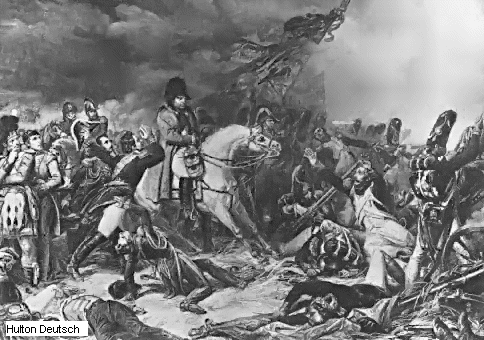 Shortly
after midday, Napoleon ordered a barrage of his most
powerful cannon — seventy-four guns steadily lobbed
cannon balls at Wellington’s center. But Wellington
had ordered his soldiers to take cover behind the crest
of the ridge on which they stood, beyond the reach of
the French guns. Napoleon’s
soldiers charged. The British counterattacked, driving
the French back in confusion.Advance
elements of the Prussian army were beginning to reach
the battlefield. Napoleon would have to break Wellington’s
center at once. The French cavalry charged on the order
of Marshal Michel Ney.
Convinced that the British line was weakening,
he led his cavalry forward.With reckless
abandon, Ney led charge after charge. Napoleon was
losing control of the battlefield.
The French cavalry was destroyed - but the English
center appeared on the verge of collapse.
Prussian soldiers began to emerge from the smoke,
still in the far-distance.
Shortly
after midday, Napoleon ordered a barrage of his most
powerful cannon — seventy-four guns steadily lobbed
cannon balls at Wellington’s center. But Wellington
had ordered his soldiers to take cover behind the crest
of the ridge on which they stood, beyond the reach of
the French guns. Napoleon’s
soldiers charged. The British counterattacked, driving
the French back in confusion.Advance
elements of the Prussian army were beginning to reach
the battlefield. Napoleon would have to break Wellington’s
center at once. The French cavalry charged on the order
of Marshal Michel Ney.
Convinced that the British line was weakening,
he led his cavalry forward.With reckless
abandon, Ney led charge after charge. Napoleon was
losing control of the battlefield.
The French cavalry was destroyed - but the English
center appeared on the verge of collapse.
Prussian soldiers began to emerge from the smoke,
still in the far-distance.
Napoleon called for the Imperial Guard, the most
feared of all his soldiers. Throughout the fighting
he had held them in reserve. Now he sent them forward.
As the Guard fell back, panic spread through the
ranks of Napoleon's army. And then disaster was upon them:
the Prussians were in the field.
"The Prussians really were the last drop of water
that tipped the bucket over. Napoleon had to draw
forces from his center to deal with Bleucher. Bleucher
won the battle. If Bleucher hadn’t been there,
I don’t think Wellington would have made it."
--Alistair Horne, PBS' Napoleon
"He began the battle too late, he gave orders that
weren’t clear, but in reality he lost the battle
of Waterloo because he didn’t believe he could
win it, because he didn’t believe he could win
the campaign. Waterloo could have been won, but
the war would have been lost anyway."
--Michel
Keratraut, PBS' Napoleon
On June 22, 1815 — four days after the Battle of Waterloo — he abdicated his throne for the second time. With no hope of escape, he put himself at the mercy of Great Britain. This time, they would take no chances; they exiled Napoleon to the remote island of St. Helena, thousands of miles from France. He would never hold power again.