








--Napoleon Bonaparte I
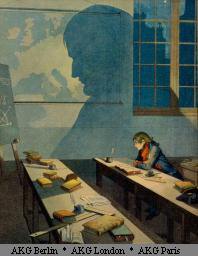 Napoleon
Bonaparte was born Napoleone Buonaparte the 15th of August, 1769 in Ajaccio
on Corsica, just three months after the island had been
defeated by the French. After
the French victory, many Corsican rebels fled to the mountains,
where they continued to fight on. But Napoleon’s father
Carlo, a twenty-three-year-old university student,
readily submitted to French rule. Napoleon
never forgave his father for betraying his Corsican heritage.
He would later say harshly that Carlo was rather "too
fond of pleasure." His mother, Letizia, was
a hard, austere woman, toughened by war, who punished her children to teach
them sacrifice and discipline. Napoleon was the fourth of eleven
children, three of which did not survive infancy.
Napoleon
Bonaparte was born Napoleone Buonaparte the 15th of August, 1769 in Ajaccio
on Corsica, just three months after the island had been
defeated by the French. After
the French victory, many Corsican rebels fled to the mountains,
where they continued to fight on. But Napoleon’s father
Carlo, a twenty-three-year-old university student,
readily submitted to French rule. Napoleon
never forgave his father for betraying his Corsican heritage.
He would later say harshly that Carlo was rather "too
fond of pleasure." His mother, Letizia, was
a hard, austere woman, toughened by war, who punished her children to teach
them sacrifice and discipline. Napoleon was the fourth of eleven
children, three of which did not survive infancy."When he was in school in Brienne in continental France, where he was very much laughed at and bullied for being a barbarous Corsican, he dreamt all the time of...liberating Corsica. But he did something quite exceptional. He conquered the conquerors. He got the better of the French."
--Dorothy Carrington, PBS' Napoleon
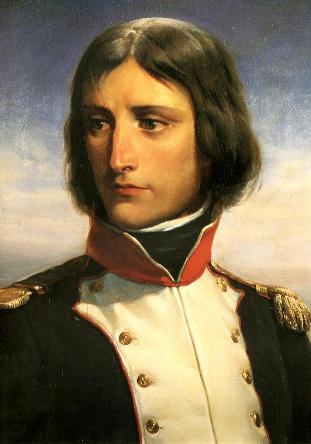 At Brienne, Napoleon received an
excellent military and academic education, and at the age of fifteen he earned
an appointment to the École Militaire of Paris. The Royal Military
Academy of Paris was the finest in Europe in the years before the Revolution.
At sixteen, he began his apprenticeship
as a lowly second lieutenant, training with the best
artillery unit in the French army. His ambitions soared
far beyond a military career, but in French society
power and achievement was reserved for the nobility
— not for an unsophisticated Corsican soldier.
At Brienne, Napoleon received an
excellent military and academic education, and at the age of fifteen he earned
an appointment to the École Militaire of Paris. The Royal Military
Academy of Paris was the finest in Europe in the years before the Revolution.
At sixteen, he began his apprenticeship
as a lowly second lieutenant, training with the best
artillery unit in the French army. His ambitions soared
far beyond a military career, but in French society
power and achievement was reserved for the nobility
— not for an unsophisticated Corsican soldier.
Then
the French Revolution changed everything. Bonaparte
was twenty-three when he took leave of absence from
the French army and returned to Corsica an idealistic
revolutionary. He took part in the power struggle between
the forces supporting Pasquale Paoli, the island's governor, and those supported
by the French Republic. After Paoli was victorious, Napoleon and the Bonaparte
family were forced to flee to the mainland. The
Corsican Assembly declared Bonaparte and his entire family
"traitors and enemies of the Fatherland, condemned to perpetual
execration and infamy." Napoleon had been given a
death sentence by his own people. The
young officer
then turned his attention to a career in the French army.
Upon his return from
Corsica in the spring of 1793, Capt. Bonaparte was given a command with the
republican army that was attempting to regain control of southern France from
the pro royalist forces. On his way to join the French Army of Italy,
Napoleon was offered command of the artillery besieging the port of Toulon.