










"Incessantly I live over in my memory your caresses, your tears,
your affectionate solitude. The charms of the incomparable Josephine
kindle continually a burning and glowing flame in my heart."
--Napoleon Bonaparte
I
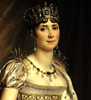
Life after the Revolution was difficult for Marie-Josephe-Rose Tascher and her two children.
To survive, she became the mistress of men who
were in a position to help support her. It was
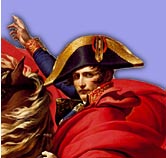
during this time that she met Napoleon. Napoleon was
a Major-General in the French Army — a man with
lofty ambition. To achieve his goals, though, he
needed a rich wife. Josephine in turn saw him as a possible
patron, and cultivated his friendship. They became lovers
in 1795.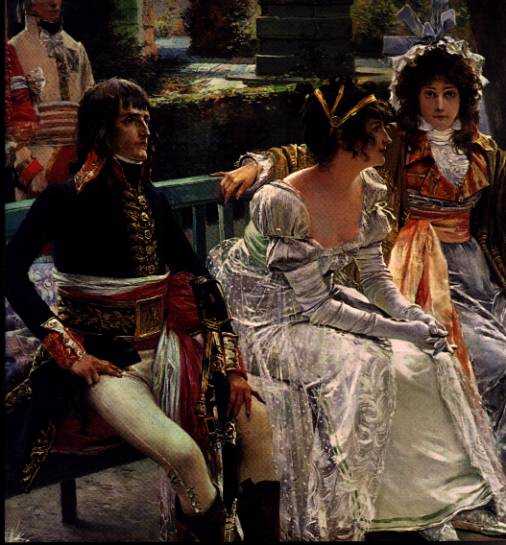
--Napoleon Bonaparte I, Letter to Josephine, December 1795
He proposed in January 1796, and they wed on March 9, 1796, just prior to his taking command of the army in Italy. She was hesistant at first to marry him, because he was "silent and awkward with women, was passionate and lively, though altogether strange in all his person."
Napoleon had great dreams for their future, and his wedding present to Rose — whom he had renamed Josephine — was a gold medallion inscribed with the words "To Destiny." Days after Napoleon and Josephine were married, Napoleon left to command the French army near Italy. Throughout the following months, he begged her to join him in Milan for their honeymoon:
April 1796:
I have your letters of the 16th and 21st. There are many days when you don’t write. What do you do, then? No, my darling, I am not jealous, but sometimes worried. Come soon; I warn you, if you delay, you will find me ill. Fatigue and your absence are too much.
Your letters are the joy of my days, and my days of happiness are not many. Junot is bringing twenty-two flags to Paris.
--Jean Tulard, PBS' Napoleon
Verona,
July 17, 1796
I write you, me beloved one, very often, and you write very little. You are wicked and naughty, very naughty, as much as you are fickle. It is unfaithful so to deceive a poor husband, a tender lover! Ought he to lose all his enjoyments because he is so far away, borne down with toil, fatigue, and hardship? Without his Josephine, without the assurance of her love, what is left him upon earth? What can he do?
We had yesterday a very bloody affair; the enemy has lost many men, and has been completely beaten. We have taken the whole country around Mantua.
Adieu, adorable Josephine; one of these nights your door will open with a great noise; as a jealous person, and you will find me on your arms.
A
thousand loving kisses.
BONAPARTE
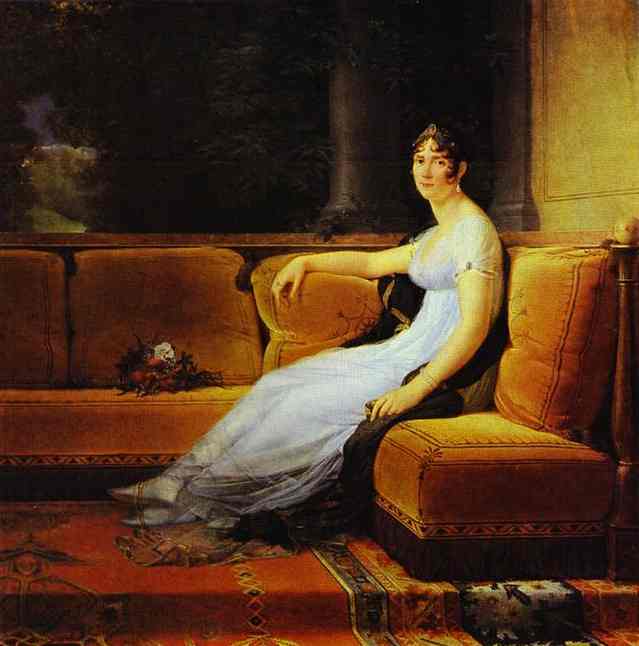 During
the First Italian Campaign Napoleon began to hear
the rumors that Josephine was being unfaithful
to him in his absence. He denied these rumors,
even to himself, and his letters became even
more passionate in response. Six
days later he returned to her apartment in Milan, only
to find it empty. Josephine had left for Genoa
— most probably with army officer Hippolyte Charles,
with whom she was suspected of having an affair.
He waited nine days for her return, but the wait
began to arouse his suspicions.
During
the First Italian Campaign Napoleon began to hear
the rumors that Josephine was being unfaithful
to him in his absence. He denied these rumors,
even to himself, and his letters became even
more passionate in response. Six
days later he returned to her apartment in Milan, only
to find it empty. Josephine had left for Genoa
— most probably with army officer Hippolyte Charles,
with whom she was suspected of having an affair.
He waited nine days for her return, but the wait
began to arouse his suspicions.
November 1796:
I don’t love you anymore; on the contrary, I detest you. You are a vile, mean, beastly slut. You don’t write to me at all; you don’t love your husband; you know how happy your letters make him, and you don’t write him six lines of nonsense…
Soon, I hope, I will be holding you in my arms; then I will cover you with a million hot kisses, burning like the equator.
In mid-March 1798 Joseph's brother finally tells Napoleon outright of the rumors surrounding Josephine. Yet when he confronts her she denies everything, angrily suggesting that if he believes such lies he should divorce her. Privately she fumes against the Bonaparte family, who she believes are in league against her:
Yes, my Hippolyte, they all have my hatred. You alone have my tenderness, my love. They must see how I abhor them from the frightful state I’ve been in… They see my regrets, my hopelessness at being deprived of seeing you as often as I desire to. Hippolyte, I’ll kill myself. Yes! I want to end a life which from now on can only be burdensome to me if it cannot be consecrated to you.Following this "day of the catastrophe," as she referred to it, Josephine must have contemplated what life would be like if Napoleon did divorce her. Her behavior from this point forward was much more amiable and loving towards Napoleon, and she appeared more willing to accompany him on his campaigns despite an overwhelming fear of carriage travel. Just the opposite could be said of Napoleon, however. Following this confrontation he realized Josephine could no longer be trusted, and his love began to turn to resentment. He took a mistress in retaliation: Pauline Bellisle Foures, wife of a junior officer. She became known among his troops as "Napoleon's Cleopatra."
Napoleon finally returned to France in October 1799, after a year away. Josephine tried to intercept him on his return journey, but they missed each other in travel and when he arrived at her house she was not there. He ordered servants to take her possessions away. When she finally arrived she was at first refused entry, but she pushed past the servants and ran to Napoleon’s room, where she collapsed outside his locked door, weeping. The accusations, pleas and shouting lasted for hours, but by dawn they were in each other’s arms again. Josephine would never take another lover, but from that point on Napoleon felt free to do as he pleased with other women.
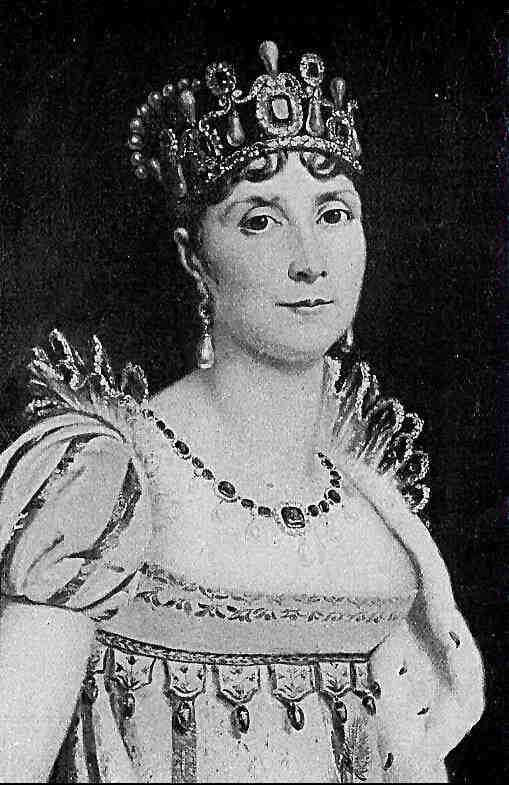
--Bernard Chevallier, PBS' Napoleon
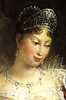
Napoleon then turned his eyes to Archduchess Marie Louise of Austria, daughter of his old enemy, Emperor Francis I of Austria. A marriage would align France with one of the oldest ruling families in Europe, and further legitimize Napoleon’s leadership of France. In a bold move Napoleon sent an emissary to the Austrian Embassy to demand Marie Louise’s hand, and further demanding that the contract be signed immediately, without consultation with the Austrian court. The Ambassador was forced to accept, and the emissary reported that Napoleon "was filled with mad, impetuous joy" upon hearing the news. Marie Louise, only nineteen years old, was terrified. She wrote in her diary "[Just] to see the man would be the worst form of torture." France had not been kind to her great-aunt Marie Antoinette, and Napoleon was far older, and an enemy of Austria. Nevertheless she bowed to the will of her father, and prepared for marriage.
They were married by proxy in a civil ceremony on March 11, 1810, and Marie Louise began her journey to France. Napoleon met her at Compeigne, and immediately rushed her into bed — even before the religious ceremony. Later, Napoleon claimed that his new empress had just one thing to say: "Do it again."
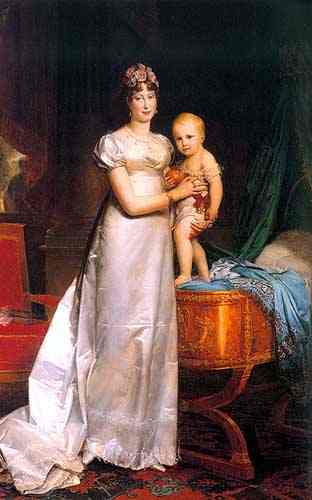 Despite their inauspicious engagement and rushed
marriage, the couple seemed happy. After their
wedding she wrote her father: "He loves me very
much. I respond to his love sincerely. There is
something very fetching and very eager about him
that is impossible to resist."
Despite their inauspicious engagement and rushed
marriage, the couple seemed happy. After their
wedding she wrote her father: "He loves me very
much. I respond to his love sincerely. There is
something very fetching and very eager about him
that is impossible to resist."
"The Emperor is much taken with his wife," Austrian ambassador Clemens Fürst Von Metternich noted. "He is so evidently in love with her that all his habits are subordinated to her wishes." In March 1811 Marie Louise delivered a long-awaited heir, to whom Napoleon gave the title "King of Rome." Two years later Napoleon arranged for Josephine to meet the young prince "who had cost her so many tears."
In 1814 the Allies invaded France, and Napoleon left for war on January 25. Defeated in the Spring, Napoleon abdicated his throne and was forced into exile on the island of Elba. He would never see his wife or son again.
Josephine died on May 29, in the arms of her son Eugene. Napoleon learned of her death via a French journal while in exile on Elba, and stayed locked in his room for two days, refusing to see anyone. Throughout her life Josephine had surrounded herself with the sight and scent of violets. Two days after his return from exile on Elba Napoleon visited Malmaison and collected violets from Josephine’s garden. He would wear them in a locket until his death, a reminder of their tumultuous love.