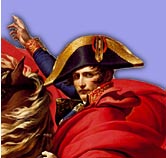











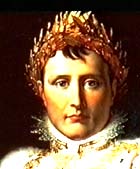
To
play the Waterloo Interactive Battle Simulator, you must first choose whether
to play as Napoleon (French side) or as
Wellington (Allied side). The computer will play as your opponent. The
game is played as a series of situations. The exact number of situations
required to complete the game will vary, but expect to play about eight
or so to finish the game.
Mac users:
You may need to download the Mac OS Runtime for Java plug-in from
apple.com in order to play. Please
note that Netscape will not run this game on the Mac platform.
The game begins with an Overview screen which will set the stage for the game.
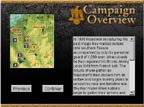
You then proceed to the first situation.
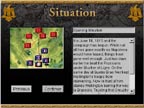
On each Situation screen, the general situation at that point in the battle will be described, and a map will show the positions of the various armies, using the following icons:
Allied Forces British —
these forces are under the control of Wellington.
British —
these forces are under the control of Wellington.
 Prussian —
these forces are allied with the British and although they are under
the direct control of Blücher, you will be commanding these forces
as Wellington in the game.
Prussian —
these forces are allied with the British and although they are under
the direct control of Blücher, you will be commanding these forces
as Wellington in the game.
 French (other than the Imperial Guard
) — these forces are under the control of Napoleon.
French (other than the Imperial Guard
) — these forces are under the control of Napoleon.
 Imperial Guard — these are the best French forces
on the battlefield and are under the direct control of Napoleon.
Imperial Guard — these are the best French forces
on the battlefield and are under the direct control of Napoleon.
On the Decision screen, you will be given several battle strategies to choose from. You can click on each option in the list provided to see a short description and a map illustrating that choice. Select your choice, then click on the Continue button.
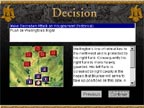
At the same time you are making your decision, the computer, playing as your opponent, will make a decision for the other side. The impact of these two independent decisions will determine the battle outcome, although the exact result of this outcome can vary each time you play the game. You must choose your battle strategy based on what you expect the opposing forces will do — but there are no guarantees they will proceed as you expected.
Based on the outcome of this situation, you then proceed to the next situation. As you progress through the game, your progress will be tracked to determine the final outcome.
Winning the Game
After you have completed all of the situations, the final outcome of the game will be displayed on the Outcome screen. There are 7 possible outcomes:
- Complete Allied Victory (The death of Napoleon)
- Major Allied Victory (Historical)
- Minor Allied Victory
- Draw
- Minor French Victory
- Major French Victory
- Early French Victory
Historically, a Major Allied Victory was the outcome of the Battle of Waterloo. If you are playing as Napoleon, and you obtain any type of French victory or any outcome short of Major Allied Victory — even a Draw — then you have done better than Napoleon did. If you are playing as Wellington and you obtain a Complete Allied Victory (and thus the death of Napoleon on the battlefield), then you have done even better than Wellington did in the actual battle.
Even if you make the same decisions, the course
of the game and the final outcome can vary, so you will want to play
the game several times to see the different possibilities. The final
outcome of the game is a combination of skill and a bit of luck, not
unlike the situation faced by Napoleon and Wellington.
Meet the Commanders
The French Army
Emperor Napoleon Bonaparte (1769-1821) Commander of the L’Armee du Nord, Emperor of France.
Marshal Michel Ney (1769-1815) Commanded a wing at Quatres Bras, field commander of the army at Waterloo.
Marshal Emmanuel Grouchy (1766-1847) Commanded a wing at Ligny, commander of a wing (33,000 men) given the task of pursuing the Prussians and preventing their arrival at Waterloo.The Anglo-Allied Army
Field Marshal Arthur Wellesley, 1st Duke of Wellington (1769-1852) Commander of the Anglo-Allied army.
Lieutenant General Henry Paget, the Earl of Uxbridge (1768-1854) Commander of the cavalry and next in command to Wellington.
Prince William of Orange (1792-1849) Commander of the I corps.
Lieutenant General Sir Rowland Hill (1772-1842) Commander of the II corps.The Prussian Army
Field Marshal Gebhard Blücher (1742-1819) Commander of the Prussian army.
General von Gniesenau (1760-1832) Chief of Staff of the Prussian army.
Generallieutenant von Ziethen (1770-1848) Commander of the I corps.
Generalmajor von Pirch I (1763-1838) Commander of the II corps.
Generallieutenant von Thielemann (1765-1824) Commander of the III corps. Assigned to delay Grouchy’s French wing at Wavre.
General der Infantrie Bulow von Dennewitz (1755-1816) Commander of the IV corps.
Here’s
your chance to compare your military skills
with two of the greatest commanders in history. Your fate on the battlefield
awaits you!
Enter the
Interactive Battle Simulator