











 Following
the autopsy of the Emperor's body, on 6 May 1821, the afternoon of the day
after he died, Dr. Antommarchi, the Emperor's personal physician, who also
performed the autopsy, made the following observations from the Emperor's
body:
Following
the autopsy of the Emperor's body, on 6 May 1821, the afternoon of the day
after he died, Dr. Antommarchi, the Emperor's personal physician, who also
performed the autopsy, made the following observations from the Emperor's
body:"The overall height from the top of the head to the heels is 5 feet, 2 inches, 4 lines. His reach, stretching between the tips of his middle fingers, is 5 feet 2 inches. From the pubic symphsis to the top of the head, 2 feet, 7 inches, 4 lines. [2 feet 7 1/3 inches] From the pubis to the heel bone, 2 feet 7 inches."
Also, the fact that Napoleon's upper and lower body measurements were virtually identical indicate that his body was perfectly proportioned.
What was the name of Napoleon's Horse?
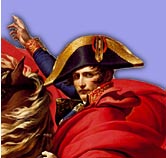
Since so many of the paintings of Napoleon show him riding a horse, it has become a common trivia question to ask "What was the name of Napoleon's horse?". However, it is not an easy one to answer, for Napoleon owned and used over 150 horses during the course of his life. The most famous ones were:
- Wagram, a gray Arab Napoleon rode from 1809 onwards, it was brought along during the Elba exile.
- Roitelet, an English-Limousin chestnut given to Napoleon by Prince Eugene de Beauharnais, it carried Napoleon back from Russia and was ridden at Lützen and Arcis-sur-Aube.
- Intendant, a pure white Norman nicknamed "Coco" by the Imperial Guard. He was mainly used for parades and reviews because of his calm, steady, and graceful nature during such ceremonies.
- Vizir, one of the Emperor's favorites, this gray Arab was a gift from the Sultan of Turkey in 1805 and 10 years later Napoleon brought it with him to Saint-Helena. It now resides — stuffed — in the Musée de l'Armée in Paris.
- Marengo, a gray Arab captured after Waterloo. His skeleton is kept at the National Army Museum in London.
- Tauris, this gray was a gift from Alexander (Tsar of Russia) was ridden by Napoleon at Vitepsk, Smolensk, Borodino, during his entrance in Moscow, and during the retreat from Russia. After being brought to Elba, it was ridden from Golf-Juan to Paris during the Hundred Days.
- Cyrus, one of the horses Napoleon rode at Austerlitz.
- Styrie, ridden by Bonaparte across the Great Saint-Bernard, and at Marengo.
- Désirée, ridden at Waterloo.
The names of some of his other horses include: Aboukir, Familier, Cheikh, Triomphant, Austerlitz, Calvados, Cid, Cordoue, Sagonte, Sélim, Bouffon, Conquérant, Extrême, Folâtre, Gracieux, Timide, Sahara, Major, Belle, Distingué, Gisors, Lowska, Favori, Harbet, Néron, Tamerlan, Hippogriffe, Kurde, Labrador, Sara, Épicurien, Embelli, Gessner, Bréant, Wuzbourg, Montevideo, Artaxercés, Aly, Coceyre, Sultan, Russe, Estime, Arabella, Babylonien, Euphrate, Hahim, Harbet, Helavert, Héricle, Lydienne, Lyre, Naïade, Nankin, Naturaliste, Naufragé, Nausicaa, Navigateur, Navire, Ninon, Emin, Gonsalvo.
What's with the Hand?
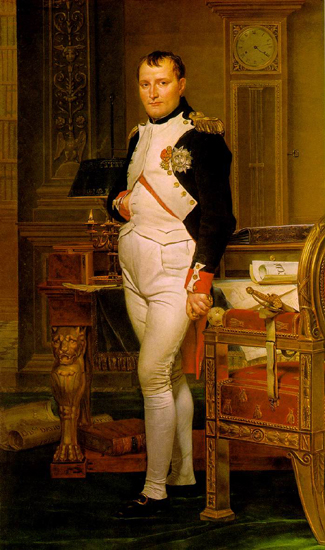
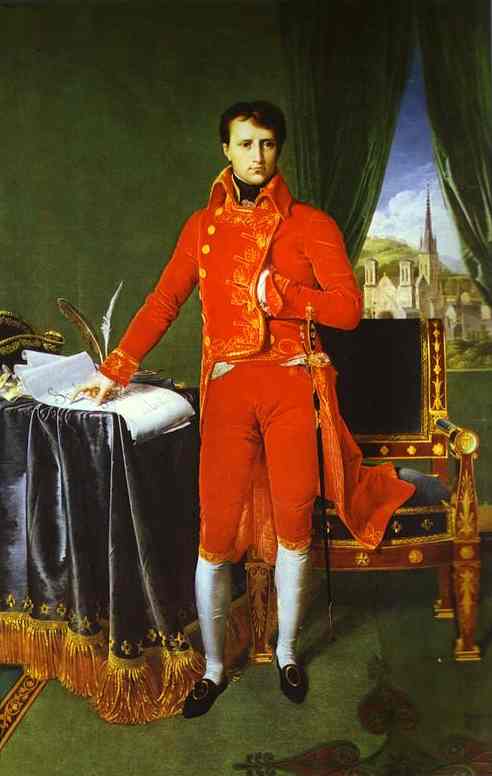
Many theories have been presented as to why Napoleon is traditionally depicted with his hand in his waistcoat. Some of these theories include: that he had a stomach ulcer, he was winding his watch, he had an itchy skin disease, that in his era it was impolite to put your hands in your pockets, he had breast cancer, he had a deformed hand, he kept a perfumed sachet in his vest that he'd sniff surreptitiously, and that painters don't like to paint hands. A simpler and more elegant theory is contained in an article entitled, "Re-Dressing Classical Statuary: The Eighteenth-Century 'Hand-in-Waistcoat' Portrait." by Arline Miller. Art Bulletin (College Art Association of America), Vol. 77, No.2, March 1995, p.45-64. Miller points out that the 'hand-in' portrait type appeared with "relentless frequency" during the eighteenth century and became almost a cliched pose in portrait painting. The pose was used so often by portraitists that one was even accused of not knowing how to paint hands. "In real life," Miller observes, "the 'hand-held-in' was a common stance for men of breeding." Miller goes on to give many examples of this posture in painted portraits dating from the early and middle 1700s, well before Napoleon's birth. In 1738 Francois Nivelon published A Book Of Genteel Behavior describing the "hand-in-waistcoat" posture as signifying "manly boldness tempered with modesty." Miller says that the hidden hand was a feature of some statues of the ancient Greeks and Romans and that later painters based their poses on classical models. The pose was recommended by certain classical writers as a useful posture for orators. Aeschines of Macedon (390-331 B.C.), an actor, orator and founder of a school of rhetoric, who wrote an important book on oratory, postulated that speaking with one's arm outside the toga was considered ill-mannered. A number of textbooks on oratory published in the eighteenth century, following Aeschines, recommended this gesture. Although Miller doesn't mention it, it is possible that the great French actor Talma, who reportedly trained Napoleon in Imperial comportment, may have been familiar with these works.
Was Napoleon poisoned or did he die of
stomach cancer?
Analysis of the emperor's hair and the discovery of high level of arsenic therein poses several questions. But it is intellectually impossible to accept the theory of death by arsenic poisoning. First of all, we can never be 100% certain that the hairs analysed come from Napoleon. Furthermore, the level of arsenic could be interpreted in different ways, notably the methods of analysis and the ways of calculating the levels used by the toxicologists (numbers obtained weighed against the number of hairs analysed: in fact, very few hairs have been analysed. Whilst presence of arsenic cannot be explained arguing from its external use (in cosmetics, for example), we still do not know where the arsenic came from, and it could have come from many sources. The hairs on the head of the people in Napoleon's entourage could also have a high arsenic content. Finally, to pass from toxicological results to a poisoning theory, then to a voluntary criminal act is very difficult. Indeed, one cannot establish a theory, accepting certain elements of the correspondence of one of the protagonists whilst eliminating other elements two paragraphs further on which contradict this position.
The only certainties thus are, Napoleon's general state of health was very poor and no direct cause of death can be determined accurately. This is the only satisfactory conclusion from an ontological point of view, both for the scientist and for the historian. A deeply held conviction may be the starting point of an investigation but certainly not its conclusion.
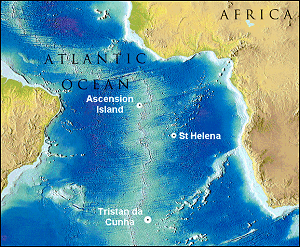 The only means at present is by boat (althought there are plans to build
an airstrip). The voyage goes from Cardiff (Wales) or Falmouth (England)
to Tenerife, Ascension and then Saint Helena and takes 15 days - those in
a hurry can fly to Cape Town and take the boat from there (only 6 days).
The only means at present is by boat (althought there are plans to build
an airstrip). The voyage goes from Cardiff (Wales) or Falmouth (England)
to Tenerife, Ascension and then Saint Helena and takes 15 days - those in
a hurry can fly to Cape Town and take the boat from there (only 6 days).
For more information, visit the following sites:
Tourist Office: http://www.sthelenatourism.com/
Saint Helena information site: http://www.sthelena.se/index.htm
Cruises: http://www.rms-st-helena.com/index.asp
Although popular legend blames Napoleon and his troops during the French campaign in Egypt (1798-1801) for having shot the nose off the Great Sphinx, in fact this story just isn't true. The idea that Napoleon was to blame for the Sphinx's missing nose dates at least to the beginning of the twentieth century.
One traveler to Egypt around the time of World War One wrote the following: "To take our photos sitting in front of the Sphinx on a camel was the aim of another....And so, repulsing the hordes of robbers on all sides, we came to the wonderful, inscrutable, worth-millions-of-pounds-to-authors Sphinx. The great riddle of the mysterious East. How many reams of rubbish have been written about this misshapen block of stone. Napoleon, a practical man, fired a few cannon balls at its face. High explosive shells were not invented in those days." [From: Sommers, Cecil. Temporary Crusaders. (London: John Lane, 1919) Chapter VI. "19th April."]
Another book from about the same time, In the Footsteps of Napoleon (1915) by James Morgan (p 85), states "There is a tradition among the Arabs of the Pyramids that all the scars of time and the wounds of a hundred wars, which the Sphinx carries, were inflicted by Napoleon's soldiers, who used its mystifying and majestic countenance as a target. That, however, is only a legend for the tourist. Long before the discovery of gunpowder, the Arabs had laid iconoclastic hands on the beard of this god of the desert..." Though the Arab guides may have originally spread this tale, this myth appears to have been perpetuated over the years by countless teachers the world over who have passed this bit of "history" on to their students.
This error has persisted in spite of the fact that the truth can be readily found in such common reference sources as the Encyclopedia Americana (Danbury, CT: Grolier, 1995). vol.25, p.492-3 under "Sphinx", which states: "Over the centuries the Great Sphinx has suffered severely from weathering...Man has been responsible for additional mutilation. In 1380 A.D. the Sphinx fell victim to the iconoclastic ardor of a fanatical Muslim ruler, who caused deplorable injuries to the head. Then the figure was used as a target for the guns of the Mamluks." In the book The Egyptian Pyramids: A Comprehensive Illustrated Reference (Jefferson, NC: McFarland, 1990), p.301, the author, J.P. Lepre, adds the fact that, in addition to the 14th century damage, "The face was further disfigured by the eighteenth century A.D. ruler of Egypt, the Marmalukes [Mamluks]."Is Napoleon still buried on St. Helena?
"In 1830 the elder branch of the Bourbons fell, and Louis Philippe succeeded Charles X. The new monarchy professed to be liberal and national enough not to fear reviving the memories of the great Emperor. The tricolor once more waved over France, and at last it seemed impossible to let the body of the Emperor rest in its distant grave."
 On 8 October
1840, with the permission of the British government, a French commission
headed by the Prince de Joinville, Louis Philippe's third son, landed at Jamestown,
St. Helena. At one o'clock in the morning of 15 October, they began the procedure
of exhuming Napoleon's body. Seven hours later, at 8 o'clock, the coffin
was finally reached and removed. The coffin was carried to a tent where it
and the enclosed coffins were opened until the face of the Emperor was exposed.
"The body had remained intact. 'Some of the eyelashes still remained. The
cheeks were a little swollen, the beard had grown after death, as had the
nails of the fingers and toes. The hands had preserved the colours of life'
a burst boot had allowed the toes of one dull white foot to escape. The nose
alone had decayed, but only its lower part. The uniform of the Chasseurs
of the Guard was easily recognisable, though the epaulettes had lost their
brightness, as had some of the small decorations placed on the breast. The
two vases holding the heart and the entrails were also found intact and perfectly
preserved.' The effect was most striking. The coffins had been opened in
dead silence; and when the Emperor was revealed as if alive among his kneeling
and weeping followers the scene must have been such as we read of in olden
days at the opening of the shrine of some loved Saint. The body was placed
in three coffins, the outer one of lead, and then in a fourth, brought from
France, a magnificent one of ebony."
On 8 October
1840, with the permission of the British government, a French commission
headed by the Prince de Joinville, Louis Philippe's third son, landed at Jamestown,
St. Helena. At one o'clock in the morning of 15 October, they began the procedure
of exhuming Napoleon's body. Seven hours later, at 8 o'clock, the coffin
was finally reached and removed. The coffin was carried to a tent where it
and the enclosed coffins were opened until the face of the Emperor was exposed.
"The body had remained intact. 'Some of the eyelashes still remained. The
cheeks were a little swollen, the beard had grown after death, as had the
nails of the fingers and toes. The hands had preserved the colours of life'
a burst boot had allowed the toes of one dull white foot to escape. The nose
alone had decayed, but only its lower part. The uniform of the Chasseurs
of the Guard was easily recognisable, though the epaulettes had lost their
brightness, as had some of the small decorations placed on the breast. The
two vases holding the heart and the entrails were also found intact and perfectly
preserved.' The effect was most striking. The coffins had been opened in
dead silence; and when the Emperor was revealed as if alive among his kneeling
and weeping followers the scene must have been such as we read of in olden
days at the opening of the shrine of some loved Saint. The body was placed
in three coffins, the outer one of lead, and then in a fourth, brought from
France, a magnificent one of ebony."
On 18 October, the commission sailed
from St. Helena on the Belle Poule to return to France with the Emperor's
body. They anchored at Cherbourg on 29 November, where, the next day the
forts and warships in the harbor saluted the Emperor. "On the 8th of December
the coffin was transferred to the steamer Normandie, a thousand guns
being fired when the body left the Belle Poule and another thousand
when the Normandie left the basin. On the 9th of December the Normandie
entered the Seine. At Valde la Haie the coffin had to be removed to a smaller
vessel, the Dorade, which carried it to Courbevoie, which was reached
on the 14th of December. On the 15th of December 1840 the body was carried
through Paris to the Invalides. It was placed on a splendid car drawn by
sixteen horses. Marshals Oudinot and Molitor, Admiral Roussin, and General
Bertrand, mounted, held the cornersof the pall. Gérard, recovered from
his wounds at Wavre, and now a Marshal, commanded the escort, which included
the other Marshals. Covered with all the insignia of his rank, surrounded
by every detail of ceremonial with which the Army, the State, and the Church
ever seek to honour their greatest dead, encircled by his old comrades, met
by the priests of the religion to which he had restored France, amidst the
solemn thunder of the guns which had sounded so often throughout his stormy
life,--the body of the great Emperor moved under the arch which told of his
triumphs, through a double row of eagles to the Church of the Invalides. The
Royal family, the Ministers, the Peers, the Deputies, the Great Dignitaries,
were there assembled to meet it. Marshal Moncey, the Governor of the Invalides,
too feeble to stand, was brought in to receive the ashes of his old Chief.
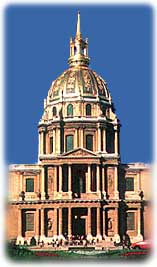
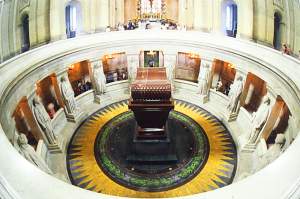
'Sire,' said the Prince de Joinville, standing at the head of the coffin, to the King, 'I present to you the body of the Emperor Napoleon.'--'I receive it in the name of France,' answered the Sovereign. Generals Bertrand and Gourgaud placed on the coffin the sword and hat of the Emperor, and in 1843 Joseph Bonaparte sent the great collar, ribbon, and bade of the Legion of Honour which his brother had worn. Napoleon had again and finally conquered. He had died an exile, an outlaw, denied title, wealth, comfort, and even the family rights common to the lowest. Now all that affection, gratitude, and honour could give were lavished on his corpse. 'Slowly wise,' France had claimed her great dead. While every throne in Europe was shaking, the Great Conqueror came to claim and receive from posterity the crown for which he had sacrificed so much. In the Invalides the Emperor had at last found a fitting resting place, 'by the banks of the Seine, amongst the French people whom he had loved so well.'"
Interactive Quizzes
Test your knowledge on the "Little Corporal"
Answers provided by: