

|
"An American in Paris"
|
Paris, France April 2000
|










|
Vendôme Column
|
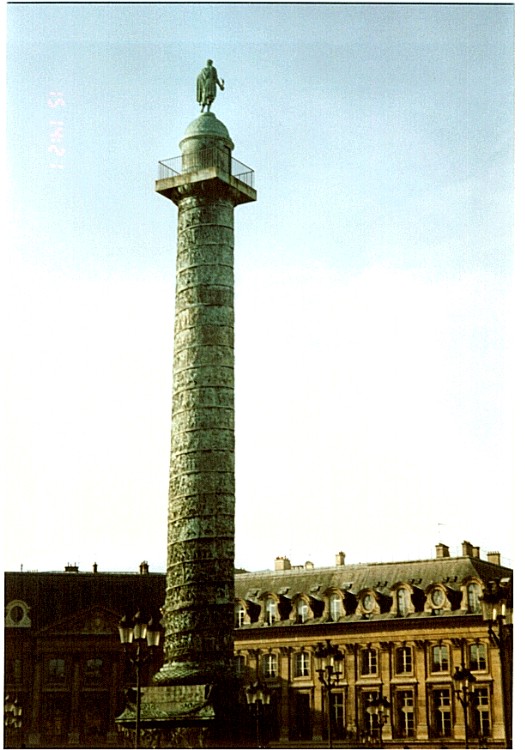
"The city of Paris has a great mast, made entirely of bronze, with sculpted Victories and Napoleon as its lookout". Such were Balzac's words on the Vendôme column, the obelisk which throughout the 19th century was seen as the most important symbol of Paris and upon which each government attempted to make its mark. Its chequered history is as much the history of 19th-century France. In 1805, the day after Austerlitz, Vivant Denon, the Director of Museums, proposed that a commemorative column be erected dedicated to the Grande Armée, using the cannons taken from the Austrians. A decree of 1806 confirmed this proposal. Astutely, Denon abandoned the idea of a column dedicated to Charlemagne, deciding rather on a 'German' column on which 'the recent campaign' was to be 'set in bronze on an eight hundred and thirty foot bas-relief frieze, representing the memorable campaign of 1805, just as the expedition against the Dacians was carved into Trajan's Column'. The column was designed by Lepère and Gondoin and received many different names - first the 'Austerlitz Column', then the 'Victory Column' finally becoming the 'Colonne de la Grande Armée'. Lepère supervised the melting down of the 1200 artillery pieces taken from the Russians and Austrians. The following inscription was engraved on the abacus of the capital: 'Monument erected to the glory of Napoleon the Great's Grande Armée, begun on 25 August 1806 and finished 15 August 1810'. |
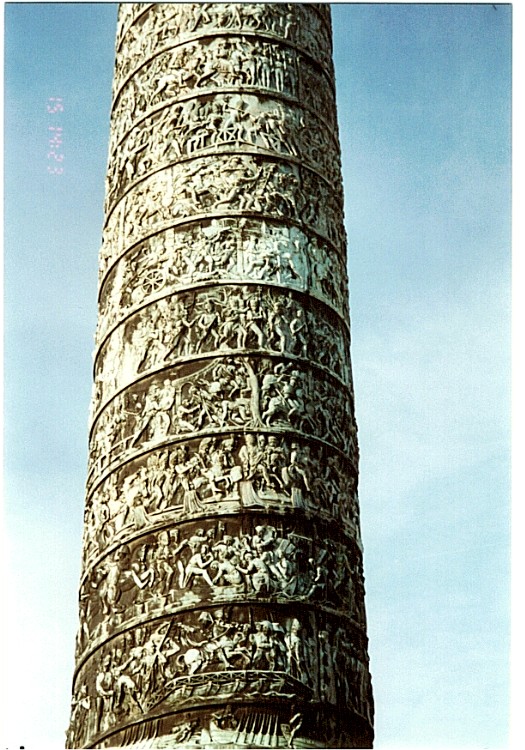
The column comprises a stone core enrobed with 425 bronze plaques fixed to the stone with pins. A 280 metre-long frieze of bas-reliefs, designed from drawings by Bergeret, winds round the column depicting the major events of the campaign - from the camp in Boulogne to the return of the Emperor and his guard in 1806. Forty-two metres tall, the column was crowned with a statue commissioned from Chaudet of "The Emperor in Roman dress." The statue was taken down by the Allies in 1814 and replaced during the Restoration by a flag bearing fleurs de lys. Under the July Monarchy this was replaced with a statue by Seurre showing Napoleon as 'Little Corporal', a statue today held in the Invalides. During Second Empire, a copy of Chaudet's initial statue designed by Dumont was hoisted to the top of the column to replace that by Seurre. Dismantled during the Commune at the instigation of Gustave Courbet, the Vendôme column was restored and re-erected once more in 1873 at Courbet's expense. |
|
|
Les Invalides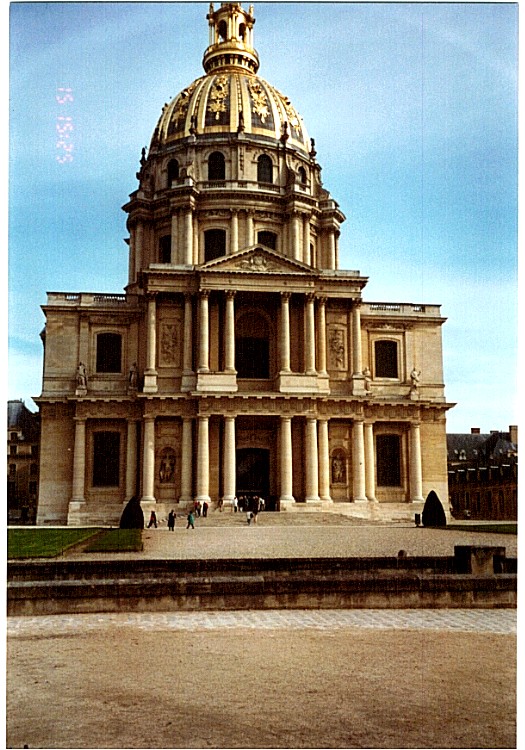
|
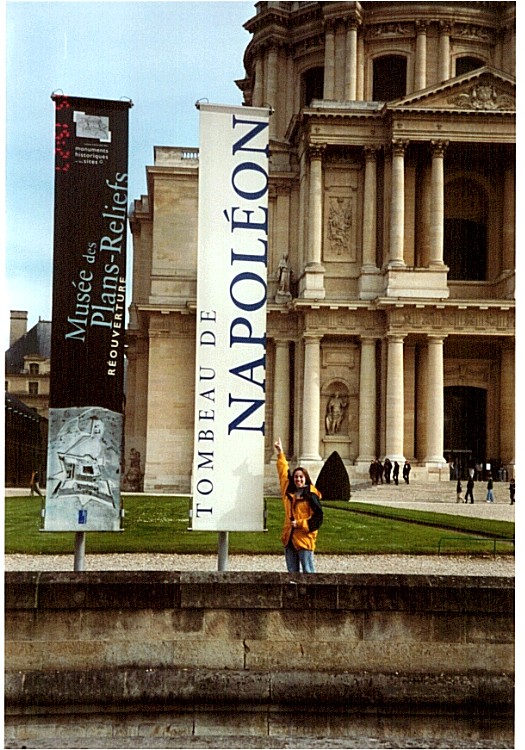
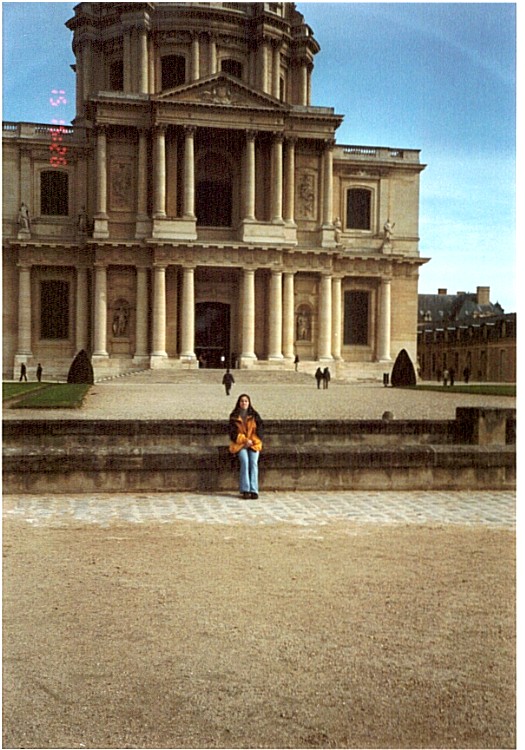
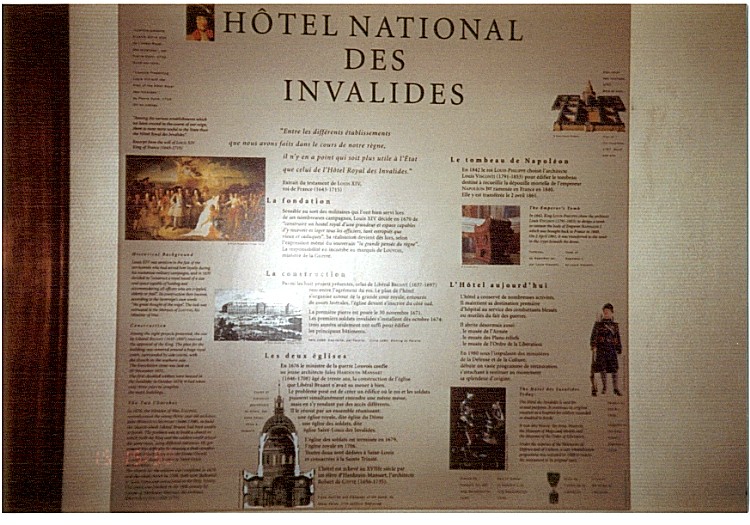
The Hôtel des Ivalides was commissioned in 1670 by Louis XIV in order to provide accommodation and hospital care for wounded soldiers. In 1815, after Napoleon's abdication, over 5,000 survivors of the Great Army were listed there. Napoleon inspected the place and visited his men in 1808, 1813 and 1815.The chapel of the Invalides was built at the end of the 17th century by Jules-Hardouin Mansart and contains Napoleon's tomb. In 1840, during the 'Return of the Ashes', a law passed on 10th June ordered the construction of the Emperor's tomb below the dome of the Invalides. A national funeral was celebrated on 15th December and the body was laid to rest temporarily in the chapel of Saint-Jerôme until Visconti had completed his work. |
|
|
The coffin was subsequently transferred to the chapel on
2nd April, 1861, in Napoleon III's presence and set up in a red porphyry
sarcophagus in the middle of a circular uncovered crypt.Visitors enter the
crypt via a staircase. This leads to a heavy bronze door (forged from cannons
taken at Austerlitz) flanked by two statues. Above the lintel is the following
inscription (an extract from Napoleon's will): "I wish my ashes to rest on
the banks of the Seine among the people of France whom I so much loved".The sarcophagus was put
up on a green granite pedestal and contains a nest of six coffins: one made
of soft iron, another of mahogany, two others of lead, one of ebony and finally
the last one of oak. Napoleon is dressed in his Colonel's uniform (of the
cavalry of the Guard) which bears his sash of the Légion d'Honneur.
His hat rests on his legs.
|
|
|
Halfway along the gallery, there is a vault containing the
coffin of the King of Rome, transferred there on 15th December, 1940, and
placed under a marble slab in the crypt on 18th December, 1969. Over the
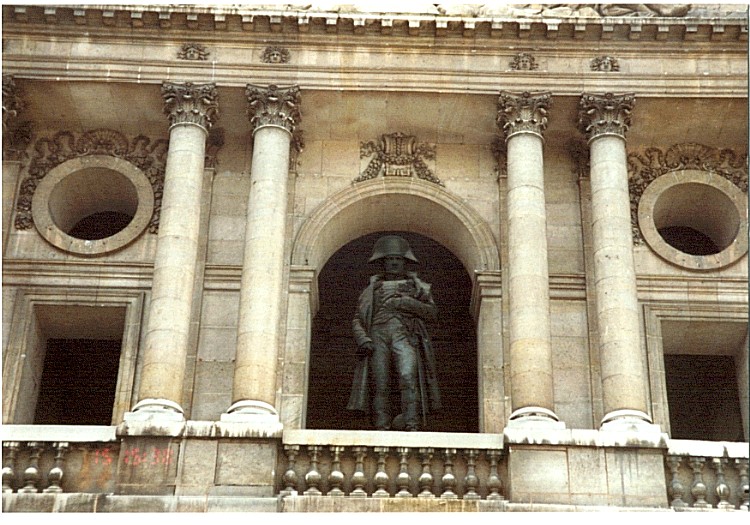
tomb stands a statue by Simart representing Napoleon as a Roman emperor.Inside
the church, two side chapels contain the tombs of Joseph and Jerôme
Bonaparte. The gilt bees on the walls of the chapel of Saint-Jerôme
serve to remind visitors that the Emperor's coffin lay here while the crypt
was being transformed.
|
|
|
Arc de Triomphe de l'Etoile
|
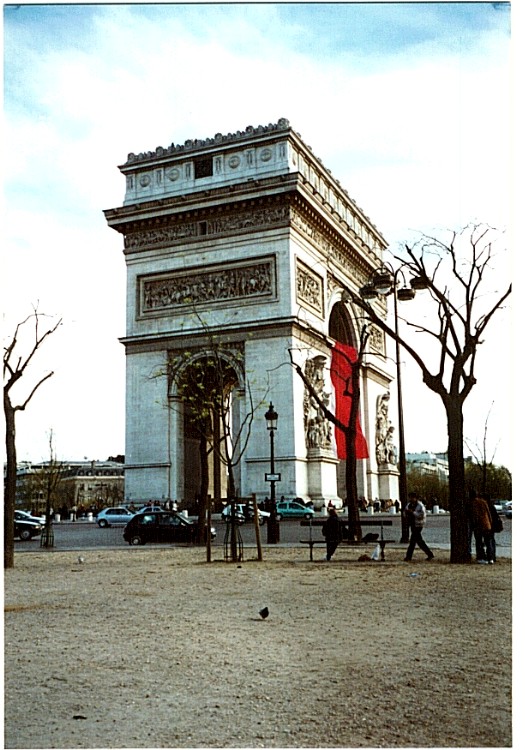
In 1806, Napoleon ordered the construction of a triumphal arch to glorify the Grand Army, and the first stone was laid on 6 August of the same year. Over 160 feet high, it outshone by far all of its predecessors. Designed after the Arch of Titus in Rome, it was meant to provide a majestic close to the prospect of the Champs Elysées.The fall of the Empire in 1815 brought the construction work to a standstill. Building was resumed in 1824 and the arch was finished in 1830 and opened on 29 July, 1836. It did not however receive its official consecration until 15 December, 1840, when the hearse bearing Napoleon's corpse passed underneath the arch.The series of sculptures the arch was to bear was defined after the 1830 Revolution. The pedestals were decorated with four allegorical high-reliefs: two facing the Tuileries, "The Triumph of Napoleon" by Cortot and the extraordinary "Departure of the Volunteers in 1792" by Rude; and two facing Neuilly, works by Etex symbolizing the Resistance and Peace of 1814. |
|
Above these reliefs but below the entablature are "Marceau's
funeral", "The Battle of Aboukir", "Crossing of the Arcole bridge" and "The
Capture of Alexandria". Above the small, side arches are "The Battle of Austerlitz"
and "The Battle of Jemmapes". Sculptures by Pradier, "The Renowned", decorate
the spandrels of the great arch with subtle harmony, while "The Infantry"
and "The Cavalry" are incorporated into those of the small arches. The frieze
of the entablature bears a bas-relief 157 metres long featuring "The Departure
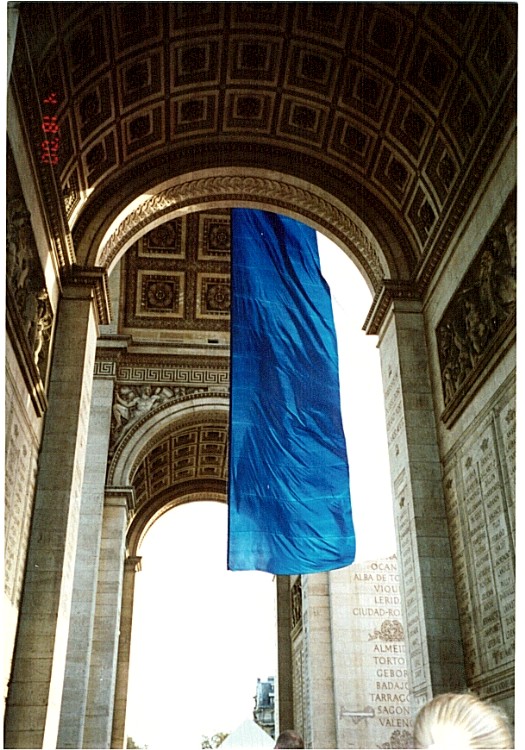
and the Return of the French Armies". In 1835, it was decided that the Roman-style
coffered vault would be be engraved with the names of 128 battles fought
during the Republic and the Empire and those of all the generals who took
part in them. Six hundred sixty names thus figure on these walls. A museum
inside the arch details the history of its construction and recalls the important
events that took place there.
|
|
|
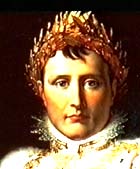
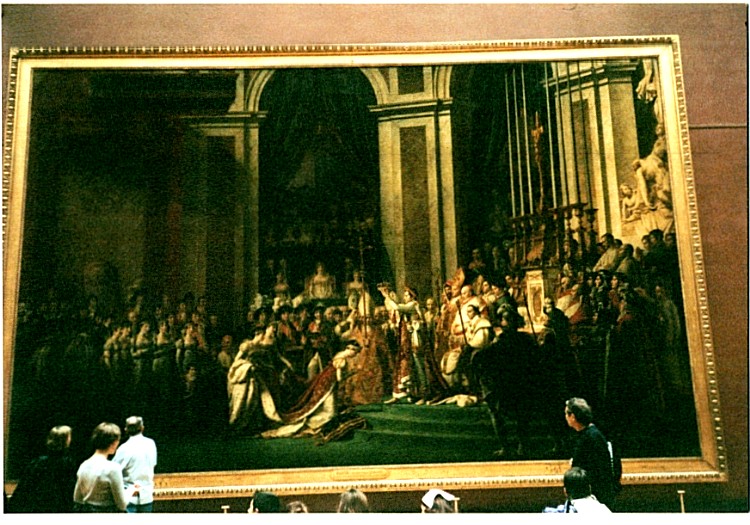
| "The Coronation of Napoleon" (Musée du Louvre)
The reign of the Emperor
Napoleon (1804-1815) was a time of great glory for France. Her armies
conquered all Europe from Russia to Spain. As General Bonaparte he
had conquered Italy in 1797. This enabled him to force the Pope to come
to Paris and crown him Emperor. The scene is the nave of Notre Dame
Cathedral, December 2nd 1804. In the presence of Pope Pius VII, Napoleon
has just crowned himself with the imperial laurel wreath. In a few
seconds he will place a jewelled crown on the head of the kneeling Empress
Josephine. The ceremony has already taken several hours and everyone
is starting to look uncomfortable! Napoleon commissioned two copies
of this moment of triumph (the other is at Versailles). Try to spot
the single difference! The advantage of painting is that it is easy
to cheat. His mother, who is shown in the centre below the arch, was
not there at all. The Emperor, who was only average height, is shown
standing tall (at the top of the steps!). However, Jacques-Louis David
did not disguise the dissatisfaction of the Pope, who had been forced to
come to Paris, only to see Napoleon crown himself.
Taken from pamphlet, "A Walk Through the Louvre with ACIS" |
|
|
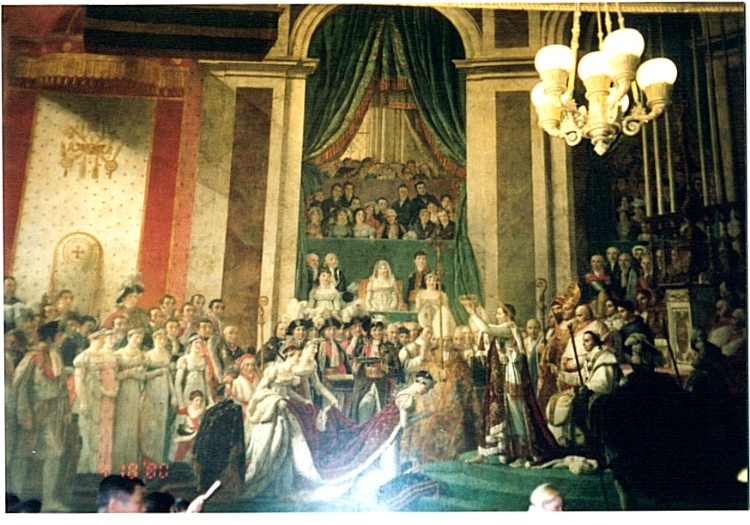
| "The Coronation
of Napoleon" (Musée et domaine
national de Versailles et Trianon)
At Versailles, King Louis-Philippe decided to dedicate a
room to the glorification of Napoleon. Thus, the Coronation room was installed
at the exit of the Queen's apartments. Three prestigious paintings are exhibited
around a Sèvres china column commemorating the victories of the Austerlitz
campaign in 1805, including a copy of the painting depicting the coronation
which David worked on from 1808 to 1822. It was installed in 1889 to
replace the original painting sent to the Louvre.
Were you able to spot the single difference (besides the large, bright spot from my camera flash)? Although it may be difficult to see in the first version, all of Napoleon's sisters, as well his step-daughter, are painted wearing violet or white dresses. However, in the second version located in Versailles, the second sister from the left, Pauline, is painted wearing a pink dress. The reason for her alternate attire has been linked to a romantic entanglement between herself and the painting's artist, Jacques-Louis David. |
|