AH
340 19th Century European Art World
Art in the Age of Art History
 |
Welcome!
This webpage is the final workbook project by James Hicks. The course is AH 340: 19th Century European Art World: Art in the Age of Art History. The course is taught by Dr. Anna Brzyski at the University of Kentucky in the Department of Art History.
Notes on organization on content - please read carefully!
- The content is organized by week
- Each section contains lectures notes and notes from assigned readings in Art in Theory 1815-1900. An Anthology of Changing Ideas.
- In addition to the notes, each section includes a personal reflection and critque of that week's content
- Each week has a corresponding image gallery with works of art discussed in the lecture
Please select a week:
WEEK 1
12 January 2005
Alfred Barr - director of MOMA 1930
-Flow Chart from Cubism and Modern Art
-Centered on Parisian Art movements
-Influence on European art, only chose movements
-Barr b. 1890 d. 1935, (Cubism published 1936)
-Assumptions, implications, of art/movements not mentioned in chart
14 Janurary
Arthur Danto, "The Artworld" in Journal of Philosophy
-
Danto - first introduced word "art world"
-Who determines what is and isn't art?
- mimesis - imitation of nature, last until Post-Impressionism
-photography disqualifies mimesis as necessary for art
-theory - an explanation, theory of art shows you what you already know
-Art as a mirror
-Socrates vs. Hamlet
-Socrates - art simply reflects what is already known
-Hamlet - reflects what we ordinarily can't perceive
-Problem of distinguishing true art from mimesis.
-Definition of art - separate works of art from non-art
- We know the phrase "work of art" and ‘art" because of our mastery of language, like the mirror of Socrates: the word ‘art" is obvious and shows us what we already know.
-Imitation Theory of Art - Socrates
-Reality Theory - Hamlet
-History of art much like history of science: concepts couldn't emerge due to prejudices, refusals to accept new ideas.
-process of accepting new art movements like Post-Impressionism
-Objects/new movements become art, but nothing becomes art that already was
-Art is creativity, Reality Theory
-Art such as P. Impressionism show "reality" by avoiding prefect imitation, non-imitations.
-Middle ground between reality and imitation, non-facsimile
-Lichtenstein - scale is important, makes his works Reality Theory rather than Imitation Theory (Pop Artist)
Danto - continued
- Jasper Johns - works aren't imitations; a copy of a number is a number, it's inimitable
-Rauschenberg - someone could mistake his Bed for a bed, because it is a bed. Bed, paint are parts of the work, a paint-bed, like people are conscious bodies, not just the material that makes them up.
-"Is of Artistic Identification" - to use "is" requires an atmosphere of artistic theory, otherwise one can't use it.
-Warhol - Brillo Boxes are art, but actual Brill boxes is a stock room are not
-Some art is both Reality Theory and Imitation Theory, but there is still an absolute distinction as art.
WEEK 2
19 January
Art - assumption of definition of art as Western art
Art theory - interpretation and evaluation, what art is - art theory
19th century art - to sell work on the market was to "sell out"
-Art - multi-valent meaning
-not a homgenous art audience in the 19th century
-different theories assume different things
Context
- Broughes Cathedral, Belgium - altarpiece, inside church, not art, but when taken out of context is museum, it becomes art (Cenni de Francesco, Altarpiece, 1390s)
Museums - 18th century invention, originally for masterpieces. Not until 19th century was modern art shown in museums
-Different nationalities, museum produces values
-Museums are frames within which meanings and values are created
-Taking utilitarian objects and turning them into design, focusing attention within museum
Plato (handout)
Plato (427-347 BCE)
Socrates (469-399 BCE) - Plato's teacher
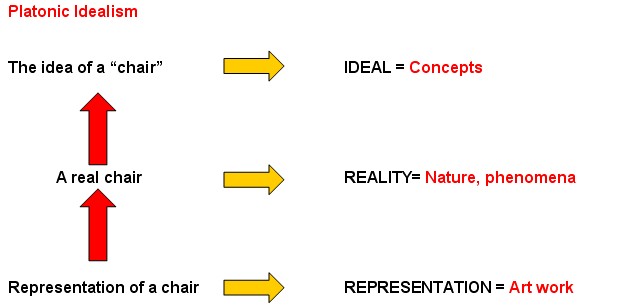
Mimesis = depiction of external reality (the world)
Mimetic work
Mimetic relationship to reality
Joseph Kosuth - 3 in 1 Chairs, 1965
-representation, idea, and actual chair
-depiction of reality
Pompeii mosaic (House of the Faun) - mimetic, reality
Laocoon - hybrid reality, real people, but idealized
Peter Claesz - mimetic, trompe l'oeil (Still Life, Dutch Vanitas 17th century)
21 January
Art in Theory - Gericault
-Great countries: Holland, France, Italy
-Countries only produce great art if they are wealthy and powerful
-In such countries, the boredom of easy life will necessitate at.
-France embodies what is necessary to produce great artists
- Athens and Rome - produce mediocre artists
- David - own genius got his success, founded his own school
-Good education the basis for any profession
- Minimum age for success: 16. G believes no one should be allowed into the Academies before then
-Too many painters in France, painting should be allowed for only true geniuses, non-geniuses wouldn't have become painters otherwise. Allowing anyone to paint prevents originality, too many mediocre artists copying old masters.
Gericault, Raft of Medusa
- Enormous scale, intended for public display
- G. was confident and thought highly of himself
- Exhibited in Louvre 30 years after the French Revolution
-Aware of French artistic style
David
-Napoleon's portraitist
-Oath of the Horatii
-David is considered the founder of the French school.
Delacroix - Barque of Dante, Massacre at Chios
Friedrich - Abbey in an Oak Grove, Wanderer of the Sea of Clouds
Art in Theory articles
-What do the articles have in common?
-no negative associations with art
-Artist's role, responsibility, separation from the mediocre
-Artist's own ideas, not imitating old masterpieces
-The essence of a thing is the idea of art, not the thing itself. (ant. - shell, appearance)
-Authors act as though they are speaking to everyone, but are actually only speaking to France
-Originality - product of one's own unique makeup and ability to extract essence from an object.
-The artist is the filter, medium, conduit for reality in art.
WEEK 3
24 January
Museums and Collections
The Enlightenment - 18th century
-movement of thinkers, primarily in France
-All subjects, thinkers figure out what is known, systemization of knowledge
-Production of first encyclopedia - categorized knowledge
-First produced in France, 32 volumes (11images)
-Diderot (philosopher) and Jean LeRond D'Alembert - first editors
French - the learned language of scholars, like Latin in the Renaissance
Encyclopedia - map of human knowledge
-taxonomy of knowledge
-Title Map of the System of Human Knowledge - from first English edition
-three categories - memory, reason, and imagination
-Art is a skill (Latin ars) on map
(Handout)
AH 340 1/19/05
Assumption Implication
Common 19th century
assumptions:
assumption: a proper woman must be sexually chase
implications: women who are not sexually chase can not be good or proper; they are "fallen"; they are unacceptable as wives and mothers
assumption 1: superior intellect is a mark of genius
assumption 2: men are naturally intellectually superior to women
Implications: women are not capable of genius; if a woman is showing superior intellectual ability, she is not feminine
Art
Assumption: Art should be mimetic
Implications: ???????
Assumption: Ideas are superior to representations
Implications: ??????
Assumption: Art has a history
Implications: ???????
Germany - Immanuel Kant, Critique of Judgment (1790) - sections 43-54
-Same Enlightenment - classification of knowledge in Germany
-Kant wrote about status of human knowledge
-Defines art more as music and poetry, but not painting
Charles-Antoin Coypel Great Masters, 1721
-Engraving, allegory of art
-statues of great painters
Louvre - pre-revolution Royal residence
-Wunderkammer - wonder chamber
-Kings had collections for prestige
-Also held exhibitions
Luxembourg Museum - 19th century
-For contemporary living artists. Post-mortem display in the Louvre
26 January
Museum in Relation to art history
David Teniers, Archduke Leopold-Wilhelm in his Gallery in Brussels, 1653
-Royal origin of modern museums
-Dogs in picture, indication of private residence, not museum
Imperial Gallery, Vienna (plan) 1784
-Shows division of galleries by nation (Flemish, German, English)
-Modern countries didn't exist at the time (Prussia, Italy, etc)
Johann Zoffany, Tribuna of the Uffizi, 1772
-Uffizi - Firenze
- Medici private collection
-gallery view, Venus of Urbino shown, with wealthy patrons actually touching the work.
-only aristocrats, artists, politicians, etc. could get access
The Louvre
-Totality of art history, antiquity to present
Hyacinthe Rigaud, Louis XIV
-Louis XIV - Palace of Versailles
-Art meant to impress, decorative
Salon at Louvre (print) 1787
-exclusive crowd
David, Oath of the Tennis Court - drawing for painting (1791)
French Revolution
-redefined museum public, no longer just for aristocracy
Hubert Robert, Grand Gallery of the Louvre
-Shows middle class in louver because of the Revolution
Robert, Project for the Arrangement of the grand Gallery of the Louvre
-Shows rearrangement of Louvre as public space, with barriers to protect works, skylights, etc.
David, Napoleon Crossing the Alps, 1800
-Napoleon and the aftermath of the Revolution
-Napoleon declares himself emperor, but can't get rid of the nation of France
28 January
Giorgio Vasari, The Lives of the Most Eminent Painters, Sculptors and Architects (1550)
Preface and Part I
-1st ed. 1550, numerous other editions, esp. 1568 2nd ed.
-Vasari established a canon for Western art
-Narrative writing
-Aspires to produce history
-Attempts to establish an order, by school, for artists
-God is the original artist, man is like God, link of man to divinity
-Sculpture comes from Egyptians
-Origin (early art) to perfection, things got better as time progressed; perfection=nature
-Exception - Greeks, fell after the decline of Rome
-Art declines with the Arch of Constantine, loss of skill, piecemeal
-made from preexisting parts, not original, movement of empire to Byzantium
-Barbarian Goths invade Rome, produced less prefect works, ignored Classical canons
- e.g. - Notre Dame jamb sculptures
-All the good artists fled to Byzantium
-Art began to recover, according to Vasari, in Pisa in 1016
-Nicola and Andrea Pisano, Allegory of the Church (Ecclesia) - shows more naturalism
-San Giovanni baptistery doors - quatrefoil panels, bronze, more naturalism
Part II - Vasari
- 2nd part of development of art, according to V.
- This part takes place entirely within Italy, no other nations try to re-achieve perfection in art.
- Cimabue - showed promise, altarpiece painting
- Giotto - first to show improved naturalism
- Massacio - first to show perspective, space
- Raphael - High Renaissance
-Equal of the Greeks, perfection
- Michaelangelo - pinnacle of perfection, master of all three arts, more than perfect, eclipses Greeks, ideal
Week 4
31 January
Textbook Assignment
- Andre Malraux -"Museum Without Walls" - Art Textbook
- Art textbook as a museum
- Read selectively, look for narrative structure
-Story of: world art, art market, 21st century perspective, timeless perspective?
-Look for author favorites
-amount of text devoted
-images: size and number
Louvre - continued
- Open to public post-Revolution
Art in post-Revolutionary France
- no longer private royal collections, for the public
- museum goers came from different social strata
Napoleon
- Took power as people's bequest
- declared himself emperor, conquered Europe
- David's Napoleon portraits
- Confiscated art from Italy et al, for "protection"
- "Entry of Monuments of Arts and Sciences" (1798), print
-Allegorical representation of works coming to France
Apollo Belvedere
- Most celebrated statue from antiquity
- From Hellenistic period
- Trophy for Napoleon
- Went back to Vatican after Napoleon was dethroned
- Studied by students as paradigm for Classical proportions
Saint Denis
- Abbey church looted during the reign of terror
Museum des Monuments Francais
- looting of churches, mausoleums throughout France, taken as French property
- Removal of Gothic portals to museums, now "art"
Louvre/18th century museums
- Organized gallery space chronologically
- 13th century Gothic to 15th century French Renaissance (French opinion of Renaissance)
- 16th century art in situ
Luxembourg Museum (Paris)
- 1st contemporary art museum
- old works, i.e. post-mortem works, went to Louvre
2 February
Rene Menard - Histoire des Beaux-Arts (1875)
-no real art historians at this time
The Salon
- Begins as an exhibition at the Louvre
- Salon moves to more international and public venues by 1870s
Royal Academy and the Salon
- King wanted to supervise the Academies, so Salon began circa 1699
- Became an annual event
- By 18th century, access much less restricted, but far less exclusive than 17th century
- Salon exhibitions had walls crowded with paintings, top to bottom
- Exhibitions had catalogues with artist contact info and address for commission opportunities
- Art critics frequented salons, beginning of art criticism
- By revolutionary years, Salon exhibition more frequent and less exclusive, more artist allowed, less jurying
- 1790s - 300-1000 entries, late 19th century more than 3000
- Artists allowed maximum number of entries, some more than others based on merit
Salon Jury
-selection committee: painting is reviewed for membership
-no women, conservative middle class, no avant-garde
Hanging Committee
-Determined where works would hang
-central, lower were the optimal spots
-Salon medal winners - became widely recognized, even outside of Paris
-winners' works were purchased for collections or museums
-received new commissions
-By 1880s, Salon wains in prestige
-artists turn to galleries, private commissions
-bypassed Salons
-Salons admitted controversial paintings
- Manet - Olympia
- Daumier's caricatures
Salon des Refuses
- Response to vast number of works rejected from the Salon
- Jurists became less biased as a result
4 February
Art in Theory readings
Hans Heine (p. 81)
- Delacroix - Liberty Leading the People
- Shows the rabble, dirty, lower class rising up in arms
- Persistence of human dignity
- Allegory of Marianne (France)
- Heine: Critics - too much Partisanship, hinders originality
- Need for artistic genius, freedom of expression for all history
- Delacroix - Liberty Leading the People, Massacre at Chios, Women of Algiers
Marie Camille de G (p 155)
- Ingres and Delacroix
- Both Romanticists, but Delacroix identified with Leftists, Ingres with the Right
- Ingres - Academic, painted state pictures (e.g., Napoleon)
- Delacroix - challenging the norm
Kant - Genius and Originality
- Classicist - Ingres, Romanticist - Delacroix, Realist/Naturalist - Courbet
J. Castagnary (p. 410)
- Naturalism is the future
- Romanticism vs. Classicism (Delacroix vs. Ingres)
Week 5
7 February
International Expositions
- Salon - access to more of the populace - childen, women, etc., uneducated, lack of knowledge
- Free Sundays
- Courbet - audience was considered cruel and vulgar
The Crystal Palace
- 1851 Hyde Park, London
- Expo to show Great Britain's power: economic, military, etc.
- Displayed British colonial accomplishments
- World's Fair style - all nations invited to display
- Built according to architectural plans in 10 days, pre-fabricated sections
- Metal and glass
- Sir Joseph Paxton - architect, designed bridges primarily, not a building designer
- technological marvels, inventions, etc.
- like a large trade show; exotic replicas
9 February
The Crystal Palace
- Multicultural - each nation had an opportunity to show off culture (from art industry)
- Arts (i.e., Fine Arts, Beaux-Arts) and Crafts (Decorative Arts)
-Each country had display galleries at the Palace to show the cultural uniqueness of their art, crafts, industry, etc.
- Commercial competition - who has the best design, crafts, technology
- More international shopping occurring
Salons in England
- Salons always remained very exclusive because there was no revolution as in France.
Exposition Unverselle, Pairs, 1855
- Larger space, more elaborate, stadium-like building
- Expo halls meant to be temporary, assembled than disassembled
- Parisian artists had advantage over foreign artists
- Upstarts Manet and Courbet
- At the time, they were not well known enough to get an Ingres Retrospective, so they built their own expo hall, entrepreneurial spirit
Welt Austellung, Wien 1873
- Expos not just occurring in England and France
- Also had temporary expo halls
Paris Expo, 1878
- Ethnographic art, colonial art
Paris Expo, 1889
- Eiffel Tower - built specifically for the expo
- Ethnographic exhibit expanded
- Ethnic village reconstructions
- Eiffel Tower
- Symbol of French modernity, technology, steel, unprecedented forms
- No function other than for the Expo and to symbolize France
- Now had electricity, more modern machinery, steam engines
- Art unchanged at expo - still paintings and marble sculpture
- Avant-garde artists made a showing- "Groupe Impressioniste et Synthetiste"
11 February
Gustave Courbet
-Burial at Ornans - unheroic, perfunctory funeral. Unconcerned mourners.
Naturalism and Realism
- Naturalism - observation of nature, painting the world as it should look, but naturalism is still edited and ideal
- A nude is naturalistic, but functions as a nude, not a woman.
- Realism - related to naturalism, but unedited. Often deals with social issues, has a political dimension.
- Courbet - Artist's Studio
- Self-portrait while painting landscape (though not painting en plein air)
- Allegorical for a master artist
- Intended for a museum
- Group to the left - typical artistic subjects, a cross-section of society
- nude figure - not a nude here, just a working model
- picture of studio as it really is
- Child - notion of learning, artist as teacher, or that artist should shed conventions of education and become a child.
Art in Theory Readings
- Courbet - "Statement on Realism" (p. 372)
- Bathers - Obese woman, not ideal, with a towel, not a toga
- Origin of the World - pornographic, not social
Week 6
14 February
Academies - Renaissance
- Origin in guilds/workshops - masters and apprentices
- Initial position as an apprentice, then freelance journeyman, apprenticing under various masters, then a submission of a masterpiece for guild membership
- Atelier - "studio"
- pre-17th century - workshops/guilds
- Post-17th century - studios/ateliers
- Apprentices also trained to make paint, canvases
- Learned from Classical models, to emulate, not to copy, was the goal
- to emulate, one had to copy first
- Master's interests to reproduce his style in his apprentices, so that they might assist in commissions
- In the 16th century, painters switched roles from craftsmen to poets, no longer artisans, but poets.
- Academies - professional associations, not an art school
- ideal academies - reading, writing, anatomical studies, classical sculpture, canons
- focus on design, less on craftsmanship
- close examination of sculpture, of other artists' works.
- Academies originate post-17th century in France, model for Europe. 1664 - Royal Academy of Painters and Sculptors.
Ecole des Beaux-Arts
- First art school with professors, lectures
- Assumption that theory and rule can be taught, but can't be taught how to make great art.
- Didn't teach painting until 1863 (only taught drawing before) , had to be apprenticed to paint
- Steps - had to master skills to advance, took a long time.
- study of old masters
- only place where instructional nude drawing occurred.
- Stages:
1. copy engravings, simple 2d objects
2. copy sculpture fragments
3. draw from plaster casts, full sculptures
4. draw from live models
16 February
Royal Academy, France, est. 1664
- Received royal patronage
- Required regular Academic exhibitions (Salon) to show for the king.
- Jury came from the Academy
- conservative Academy
Academy in St. Petersburg, Russia, est. 1757
- France didn't have the only academy
Royal Academy in England est. 1768
Royal Academy, France, est. 1664
- Was an exclusive club with great sway
- Generated resentment in 19th century
- Had a monopoly on the Salon and education
- Ecole des Beaux-Arts - only academies could teach
- Academy was not the school, Ecole was the prep school for the Academy
- No standards for advancement, professors judged achievement
Ecole des Beaux-Arts
- Had an entrance exam for competenace
- Often students had to apprentice under a professor, needed to sponsor a student
- professors not there everyday, students were very competitive, like a fraternity.
- Only male students, women were just models.
- Basic exercises were copying classical canons, memorizing forms. Copying was worthless, the process and internalizing the process was important.
- Always copied/learned from the human body, main source of inspiration. Figure became memorized, no longer drew from models after graduation.
- Students abided strictly to classical canons, no expression, originality only within the canons
- Drawing from casts - white color showed shadows well, (usu. done at night).
- Advanced students drew from live models. Models posed in Classical poses, students memorized classical poses.
1863 - separated into different ateliers for painting, sculpture, etc.
Prix de Rome
- Graduated students/ advanced students competed for the
prize.
- Winner received 4 year fellowship in Rome, had to submit works, judged by
academy and awarded membership.
- Contestants had to draw a certain subject
- Had to draw composition, although it wasn't taught to them, had no models, al from memory
- competition entries often unfinished, abstract
- Daumier's entry - allegory of the Republic - abstract unrefined
Academy Meanings
1. School - 2nd half of the 19th century, school for producing artists
2. Membership Organization - Academic painter - member
3. Academic Painting - single nude images based on live models
French Academy
- Students weren't taught with images, students required to go to museums to study old masters.
- Encouraged to travel to Paris, Italy
Academic Finish
- finished painting requires more than just a sketch
- David - Death of Socrates - student copy - finished from left to right, use of half-tones to finish painting, transition from light to dark
- Process of Academic painting
- Requires drawing, thinking, reading, to finish.
- David - Oath of the Horatii
- Several sketches from Roman story were considerd by David, specific episodes from the play Horatii
- Chosen work doesn't come from play at all, no oath in the play
Gros - Battle of Elau - 1803
- Sketch - basic drawing for painting, first conception of finished work.
- different slightly from finished work, steps from sketches to finished drawings (which could also be sold) to finished drawings.
David - Oath of the Tennis Court
- Everything based on nude models. Sketch shows nude models drawn first (finished work wouldn't have been nude)
- No finished painting - only a finished drawing
18 February
No class - meet in groups to discuss textbook critique
Week 7
21 February
Art in Theory readings
Greuze
- Prepatory drawing for a painting. Sold as a finished work in full detail. Some done with sepia wash.
- The act of painting not important for finished work, just another stage (the final stage)
- David - started with major figures, worked always from dark to light, background always done last.
- Paintings, with sketches, drawings, studying, often took years to finish.
- Impressionism - against Academic - not a finished work, a sketch.
- Painting done in studio. Sketches done on site. Painting wasn't exactly as the scene was.
23 February
Academies
- Student copy of old masters, in order to figure out elements of composition/painting (not taught to them - only drawing)
-Academic values of painting in first half of the 19th century:
- Classical nude - history painting, classical myth, Bible
- genre painting - miscellaneous scenes, everyday life
- landscapes
- still lifes
Ingres - La Source (1856)
- Ancient Greek goddess motif
Bougereau - Bathers
- painting in the mode of Ingres
Cabanel - Birth of Venus - 1863
- Venus unimportant, excuse to paint a nude, to show technique of academic finish
Academic Painting, 1st half of the 19th century
- concept, ideal, more important than process
- challenge to academy
- Classicism (Ingres) vs. Realism (Courbet)
- Not a different painting technique, but subject
- Issue of appropriateness, proper subject for art
- Realists - looked at unwanted aspects of society, no veneer of academic painting
- Ingres vs. Delacroix
- Delacroix didn't follow usual method of academic finish
- Delacroix looks like a painted sketch, less sense of the line, less steps, thought more about color than the line.
Week 8
28 February
Modernity and Modernism
- Commerce and sex, sex sells
- Admiring a work of art only for its form, beauty, not for its pornographic value.
- Supposed to see beauty in the form of the nude
- not to view it as porn, be it a favorable or negative response
Aesthetic experience
- must figure out the reality of a figure as a naked one.
- As soon as means of reproduction came to be, pornography occurred in engravings and prints.
- pornographic images not much different than artistic nudes.
- photographs - 1830s - immediately had nudes as pornographic images, though still had classical poses.
Pornography and Art
- The Odalisque - female harem slave, exotic location of North Africa, safely remote, not as porn.
- Photos attempted to portray the artistic nude.
- Despite this, photos showed imperfections not in the Classical nude.
Stereoscope - pornographic images
Courbet - Origin of the World
- pornographic or aesthetic
- meant to be pornographic, private commission
- taking an image to make an aesthetic image
- Porn to some, art to others
Manet - Olympia
- Looks right at you, unlike Venus, but covers genitals
- Nude or pornography?
- Titian - Venus of Urbino - hailed as great work, but still a portrait of a courtesan like Olympia
- Manet recreating modern Venus of Urbino
2 March
Courtesan, class, socialism
- 1864 - two works shown in the Salon, Olympia and Birth of Venus
- Olympia - epitome of modernity, courtesan, urban dweller, symbol of urban problems, prostitution, etc.
- Venus - nature, purity, innocence, etc. not urban
Art in Modernity (1860s onward)
- 1848 year of revolutions, rise of Socialism (marx)
- concept of class rose - proletariat, bourgeoisie, aristocracy
Olympia - courtesan comes from lower class, but associates with aristocracy
- portrayed elegantly, but still dirty - flowers wrapped in newspaper, inelegant, not provocative in-control pose. The gaze reversed - not just men looking at her.
- reinventing the old master Titian
Breton - Gleaners - 1854
- Gleaners - genre scene of everyday life
- no sign of modernity
- Escapism - painting countryside, observing nature, painting en plein air
- Invention of tube paint allowed artists to go to country
Rosa Bonheur - Plowing of Fields in Nivernais 1849
- intense naturalism
- had to gain permission to wear men's clothing to paint in farms and fields
- Not modernism, timelessness, continuity, naturalism
Julian Dupre - In the Pasture 1883
- in the vein of Bonheur
- struggle of peasant girl
English Painters
- international scope in class struggle, Marx and Angles publishing throughout Europe.
Fred Madox Brown - Work 1852
- Allegorical work similar to Courbet In the Artist's Studio
- London city street - Hamstead
- cross-section of society, all walks of life
- not just a celebration of working class, but indication of the problem - young girl taking care of siblings
- Admired by Brown - Thomas Carlisle - Christian Socialist; Rev. F.D. Maurice - Education reformer.
- Men wearing campaign sandwich boards - democracy
- Based on observation, naturalism.
Brown - Last Glance to England
William Holman Hunt - Awakening Consciousness 1853-1854
- Courtesan
- nouveau riche interior - factory made décor, kitschy
4 March
19th century
↓ Idea/concept - abstract (perfect)
Representation - mediating term
Reality - concrete/particular (imperfect)
Plato
↓ Idea/concept - abstract
Reality - concrete
Representation - mimesis
Historic Materialism (Marx and Engels)
↓ Reality - concrete, knowable, science, economic/social reality
Representation - philosophy, art
Idea/concept - abstract
Karl Marx
Commodities - products that are traded
Use-Value - Table - decorative/utilitarian function
- bartering - negotiating/agreement
- use value doesn't function for commodities
- supply and demand - market value - disassociation from individual - societal determinate
- worker - wage
- labor - alienated
Art in Theory Readings
Delacroix (p. 326) and Girardin
- Girardin - steam plough proposal to alleviate manual labor, allow rustics to relax, improve their mind
- No use for peasants, will move to city and become proletariat
- Delacroix - thinks it's dehumanizing, deprives peasant of identity
- Nostalgia of farming the land, pre-industrial, idyllic view
- Globalism - interdependent international economies and trade.
- Delacroix - something organic is lost
- Delacroix, not a peasant
Week 9
7 March
Recap of Modernity
When? - In the 19th century, Modern was anything not Ancient, Renaissance onward was Modern
What? - Whatever is characteristic of a given period
Unique character - differences in culture, celebration of one's own time
Modern Art - to be of one's own time, art must be about it's own time
Charles Baudlaire
- Art = Classical (timeless) and Modern (contingent, changing)
- timeless - relevant even to modern times
- modern element - contingent, changing part of timeless work
Content (what) and Form (how)
Academic paradigm (19th century)
- Content (proscribed) = beautiful, sublime, enlightenment
- Form (partly proscribed) = mimesis and invention, composition
- Decorum = rules for what is appropriate and what is not
Assumptions
1. There are rules for art
2. They are natural
3. Can be taught through theory and emulation
4. Ultimate goal to produce original work
5. Original work makes visible hidden rules of art
6. Originality for its own sake is nonsense
Non-Academic Paradigm
- Content = to be of one's own time
- Form = naturalism and invention
- Modern content and form
Assumptions
1. Each period produces its own art
2. Therefore, there are no a priori, timeless rules for art
3. New rules made each period to reflect its uniqueness
4. Artists create new rules through their art, they don't discover eternal rules
5. Art history practice changing in time, reflecting changing conditions
- this also applies geographically
- different cultures are different because they produce different art
- cultural relativism (no single standard of quality)
6. Imperative - to be authentic and sincere
7. Natural reality is the touchstone of art practice
8. From 1880s on, metaphysical/transcendent reality is the touchstone of art practice
Photography
Renaissance - camera obscura
- "dark room" - artist draws within the images through a small hole
- couldn't record the image
Nicephore Niepce - 1826
- recorded camera obscura image
Louis Daguerre (1848 photgraph)
- sponsored dioramas
- collaborated with Niepce, created Daguerreotype - glass covered with photosynthetic material. Long exposure time, originally only still-lives.
Daguerre - 1838 photo of Paris - shoe shiner remained long enough in the exposure to be recorded, first photo of a person.
9 March
Photography (continued)
- no longer a monopoly of the image by painting, etc. (fine arts)
- wood engraved images for reproducing of photography
- extreme growth, popularity of photography
- Dioramas - occupied whole buildings
William Henry Fox Talbot
- created negatives, sought how to make images reproducible
- collotype - could make copies from negatives
- The Pencil of Nature - 1843, book
- pasted in collotypes
- nature as the artist, not just a mechanical process
composed like paintings.
Moorish Woman - 1865
- Orientalism - exotic subjects
- like Odalisque paintings
- travel to colonial countries, ease of travel, professional photography
Stereoscope
- pornography, simple entertainment
- image set of different countries
- set of image "novels"
News
- news of war, first of Crimean War 1850s
- first images of death, carnage, not heroic or romantic
- Timothy O'Sullivan - Gettysburg, 1863: A Harvest of Death
- Andre Adolphe Disderi - Dead Communards, 1871
- Paris commune uprising, not cleaned up, documentary
- Matthew Brady - Lincoln - portrait
- newspaper images - engravings exposed to images
Nadar (Gaspard Felix Tournachon) Self-Portrait 1855
- photography entrepreneur
- studio in Paris - Boulevard des Capucines
- first Impressionist exhibition here
- photographed "people of culture": Baudelaire, Sarah Bernhardt
- wanted his work to be art, although it was commercial enterprise
- looked to art for models
Nadar - Nude 1855
- modeled after Ingres, Courbet, and Delacroix
- photos became drawing aids, cheaper than live model
Eadweard Muybridge Gallop 1877-1888
- idea of motion, index print of horse gallop
- conventions of movement change, unkown before because the eye couldn't perceive it.
Photography as Art
- wasn't considered art; too mechanical, no natural genius
11 March
Photography (continued)
- Mimics art - landscapes framed using natural elements
- nudes, allegories, salon painting.
R. Fenton - British photographer, still-lives
J.M. Cameron - female artist
- used photography's unique effects - selective focus, etc.
- photography as an independent art, not mimicking painting
Week 10
- Spring Break, 14 - 18 March
Week 11
21 March
Impressionism
- Group of individuals founded 1874 - Societe Anonyme Cooperative D'Artistes
- weren't originally called Impressionists
- weren't unknowns, weren't Bohemians, were young students with studios.
- Precedents for Impressionist Exhibitions
- Salon de Refuses
- Universal Expos - Courbet's expo
- Artist's Union (Union Artistique) - 1869
- Impressionists driven to make a living as an artist, not necessarily after Salon fame, but survival
- Rise of art dealers, who sought to sell the artist, not single works.
- dealers had to shift focus from single masterpieces to a name.
- art galleries for elite, social events. Not egalitarian, just for collectors
- Paul Durand Ruel
- dealer, art dealer - first bought Impressionist paintings
- held auctions for artists, developed art market for Impressionism
- Primary market - galleries
- Secondary market - auctions - controlled prices of primary market.
- Impressionists wouldn't have organized their own show without Durand-Ruel
First Impressionist Show
- 1874, Nadar's studio at Blvd. des Capucines
- 15 April - 15 May
- were against juried shows, Salon. With Durand-Ruel's backing, they held the exhibition as Nadar's studio on a cosmopolitan Parisian street, a well known location
- Degas - only aristocrat of the Impressionists
- Impressionists - part of Artist's Union, 30 original members with membership fees.
- Societe Anonyme des Artistes Peintres, Sculpteurs, Graveurs, etc. - not just painters
- Charged admission - 50 centimes, not much, but enough to keep riff raff away
- Received mostly critical acclaim, defined it as new and valid.
- Artists charged high prices for their work.
- 200 works, 3500 patrons, not much compared to the Salon
- 15 April - 15 May, overlapped 5 May Salon opening
- Alfred Sisley, Berthe Morisot, et al.
- Works were unfinished to patrons used to finished works
Pisarro - Hoar Frost - embodiment of fleeting ideal of Impressionism
23 March
First Impressionist Exhibition
- not urban scenes, mostly suburban Paris or countryside
- Impressionism unlike academic painting, which paints the Platonic ideal of an object, not a specific object
- Impressionism paints reality, fleeting moments
- Jules Castagnary - critic of Impressionism, said that they paint the feeling the landscape produces.
- Renoir and Cezanne were in-between artists - neither Academic nor Impressionists, lack of Academic refinement, but Academic subjects and composition
- Degas - loose painting, simple subjects
- Laundress, Ballet Dancers, unimportant subjects
- Impressionism - immediacy of sight, non ideal composition, Academic too formal, obsolete, too timeless and contrived
- Gustave Caillebotte - not loose like other Impressionists, but similar in subject matter, camera framing
- Intransigent - (political radical) - identifies Impressionists as radicals, Socialists. Impressionists had no political agenda except Pisarro
25 March
Impressionism - Since Monet, Academic finish diminished less and less to a prepatory sketch
- Compare Olympia to Birth of Venus
- more sense of paint on canvas, texture
- more sense of artist's hand
- painting on raw canvas, no preparation
- Salon artist vs. Radical Independent (Impressonist)
- Impressionists couldn't be completely ignorant of old styles, "know thy enemy"
- Impressionist style
- serial works, painting fleeting moments, light and emotion
Week 12
- no class, group meetings to discuss Emile Zola's The Masterpiece
Week 13
4 April
- Salon des Artistes Francais 1881
- Salon des Independents 1884
- Seurat, Signac were not Impressionists - Pointillists, Eclecticists, Symbolists (literature)
- Societe Nationale des Beaux-Arts 1890
- Salon D'Automne 1903
Nabis 1888 - 1890
- Paul Serusier, Edouard Vouillard, Maurice Denis, Jan Verkade, Pierre Bonnard, Mogens Ballins, Paul Ranson, Feliz Vallaton, Henri Ibels
Impressionists
- L'Impressionistes - own publication, taking over discourse from critics
- Began to call themselves Impressionists by 1877
- No Manifesto yet, just trying to carve out their own niche
- Art = an army
- avant-garde = front line, scouts, on the leading edge
- Impressionists not avant-garde yet, only a literary movement at the time.
- Theodore Duret - Les Peintres Impressionistes
- one of the first instances of art history written on contemporary art
- No publishing art historians, writings by critics
- art historians were teachers in art schools, not universities
- Critics - became aware of Impressionists through cartoons
- Competition - Impressionists, by 1880s, held competing shows with one another to vie for the market share
- Artists had to be part of the latest "ism" or be considered anachronistic
Neo-Impressionism 1889
- Critics create new "ism"
- Exposition Universelle
- Gauguin - "Exhibition of Painters - Impressionists and Synthesists"
- "Café des Arts" - across from the Expo, much like Courbet and Manet's booths.
- New artists like Gauguin tried to gather a following, creating new "isms". Had tohave a following to aspire to start a school.
- Gauguin began with Impressionists, but new follwings gave the association with a master and school
Gauguin and Van Gogh
- Van Gogh - brother gave him a stipend for paintings.
- Works didn't sell because his brother overpriced paintings too early (Theo Van Gogh)
- Serusier's painting on a cigar box - Talisman
- Painting of a lake with a house, reflection on the water
Neo-Impressionists
-all about color and line on a flat space, 2d works
Nabis 1889-1890 "Prophets"
- Mixture of avant-garde artists - Swiss, French, Dutch
- Religious aspect of works
6 April
- Brotherhood of St. Luke (Lukasbund)
- Nazarines
- 1809 Academy of Vienna
- Franz Pforr, Friedrich Overbeck, Peter Cornelius
- Pre-Raphaelite Brotherhood
- Royal Academy School - 1849, London
- Dante Gabnel Rossetti
- John Everett Millais
Lukasbund - "Nazarines"
- Established by two Academy of Vienna students: Overbeck and Pforr
- St. Luke - patron saint of artists
- Recovery of Medieval art, heritage of German culture, in defiance of France (Napoleonic wars)
- Rejection of Classicism
- Overbeck - Italia et Germania
- Union of Germany and Italianate culture
- Pforr - Sulamit and Maria
- Sulamit - Germanic tradition - interior, literal and figurative
- Maria - Italian tradition - outdoor, transcendental
- Lukasbund works emulate Medieval manuscripts
- Spiritual, religious works
- Artist as a craftsman
- Post-Napoleon shedding of ideals
Pre-Raphaelite Brotherhood (PRB)
- Dante Rosetti - initialed PRB on works
- Pre-Raphael (Raphael = Academic), anti-Academy
- John Ruskin - Stones of Venice - extols Medieval art, craftsmanship, communal art
- Crafstmanship became important in the face of the Industrial Revolution and mass production, the opposite sentiment in France.
- Rosetti - Annunciation - purely Medieval scene
- Beatrix - recourse to literature, Dante
- Architectural painting - Oxford Library, panel painting
- Rosetti - published poetry
- Designed book cover for William Blake
John Edward Millais - Ophelia
-attention to detail
William Hunt - Light of the World - religious
- Awakening Consciousness - for the downtrodden
Week 14
11 April
Leo von Klinse and Ludwig I - Munich, Germany
- First museum in Germany, neo-classical style
- Glyptothek, 1830 - art of all kinds, scientific objects
- Pinakothek, 1838 - only art, northern and Italian masters
- Neue Pinakothek, 1853 - contemporary art
Munich, Royal Art Academy
- attracted international students
Glass Palace, Munich 1854
- Industrial exhibition for German technology
- also an international art salon
- Progressive, more liberal jury
- More than half of the works displayed not German - Scandinavian, British, Impressionists, Belgian
- 1869 - 100,000 visitors to the exhibition
- Munich Artists' Association - est. 1868, ran the Glass Palace shows, very liberal
- By 1880s, foreign artists outselling German artists, wartime Germany wanted foreign art out.
- German art periodicals - national art culture - Die Kunst fur Alle
- Anton von Werner - Munich Artists' Association
- lead group of 48 artists
- foreign artists should only be able to show by invitation, three works per artist
- didn't want to eliminate foreign art, just limit it
- Fritz von Uhde
- Disagreed with von Werner and his 48 artists
- Started his own group, saying that German art must be exposed to international art in order to grow
- Uhde's Impressonist style vs. Werner's realism
- April 1882 - Uhde breaks away and founds Munich Society of Visual Artists, though not as rebellious as Nabis
- Allowed corresponding members, foreign artists
- Secession from from MAA
- Though seceded from MAA, not revolutionary
Munich Secession (Formerly MSVA)
- criticized for mediocre art, art just for the market
- Athena - symbol, =wisdom, modern art is Classical, continuity
- Composed of middle class artists, professors from the Academy
- Louis Corinth Self-Portrait
- member, academy teacher
- Max Klinger - Surrealist style drawings
13 April
Austro-Hungarian Empire (Hapsburgs)
- One national group living in three empires - Poland
- Prussia, Austria, Germany
Association of Polish Artists - Sztuka
- 1897 Krakow - Austria-Hungary
Manes Union of Artists
- 1887 Prague - Austria-Hungary
- 1898 - First Exhibition
- Free Directions - periodical
Vienna Secession
- 1897 Vienna - Austria-Hungary
- Ver Sacrum - periodical
- Krakow - no academy, only a school, not considered equal to Prague and Vienna
Manes Union of Artists
-1887 - Prague Academy students established MUA
- younger artists, allowed more modern art
- Prague, Austria, Hungary
- Didn't have an exhibition until 1898, in response to Vienna Secession and Sztuka
- Three groups vied with one another
- Bought works form their own exhibitions, gave to own members
- Jan Matejko - Polish Artist, patriotic artist
- Prussian Oath - swearing fealty to Prussia, anti-Prussian
Sztuka
- To be noticed in Europe, didn't paint Polish historical/patriotic art
- Sztuka - "art" Modern art is superior, nothing else is art
- Had own exhibition in Krakow
- had own logo similar to Munich Secession (Athena)
- Registered themselves as an organization in Vienna, to be official and get funding
- Professional, sophisticated artists, faculty members from School of Fine Arts in Krakow
- Elite organization, exclusive membership, invited other artists to exhibit
- Austrian government invited Sztuka to exhibit in London, Vienna, Düsseldorf
- Exhibition spaces aesthetically arranged, curated. Furniture, plants, etc.
- Works included furniture, graphic design (posters), as well as painting
- Stanislaw Wyspianski - Polychromy
- Regional Art Nouveau, geometric
- Modern art in traditional church setting
15 April - No Class
Week 15
18 April
Austro-Hungarian Empire
- Austrian (Germany, Czech, Polish) and Hungary
- Manes Union of Artists
- 1887 - Functions mostly as union at first until 1898, first exhibition
- Sztuka
- 1897 - Exclusive Polish organization, non-members not considered artists
- Vienna Secession
- 1897 Ver Sacrum
- Austrian, German, and Polish Sztuka members
- Frantisek Kupka
- Gustav Klimt
- Joseph Mana Olbrich
Sztuka
- not young rebels, but prudent, professional artists, convinced of own superiority
- Oversea shows - London and Vienna
- Monopolized foreign exhibitions of Polish art
- Exhibitions not about commerce, though they did sell, but about art.
- Criticized other for commercial ambitions
Manes Union of Artists
- Prague - Czech Republic
- Poster - like a Japanese print
- artist drowning = art drowning
- mission to save Czech art
- All male members, middle-aged, middle class
- Published own periodicals, like Ver Sacrum of Vienna Secession
- F. Kupka (Manes)
- The Book Lover - 1897
- Subject less important the Impressionistic light effects
- Shows light effects, but detailed strokes
- Kupka - moved to more Symbolist works
- move to abstraction in early 20th century
- Babka - Czech Art Nouveau
- Vienna Secession
- Urban Renewal - modeled after Paris
- Busy, scientific city
- Kustlerhaus
- in Vienna, for annual exhibitions
- organization, like Vienna Secession
20 April
Vienna - Kunsterhaus
- Austro-Hungarian Empire
- Vienna - seat of power
- Vienna Secession - close to the seat of power, majority group, thought of self as Austrian, but had foreign members
- Kunstlerhaus
- Artists' guild, for Austrian artists only
- conservative, wanted to protect Austrian artists' sales, against foreign artists
- had gallery only for Austrian artists
- style unimportant, as long as Austrian
- Vienna Secession
- didn't agree with Kunstlerhaus' xenophobia
- Lead by Gustav Klimt
- followed paradigm of Munich Secession
- iconoclasts, saw Kunstlerhaus as old fashioned, like French Impressionists saw Academy
- Needed to be modern to compete internationally
- Painting, sculpture, design
- 1914 World War I
- wanted to choose who to invite, wanted membership
- 1st exhibition at the Agricultural Society, 200 works, but only 24 by members of Vienna Secession
- Composed of mature, middle class artists
- condoned by Emperor Franz Josef
- 1st show 1898
- Klimt (VS president) designed show poster
- Drawing of Athena, like Munich Secession - symbol of artists' beliefs, goddess of wisdom, allegory
- Theseus - slaying Minotaur, youthful energy
- Klimt Pallas Athene 1898
- Apollonian (control) and Dionysian (revelry)
- Nietzche - need both aspects in considering art
- Nuda Veritas - 1899 (Naked Truth)
- With Nike in hand - victory
- pale red-head, sexual energy, pubic hair
- snake = truth - Garden of Eden
- Holding mirror - mirror of truth
Ver Sacrum
- Vienna Secession's Journal
- high production, expensively made, color images
- ver sacrum - Roman city's first bloom, leaving to found a new city. Artists leaving to found a new group, but maintaining continuity
Vienna Secession Building
- On a busy Viennese street
- Resembles temple, different realm of art
- Inscription - "Dr Zeit … Ihre Kunst; Der Kunst … Ihre Freiheit"
- "To time, its art; To art, its Freedom"
- Held a Sztuka exhibition here
22 April
Art in Theory readings
Herman Bahr
-defines goals of the Vienna Secession
- not for personal sake, for art's sake
- against commercial, commodity art
- claims not to be iconoclastic
Introdcution to Ver Sacrum (anonymous)
- Explains Roman ritual of Ver Sacrum
- Vienna Secession like Roman youth finding a new city, only a new art gropu in this case
- Like Roman youths, still maintaining connection to mother city
Week 16
25 April
Klimt
- Commission for University of Vienna
- had to depict allegories of medicine, law, etc.
- showed works first at Vienna Secession building
- Relationship between Vienna Secession and the government
- Public statement vs. Private expression
- Klimt - Panel representing "Medicine" 1897-1898
- Patrons didn't like it, didn't show medical future, men in lab coats, but showed Hygaea, Greek medicine goddess
- Flow of bodies in mid air
- only a sketch survives for all commissions, the rest destroyed in WW II
- destined to die, mortality, afterlife
- decorative, gold leaf, mosaic like, mized materials
- Deity/face in the stream - the unknown
27 April
Klimt - University of Vienna - panel for Jurisprudence
- focus on victimization, emaciated naked man, the artist himself judged unfairly
- "LEX" Law, goddess
- small faces in the background, real people hiding behind the law, the real victimizers
Vienna Secession Show 1902
- in honor of composer Ludwig von Bettmann
- headed to abstraction
- Klimt did wall murals for exhibitions
- The Battlement Frieze
- the Strong One (i.e. the artist) being sent on a quest (portrayed as knight)
- someone who can see beyond the mundane, a great artist
Edvard Munch
- Norwegian artist
- Image of Oslo Street - mindless automatons
- The Scream - artist's frustration with tradition and oppression