 |
|
|
|
|
|
|
|
|
|
|
|
|
|
|
|
|
|
|
|
|
|
|
|
|
|
|
|
|
|
|
|
 |
|
|
|
 |
|
|
|
 |
|
|
|
|
|
|
|
|
 |
|
|
|
 |
|
|
|
Page still in contruction. . .please check back later for complete information |
|
|
|
|
|
Film development has come a long way since it was first discovered, from colossal black and white plates to silent rolls and onto color film complete with soundtracks. The �unexposed film is called raw stock� (Harmon, 35), and comes in film cans, which look like large spools with tire spokes. They must be transported in closed containers in order to prevent damage on raw or exposed stock. Film cans are then taken to a developer, processed, manipulated digitally (if needed), cut and pasted (edited), and then run as a long series of simultaneous images. In this section we will explore the effect of toils and troubles from all the cast and crew, including the cinematographers choice of light, speed, color, tone, and movement on the product that incorporates it all. |
|
|
|
|
 |
|
|
|
|
|
 |
|
|
|
|
|
|
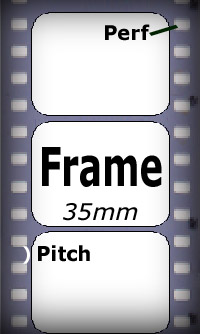
Movie film is organized as frames, and on both sides of each frame are perforations or �perfs.� The space between �the leading edge of one perforation to the leading edge of the immediately following perf� (Hines, 141) is known as the pitch. This is important for the cinematographer when judging formats such as film speed and for the editor when he must run the film continuously. Although film frames are extremely thin, they are durable enough to sustain three different emulsions for color and one for black and white. If you had to compare emulsions to a substance, it is much like glue. Emulsions are thin, but capture the properties of the light and hue of reality, as any object would stick to glue. If you don�t put enough glue on, the object does not stick and vice versa, which could be seen as overexposure (too dark) or underexposure (too light). Silver particles �form in areas that were exposed to light� (Highlander Film, par 1) when run through a developing liquid and form a negative, which is the contrasting colors and lighting that was actually captured. Positive prints are then made from negatives, and final edits can be made for the finished product. Types of film classification are measured in millimeters or �mm� of the frame. The larger the film format, the sharper the quality, which is why IMAX or big-screen theatres play films that have been filmed (or transferred) to a format larger than 35mm. From this come the major film stocks and forms of the camera. |
|
|
 |
|
|
|
|
|
 |
|
|
|
|
|
 |
|
|
|
|
|
 |
|
|
|
|
|
 |
|
|
|
|
|
|
8mm
Was used primarily for home video
Discontinued
Super 8mm
About 25% larger than 8mm, but used for the same purpose
Discontinued
16mm
Used on more documentaries, student films, and commercials or
Ambiance of a time period
One minute of film=45 feet
Frames are square
35mm
Standard movie format
�16 frames per foot and 4 perfs on each side�
One minute of film=90 feet (Harmon)
Frames are parabolic
65mm
For large projections
�12.8 frames per foot and 8 perfs on each side� (Hines)
70�75mm
For large projections
Costs a pretty penny: �more than twice as expensive as 35mm stock footage and processing�(Highlander Film, par 5) |
|
|
|
|
 |
|
|
|
|
|
 |
|
|
|
|
|
 |
|
|
|
|
|
|
|
Film is loaded in cans, but is run through two magazines when mounted onto the camera |
|
|
|
|
|
|
|
|
|
The film is loaded in cans, but is run through two magazines when mounted onto the camera: one before it is exposed and the other after the image is captured. As far as gravity is concerned, the heavier the magazine, the stronger mount or adjustment you have to make. William Hines makes the suggestion that with any 35mm magazine larger than 2000 feet or 16mm larger than 1200 feet, it is �important to rebalance the camera on a controlled head after each take" (Hines, 41). After the film has been exposed, it must still be locked in a light-tight container or else the light will burn out the image before development. These cans are held on large spools and closed in circular cans with must be labeled as such: |
|
|
|
� Production Company
� Production Title and Number
� Film Stock Type
� Roll Number
� Amount of Exposed Footage
� Marked �Exposed� and �Push (or) Pull X-Amount Stops�
� Camera Report (for that roll of film) (Hines, 147) |
|