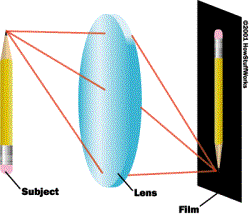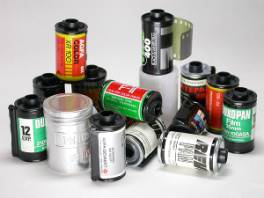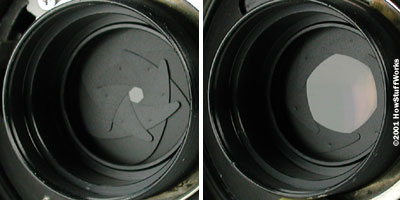
The Film CameraBefore exploring the digital camera we will briefly examine the basic film camera. This will give you a foundation on which to explore the operation of the digital camera, since, despite being very different, both types of cameras have certain concepts and operations in common. Also, knowledge of how the film camera works will help to amplify the contrast between its operation and that of the digital camera. The basic technology that is used to capture images by means of this type of camera is somewhat simple. The typical film camera consists of three basic components: an optical element (the lens), a chemical element (the film) and a mechanical element (the camera body itself). The Optical ComponentThe optical component of the camera is the lens. Simply put, a lens is just a curved piece of glass or plastic. Its purpose is to take the beams of light bouncing off of an object and redirect them so they come together to form a real image, that is, an image that looks just like the scene in front of the lens. This is used to focus the image on the storage media, the film. The figure below illustrates the process. Figure 1. Illustrating how a lens focuses the image on the film. The FilmThe component in a traditional camera that captures and stores the projected image is a chemical component called the film. Essentially, when you expose film to a real image, it makes a chemical record of the pattern of light. It does this with a collection of tiny light-sensitive grains, spread out in a chemical suspension on a strip of plastic. When exposed to light, the grains undergo a chemical reaction. Once the roll is finished, the film is developed, that is, it is exposed to other chemicals, which react with the light-sensitive grains. In black and white film, the developer chemicals darken the grains that were exposed to light. This produces a negative, where lighter areas appear darker and darker areas appear lighter, which is then converted into a positive image in printing. Color film has three different layers of light-sensitive materials, which respond, in turn, to red, green and blue. When the film is developed, these layers are exposed to chemicals that dye the layers of film. When you overlay the color information from all three layers, you get a full-color negative. This negative is then taken to a photo lab for processing and then a photograph of the subject is then obtained. Figure 1.1. Picture films. The Mechanical ElementAt its most basic level body of a camera is a sealed box with a shutter that opens and closes between the lens and film. The camera depends of two mechanical factors to expose the film so that a picture can be recoded. These are: how much light is passing through the lens and how long the film is exposed. To increase or decrease the amount of light passing through the lens, you have to change the size of the lens opening, or aperture. This is accomplished by means of the iris diaphragm, a series of overlapping metal plates that can fold in on each other or expand out. Essentially, this mechanism works the same way as the iris in your eye, it opens or closes in a circle, to shrink or expand the diameter of the lens. When the lens is smaller, it captures less light, and when it is larger, it captures more light. Figure 2 illustrates a typical SLR iris diaphragm. Figure 1.2. A typical SLR iris diaphragm The length of exposure is determined by the shutter speed. Most SLR cameras use a focal plane shutter. This mechanism basically consists of two "curtains" between the lens and the film. Before you take a picture, the first curtain is closed, so the film won't be exposed to light. When you take the picture, this curtain slides open. After a certain amount of time, the second curtain slides in from the other side, to stop the exposure. This covers the basic concept behind the operation of the typical film camera. The following chapters explore the digital camera. |