| |
Advantages and Disadvantages of the Digital Camera
Lets the benefits or advantages of the digital camera as well as the disadvantages
Advantages
-
With the film camera the pictures are stored on a chemical film, which has to be taken to a photo lab for processing. The photographer has no idea what the photograph looks like until the film is processed. So if the picture is not satisfactory or the film is damaged during processing, all the information is lost and all the money invested is wasted. The digital camera, on the other hand, stores the image electronically and allows the user to view the photograph, edit the photograph or discard an unsatisfactory picture immediately after the photograph is taken, thus saving the user money and preventing the loss of priceless moments.
-
Another feature that gives the digital camera an edge over the conventional film camera is the number of photographs that it can store. The conventional camera typically can store from 24 to 36 photographs, depending on the size film used. The digital camera, however, uses a digital medium to store the photographs taken by means of internal flash memory of an external flash memory. A typical 128 Megabytes flash memory card can store approximately 160 photographs with a print quality of up to 8 ½ x 10 inches. Also memory cards range in size from 64 Megabytes to 2 Gigabytes of memory. Thus, the digital camera far outranks the film camera in the number of pictures that it can store.
-
The conventional camera only allows you to store your photographs on two mediums, the film itself or to develop the photographs at a photo lab. However, the digital camera offers the user a wide range of storage mediums. Since, the pictures are stored ad digital data the user can store the images on a flash memory card, transfer the pictures to a personal computer (PC), burn the images onto a compact disc (CD) or a DVD, copy the images to VHS cassettes and also print the photographs on photo paper.
-
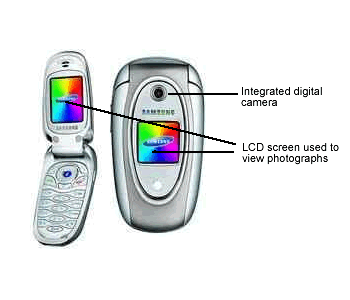
As discussed in a previous chapter, the focal length of the digital camera is much smaller that that of the film camera. Also, the storage medium is flash memory rather than film, which is much smaller that a typical film. As a result digital cameras are typically smaller than conventional cameras and in some cases much smaller than the smallest film camera. This advantage has led to the digital camera being integrated into other devices. The most common device that features digital camera integration is the cell phone. Many cell phones are now equipped with digital cameras that have some of the same functions of a typical stand-alone digital camera. Figure 4.1 demonstrates a cell phone with integrated digital camera.
Figure 4.1. A Samsung camera phone
-
With film cameras what you “shoot” is what you get; in other words, once you have taken a picture you cannot edit it. Digital cameras are much more flexible. You can either select a specific setting, such as black and white, sepia, or colour before taking the photograph or you can edit a photograph after you have taken it. The editing possibilities are endless with a digital camera. The user can manipulate the colour, the exposure, add special effects and graphics, or enhance a photograph after taking the picture via the camera or computer software.
-
Film cameras are limited to just taking still photographs. Whereas, digital cameras have the capability to double as a video camera. Most digital cameras have the additional feature of video recording, which also includes sound recording, thus allowing the user to capture a complete movie. Some of the file formats are: Quicktime, mpeg, mp3 and mp4 video formats.
-
Digital camera picture processing is much more economical that conventional picture processing. With film cameras, the user would have to buy a role of film, which is relatively cheap, however, if you plan to take a lot of photographs you would have to by several films. The digital camera uses flash memory to store the images, which can have a memory capacity of up to 2 gigabytes, and can accommodate several hundred high quality photos. And unlike the film, the memory card is reusable. Also, with film cameras you would have to take the film to a photo lab to process the film and to develop the pictures or spend hundred of dollars on film processing equipment if you wish to do it yourself. The digital camera is far more economical, since you can store the photographs on a memory card, a photo CD, DVD. Printing digital photographs can also be printed at a photo lab almost the same price as developing and printing from film. Also if you wish to print the photographs yourself, all you need is a printer and ink as even an inexpensive inkjet printer can do the job.
-
If you wish to store your photos electronically, the digital camera has a clear advantage over the film camera. There is no need for scanning when using a digital camera, therefore there is no loss in picture quality. Since the image is already in digital form, it is easy to share with friends via email or instant messaging.
Disadvantages
As with any technology, the digital camera is not perfect, and thus has some disadvantages. We will now explore the most common disadvantages of the digital camera
-
Recall that the devices used to capture the images, the CCD and CMOS sensors, requires power to operate. Also we saw that the most commonly used sensor, the CCD sensor, uses a large amount of energy. Thus digital cameras need to be powered and they require a lot more power than a conventional electrically operated film camera. Therefore if the user were using ordinary batteries they would be spending a significant amount of money on batteries. However, using rechargeable batteries can minimize this expense significantly.
-
The resolution of the photographs taken by a digital camera depends on the amount of pixels the camera has, the more pixels the better the resolution and thus quality of the picture taken. Even though the best digital cameras have very large numbers of pixels and give very good quality photographs, they cannot match the resolution, sharpness, total range and colour reproduction capabilities of the film camera. In spite of this, digital photography is still a fairly new technology and is rapidly improving.
-
With film cameras, once the shutter opens and shuts, the image is recorded on the films. Whereas, digital cameras take a few seconds to transfer and store the images to the memory device. This would make them unsuitable for taking rapid action photography or for situations where the user may want to shoot several photographs quickly. However, most digital cameras are now made with the Rapid Burst function that allows the user to take several photographs in quick succession. This allows the digital camera to take photographs almost as quickly as the conventional camera.
-
Another disadvantage of the digital camera is its cost. Generally digital cameras are more expensive than film cameras, sometimes even twice or three times the price. However, as pointed out before, digital photography is still a fairly new technology and as with all electronic devices as the technology is improved the price falls. Over the past years the price of digital cameras have fallen significantly and is now approaching the price range of some film cameras.
Clearly, the advantages outweigh the disadvantages and as the technology is improved, the gap will only widen.
[TOP] |