[Editorial]
[Words
from the Staff]
[Featured
Discipline]
[Saddle
Seat Equitation]
[Featured
Equine]
[Trashadeous:
Trash by name; Treasure by nature]
[Book
Review]
[Learn
Horseback Riding in a Weekend]
[Glossary]
[Common
Equine Terms]
["Ask
The Trainer"]
[Training
Qs & As]
["The
Help Desk"]
[Readers
Speak Out]
[Fiction]
[Spring
Ride]
[A
Creepy Ride]
[Poetry]
[A
School Horse's Day]
[Untitled]
[Contests]
[Horse
Trivia]
[Caption
Contest]
[Writing
for the E-Zine]
[Staff
Positions Available]
[Staff
Application]
[Submission
Tips & Guidelines]
[Submission
Form]
[View Other Issues]
© Saddle Seat Equitation photograph used with written
permission of Saddleseat Riders Online
|
Featured
Discipline: Saddle Seat Equitation
By: Blair Finney |
 |
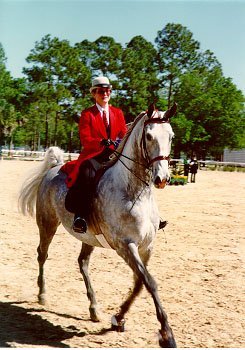 A matching cavasson
set is worn by the horse.
A matching cavasson
set is worn by the horse.
The Saddle Seat riding style was created to show off the high neck and action of the American Saddlebred show horse. While it has been adapted for Arabians, Half Arabians, and Morgans, it was initially developed for the Saddlebreds when they gained value as a stylish riding and driving mount.
Here is an explanation of on some of the tack and equipment used by the saddle seat equitation horse and rider.
Cutback Saddle:
The cutback saddle has a
nearly flat saddle. It is called a cutback because the pommel is
indented 4 inches to make an allowance for the high withers of the Saddlebreds and other such horses. This saddle lacks the padding of most other English saddles, and is part of the reason for the form used.
It places the rider farther back on the horse’s back so the rider cannot simply plop down into the saddle or he or she may risk injuring the horse’s back. In addition, the saddle also places the rider slightly behind the horse's center of gravity, which allows the rider to influence the horse’s action and head set more easily.
Double Bridle (Wheymouth Bridle):
Saddle Seat riders ride using a double or wheymouth bridle. The snaffle, or bradoon, has a very fine mouthpiece which allows the rider maximum control over the horse’s head set. The curb has a longer shank than the dressage curb. The shanks for an average show bridle measure 7 inches long with some using longer or shorter.
Artificial Aids:
Most Saddle Seat riders carry a whip, though not many use them on their horses. Instead, the whip is mainly a prop to show the steadiness of the rider's hands. If the rider chooses to carry them, they should be carried to the inside of the arena and switched by grasping both reins in the hand holding the whip. The rider should grasp the end of the whip using the free hand, pull it upward so that it does not bump the horse accidentally, and then lower it onto the opposite side.
During evening performances or championship classes, the rider may use a white whip, which is usually otherwise prohibited due to dress codes. When used, the white whip will call more attention to any minor unsteadiness in the rider's hands.
Most saddle seat riders do not use spurs, because in order to use them, one must twist the entire leg out of position, which is generally considered bad form.
| Page 1 | Page
2 | Page 3 | Page
4 |
|