[Editorial]
[Words
from the Staff]
[Featured
Discipline]
[Saddle
Seat Equitation]
[Featured
Equine]
[Trashadeous:
Trash by name; Treasure by nature]
[Book
Review]
[Learn
Horseback Riding in a Weekend]
[Glossary]
[Common
Equine Terms]
["Ask
The Trainer"]
[Training
Qs & As]
["The
Help Desk"]
[Readers
Speak Out]
[Fiction]
[Spring
Ride]
[A
Creepy Ride]
[Poetry]
[A
School Horse's Day]
[Untitled]
[Contests]
[Horse
Trivia]
[Caption
Contest]
[Writing
for the E-Zine]
[Staff
Positions Available]
[Staff
Application]
[Submission
Tips & Guidelines]
[Submission
Form]
[View Other Issues]
© Andalusian Photograph by Equi-Site's Adult Horse Gallery
|
Glossary:
Common Equine Terms
By: Liberty Dewert |
 |
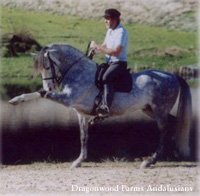 Don Marco of Dragonwood
Farms Andalusians
Don Marco of Dragonwood
Farms Andalusians
Sometimes when people talk about horses, the language they use can get a little confusing. Hence, each month in this column, we will focus on certain aspects of equines, such as equine health, training, and such, with an occasional potpourri selection. The 15 words this month are all terms associated with
gaits.
| Amble |
A lateral gait. Similar to the pace, but slower; and the hind foot may strike the ground slightly before the fore foot. |
| Canter |
A three-beat gait with a slight diagonal movement.
Sequence:
1. One hind foot strikes the ground
2. The other hind foot and diagonal front foot strike the ground together
3. The remaining front foot strikes the ground
|
| Diagonal
Gait |
The front foot and opposite hind foot take off and strike the ground at the same time eg. the trot.
|
| Free
Going |
Gaits are executed in a smooth, collected manner ,and action is not excessive or labored. |
| Fox
Trot |
A
slow, short, broken, nodding trot. The hind leg of one side strikes only an instant before the diagonal fore leg. |
| Gallop
(Or Run) |
A
fast, four-beat gait.
Sequence:
1. One hind foot strikes the ground
2. The other hind foot strikes the ground
3. The diagonal front foot strikes the ground
4. The remaining front
foot strikes the ground
|
| Jog |
The
western pleasure form of a trot though it is considerably slower.
Sequence:
The fore foot of one
side and the hind foot of the other side strike the ground together
|
| Lateral
Gait |
The fore and hind legs of the same side strike the ground at the same time eg. the pace. |
| Lope |
A
canter that is performed as slowly as possible for western events such as western pleasure.
Sequence:
1. One hind foot strikes the ground
2. The other hind foot and diagonal front foot strike the ground together
3. The remaining front foot strikes the ground
|
| Pace |
A
fast, two-beat gait.
Sequence:
1. The front and hind feet on the same side strike the ground together.
2. All four feet are off the ground for a moment.
|
| Rack |
A
fast, flashy, evenly-timed four-beat gait. The feet start and stop
at the same intervals. It has extreme knee action and considerable
speed, with the front legs appearing to trot while the hind legs seem to
be pacing.
|
| Stride |
Distance from imprint to imprint by a horse's foot when completing one step. |
| Stepping
Pace |
A
slow, lateral, four-beat gait. Each foot strikes the ground at a
different time from the others.
Sequence:
1. The hind foot strikes the ground
2. The fore foot on the same side strikes the ground
3. The other hind foot strikes the ground
4. The remaining fore foot strikes the ground
|
| Trot |
A
rapid, two-beat, diagonal gait.
Sequence:
The fore foot of one side and the hind foot of the other side strike the ground together
|
| Walk |
A
slow, natural, flat-footed, four-beat gait.
Sequence:
Each foot takes off and strikes the ground at different times
|
Source: Ohio State University's Extension 4-H book, "Basic 4-H Horse Science".
|