[Editorial]
[Words
from the Staff]
[Featured
Discipline]
[Saddle
Seat Equitation]
[Featured
Equine]
[Trashadeous:
Trash by name; Treasure by nature]
[Book
Review]
[Learn
Horseback Riding in a Weekend]
[Glossary]
[Common
Equine Terms]
["Ask
The Trainer"]
[Training
Qs & As]
["The
Help Desk"]
[Readers
Speak Out]
[Fiction]
[Spring
Ride]
[A
Creepy Ride]
[Poetry]
[A
School Horse's Day]
[Untitled]
[Contests]
[Horse
Trivia]
[Caption
Contest]
[Writing
for the E-Zine]
[Staff
Positions Available]
[Staff
Application]
[Submission
Tips & Guidelines]
[Submission
Form]
[View Other Issues]
© Saddle Seat Equitation photograph used with written
permission of Saddleseat Riders Online
|
Featured
Discipline: Saddle Seat Equitation
By: Blair Finney |
 |
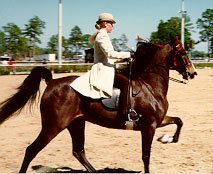 This rider demonstrates
the straight back,
which is mandatory in good Saddle Seat Equitation.
This rider demonstrates
the straight back,
which is mandatory in good Saddle Seat Equitation.
Although the position of the Saddle Seat Equitation rider may vary, depending on the instructor's preference or the current style, this is the typical basic position of the rider.
Neck and Chin:
The rider’s neck should be stretched high and carried directly over the shoulders, while the chin should be tilted slightly above the usual, vertical position.
Shoulders, Back and Elbows:
The shoulders should be directly over the hips, and the shoulder blades should be pulled together. The back should be slightly arched but not, under any circumstances, should the rider be leaning back, with the elbows by the rider's side and pointing at the hipbones.
Arms, Hands and Wrists:
The lower arm and upper arm should make no more than a 90 degrees angle as a larger angle has a tendency to make the rider lean forward, which will cause the horse to drop onto the forehand.
Ideally, the rider should have his hands higher than just 90 degrees but it will vary with the horse's conformation. These higher hands lift the horse’s forehand so that the horse is free to lift its forelegs higher.
The hands and wrists are to remain flexible with the fingers boxed out and the thumb pinching the reins. The wrists should also be the highest point of the hand.
Legs and Feet:
The rider should place the ball of their foot straight across the stirrup iron so that the toe is pointed straight ahead. If the rider’s toe is not straight ahead, his weight is not being properly driven into the iron, which will cause his leg to swing unsteadily.
The stirrup leathers should be in a vertical position when viewed from the side. The rider must push his weight onto the stirrup irons, but not onto the heels, to place them in such a position, which will not only give the rider a more secure seat, but also help to relieve the horse’s back.
A common error is to hold the leg in this position by gripping hard with the calves and pivoting from the knee at the posting trot and canter. Not only is this improper, it also compromises security as the rider is “perched” precariously on the top of their mount.
While the leather should appear to be vertical from the side, it should not be vertical when viewed from the front. The thigh must be pressed flat against the saddle, therefore pushing the rider's weight into the leather and altering tits position.
| Page
1 | Page 2 | Page 3 | Page
4 |
|