HOME author calendar names chief appearance Lewis&Clark origins family sisters
ponies council battle wwtown cayuseindians letters 1856
Wallawalla Village
Ancestral Home of the Wallawalla Indians
Home of the Wallawalla Warriors
Wallawallapams
Crossroads to Many Places
The Wallawallapams lived in the Wallawalla Village at their usual camp near the mouth of the Walla Walla River. They lived at different places along the River. Sometimes on the north side, the south side, at the mouth of the Tushay/Touchet River or at different places along the Tushay (called Tushee by settlers). The River was their border line with the Cayuse Indians, with whom they had a close association.
They were a branch of the Wallawalla Tribe and it was thought they spoke the root dialect of the Wallawalla language. They, along with the Chimnapams, Priest Rapids, Kennewiks, Wehopepams, Umatillas, Wahowpams, Deschutes and those living along the Columbia River to The Dalles, were part of the Wallawalla Tribe, that was made up of fish Indians and pony Indians. All spoke dialects of the Wallawalla language as did the Wallawalla Nation of Palouse, Sokulks, Wallawalla, Kittitas, Yakama, Klickitats, and they used Wallawalla speaking interpreters.
The Wallawalla language was a heavy sounding, very gutteral, spoken deep down in throat, disagreeable sound of swishing air, breaks, grunts. Dialects of Wallawalla language were different, similar, same. It was a hard language to interpret.
Walla means water, wallawalla means much water, alot, flood, abundance of water or Walla Walla "Valley of Many Waters".
Before Lewis and Clark, before Hudson Bay, they lived on the north side of the River one mile from the mouth. They were pony Indians, hunters, gatherers and off to buffalo land in Montana.
After Marcus Whitman came, they moved 3 miles up to the fertile banks of the River where they became farmers with large productive gardens. They were good farmers, very proud of their gardens and loved to talk about the art of agriculture with anyone passing by.
They had thousands of ponies circling their village and it was said that Peupeu had 4000 of his own. These ponies were their pride and joy and they believed the Creator had especially given them the white ponies and this was the highest gift they could give anyone. They loved the black and white pied the best and had large herds of them. The children galloped about and played pony games and the ponies were as madcap as the children.
Their village population was between 700 to 1000, depending on what year, as before the coming of the whitemen they had large families and a large Indian population. At times they separated in small or family groups for the purpose of fishing, gathering or hunting. But they came together in the Fall, to go to their usual winter home on the northside of the Columbia below Priest Rapids, or some going to Chimna.
The Village was the communication center, the crossroads, and here many travelers made their way thru town for different reasons of visiting, councils, festivals, religious services, feasting and dancing, or taking the road to Cayuse land or Whitman Mission that went by their village. Travelers used the crossroads coming or going many different places on many different trails. It was also a highly populated fishery. The Wallawallas were happy, very friendly and hospitable, and they loved company and one could walk into any of their lodges at any time and feel welcome.
Here is where their Head Chiefs lived, especially Peupeumoxmox who held many councils, dances, and religious meetings. Things were always happening or going on there.
Of course, this is the way they got to know what was happening around the country and from here went to pony riders to spread the news. If someone was going by their village on the Columbia River they would go out and bring them in, so they could hear all the news.
Because of Peupeu's concern for the future of his people he made them learn. He knew his people must learn of the whiteman ways, knowledge was important to him, he felt knowledge was the future and was concerned that the next Great Chief to be, his son Elijah Hedding, was educated in Indian and Whiteman ways. The children went to Whitman Mission and then brought back their learning to the others. They knew 4 or 5 Indian Languages and some English and French, sign language and could write in hieroglyphics and left messages along the trails for all to come to a dance or dinner or religious fest.
His village children were well behaved and giggly like most children and they delighted in impressing you with their knowledge speaking in different languages. They were well educated and informed with living in the crossroads.
The womenfolks were very important to him as mothers established the home front and they willingly worked for Narcissa Whitman and she paid them in different things.
He was a very strong leader, he kept his people busy and involved, took care of them and helped those less fortunate.
Alexander Ross -- 1818
"1/2 mile north above the Wallawalla River on the Columbia is the Wallawalla Camp. It was the most desolute, barren, sandy, wind blown, furnace hot, ice cold place in the whole land. Not a shrub, bush or tree could be seen in this sandy place.
On the westside was the view of the Columbia, and the heights of the hills.
On the north side and east side of the Columbia were great open plains where their ponies spread out for miles. From the banks of the Wallawalla River to the Snake River were multitude of Indian ponies grazing (on bunchgrass). Herds of ponies gave movement and beauty to the area --- ponies in droves raced about and grazed on these endless plains as far as the eye can see. The Indians are outdoing each other racing their swift ponies, as wild birds filled the air.
The Wallawalla River mouth has small grove of willows (called Wallala), the only green spot that could be seen in this place. Here were groups of Indian lodges with their spiral columns of smoke.
Summer activities of young people swimming in the River, with water games going on. People were visiting, smoking, communing.
The summer evening air with all this motion and activity was a delight to behold and it gave a feeling of rightness".
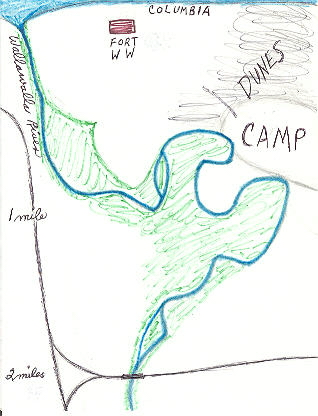 "Serpentine Mouth of Wallawalla River
3 Miles Up River
Gardens
3 miles up river was where the grass grew for the ponies and cattle and the fertile banks of the river. Farming soil at various places along the river was not continual, but only appeared here and there in patches in the midst of the usual sand, sage and dry barren banks.
Therefore the Indians could only farm in these isolated fertile areas along the banks. Individual families in their tulemat lodges spread themselves out along the river taking up claims of 3, 5, to 10 Acres and Peupeu's family had taken up 50 Acres for their garden. Governor Isaas Stevens at the 1855 Treaty Council told them since they were giving up their homeland they could have the same garden acreage on their Reservation.
In their gardens they planted wheat, grains, Indian corn, potatoes, different types of melons, peas, squash, pumpkins, sunflowers. Smaller kitchen gardens of onions, carrots, turnips.
Gathered Indian roots from different location on their sand and sage countryside, along with many edibles on the Rivers,
They traded in corn, potatoes, vegetables, melons, berries, fish, venison, beef and cayuses(ponies) with settlers or incoming Oregon Trail settlers at different places.
The Chief had land at the mouth of the Yakama River peninsula where his cattle and ponies ranged, but the land was not suitable for farming.
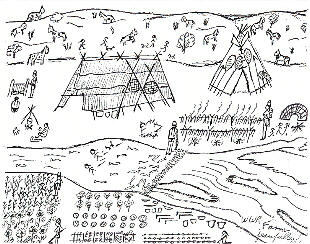
HOME AND GARDEN
A Good Trading Man
Peupeumoxmox had a fine beautiful black American horse (this was the one that carried the message to Fort Henrietta during the Battle of Wallawalla) and he rode around with the dignity of a King. He had holsters on each side of his saddle, with two navy revolvers.
He was a nice looking man and fully aware that he was "THE" Great Chief, showing this power many times.
Was very shrewd in his trading with the settlers or at Fort Walla Walla when he brought his produce to be sold and very good at it, which had made him a rich man.
The Chief would watch the trading with an eagle eye wanting to be sure everything was measured exactly. He would sit quietly then get up, go take a look at the scale or portion, grut his approval or disapproval, then sit back down again.
Each time something was measured he would do the same thing till all the trading was done. He seemed to think if he didn't do this he would be cheated, as most Indians did not have any idea of the value of their trade goods, and settlers knew this.
John Longmire 1853
"We camped nearby Fort Walla Walla before starting down the Columbia River.
The Great Chief of the Wallawallas arrived with fresh meat he had cut into various pieces and asked if we had a scale to weigh. That way we could not say he had crooked scales.
The Chief went to the only man in our party who had scales and taking them in his hand examined them carefully. He seemed satisfied with his scrutiny and came to me with the scales and in sign language signed I was to do the weighing, at the same time sitting himself on the ground amongst the rest of us.
I weighed, another man standing by with a book and pencil to tally.
Everytime a piece of meat was weighed the Chief would spring quickly up, examine the scales closely, although I do not know whether he could tell one figure from another, give a low grunt "yes" and sit back down again.
He continued to do this until every piece of meat was weighed, and payment was made".
Law and Order
The Chief was very strong on law and order, and taking care of problems.
He would go to each lodge and ask of any problems. The problem was solved right then, sufficient to the day. If there was a bigger problem, then council was called with Chief and Headmen.
They listened to testimony by all, women and children were included. Then the Chief and Headmen held closed council and discussed the problem. The Chief then decided the verdict, sentence was carried out and the matter closed. His word was absolute and not questioned by anyone.
They lived by "thou shalt not" rule and punished severely any broken. If there was no order --- things would go amuck. They didn't have jails, took no prisoners, sentence was carried out then and there and it was over.
Murder: depending on degree === hanging or taking care of victim's family, sometimes for life, or a good whipping, or all 3.
Molesting women was serious, as they were extremely moral === hanging or severe whipping, also one answered to father, brother, husband, and that could be even worse.
Stealing: === whipping or repayment or both.
They believed one was responsible for their own actions and punished accordingly
Council of Nation
The Village was the capitol of the Wallawalla Nation, especially during the Great Chief's reign as "Chief of Many Tribes".
Here the Headchiefs and Headmen of the other Tribes came together yearly or at some such time, to discuss the past year's business and problems and the upcoming year's business of the Nation.
The Chief did not interfere with other Tribe's business, unless he was asked. It was "other Tribe's business was other Tribe's business".
They also discussed
pros and cons if they were at war with enemies or needed to declare war on enemies. The Wallawalla and Cayuse were continually fighting the Snakes. This was a serious and continual problem they seemed not to be able to solve one way or another, as the bloodthirsty Snakes rode right into their village and caused extreme chaos. Killing, and stealing women and ponies that they sold in their own land or in California.
These business meetings were also a time to enjoy each other's company, to eat, to dance, to visit, and since families came along, most knew each other well.
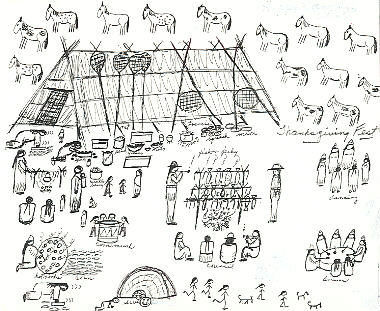
OCTOBER HARVEST FEST
When visiting the Village, you presented yourself first to Peupeumoxmox's lodge. Here's where Whitman and Spalding, good friend's of the Chief's, stayed overnight when traveling.
Travelers were made to feel welcome at the Chief's large comfortable lodge and the ladies of his home presented a good meal and hospitality. To do less would be to lose face and injure not only his reputation as a good host, but also the village's good name.
Different types of homes:
If you were having a dance, meeting, dinner, council, you could make the lodge longer by adding more poles, tule mats, skins - - or your lodge could have closed ends and doors on each side like the Chief - - or a skin or mat tepee - - or square with a flat roof - - or temporary throw skin over bush - - or if too hot or too cold, a subterranean 10-12 feet deep home.
Anything or anyway you wanted it, was home.