born the father looks out the lodge and the first thing he sees is what he names the baby.
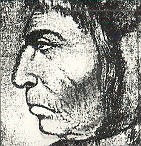 I would like to think the first thing his father saw were "sunflowers and yellowbirds".
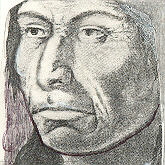 Pictures by:
It was thought at the l855 Walla Walla Indian Council that the Chief was around 70 or so years old. It is not known if the Chief was born in the Walla Walla Valley or somewhere else, but he was a Cayuse and grew up in the valley in the Village of Way-e-let-pu.
There is an Indian story which I like very much and that is when an Indian baby is
born the father looks out the lodge and the first thing he sees is what he names the baby.
I would like to think the first thing his father saw were "sunflowers and yellowbirds".
There is nothing known about his youth, but going by Cayuse belief and their ways
he was probably a normal Cayuse boy.
Growing up in a Valley that was covered in cayuse ponies, he would have had a small
herd of his own. The Wallawalla Indians loved the black and white pied the best and the
Cayuse Indians select breeding of the pied/pinto gave them their beautiful calico cayuses.
In his youth he had been a free spirit and loved to race his ponies across the sands going
full out with his long black hair flowing freely and the silky feel of the wind against his
bronze body. He ran many races with his ponies. He rode them standing up, sitting 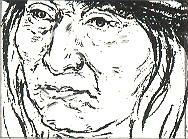
down or running beside. Some Indians could run as fast as ponies.
He chose to become a
warrior and his education would have been the training of
a warrior and he would have trained his ponies to be war ponies. Their ponies were
trained either for war or the buffalo hunt. They constantly practiced mock battles to highly train their warrior ponies, much to the delight of their watching audience. These ponies were well trained to do their job properly and the Indians would not part with them for any price.
As boys usually married around the age of 18 or 20 and the Cayuse normally married Cayuse to keep their family, language and customs strong, he would have probably had a Cayuse wife from his own village. The Cayuse were extremely moral and their children married young and stayed married as they did not like divorce.
A few years later, the Wallawallapams were in need of a new Chief. They asked the Cayuse man to be their new Head Chief, because they felt he had been so honored to have his knee doctored by Clark. They made him the new Head Chief and gave him the new name of Tomatapam after their old Highest Chief. Tomatapam called "Tom" did not have as much power as did Cayuse Head Chief Alloukt, or his brother War Chief Quahats.
Tomatapam brought his Cayuse family and followers from Wayeletpu to live at the Wallawalla Village and they became known as the Wallawalla "Cayuse".
Tomatapam was chief when in 1818 Fort NezPerce was built and then later went to Hudson Bay Co. Hudson Bay trader Alexander Ross wrote his name "Tumatapum".
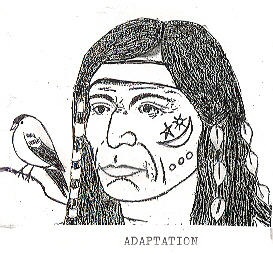 After his father became Chief, Yellowbird, as he liked to be called by his English name, joined the ranks of the Wallawalla Warriors. He was a daring fearless warrior with much aggressiveness in the game of war. He liked the game of war, it made him come alive and his blood ran wild. He had been very brave, adventurous, roguish and skillful even cruel in the game of war. He had learned the craft of warrior and had showed himself well in battles with their enemies.
When his father stepped down, sometime perhaps between 1825 and l830, Tomatapam eldest son Peupeumoxmox not only became the Head Chief of the Wallawalla Tribe, but also the Highest(great) Chief of the Wallawalla Nation. He said of himself, "I am like yonder mountain, above all men(Indian).".
So that's how a Cayuse, because of Lewis and Clark, became the famous, celebrated, notorious Wallawalla Chief, a legend in his own time.
He held himself like a King, well aware of his power over the surrounding Tribes, who held him in the highest awe, greatest respect and alittle fear.
He was mentioned in many diaries, journals and letters of the traders, trappers, missionaries, and white settlers all aware of his great importance to the region.
He was above average in intelligence, wise, caring, clever, shrewd and alittle passive as he didn't jump right into things, but wisely meditated and counciled before deciding.
He was a born leader of men, wise statesman, fine orator and a good representative of his people, in this region of a large white influx of tumult and chaos brought by the whites into the Indians world.
He was a wise generous man with deep concerns for the future of his Indian people, especially the children and the world they would be born into, and was regarded by Indians as God like.
Whitman, Spalding, McLoughlin thought well of him and he was the Indians spoken representative. They looked to him to solve their problems and be their voice and he was well-equipped to do both.
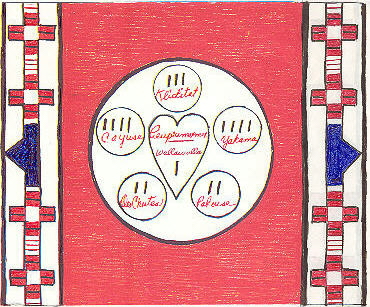
Peupeumoxmox had fame, power, wealth, position and was the most celebrated and renowned Chief West of the Rockies, who had been a legend in his own time.
His authority was absolute and orders carried out without argument.
He was a good friend to the whites, but he did not betray his Indian side. He didn't go over to the whites entirely, but held fast to his Indian beliefs and the whites understood that he had a wild Indian fierceness they could not overcome. That they might sound brave, but they knew in the long run that they had to respect his authority. He possessed strong character and complete control, and had a most determined and powerful personality
He was like royalty, a big impressive looking man, followed by his entourage.
Shrewd, cunning, clever, wily and guarding his Tribe with the fierceness of a serpent, Hudson Bay gave him the name Yellow Serpent or Serpent Jaune.
November 30, 1846
Lt.Col. John Fremont - l846 California War
"A battalion of mounted riflemen under Lt.Col. Fremont also held a party of Chief Yellowbird's men. They wore broad brim, low crowned hats, blue wool flannel shirts or their buckskin shirts, with buckskin pants, red quilled toed moccasins. A leather girdle around their waist held hunting knives, pistol and they carried rifles.
The Wallawalla warriors like to fight wars, are very handy at riding and fighting with both hands, can very easily and quickly hit you with one and knock off your head with the other. They are very expert with the bow and arrow, tomahawk and long pole spear in battle. They take orders, are very disciplined and very well trained in the art of war and have no boundary in courage and bravery in battle, they are a good fighting force in themselves".
They were a credit to their Chief and brought back many trophies of war, lost only one Indian and were paid by Sutter with worn out U S government horses. They returned to their Wallawalla Village in July 1847 at the time artist Paul Kane was at old Fort Walla Walla when Kane took the Chief's sketch.
Gov. Isaac Stevens - 1853
"On our way back to Old Fort Walla Walla we met Pupumoxmox, well known and respected far and wide. He is of a dignified manner, well dressed and very qualified to manage men. He is a very rich man owning many ponies and cattle and has a profitable farm of over 50 Acres of good produce on the fertile banks of the Walla Walla River near the old Fort. He has a regal kingly bearing and the air of a most successful farmer. He has saved his money, about $5000, is frugal but still very generous, giving food and articles of value to his neighbors and those less fortunate."
Stevens - 1854
"He was a born leader of men, wise statesman and a good representative of his people. He was well qualified to be a leader, his words carries much weight and not many argued with him "Indian or White" although the Whites often found a way around him by his backing down to keep the peace. His word was absolute and not questioned".
l855 Council
"Yellowbird fiercely holding tight to the independence of his Wallawalla Tribe was well advanced in years, kinda childish and changeable in small things, showing little fatigue his form was erect, his mind firm and his authority strong and unimpaired as it always had been. He had unlimited influence and authority of the surrounding Tribes and strongly held fast to his Great Chief's rights."
Yellowbird had a fine beautiful black American horse and he rode around with the dignity of a powerful king. He had holsters with 2 navy revolvers tied to each side of his saddle and always carried a whip which he used on several occasions to prove his point, solved many problems. He was very strong on law and order and kept his young men in line with strict and stern discipline. He was a nice looking man and fully aware that he was the highest Chief, showing this power many times.
He was very shrewd in his trading and gambling and very good at both, which had made him a rich man.
l855
Settlers came to the Hudson Bay Trader complaining about some troublesome Cayuse boys. The boys were not doing anything really bad just acting their usual high spirited obnoxious mischievous ways and pestering the settlers and their stock.
The Trader went to speak to the Cayuse Chief with the complaints who said he would talk to the boys
The boys continued their troublesome ways.
The Trader went to Peupeumoxmox with the many complaints.
The Chief said "Those boys have been warned before, now I will handle it". There was no more trouble from the boys.
l855 - Council
Peupeumoxmox in a speech marked by strength and sarcasm complained the Indians were being treated like children. He demanded no Whites should be allowed to come into his country to settle, as he wanted no settlers in the Wallawalla Valley. They could go thru his country as they had alway done, but they could not stop. The Valley was not for sale!
The Indians refused to leave their homelands, their ancestors and their sacred religious places.
Peupeumoxmox hearing rumors circulating about him and the other Chiefs at the Council, that NezPerce Lawyer had told Stevens, all the Chiefs were plotting to exterminate all the white men there. Learning of this tale Peupeu confronted Lawyer at the council and drawing him out, called Lawyer a "liar" in front of the council.
"That no Chief would okay such a plot".
It was thought Lawyer had not moved his lodge to protect Stevens, but to protect himself from the enormous wrath of the other Indians for selling his land and being friends with Stevens.
Stevens - - - The NezPerce took great pride in their unwavering devotion and friendship to the whites and were very fond of contrasting their course, with that of the Cayuse who they hated. A hatred between the two had sprung up.
Lawyer disclosed a conspiracy on the part of the Cayuse to suddenly rise up and massacre all the whites at the council. The Cayuse were only waiting for the assent of the Wallawalla and Yakama to strike the blow and the Wallawalla and Yakama were on the point of joining the Cayuse in the fullout massacre. The killing of Stevens and all his party would be the signal to start.
Lawyer had sent a spy amongst them and had discovered the plot and only just in time to avert the tragedy.
Lawyer moved his tent beside Stevens to show Indians that Stevens was under the protection of the NezPerce.
Lawrence Kip did not know of any Cayuse plan to kill Stevens. Lawyer and his wild imagination made up the Cayuse uprising to massacre every white in sight, wiping out The Dalles military and all settlers. Lawyer just in time had foiled their plan.
There was not much love lost between the Cayuse and NezPerce.
Joel Palmer said, "Lawyer was a teller of tall tales to make himself look good in Stevens eyes".
R.R. Thompson, Indian Agent l855 Council
"Pupumoxmox told Thompson the Wallawalla Valley was not for sale and had not been sold. Pupumoxmox was a man of strong decided character and he wheeled an almost despotic power amongst his people. His influence among the neighboring Tribes all of whom looked to him as their leader was extremely great.
He was possessed of great wealth according to his station, principally in ponies and cattle of which he possessed thousands of both and is currently reported and believed that he had amassed a large sum of moneys from trading and gambling with the settlers, Hudson Bay, and immigrants".
"In his bearing he was unobtrusive, dignified and of a gentlemanly manner".
Peupeu was being caught up into the influx, chaos and problems of the white world with little to say for his Indian people and this troubled him much.
Peupeumoxmox to Stevens l855 Council
"If you say it shall be so, then all these Indians will say yes. Although you have said the Whites are like the wind and you cannot stop them, you make good, what you have promised".
It was time to smoke the peace pipe.
The peace pipe was brought out for all the Chiefs to unite with the whites in the smoking of the pipe in token of their alliance and friendship. It's stem one inch in diameter, about 3 feet long, the bowl 4 inches long and 2 inches around, made of dark brown freestone. It was passed to all the Chiefs who took 3 puffs and then to the Whites who did likewise.
The Whites always thought the Indians should keep the peace, but did the Whites ever keep the peace?
1843 - To make a long story short -
At old Fort Walla Walla it was the duty of the officer in charge to furnish horses, pack saddles and other equipment to all over the country from Utah to B.C.
I had a man especially employed to make pack saddles. The only hard wood we could find for this purpose was birch which we got 50 miles away from the Blue Mountains.
The pack saddles were finished, however there was still a quantity of birch wood left in the saddlemaker's house.
I happened to go in one day and found the wood had diminished in bulk. Both Indians and Whites had helped themselves to the wood.
I told Mr. Todd that the wood would be required next year and not to allow no person to take any of it.
A few days later - I was told an Indian was taking a piece of wood, and that Todd had objected, but the boy wouldn't give it up. I heard noice and looking out the window Mr. Todd was grappling with an Indian boy, had thrown him down and was kicking him unmercifully. On stopping Todd I asked him who the boy was. He told me the boy was the son of Peupeumoxmox the High Chief of the Wallas. I blamed Todd for being hasty and making too much of it and now we would have trouble with the Old Chief. It was a great disgrace for a Chief's son to be thrashed as it would make him lose face with his people. I anticipated only a big talk by the High Chief.
A hour later, here came the Big Chief with 40 to 60 of his handpicked men. He and his men flying by me to take hold of Todd. I was in time to take hold of the Chief's arm who had a tomahawk in his hand about to use it on Todd's head.
The Chief and I were forcefully scuffling about. The other Indians let go of Todd to see what was happening with the Chief and I.
I handed Todd a pistol from my desk and I keeping 2 for myself with the order not to fire till I gave the word.
The Chief thrusted out his chest and asked if I was going to shoot him? "Shoot me and you shoot a man," he said. Such was not my wish.
Then ensued a very long discussion by the Chief about Dr. White's laws that the Chief had adopted, if a white man struck an Indian he was to be flogged. The Chief insisted Todd be flogged according to the law.
I told him, that they would have to kill me first. Then thinking of a keg of powder in the adjoining room I sprung to the door, took hold of a flint & steel ready to blast off.
There was the fastest exit I have ever seen, not an Indian was left inside, except the Chief and his son.
The Chief sitting in a quiet moody manner for a few minutes, then addressed me, "Don't you think you are very smart to frighten my young men so? Let's you and I challenge each other to a duel."
My reply to him was "There are only 6 whites here and hundreds of you. There is no one to take my place, there are plenty just as good as you if not better to take your place.
With this, the Big Chief went off in a highly angered state.
A few days later Cayuse Chief Tauwatway and Peupeu's son Elijah Hedding arrived at the Fort. After being seated for some time without saying a word, Tauwatway said "Is it not a possibility of the Big Chief and I coming to some kind of peaceful arrangement in order to settle this difficulty" After hearing my case, Tauwatway sent for Peupeumoxmox.
The Chief came in and sat down. He said he had nothing against me personally but I would have to send Todd away. I replied I would do nothing of the kind, that if his heart was not good toward Todd it could not be good toward me.
Springing up from his seat and beating his chest forcefully Peupeu said "Then my heart will never be good" and rushed angeredly out the door.
There was dead silence, not a sound, total silence.
Tauwatway slowly rose to his feet. Sternly addressing me, that I was a fool, if I wanted blood, the old Chief would certainly oblige me. It was a critical time.
I said I was Chief of the whites, not withstanding the number Indians standing around me I would not change one iota what I had said. Tauwatway spoke to a young man and he left the room. I don't know what was said to the Big Chief but he reentered the room, came to me and offered his hand in friendship.
I looked at him in surprise and took his hand in like friendship. The Big Chief swallowing his pride, said his heart was now good. I asked if his heart was good toward Todd and he answered "yes" and his son was coming with a horse as a good faith present for Todd. To seal this friendship I gave his son a suit of clothes and we smoked the peace pipe.
I have been proud of the termination of this incident and secured a lasting peace with honor to all concerned. It would be hard for me to say what the consequences might have been either, if the Great Chief had not humbled himself to peace.
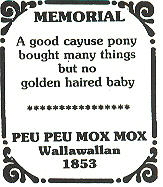
Peupeumoxmox was very fond of children. In all my research I found many stories about the Chief, but this one is my favorite.
Peupeumoxmox would sometimes meet the wagon trains in the Grand Rond(gran roan)Valley and trade ponies and food for the cattle and goods of the incoming settlers.
One time when he met it, there was a small golden haired baby girl of around 2 years in the wagon train.
The Chief was quite taken with this pretty baby and spent several hours watching and playing with her.
Early next morning he and his braves arrived with around l00 excellent cayuse ponies.
Dressed in their very finest, wearing buckskins, with leggings beaded in many colors with colored quills, red quilled toed moccasins, and hawk bells on their shirts that tinkled as they walked.
The tall, fine-looking Chief told the mother he had come to trade his excellent cayuses for her golden haired baby.
The mother was quite frantic about the whole idea, and told the Chief definitely not, that under no circumstances would she trade her baby for a bunch of horses.
After much debating on the subject, as the Chief liked to give long oratory speeches, he finally admitted defeat.
He got on his pony and slowly rode away, thumping his chest soundly and with a very sad voice said, "His heart cried and was broken for now he would have no golden haired baby".
Peupeu sat on his buffalo robe in front of his lodge in the evening cool, after a blistering hot day, quietly smoking his sandstone pipe and watching the ponies in the distance. Some of the men had gone to buffalo land and all was quiet but the bustling of the women as they prepared the evening meal and the young children playing along the river bank. As far as the eye could see was the sandy plains and the rolling hills of his homeland, with the dim outline of the distant river cliffs. Darkening clouds of birds filled the everchanging sky. Close by were the many swift fleeting ponies of many colors who were grazing peacefully, and then suddenly at the slighteous noice would lift their heads to look about and then dash off as swiftly as the wind, as they raced across the sandy plains.The Chief was heavy with grief and longing for his Elijah, who had been killed by Grover Cook at Fort Sutter (California) over an argument about a mule.
1845 --- Joel Palmer
We camped about a mile up the Wallawalla River near the camp of the Wallawalla Chief. The Chief had just lost his son Elijah who had been killed at Ft. Sutter. The Chief at this time was hating Americans and was very unfriendly and surly towards us. Next morning the Chief appeared and wanted to trade. We traded and talked to him. He said he would be returning to California for justice of Elijah and was very bitter because the white man hadn't been punished for killing his son. We talked to him about his son and he was much comforted and more friendly when we left him.
l853 Hudson Bay Trader Andrew Pambrun
Pambrun received word at Old Ft. Walla Walla that a large settler train had reached the Columbia on their way to Puget Sound by way of the Yakima River.
The settlers had put together boats to carry the wagons and team horses across the Columbia. The Wallawalla Indians had been hired to drive the cattle across to the opposite side.
For 2 days the Indians had been trying to drive the cattle across and as soon as the cattle got halfway cross the River, they turned around and went back to shore.
The Indians were discouraged and tired of it all and refused to try again. The Indians stood their ground and refused to budge.
Pambrun told the settlers to start the cattle in the early morning so they were across before the glare of the sun blinded them, as they were unable to see and turned around and went back. In early morning they would be dry by night time and not wet during the cold night.
Next morning the cattle were again bunched ready to go across, but Indians refused to drive them.
Pambrun went to see the Old Wallawalla Chief and told him what was happening. Some of the Chief's people had a contract to ferry the settlers across the Columbia and he compelled them forcibly to carry out their contract faithfully.
The Chief armed himself with his trusty navy revolvers and faithful ole whip and went to call the ring leader out, hitting him and knocking him down. The old Chief then turned to the other Indians, chasing and lashing out at them with his whip, first one then the other till there was a great scattering to get out of the area of his fast flying whip.
Peupeumoxmox was the most notorious determined Chief that Pambrun had ever know. He did not say, "I can not control my young men." He did it.
The Chief's word was the law and it was greatly obeyed by each and every Tribe he controlled. Any misdemeanor he would punish and he was the Holy Terror of the Medicine Man.
No one got this old Chief down and they considered him the greatest of the great.
Many dugouts and log rafts were lined up along the beach and river edge in front of Ft. Walla Walla.