HOME author calendar names chief appearance village Lewis&Clark origins family sisters
council battle wwtown cayuseindians letters 1856
Cayuse Ponies
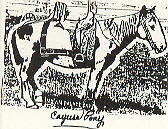
Just turn me loose, let me straddle my old saddle
Underneath the western sky
On my cayuse, let me wander over yonder
Till I see the mountains rise.
"Don't Fence Me In"
words and music by Cole Porter
Indian Ponies have always been here
The Cayuse Indians had so many ponies that's why the Indian ponies were called cayuses.
Looking down from the hill (near present day Pendleton, Ore.) the Oregon Trail settlers were astonished to see spread out below them, as far as the eye could see in all directions, ponies, ponies, ponies. They had never seen so many ponies before, there were masses of them.
From the Utalla (Umatilla) Valley to the Wallawalla Valley were 10's of thousands of ponies, tame and wild.
The settlers traded their worn out horses and stock for the ponies of the Cayuse Indians, thereby giving the name "cayuse" to the ponies.
Cayuses became the name for all Indian ponies, across the West from Montana to Oregon to Texas, "cayuse" also became their name in song and verse.
Mustangs are not cayuses said early Indians. Cayuses are Indian.
"A Palouse horse" was just an old cayuse.
An Inglorious Columbus
By Edward P. Vining
458 A D Taken from the Chinese Monk Hwui Shan journal Description of Fu-Sang Sonora
"They have a horse, warlike, quick as a horse. They have horse-carts, longhorn cattle-carts, and deer-carts. In this country they make use of carts harnessed to cattle, horses, and deer. They raise deer there as they raise cattle in China, and make cheese from the milk of hinds".
Fourth Journey of Columbus --- Costa Rica --- 1502
Page 82 --- "Further they said that the ships carry cannon, bows and arrows, swords and shields, that the people go clothed, and that in the land there are horses, and that the people are warlike ---
Some authors interpreted it as "Indians fought wars on horseback" and that Indians were familiar with horses --- that even if Columbus had not seen horses, he had no doubt the Indians were telling the truth".
The American Horse
By E.L. Berthoud Golden, Colorado
"Sebastian Cabot went in 1527 to the east coast of South America on an exploring voyage, that he discovered the rivers La Plata and Parana, and explored them some distance inland, returning to Spain in 1530. Cabot has marked on the map pictures of the natives, prominent animals and some trees, and that at the head of the LaPlata with the Puma and Parrot he has given the horse as apparently a quadruped that existed then in those vast plains of the Gran Chaco, where they roam in countless herds. Neither Spaniards in Peru, nor other parts of America, had been long enough in South America for the few Spanish horses introduced to have roamed wild from Peru to the head of the Paraguay and Parana Rivers to have increased in numbers sufficiently. The period was too short and distance too great from Peru to the Rio Plata. The paternity of the vast herds of the Argentina Republic and of Paraguay, was a native breed of the American horses, mixing afterwards with the Spanish breed introduced by the conquerors."
Sebastian Cabot, was the son of John Cabot an Italian Explorer who sailed from England to discover the East Coast of United States and explored the Gulf of St Lawrence and Labrador and Newfoundland. Sebastian's voyage in 1527 was to Argentina and he discovered the Rio dela Plata River and ascended the Uruguay River, entering the Parana River to Apipe Rapids and descending Paraguay River to Bermejo River to the vast plains of the Chaco. Here on the Argentina Pampas or Aucas as the Native Indians called it, roamed immense herds of ponies. Wherever you turned, you met droves of these wild ponies, the property of whoever caught them.
An Account of the Abipones - Paraguay
By: Martin Dobrizhoffer 3 Volumns The following is taken from: 1762
CHACO = "The equestrian nations of the CHACO are the Equestrian Tribes of many different Indian Tribes.
These Indians were chiefly supported by the wild ponies in which the Plains are overrun. Immense plains which stretches out to the Southwest of Buenos Aires is inhabited by equestrian savages. They have not all the same names or languages, there are many different Tribes in this region.
The area they inhabit is almost destitute of wood and water, but abound in wild animals. The wild ponies supplies them with food, clothing, lodging, bed, arms, medicine, sinew thread, and etc's. They used the pony like the buffalo. They drink horse fat and wash themselves in the blood to regenerate and strengthen themselves, then wash in cold water. These ponies are their whole being.
They have small fleet ponies and use a sword, spear and 3 stone balls covered with leather suspended from many thongs that they hurl with great dexterity at their enemies.
Their ponies are ornamented with small copper bells, strings of colored glass beads, and ostrich or parrot feathers.
They kill the pony of the deceased and stake them to the spot and cover it with many colored garments or materials. They paint their Warriors in many colors and adorn them with blue beads.
The Indians daily food was these ponies
There are also vast herds of wild oxens and can be taken in numbers of 10,000 very easily. Besides this incredible amounts of oxen, the Indians breed infinite numbers of ponies. The whole of the Country is covered for 200 leagues (league = 3 miles) in every direction with droves of wandering ponies, which any Indian can caught using a leather cord halter, and becomes his property.
In 1762 the historians have said that the American ponies have small bodies and no spirit, that they are mere dwarfs and spectres in comparison with those of Europe. I boldly affirm that the Paraguayrian ponies differ nothing from those of our own country in size, shape and good quality. You meet here ponies of different heights. I allow that Paraguays are as unacquainted with horses like those at home(Europe) and our horses are as rare in Paraquay as comets in the sky. This country produces a different type pony, better for riding and racing.
The ponies of Paraguay are raised out of doors and not stable pampered like ours, but night and day eat only grasslands, tree leaves and dry wood. Being constantly in the scorching sun and cold showers, bitter frost and swarms of insects.
I attribute it to these causes that the ponies of Paraguay never attain the size of our Styrian, Holsatian, Danish and our Neapolitan horses.
In winter because of harsh weather their coats darken, but with good weather they regain their strength and natural color. They fatten on fertile grass and the richness of these grasses fattens the Paraguayrian ponies, but never gives them that strength that our European horses derive from oats, barley and hay. The Indian ponies are all the different colors that are in Europe. Though they are more oftener white, chestnut, black or bay, the red is like toasted bread. White ponies sprinkled with black with black tail and mane possesses great deal of strength. Dark bay with blackish tail and mane, and the piebald ponies are thought crafty and dangerous.
I do not find I feel the confidence and security in riding these ponies as I do the European horses. Ponies can become very terrified at any sudden noise and take off in full speed. They are somewhat stubborn, may stumble or throw off the rider if they are not firmly seated.
In such a vast multitude of ponies there is a great variety ---- handsome, stronger, swifter then others as in Europe. Those may have broad breast, small head, large black eyes, short and prickling ears, wide nostriles, bushy mane, large long tail, hairy feet, small belly, wider round back, straight legs and hard hooves. There are 4 different paces by these ponies. Those born in a more rough stony situation are more accustom to those places and are different.
Indians don't like the short tails of the European horses. They think long bushy tail is a great ornament to their ponies and instrument of defense against insects.
The Abipones keep their ponies free from dust and free from burrs with tallow and wash them by keeping their pastures close to water, river, streams and lakes where they can bathe.
These ponies wander at will and never have to pull a cart and are more healthy and spirited then European horses which are chained in stables and never see the light of day.
It seems to this author that the above writer in using the term European Horses did not think the Indian ponies came from Europe!!! as we are being told.
&&&&&&&&&&&&&&&&&&&&&&&&&&&&&&&
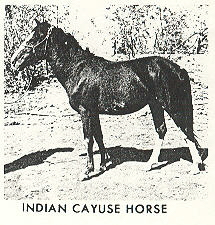 My mother was born in 1902 and raised in Heppner, Oregon and she told me about the Indians who lived at the headwaters of Willow Creek.
She thought they were of the Umatilla band. Their camp was a mixture of young and old staying in camp while others traveled, but they were all together in the winter.
They were small statued people looking very typically Indian and wore no American clothes. They wore skins, even small children. The skins were mostly buckskins but the skins could have been any type of skin as nothing went to waste, everything was used for some purpose.
Her grandfather liked them, traded with them and they came quite often to her house on Willow Creek near town and got chickens, eggs, wool fleece they called woolies, and dairy products.
My mother liked them very much and said they were very nice people, very clean, well mannered with a nice sense of humor and had lovely blankets and pretty small ponies. She was quite taken with the little papooses wrapped in blankets or on their mother's backs or tied in cradleboards.
Her grandfather got along well with them and her family was always glad to see them when they came and enjoyed visiting with them as the Indians spoke good English.
Each summer the Indians would go down Willow Creek to The Dalles where they fished and she could see them and their camp go by her house with their many ponies, at different times of the year in their food cycle.
They would pay their bill with dried salmon and other Indian foods.
They were very honest in their trading and paying and her grandfather treated them with respect and neither cheated each other.
At the turn of the century there were not alot of wild ponies anymore and they were usually with the Indians.
They had large herds of ponies tame and wild, along with many small pied/pinto ponies that they seemed to prefer. Ponies were small with black or brown patches, some had more white, some had more color. They also had all brown ones. Their ponies were in good condition and well taken care of.
In the evening you could see ponies all galloping around in the foothills and then they went up into the mountains for the night.
Mr. Decker's Story
"Indians on the head of Willow Creek wore bucks lightly beaded, had beautiful wool blankets of their own designs. Babies in blankets or cradles or mothers had blankets over heads with babies.
Their own Indian ponies were small, active, brightly alert, and they went like the wind. Their pony herds were up above town (Heppner) on flat plains and they came and went into the mountains and you could see them racing about".
&&&&&&&&&&&&&&&&&&&&&&&&&&&&&&&&&&&&
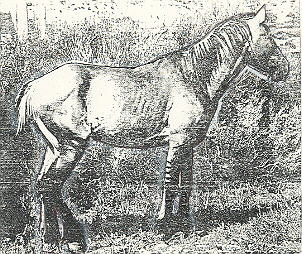 Pryor Mtn. Montana Ancient Antecedent
Mexico Indians told Spaniards there existed a very small horse called sa-to-wats, the name Indians called the first Spanish horses.
1492 - - - - The Americas were occupied by the redskinned people, from the North Pole to the South Pole. They owned the largest land mass then any others. It was invaded by civilized people who holocausted l00s of millions of natives, the worst holocaust in the history of the earth, and completely destroyed the Indian World and they could care less. This was their land and all natives must go. Their God would make it happen. They didn't come here to share, they came for all of it and they would bring millions of immigrants to do it. Perhaps one day it might happen to them, in the course of this world.
A good question for you to solve =
How long would it take a handful of ponies in 1541 to multiply into millions of ponies across the West by 1650, with freezing cold, blazing hot, and large packs of wolves that could take down pony herds.
1541 - - - - Desoto's loose horses.
Did Indians kill them or eat them, or how many got loose, how many stallions, how many mares, how many geldings? All stallions, all mares, all geldings? What is the Indian side of the story?
Coronado saw long horned cattle near Cibola NM, they were huge animals with very long horns. HwuiShan 458AD said Indians had long horned cattle, and the ponies were larger in the north then they were in the south.
The few Spanish horses here in America could not have increased sufficiently to promote reports of ponies already in Texas, Dakotas, Washington, Oregon, California in the 1600's.
1650 - - - - The French coming down on the Missouri River wrote the Blackfeet, the Sioux, the Crow, the Cheyenne had plenty of ponies. The Plains Indians rode ponies and hunted buffalo. The other Indians who used dogs with travois said they didn't need ponies like the buffalo Indians. Ponies had to have grass or bunchgrass areas to survive. If Indians did not have grass areas they had no ponies. They went by dog or canoe or on foot.
The Crow had large pony markets and many Indians came to get ponies.
1670 - - - - We watched Indians hunting buffalo on foot and horseback.
1683 - - - -LaSalle wrote Cenish Indians in Texas had large multitudes of ponies. Indians hunted buffalo and waged war on ponies. In 1685 West Texas had 100s of thousands of ponies.
1690 - - - - There was a terrible drought in Indian Pueblo Country with river, creek, spring bone dry. To keep from starving they were eating Spanish pony hide soup and then also moving south along the RioGrande and into southern friendly tribes. It is not known how many horses or if any escaped to the north, as it is said.
1733 - - - - LaVerendrye wrote Indians told him that there were great masses of ponies in the West. That it would take one week on a good pony to get to the land of the setting sun.
1742 - - - - Tribes had great many ponies, donkeys and mules.
1805 - - - - Lewis and Clark saw many ponies along the banks of River and Plains.
1811 - - - - David Thompson asked an old Okanagan Chief how long the ponies had been there. The old Chief told him the ponies had been here for generations and generations. That in the old Chief's grandfather's day they had ridden to the Palouse Country to get buffalo. That buffalo wasn't so many anymore and only small groups remained. With so many Indians, so many wolves had seen the loss of them. Many ponies and many buffalo had gone with freezing winters.
Peupeumoxmox said his fathers, fathers, fathers had taken ponies to California to trade.
1825 - - - - John Works = Ponies on the Columbia Plateau are better, bigger and cheaper then NezPerce. The Indians along the Columbia River and across the Plateau are very numerous and there is NO shortage of Indians and ponies.
1834 - - - - Townsend = We saw very large bands of wild Indian ponies. Some very beautiful but very wild, as they seldom letting us closer then 100 yards. They mostly had owners as we could see their brands of strange hieroglyphic type characters used as owner's brand. Some had never been ridden and some always ran loose. The Indians twists a loop around pony's nose and secures him with a buffalo hide thong. The wild ponies were a great curiosity and we watched them endlessly racing wonderfully across the open prairie. They were in droves and groups had leaders.
A large band of wild ponies they were very shy, never letting us close to them, but yet they followed along keeping us in sight. We tried to get closer, but they were off and running like the wind, dashing off with great energy their long tails and manes flying in the breeze. They would stop and watch us at a distance, charting our course and then dash off. Stop and graze, then turn and look at us as we approached, pawing the ground, a loud clattering of hoofs and they were off again into the distance. A wonderful sight to behold.
Each Indian knows his hieroglyphic character brand and everyone elses beside. Hieroglyphic is their way of writing".
1834 - - - - Parker = "Ponies in red - blue trimmings with small bells. Ponies are Cayuse Indians wealth and all must have enough for every member of their family, to ride, to travoy, to pack. If they don't have, they consider themselves very poor and no Cayuse Indian can be poor or they would lose face.
There are many wild ponies that can just be taken and yet evidently Indians must come by them honestly to have so many.
Ponies are put in one spot and will remain there. They don't wander off. Those in camp are content to stay close to camp and in a herd. When Indians come to one of their herds they get fresh ponies and exchange their tired ones for fresh ones".
Cayuses have a most good reputation then any other pony. California ponies are not equal to those raised in the Wallawalla Valley".
Going down the Columbia you could see thousands of wild ponies grazing peacefully on the hills and miles of endless plains, with occasionally groups of Indian mat lodges.
Farnham - - - - Cayuses ponies varied from black to white and everything pied between. Some pied singularly, some roan body, bay ears, white tail and mane. Some spotted pied with white on roan, bay, black, sorrel with black tipped ears and tail. Indian ponies are better form and more active then American horses. Cayuse also select breed the calico colored.
Ponies are of the finest, well knit, deep and wide of shoulders, broad loin, very small, lower limbs and feet, extremely active, great capacity to endurance of long distance.
Ponies were well trained for war or buffalo hunt.
WAR PONIES - - - - were painted with decorations.
Red circles around eyes to see far afield.
Lightning zigzag to show pony great speed.
Old wounds painted with red dot and flow of blood.
Wounded warrior put red handprint on rump.
Wounding enemy painted stripes on legs.
Feather in bridle or tail meant striking hoofs.
TicTac design showed warrior escaped enemy.
Their painted war ponies told their war history like medals. Warriors spent months in training ponies and wouldn't take any price for them. Cayuses were well trained for fighting noisy fighting commotion. They were trained not to shy from noises or fighting movements. In battle the warrior was active on and off pony and the pony was to stand and wait for his owner. When being trained, a rope was tied to ground to make pony stand and a rope by jumping off and on. Rope was jerked hard if pony moved. Pony was to stand until his rider returned.
Small cayuses were easy to jump off and on and Indian would ride pony into camp, jump off, jump on, and ride off at fast speed. The minute the Indian mounted, the pony was long gone and they continued at this high reckless speed. Ponies could run into each other, knocking themselves down, even get killed.
BUFFALO PONIES
The buffalo pony was also very well trained for a very dangerous job. It took a pony that had great endurance, intelligence, speed and quickness in turning, surefooted as not to trip on rough terrain.
Ponies had to travel right beside fast charging buffalo and had very close contact with the fast running beast. Ponies could not be skittish or fearful in any manner and had to sense the quick changing movement of the buffalo.
In using bow and arrow or gun, the Indian had to have his hands free and ponies were trained by voice, body or knee commands.
Ponies had to be smart enough to outwit the wily buffalo, think before and must be alert to the constant changing of movements or pony and rider could find themselves under buffalo hoofs.
It took fast moving, good thinking and timing. The arrow was put to bow fast and Indian had to know instinctively how and where to aim without aiming.
The Indians valued their ponies, but in a buffalo hunt they spared neither themselves nor their ponies, it was a race for food.
Racing across the plains at full out speed and plunging down hills and frightening ravines that seemed to threaten the very life of rider and animal.
The buffalo hunt was not for faint heart rider or pony, and both were well trained for any event.
The Wallawalla took as many as 2000 ponies with them to Montana buffalo land in hopes the ferocious Blackfeet Indians wouldn't steal all of them or they would not be able to bring back large amounts of dried buffalo meat for the winter.
PAINTED PONIES
Ponies were painted anytime, for any occasions, celebrations, war, or the lack of nothing else better to do.
They painted themselves like they painted their ponies so to look like each other.
After they got the looking glass, they enjoyed painting their faces for hours.
They painted their faces whether visiting or receiving guests. Arriving as a guest, they would clean and paint themselves before arriving as company. If company came they were asked to wait till receiver was dressed and acceptable to receive company.
Pambrun - - - - "The Indians and their ponies painted in the varied colors of the rainbow were picturesque of the highest degree".
Horse Heaven Hills
They called it Horse Heaven Hills, a truly bunchgrass heaven for horses.
The beautiful hills were covered in knee high thick lush green bunchgrass that turned to summer hay, then burnt for winter feed. Purple sage, green bunchgrass and hills covered with wild flowers and wild ponies as far as the eye could see.
"The coulee held Indian campfires, he watched the dust cloud in the distance that held dark moving shapes, drumming hooves reached his ears and a large band of ponies dashed across the horizon. They were headed for water and they were plenty wild".
Mabton, Wa. was the shipping point for ponies and cattle.
Many horse ranches were started with free cayuses on the plateau. One white man had 300 cayuses and operated corrals where cayuses were caught, branded, broke and sold for spring work horse or fall roundup. He had a bunch of wilds that made good riding ponies. Had 2 beautiful black driving ponies, matched pairs and their harness was the best leather and fancy rings and bells.
The Utalla (Umatilla) Valley is well known as the "land of the cayuse ponies". One can not find ponies of greater speed and powers of endurance then cayuses or better racers. The Cayuse Indian way of training is different and no one can ride or race like an Indian.
Some of their racers were very swift and they delighted in racing. Racers were well trained and as mad cap as their riders and pursued this wild game as eagerly as if it was their own idea.
Navajo said the ponies started from captured Spanish herd in 1680.
However this seems improbable as early writers were telling about the many ponies already here at that time.
An Anasazi rock petroglyphic, shows Indian with bow and arrow on pony in middle of drawing. Anasazi and rock art were here long before the Spaniards came.
1854 - - - - George Gibbs = "Many Indians don't take care of their ponies and are overrated. Nothing is known how they were introduced. They were abundant here when the country was first discovered. Those men who first came into the country did not know how ponies got there or when they came, they were there.
The best ponies are those belonging to the Cayuse and they have select breeding and are very wealthy. Their price now is $40 - $100 and some cayuses cann't be bought for any price. Chiefs have many thousands and ponies given as dowry for marriage".
Author Comment - - - - I believe the Indian ponies have been here long before the Spanish came. I don't believe ponies went extinct 10,000 years ago -- just because ONE man said they did. How would he know?? Just because someone declares it, doesn't make it true unless he can prove it.
A skull was found in Casas Grandes Mexico carbon dated around 200BC.
We have destroyed the ancient Indian world and we cann't even let them have Indian ponies.
The fact that the Americans have declared no Indian ponies here, has probably been the instrument in making sure there isn't.
By declaring ancient antecedents not Indian may have robbed the Indian of their God Given ponies. The ponies were mixed with other horses, not kept pure and those ponies that were left were said they were Spanish Mustang.
What if the ancient ponies of Pryor Mountains were Indians - what if Kigers are of the ancient Indian bands. Why do we just accept, no ponies here. Why do ponies have to come from Spain? Why aren't they given the right to have existed in the Americas?
By declaring all ponies came from Spain, has made sure we all believe it, whether or not it's true.
Who has 500 year old DNA. Indian ponies were not like American or Spanish. America did not begin with the coming of the Spanish, and may be neither did the ponies.
&&&&&&&&&&&&&&&&&&&&&&&&&&&&&&&&&&&&
Things you might like to know about cayuse ponies.
Cayuses were small 10 hands, mostly 12 - 13 hands, 14 hands was a big pony, 750-1000 lbs. They were ponies, not horses.
Cayuse ponies had great burst of speed, they could go 0 to 60, didn't trot and ran long distances without breathing hard.
Ponies were surefooted, tough, hardy, vigorous, could starve, rough living, rough handling , had great capacity for long endurance, far superior for rugged country and mountains, showed little fatigue.
They were easily alarmed, very skittish and with loud noise took off in sudden flight.
Not all cayuses had large heads, some like fleet arabians, some had small bodies, small hoofs.
Sagebrushers were small 12 hands, go fast out, had rubber like hoofs which gripped rocks on slopes and could withstand flint edged rocks.
It was hard to outrun a sandduster in sand dune country as their hoofs were large flat and didn't sink in sand.
The Wallawalla and Cayuse were excellent expert horsemen, men, women, children and they had thousands of ponies. The Wallawalla loved the black and white pied the best and had large herds of them.
Wallawalla valley cayuses had a very high reputation. The valley is the favorite place of the Cayuse Indians for raising their ponies and they gallop about in great many profusion.
The Cayuse guard their valley with a vengeance and will fight till the last drop of blood is shed before they give up their valley.
Pony colors come in pied/pinto - spotted polka dot - multicolored calico - black, white, brown.
The blanket horse with spotted rump was not described as Indian pony.
Grand Rond(gran roan) Cayuse Indians had large herds marked with hieroglyphic brands that Indians knew what ponies belong to whom.
Each pony's name was characteristic of the animal's look.
Very well trained, very well disciplined.
Indians held on with knees and legs, guiding pony with both. Guided by no bridle only leaning to one side or the other, pony turns immediately to that side and continues turning till Indian resumed upright position.
Pony belonged to one person and is trained by that person. They become attune to their owner's feelings and know instinctively what to do often thinking faster then the rider.
Owner and pony continually practice, hunt or war maneuvering. No amount of goods or money could buy a welltrained highly prized pony.
Cayuse Indians do not steal ponies for they have so many, but their relatives come to beg, borrow or steal.
Cayuse ponies were crossed with American horses, Percheron, Belgian to become bigger work horses and many were taken by the whiteman to become a work horse or cattle pony.
Young boys on their ponies kept watch over droves of ponies in the foothills. Families kept watch over moving herds traveling with them. Most herds stayed close to where the Indians put them. They seemed to know where they belonged, often hanging around camp being a nuisance.
Babies would walk right into the lodge and had to be shooed out. If mosquitoes were bad, they literally took over the smoking campfires.
A story about Peupeu's little boy Toayanu whom he dearly loved. ---- by Jean Fuller
Once upon a time there was a little Indian boy named Toayanu.
Toayanu had always wanted a little black and white pony so very much. Not just any pony, it had to be a very special pony.
Each day he went out to his father's pony herd and looked at all the ponies. He looked and looked and watched and watched and waited and waited, but he just couldn't find that very special pony.
He kept watching and waiting. Waiting and watching.
Then one day when he was watching the ponies ----- there it was ----- just the right one, the one he had been waiting for, so very long.
A brand new black and white baby pony. A very beautiful brand new black and white baby pony. Just what he had been wanting!
Toayanu was so excited he could hardly contain himself. He had found his very special pony.
He ran quickly back to camp to tell his father, The Chief, that he was to send out some braves to bring in the mother and baby, before the pony herd moved away.
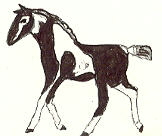 Everyone in camp was so happy that Toayanu had finally found his very special pony.
Now! Everyone must know that this was his very special pony and no one elses.
He would call the baby pony Toayanu Too. Then all would know it belonged to him.
"Yes" said Toayanu, "That's what I will call it, Toayanu Too".
And he did. He called him "Too"