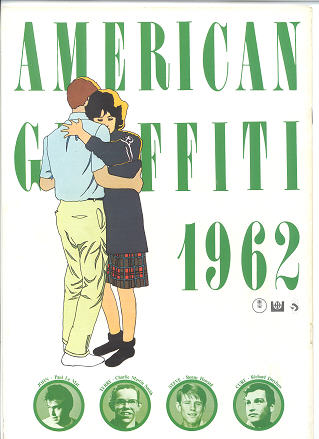
If one word could sum up the theme in Graffiti it would be "change." Although often passed off as a simple nostalgia flick, there are several distinctions between Graffiti and other films and TV shows that recall the 1950s. One key difference is that Graffiti is not about the 50s-its about the end of the 50s; the end of an era. The knowledge of change and time passing is expressed throughout the film in very clever and inventive ways. The story is set in 1962, at a time when the country had a president that most young people admired. Social values were clear and easily defined and although the country wasn't without it's problems, most believed� somehow democracy in the free world could solve just about anything.� Yet, the attitudes of young people were starting to change. U.S. involvement in South-East Asia began to escalate and the civil rights movement was starting to take hold.�
The eleven years that followed 1962 were overwhelming. In June of 1963 NAACP's Field Director Medgar Evars was murdered. Five months later, President Kennedy was also murdered. His successor, Lyndon Johnson was practically forced from office, due to his escalation of American troops in Vietnam. The next president, Richard Nixon would resign in 1974, becoming the only president to do so while in office.
Other aspects of this eleven year span are just as dark. A favorite American politician, Robert Kennedy was murdered while running for president in 1968. Another politician, George Wallace was shot and crippled while campaigning in 1972. And two of the countries strongest and most influential civil rights leaders, Malcolm X and Martin Luther King, Jr. were shot and killed.
All these things contributed to the errosion of optimisim in the free world. In his book "The Day Before Yesterday," historian, Michael Elliot has pointed out that the single factor that contributed most to American's lack of faith in the government was the politics of the Vietnam War and later, Watergate. The lies and corruption that came from the White House worked to create a general cynicism in Americans in 1973 when Graffiti was first released and that cynicisim still lingers today.
Using 1962 as a year of transition George Lucas beautifully parallels this cultural change with the lives of the teenagers in the film. By the very nature of the characters being teenagers there is certain innocence to them. They are perhaps aware of the world around them but other things are more important to them like kissing girls, cruising, and listening to the radio. The two main characters, Steve and Curt are making decisions about what they want to do in life. They are prepared to go to college on the east coast by leaving their small hometown, their families, and everything they know behind. They want to leave but they are also afraid to leave. Each is ambivalent; having feelings of sadness about letting go of the safety of their familiar world but also exhilarated at the sense of new possibilities. They're on the brink of change, just as American culture was in 1962. The film ends with one of them breaking away, and leaving behind his sheltered, insulated hometown. He is, in a sense, leaving behind an old era and moving forward towards a new age on the horizon.
Although change can be a scary concept, one can't hold on to history. Things change and life goes on. This point is illustrated in various ways throughout the film. For example, when Curt strolls down the empty school halls and tries the combination on his old locker he can't get into it; time has passed, and he can no longer be part of his old high school days. The concept of moving forward and not living in the past is a major theme in Graffiti. Nobody knows this better than Lucas, himself. In 1987 George Lucas told Rolling Stone magazine, "I got to do what I wanted to do by not being frightened away by the future and the unknown, and I figured that was a good message to get across." Lucas stresses that life is a constant transition, and one has to accept that fact. Clinging to the past only leads to spiritual stagnation and other problems. In a 1974 interview Lucas illustrated this point, "You know, the brittle bow breaks. The willow bends with the wind and stays on the tree. You try to fight it, like John did, and you lose. You're not going to remain 18 forever." |