| Lucas� films often deal with technology and the way people incorporate it into their lives. This can be seen in his earliest work. For example in his 1966 USC student film, 1:42:08: A Man and His Car, Lucas tells the story of a racecar driver trying to qualify for a race. He finishes the lap in 1 minute 42.08 seconds.The film features Shelby Daytona designer, Pete Brock, driving a Lotus around the track at Riverside. Lucas was very pleased with his 5 minute, student film. "It was interesting to me because I was interested in cars and the visual impact of a person going against the clock," he recalls. This theme was later revisited in Graffiti only on a grander scale. Not only is society's relationship with cars explored in Graffiti but also people's fascination with a technology powered radio personality, Wolfman Jack. |
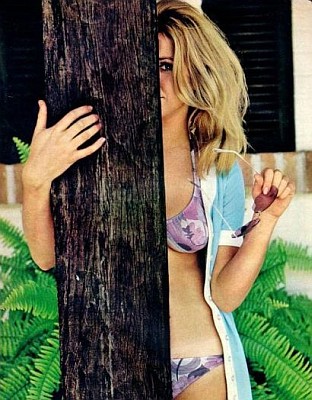
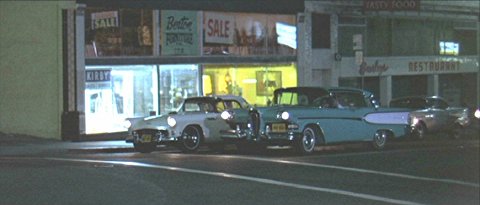
| Lucas has said that he invented the blonde girl in the T-Bird as a metaphor for the ideal that is always just out of reach. In Graffiti, Curt chases the mysterious blonde all evening while she eludes him. Nobody really seems to know who she is and each person thinks she's somebody else. She is like a dream in a white dress and a white car. Some film scholars have pointed out the similarites between the blonde in the T-Bird and the green light at the end of a pier in The Great Gatsby. In the story Gatsby sees the green light as hope for a relationship with Daisy. Both the blonde in Graffiti and the green light in Gatsby are recognized as representing all of the protagonist's wants and desires which includes the elusive American Dream. Once Curt sees the blonde he is pulled into an emotion doomed to frustration and a desire impossible to satisfy. He becomes passionately commited to the unattainable. At the end of Graffiti, Curt finally realizes that the blonde and all she represents is not real but only exists in his head. |
| CARS AS SYMBOLS |
| PEOPLE'S RELATIONSHIP TO TECHNOLOGY |
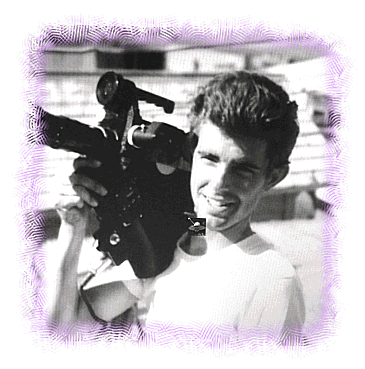
| The man with a movie camera. Lucas circa 1969. |
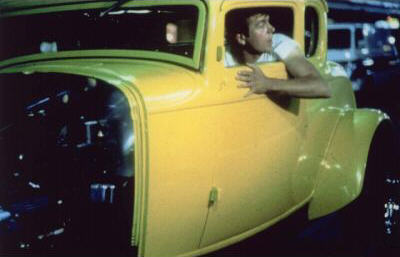
| The use of cars in Graffiti works as a metaphor on several levels. The cars can be viewed as transporting the characters through change but also as limiting them. For instance, when the nerdish, Toad inherits his buddie's elegant '58 Impala for the night he becomes much cooler. Just having a vehicle to drive up and down the circuit increases his chances with the opposite sex. On the other hand, John cruising in his little deuce coupe can be seen as a metaphor for stagnation. John is a 22-year-old teenager who notices that the cruising strip is "really shrinking." He has the sensation that things are changing around him and out of fear he desperately tries to cling to his adolescence; he is driving in circles and going nowhere. |
| And, She'll Have Fun, Fun, Fun... |
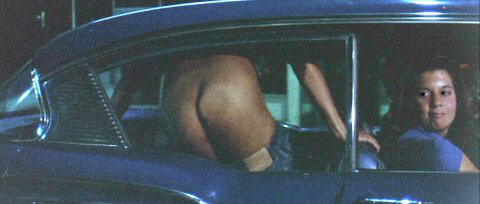
| George Lucas has described cruising as a teenage mating ritual, where interaction takes place between the opposite sex through car windows as young people communicate acknowledgements and flirtations. Some film scholars have identified cruising and particularly the car itself, in Graffiti as representing protection from a larger society. Writer Emanuel Levy is a good example of this view point. In his book "Cinema of Outsiders," Levy notes that in Graffiti, the car window is a convenient shield to the outside world. "As the film's real star, the car provides emotional security and physical protection, serving as a metaphor for American Society in the 60s, as complacent, naive, and isolationist in foreign policy," says Levy. |
 |
| THEMES & SYMBOLS page 2 |
 |
 |
 |
 |
 |
 |